“I'd learned long ago that a person's character is not defined by how they handle victory, but by how they handle defeat.”
— Sage reflects on his experiences and resilience.

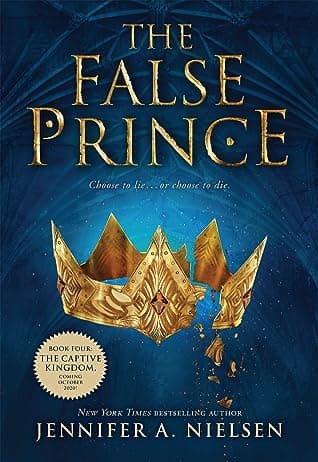
Jennifer A. Nielsen (2012)
Genre
Fantasy / Children's / Historical Fiction / Mystery / Young Adult
Reading Time
350 min
Key Themes
See below
Sign in to track this book
In a kingdom nearing civil war, an orphan is forced into a competition to impersonate a lost prince, uncovering deceit where truth may be the most dangerous lie.
The story starts with Sage, an orphan, stealing a roast and being caught by a nobleman named Conner. Instead of punishing him, Conner buys Sage from Mrs. Turbeldy's orphanage. Sage is taken to a secluded estate where he meets three other orphans: Roden, a strong and loyal boy; Tobias, an intelligent and well-mannered boy from a noble family; and Latamer, a quiet and fearful boy. Conner reveals his plan: to choose one of them to impersonate Prince Jaron, the long-lost younger son of the recently deceased King Eckbert and Queen Erin, who disappeared years ago. The chosen boy will be installed as prince to prevent a civil war and unite the kingdom of Carthya under Conner's control. Not cooperating means death.
Conner, with his servants Cregan and Mott, begins the training. The boys are taught swordsmanship by Mott, court etiquette by Cregan, and history, politics, and the specific mannerisms of Prince Jaron. Sage struggles with etiquette, often challenging Conner, but shows skill with a sword and a keen mind for strategy. Tobias excels in academics and courtly manners, while Roden is a strong fighter. Latamer, however, struggles with all aspects of the training, becoming despondent and fearful. Conner makes it clear that only one will survive this process.
As training continues, Latamer's performance lags. He fails to grasp lessons, shows no aptitude for swordsmanship, and his fear makes him a liability. One evening, Conner states that Latamer is not fit to be the prince and, to the horror of Sage, Roden, and Tobias, orders Cregan to take Latamer away. The next morning, Latamer's body is found, impaled on a sword, a warning to the remaining boys about the consequences of failure or disloyalty. This act solidifies the deadly stakes and increases Sage's distrust of Conner, even as he pretends to obey.
The competition intensifies after Latamer's death. Sage continues to be rebellious, often defying Conner's instructions, but performs well in challenges, sometimes outperforming Roden and Tobias. Conner, frustrated by Sage's insolence, often whips him. During one instance, Conner discovers a scar on Sage's back, a detail that seems to trouble him. Sage also shows a hidden talent for picking locks and moving silently, skills he says he learned on the streets. Tobias and Roden, though rivals, also show moments of camaraderie, but the pressure to win remains.
Conner makes his decision, though the identity of the chosen prince is initially kept secret. He prepares to present the 'prince' to the regents, a council governing Carthya in the absence of a clear heir. Conner's plan involves fabricating a story of how Prince Jaron was rescued from pirates and held captive, explaining his long absence and altered appearance. He intends to manipulate the regents into accepting his chosen impostor, consolidating his own power and preventing a civil war that threatens to erupt due to the power vacuum.
Conner announces his decision: Roden will be Prince Jaron. Sage, feeling betrayed, confronts Conner, who dismisses him. However, during the journey to the castle, Sage creates a diversion and escapes. He tries to steal a horse but is captured by pirates, led by Veldergrath, who Conner had claimed were responsible for Jaron's supposed death. Sage uses his wits and knowledge of the terrain to outsmart the pirates and escape, showing a resourcefulness that exceeds what Conner believes him capable of. This turn of events disrupts Conner's plans.
Sage, after escaping the pirates, makes his way back to Conner's estate. He overhears a conversation between Conner and Cregan, revealing that Conner orchestrated the murder of the royal family, including King Eckbert, Queen Erin, and Prince Darius, to clear the path for his puppet prince. Sage also learns that Conner never intended for any of the boys to be the real Jaron, but merely a malleable figurehead. He is horrified by Conner's ambition and ruthlessness, realizing his own life is in peril as long as he is involved in Conner's scheme.
Conner brings Roden before the regents, presenting him as Prince Jaron. The regents, initially skeptical, are swayed by Conner's arguments and Roden's performance. However, just as Roden is about to be formally recognized, Sage bursts into the chamber. He reveals his true identity, declaring himself the real Prince Jaron, alive and returned to his kingdom. This appearance throws the court into chaos, as the regents are now faced with two claimants, both with compelling (though contradictory) evidence.
The regents, especially Regent Millard, demand proof. Sage, using his wit, knowledge of the castle, and specific memories of his family and childhood, begins to convince them. He recalls details only the true Jaron would know, such as the location of a hidden passage and the contents of his father's study. He also reveals the scar on his back, a birthmark known to be on Prince Jaron. Conner, caught off guard, tries to discredit Sage, but the evidence mounts against him. Sage also reveals Conner's role in the royal family's murder, further solidifying his claim.
Conner, cornered, attempts to attack Sage, but Mott, Conner's swordsman, intervenes, revealing his loyalty to the true prince. It is confirmed that Mott had been a loyal servant to the royal family and recognized Jaron from the beginning, secretly protecting him. Sage is officially recognized as Prince Jaron, the rightful heir. Conner and Cregan are arrested for treason and the murder of the royal family. Roden and Tobias, initially disillusioned, pledge their loyalty to Jaron. The kingdom, though still reeling from the revelations, now has its true prince back, and Jaron faces the task of rebuilding his kingdom.
The Protagonist
Sage transforms from a street-smart orphan feigning rebellion into the true Prince Jaron, claiming his rightful place as the wise and just ruler of Carthya.
The Antagonist
Conner's ambition leads him from a position of influence to a disgraced traitor, his meticulously crafted plan unraveling due to his own hubris.
The Supporting
Roden transitions from an ambitious orphan hoping to become prince to a loyal subject of the true Prince Jaron, accepting his place in the new order.
The Supporting
Tobias strives to regain his lost noble status by becoming prince but ultimately accepts a role of service to the true king.
The Supporting
Mott maintains a facade of loyalty to Conner while secretly protecting the true prince, ultimately revealing his allegiance to ensure Jaron's rightful ascension.
The Supporting
Cregan remains a loyal and brutal henchman to Conner, ultimately sharing his master's downfall.
The Supporting
Imogen, initially a seemingly helpless mute servant, reveals her true voice and intelligence, becoming a trusted ally to Prince Jaron.
The Mentioned
Latamer's brief arc serves as a tragic example of Conner's ruthlessness and the deadly consequences of failing his scheme.
The Supporting
Regent Millard moves from skepticism towards the 'new' prince to accepting the true Prince Jaron, acting as a critical judge in the succession crisis.
The main theme is Sage's journey of discovering and reclaiming his true identity as Prince Jaron. Initially, he hides his royal lineage under a rebellious facade, even from himself. The training forced upon him by Conner helps him remember and embrace parts of his princely past. His struggle to prove he is Jaron, not an impostor, shows the importance of self-worth over external appearances. This is clear when he must recall specific memories and traits to convince the regents, proving his identity through his being, not just a scar.
““I was born to be Jaron. I have always been Jaron. And I will not let you take that away from me.””
The entire plot is built on deception. Conner's plan to replace the lost prince with an impostor is the main act of treachery, but there are smaller deceptions: Sage's hidden identity, Imogen's feigned muteness, Mott's secret loyalty, and Conner's constant lies and manipulations. The book questions what is real and what is fabricated, making characters and readers discern truth from falsehood. The climax involves peeling back these layers to reveal the truth of Jaron's survival and Conner's betrayal.
““The truth is, there is no truth. Only what we believe to be true.””
Conner's ambition for power drives the narrative. He believes he can rule Carthya better than the deceased royal family and sees installing a puppet prince as his path to control. The competition among the boys for the role of prince also reflects this theme, as they are motivated by the promise of status and influence. The corrupting nature of unchecked ambition is clear in Conner's willingness to commit murder and manipulate lives. Ultimately, the book contrasts Conner's self-serving ambition with Jaron's eventual acceptance of his royal duty for the good of his kingdom.
““Power is a dangerous thing, boy. It can corrupt even the best of men.””
Sage's journey is one of constant survival. From his life as an orphan on the streets to his forced participation in Conner's deadly scheme, he faces many threats. His quick thinking, physical prowess, and mental strength allow him to navigate dangerous situations, whether escaping pirates or enduring Conner's punishments. The other boys also show resilience, adapting to the harsh training and the constant threat of death. Latamer's failure to survive shows the extreme demands placed upon them, making Sage's ultimate triumph a sign of his exceptional resilience.
““I’d rather die fighting than live in fear.””
A narrative built around a character pretending to be someone they are not.
The entire premise of 'The False Prince' hinges on the impostor plot device. Conner's plan to replace the missing Prince Jaron with an orphan sets up the central conflict and mystery. This device creates tension as the audience wonders which boy will be chosen and if their deception will be successful. The twist, however, is that the 'impostor' (Sage) turns out to be the true prince, subverting the traditional impostor narrative and adding a layer of dramatic irony and surprise. This device allows for exploration of themes like identity, deception, and truth.
A distinctive physical mark serving as definitive proof of identity.
The scar on Sage's back functions as a crucial plot device for revealing and confirming his true identity as Prince Jaron. Early in the book, Conner notices the scar but dismisses it, highlighting his own oversight. Later, when Sage reveals himself to the regents, the scar serves as a tangible, undeniable piece of evidence, known only to a select few who knew the real Jaron. This physical mark provides a clear, objective means of distinguishing the true prince from any impostor, cutting through the layers of manipulation and doubt surrounding his claim.
A foundational mystery driving the initial plot and character motivations.
The disappearance of Prince Jaron years prior, along with the subsequent death of the rest of the royal family, creates a power vacuum and a compelling mystery. This mystery is the catalyst for Conner's plan and the entire narrative. The lack of a clear heir fuels the fear of civil war, providing Conner with a plausible (to the public) reason for his actions. The resolution of this mystery, with Sage revealing himself to be the long-lost Jaron, provides the ultimate climax and closure to the initial uncertainty surrounding Carthya's leadership.
Subtle hints about Sage's true identity through his innate abilities.
Throughout the training, Sage displays skills and knowledge that subtly foreshadow his true identity. His surprising aptitude for swordsmanship, his innate understanding of strategy, his quick wit, and his ability to move silently and pick locks hint at a background beyond that of a mere orphan. These skills are often dismissed by Conner as street smarts, but they are, in fact, remnants of Jaron's training and mischievous nature as a prince. This device builds suspense and allows astute readers to piece together clues before the final revelation.
“I'd learned long ago that a person's character is not defined by how they handle victory, but by how they handle defeat.”
— Sage reflects on his experiences and resilience.
“The difference between a truth and a lie is what you do, not what you say.”
— Sage contemplates deception and integrity.
“Sometimes the only way to get the truth is to lie a little.”
— Sage justifies his deceptive tactics.
“A person can be educated and still be stupid, you know.”
— Sage criticizes those who rely solely on formal learning.
“I don't need to be a prince to have honor.”
— Sage asserts his moral values regardless of status.
“The strongest steel is forged in the hottest fire.”
— Sage uses a metaphor for resilience through hardship.
“It's not the crown that makes the king, but the heart that wears it.”
— Sage reflects on true leadership qualities.
“Fear is a prison, and I refuse to be its captive.”
— Sage defies intimidation and control.
“A secret is only a secret if one person knows it. Two can keep a secret if one of them is dead.”
— Sage remarks on the danger of shared secrets.
“You can't change the past, but you can learn from it and let it shape a better future.”
— Sage advises on dealing with history and growth.
“Loyalty isn't given, it's earned.”
— Sage discusses the nature of allegiance.
“The greatest trick the devil ever pulled was convincing the world he didn't exist. The greatest trick a liar ever pulls is convincing you he's telling the truth.”
— Sage draws a parallel about deception.
“Power is a tool, not a trophy.”
— Sage comments on the responsible use of authority.
“In a world of lies, the truth is the most dangerous weapon of all.”
— Sage highlights the power of honesty in deception.
Ready to see how well you understood this book? Take our interactive quiz with 10 questions.

Biography coming soon.







