“I know what you're thinking: 'He's a judge, a penitent judge.' You're right. I am a penitent judge. I judge myself and I judge others.”
— Clamence introducing himself and his profession to the anonymous listener.


Genre
Thriller / Children's / Mystery / Young Adult
Reading Time
150 min
Key Themes
See below
Sign in to track this book
A former lawyer in an Amsterdam bar dissects his own moral failings, challenging the reader to confront their own hidden hypocrisy.
The story begins in a rundown Amsterdam bar called Mexico City. Jean-Baptiste Clamence, a former Parisian defense lawyer, approaches a stranger, the reader, and starts a long, unprompted speech. Clamence, with his refined speech, quickly establishes himself as intelligent and cynical. He talks about his past life in Paris, where he was a respected and successful lawyer, known for defending the poor and having a good moral character. He prides himself on his politeness, generosity, and always doing the right thing, often helping the blind and giving up his seat. This early self-description shows self-satisfaction, but a subtle unease is already clear.
Clamence recalls a specific evening in Paris when, crossing the Pont des Arts, he heard a distinct, mocking laugh behind him. He looked back but saw no one. This seemingly small event, he says, began his downfall. He first dismissed it, but the memory stayed, slowly eroding his confidence. He describes his past life as one of complete self-love and public admiration, where he enjoyed others' approval and his ease in social settings. The laugh, however, introduced a jarring note, a hint of judgment he could not shake, planting the first seeds of doubt about his own virtue. He starts to examine his past actions with new, critical eyes.
Clamence further describes the event that truly shattered his carefully built image: a woman jumping from a bridge into the Seine. He was there, heard the splash and the cries, but did nothing. He stood still, unable to act, then walked away. This moment of deep inaction, he explains, showed how hypocritical he was. His previous acts of charity, he now realizes, came not from true kindness but from a desire for recognition and self-admiration. The woman's death, and his failure to help, became a clear sign of his moral failure, a sharp contrast to the selfless image he had created. This realization leads him into a deep personal crisis and overwhelming guilt.
After the laugh and the suicide incident, Clamence's careful facade begins to break. He finds himself less able to act as the virtuous lawyer. His eloquent defenses in court now feel empty and manipulative; his acts of charity seem driven by vanity. He confesses to feeling a constant sense of judgment, as if the whole world, and especially he himself, is watching his every move. He describes a time of strong self-hatred and worry, where he struggled to match his public image with his private failures. This inner struggle eventually causes him to leave his successful legal career and comfortable life in Paris, seeking escape in Amsterdam's anonymity.
Clamence explains his move to Amsterdam, a city he calls a 'circle of hell' because its canals resemble Dante's Inferno. He now works as a 'judge-penitent' at the Mexico City bar, a role he gave himself. Here, he confesses his own sins, and by doing so, subtly encourages his listeners to think about their own. He carefully examines his past actions, showing the selfish reasons behind what he once considered virtues. He finds a strange satisfaction in shedding his former dignity, believing that true freedom comes from admitting one's own depravity. His self-condemnation is not for forgiveness, but to create a shared sense of guilt and involvement with his audience.
Clamence argues that all humans are guilty, and that the idea of innocence is simply a defense. He believes that true freedom comes from admitting this universal guilt, rather than trying for an impossible purity. He describes how he now tries to involve everyone in his confession, stating that judgment is a two-way street. By confessing his own flaws in such detail, he subtly forces his listener to confront their own possible hypocrisy and self-deception. He sees himself as a prophet of this new, uncomfortable truth, where the only way to avoid being judged is to judge oneself and, by extension, everyone else, creating a collective sense of responsibility.
Clamence shares a strange story about a stolen masterpiece, 'The Just Judges' panel from the Ghent Altarpiece, and his role in hiding it. He claims to guard a copy of the painting, and that the original is hidden somewhere in Amsterdam. He also mentions owning a pair of slippers supposedly belonging to a pope, which he keeps in his room. These details show his descent into a life of moral uncertainty and his interest in symbols of authority and judgment. The stolen painting, representing divine justice, and the pope's slippers, representing spiritual power, become ironic props in his new role as a 'judge-penitent,' highlighting the absurdity and ultimate pointlessness of seeking such external validations.
Clamence reveals the planned nature of his 'judge-penitent' role. He argues that by confessing his own sins, he disarms his listeners, making them feel superior at first. However, by detailing his own depravity, he subtly creates a shared sense of human imperfection, eventually leading his listeners to see their own involvement and flaws. This process, he believes, gives him a form of moral authority over them. He explains that by always being the first to accuse himself, he creates a position from which he can then judge others without seeming self-righteous. This complex psychological game is his way of having control and escaping the lonely burden of his own guilt.
Clamence often returns to the idea of humanity's natural desire for innocence and the crushing realization that it is impossible. He describes how, in his former life, he truly believed himself innocent, a 'good man,' and how devastating it was to discover the selfish nature of his actions. He now sees this desire for purity as a basic human delusion, a pointless attempt to escape the universal condition of guilt. He states that true freedom does not come from achieving innocence, but from fully accepting one's guilt and recognizing it in others. This acceptance, however, is not a path to peace, but a constant state of self-condemnation and judging.
Clamence ends his monologue by stressing the painful trap of his self-knowledge. He understands his own hypocrisy and manipulative tendencies, yet he cannot escape them. He is caught in a constant cycle of judging himself and others, finding no real comfort or redemption. He hints that he might be ill, perhaps terminally, further isolating him in his self-made purgatory. He offers a final, chilling invitation for the listener to join him in his self-condemnation, suggesting that once one truly sees the truth of human nature, there is no turning back. The monologue ends with a sense of inescapable despair and a deep challenge to the reader's own moral comfort.
The Protagonist
Clamence transforms from a self-deceived, outwardly virtuous Parisian lawyer to a self-aware, guilt-ridden 'judge-penitent' who seeks to implicate all humanity in his own fall.
The Implied Protagonist/Audience
The Listener is initially a neutral observer but is gradually drawn into Clamence's web of judgment, forced to confront their own potential hypocrisy.
The Mentioned/Catalyst
Her tragic act shatters Clamence's self-deception and initiates his descent into 'judge-penitence'.
The main theme of 'The Fall' explores the unclear nature of innocence and the constant presence of human guilt. Clamence's monologue is a detailed confession of his own deep guilt, from his inaction during a suicide and his realization that his 'virtuous' deeds were from vanity. He argues that true innocence cannot be reached, it is just an illusion, and that all humans are guilty. This theme shows as Clamence carefully breaks down his past, revealing the selfish reasons behind his seemingly good actions, and then extends this judgment to all humanity, suggesting everyone shares in a universal human flaw. The novel challenges the reader to face their own possible hypocrisy and the weight of their own conscience.
“Oh, my dear sir, it is a terrible thing, the need to judge, and the need to be judged.”
This theme looks at how people create false images of themselves, both for public view and private comfort. Clamence first presents himself as a model of virtue, a selfless lawyer. However, his monologue steadily removes this facade, showing the deep hypocrisy that lay beneath his 'good' deeds. He confesses how his acts of charity were driven by a wish for admiration and how his inaction during the suicide showed his true cowardice. The novel suggests that self-deception is a basic human tendency, a way to avoid the uncomfortable truth of one's own flaws. Clamence's 'judge-penitent' role is his attempt to make others confront their own self-deceptions.
“I was at ease in life. I was always at ease. I had the reputation of being a man of good counsel, a man of good works, a man of good cheer. I was, in short, a man of good.”
The novel explores the complexities of judgment, both legal and moral, and the nature of justice. Clamence, a former lawyer, becomes obsessed with judging. He criticizes the legal system's superficiality and then creates his own form of 'justice' as a 'judge-penitent.' By confessing his own sins first, he creates a position from which he can then judge others, involving them in his own guilt. This theme explores the human need to judge and be judged, and how this shapes social interactions and individual conscience. Clamence's new 'profession' is a twisted attempt to control the story of judgment, to avoid being solely judged by being the first to judge himself and, by extension, everyone else. The stolen painting, 'The Just Judges,' further highlights this focus.
“I found that the best way to be rid of judgment was to put myself in its place.”
While not an 'absurdist' text like 'The Stranger,' 'The Fall' touches on the absurdity of human existence, especially when faced with moral meaninglessness. Clamence's deep disappointment comes from realizing that his life, once seemingly purposeful and good, was built on lies and vanity. His self-imposed exile in Amsterdam, a city he calls a 'circle of hell,' and his adoption of the strange 'judge-penitent' role, reflect a sense of meaninglessness he now feels. His complex psychological games and his inability to find true redemption show the futility of seeking ultimate meaning or moral purity in a world that offers none. The stolen painting and the Pope's slippers also add an ironic layer of absurdity to his new life.
“We are all in the same boat, my dear sir, and it is a sinking one.”
The entire novel is presented as an uninterrupted, confessional monologue from Clamence.
The novel is entirely composed of Jean-Baptiste Clamence's first-person monologue, addressed directly to an unnamed listener (the reader). This device immerses the reader directly into Clamence's consciousness and allows for an intimate, unfiltered exploration of his thoughts, justifications, and self-condemnations. The lack of dialogue from the listener forces the reader to actively engage with Clamence's arguments, becoming both his confidant and his silent accuser. This narrative structure is crucial for conveying the psychological depth and manipulative nature of Clamence, as his words are designed to draw the listener into his own moral quagmire.
Clamence's account of his past and present is filtered through his own biased and manipulative perspective.
Clamence is a classic unreliable narrator. While he purports to be confessing his sins and revealing universal truths, his motivations are deeply suspect. He admits to being a master of rhetoric and manipulation, and his confessions often serve to implicate others rather than genuinely absolve himself. The reader must constantly question the veracity of his statements, the sincerity of his remorse, and the true purpose of his elaborate 'judge-penitent' scheme. This device creates a sense of unease and forces the reader to critically evaluate the narrative, preventing easy acceptance of Clamence's self-serving philosophy.
The city of Amsterdam, particularly its concentric canals, serves as a symbolic representation of hell.
Clamence repeatedly describes Amsterdam as a 'circle of hell,' specifically referencing Dante's Inferno, due to its concentric canals. This symbolism underscores Clamence's self-perception as living in a moral purgatory, or even hell, after his 'fall.' The city's foggy, melancholic atmosphere further reflects his internal state of despair and moral ambiguity. The canals, trapping the city in a perpetual embrace, mirror Clamence's own inescapable guilt and his inability to truly break free from his past. The setting is not merely a backdrop but an active participant in conveying the novel's themes of judgment and inescapable human condition.
A mocking laugh Clamence hears on a bridge, symbolizing external judgment and the beginning of his self-doubt.
The laugh Clamence hears on the Pont des Arts is a potent symbol. It represents the external judgment he suddenly perceives, shattering his complacency and initiating his journey of self-scrutiny. It is ambiguous – he never sees who laughed – which makes it all the more powerful, as it could be the universe, society, or even his own subconscious judging him. This laugh marks the moment his public façade begins to crack, introducing an element of doubt and suspicion into his previously unblemished self-image. It is the first crack in his carefully constructed illusion of innocence.
“I know what you're thinking: 'He's a judge, a penitent judge.' You're right. I am a penitent judge. I judge myself and I judge others.”
— Clamence introducing himself and his profession to the anonymous listener.
“The greater the sinner, the greater the saint.”
— Clamence reflecting on the nature of redemption and human perception.
“Living without appeal. That's the thing. No one to call on, no one to intercede. Just you, and the void.”
— Clamence discussing the ultimate solitude of human existence.
“I shall tell you a great secret, my friend. Do not wait for the last judgment, it takes place every day.”
— Clamence offering a cynical perspective on constant self-evaluation and societal judgment.
“We are all in the same boat, my friend, and we are all of us shipwrecked.”
— Clamence emphasizing the universal human condition of failure and despair.
“I had to become a prophet, of course, for a prophet is a man who throws stones at the heads of his fellow citizens.”
— Clamence describing his transformation into a 'penitent judge' and his role in society.
“When you have renounced everything, you are free.”
— Clamence reflecting on the paradoxical freedom found in giving up all pretense and ambition.
“Don't you think that I, too, have a right to accuse? After all, it is my profession.”
— Clamence asserting his right to judge others, despite his own flaws.
“I found that I was unable to condemn anyone without condemning myself.”
— Clamence's realization of the interconnectedness of human guilt.
“I used to be a good man, for I was unaware of my faults.”
— Clamence contrasting his past self with his current self-awareness.
“The truth is that every man needs slaves as he needs air. To command is to breathe.”
— Clamence's cynical view on the human desire for power and control over others.
“Oh, my dear, it is not a matter of knowing, but of doing. Of doing, I tell you!”
— Clamence emphasizing action over mere intellectual understanding.
“What does a man do when he is alone? He looks for a mirror.”
— Clamence's observation on human narcissism and the need for self-reflection.
“The game is over. I have nothing more to say. Unless you want to play another game?”
— Clamence concluding a conversation, hinting at the endless cycle of his 'penitent judge' role.
Ready to see how well you understood this book? Take our interactive quiz with 10 questions.
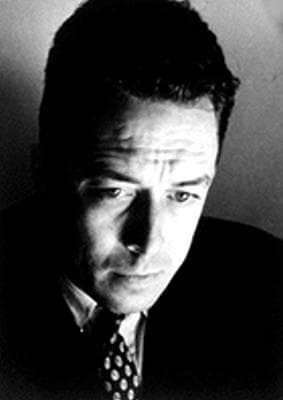
Albert Camus was a French-Algerian philosopher, author, dramatist, and journalist. He was the recipient of the 1957 Nobel Prize in Literature at the age of 44, the second-youngest recipient in history. His works include The Stranger, The Plague, The Myth of Sisyphus, The Fall, and The Rebel.







