“Grandpa was a man of science, and he believed that the world was orderly and that everything had a place.”
— Calpurnia's initial thoughts on her grandfather, setting up his influence.

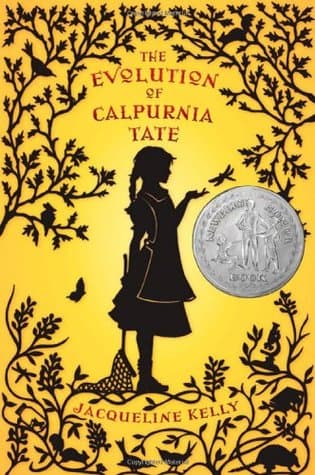
Jacqueline Kelly (2009)
Genre
Children's / Historical Fiction / Young Adult
Reading Time
450 min
Key Themes
See below
Sign in to track this book
In 1899 Texas, an eleven-year-old girl, guided by her naturalist grandfather, learns about evolution in her backyard while navigating expectations of becoming a young woman.
Eleven-year-old Calpurnia Virginia Tate, called Callie Vee, lives with her large family in Fentress, Texas, in 1899. She is a curious girl who prefers reading encyclopedias to learning embroidery. One summer day, she notices that the yellow grasshoppers in her yard are much bigger than the green ones. This simple observation puzzles her, and her mother says it is unimportant. Callie, however, wants to find an answer. She decides to ask her reclusive and often intimidating grandfather, Walter Tate, a famous but difficult naturalist. This begins their scientific partnership and changes Callie's life as she finds someone who shares her interests.
Grandfather Walter Tate first tests Callie's sincerity, but seeing her true curiosity and intelligence, he begins to teach her. He explains natural selection using her grasshopper observation, an idea that greatly affects Callie. Their shared interest in natural history grows, and they spend hours observing and documenting local wildlife and plants around their Texas home. One project involves identifying a new plant species. Callie helps her grandfather with careful observations, detailed drawings, and precise measurements, learning scientific methods firsthand. This teamwork strengthens their bond and further sparks Callie's interest in science.
While Callie thrives in her scientific work with her grandfather, she constantly faces pressure from her mother, Mrs. Tate, to fit the expectations for a young lady in 1899. Her mother insists on piano, sewing, and cooking lessons, often interrupting Callie's scientific explorations. Callie finds these home tasks boring, preferring to spend her time in nature or her grandfather's library. She often has to sneak away or make excuses to join her grandfather, creating tension between her growing scientific goals and her mother's vision for her future. Her six noisy brothers, especially the older ones, often tease her, saying science is not for girls.
Grandfather Tate decides to take Callie on a trip to Laredo, an important journey for the family, to meet another naturalist, Dr. P. The trip's purpose is to confirm their discovery of the new plant species and discuss its classification. This journey is a key experience for Callie, showing her life beyond Fentress and introducing her to the wider scientific community. During the trip, she sees her grandfather interact with other educated people, further cementing her understanding of his work's importance and her own scientific interests' value. The experience strengthens her desire to pursue an intellectual life, despite her time's social norms.
A stray dog, a scruffy terrier mix she names Viper, wanders onto the Tate property. Callie, despite her mother's initial hesitation, takes responsibility for the dog. When Viper gets sick, Callie turns to her grandfather, who, besides his plant and animal studies, has much practical knowledge of animal care. Together, they nurse Viper back to health, with Callie actively helping to give medicine and watch the dog's recovery. This experience not only deepens Callie's empathy but also gives her hands-on experience with animal care, showing her ability to apply scientific ideas and handle difficult situations calmly.
A major flood hits Fentress, causing widespread damage. The natural disaster creates a dangerous situation for the Tate family and the community. After the flood, Callie and her grandfather find an armadillo, a creature not usually seen in their area. This unusual sighting becomes another subject of scientific study for them. They observe the armadillo's behavior and consider what environmental changes might have caused its presence. The flood, while destructive, also shows Callie's ability to stay calm and observant in a crisis, strengthening her grandfather's belief in her scientific potential and her resilience.
The Tate family faces significant financial stress, mainly because the cotton crop fails. This economic hardship darkens the household and adds to the pressure on Callie's future. Her parents, especially her mother, become even more set on Callie marrying well, as a way to secure her future and possibly ease some of the family's money problems. This situation heightens the conflict between Callie's personal desires and her family's practical expectations, making her scientific dreams seem more impractical and selfish to her parents. Callie struggles with these expectations and the shrinking chances for her chosen path.
For Christmas, Callie receives a microscope from her grandfather. This gift is deeply meaningful, not only for its scientific use but as a strong symbol of her grandfather's belief in her and his wish to support her intellectual growth. It contrasts sharply with the more 'ladylike' gifts she might have expected. This gesture deeply affects Callie, confirming her path and making her feel truly seen and understood. The gift also subtly influences her family, as they begin to see the depth of her passion and her grandfather's commitment to it, slowly softening their resistance to her unusual interests.
After much waiting, Callie and her grandfather receive confirmation that the plant species they discovered has been officially recognized and named after Grandfather Tate. This news is a moment of great success and validation for both of them, especially for Callie, who contributed much to its identification and documentation. The recognition confirms the importance of their work and provides clear proof of Callie's scientific abilities. It strengthens her belief that she can make meaningful contributions to science, despite the challenges she faces as a girl in her era. This achievement becomes a foundation of her identity and aspirations.
As Callie nears adolescence, she becomes keenly aware of the very limited educational chances available to girls, especially those wanting scientific careers. She longs to attend college and continue her studies, but such an ambition is seen as highly unusual and impractical for a girl of her time. Her mother actively discourages the idea, stressing the importance of marriage and domesticity. Callie feels increasingly frustrated by these societal limits, realizing that her intellectual hunger might remain unmet. This struggle shows the novel's main conflict: the clash between individual desire and strict societal expectations, especially for women.
Sensing Callie's growing despair about her future, Grandfather Tate offers her help. He suggests he will pay for her to attend a college or university where she can pursue her scientific studies. This offer is a huge gesture, not only financially but emotionally, as it shows his deep belief in her potential and his willingness to go against social norms to support her. While the path is still uncertain and requires dealing with her parents' objections, his offer gives Callie a clear goal and renewed hope. It empowers her to keep dreaming of a future where she can combine her love for science with a fulfilling career.
As 1899 ends, Callie reflects on the big changes she has experienced. She has gone from a simply curious girl to a developing naturalist with a deep understanding of scientific principles and a clear passion for the natural world. While her future is still largely unwritten and full of societal challenges, Grandfather Tate's steady support and their scientific achievements give her a strong base. She understands that the journey ahead will be hard, but she has knowledge, determination, and the belief that her scientific pursuits are valid and important. The novel ends with Callie at the start of a new century, ready to make her own way.
The Protagonist
Callie evolves from a curious but undirected child into a focused and determined young naturalist, finding her voice and purpose through her relationship with her grandfather.
The Supporting
He transitions from a solitary, somewhat embittered scientist to a re-engaged mentor, finding renewed purpose and joy through his relationship with Callie.
The Supporting
She gradually softens her stance on Callie's unconventional interests, beginning to understand the depth of her daughter's passion, though still prioritizing traditional feminine roles.
The Supporting
He maintains a steady, supportive presence, subtly encouraging Callie without directly challenging his wife's views.
The Supporting
He remains a constant, if sometimes distracting, presence in Callie's life, representing her connection to childhood innocence.
The Supporting
He remains a typical older brother, largely unchanged in his perception of Callie, but his interactions underscore the societal norms she defies.
The Supporting
Viper's presence provides Callie with a loyal companion and offers opportunities for practical application of her scientific knowledge.
The Mentioned
Miss Minerva remains a consistent, grounding force in the household.
The Mentioned
His role is primarily to validate the scientific discovery, providing external confirmation of Callie's and her grandfather's work.
This theme explores the tension between Calpurnia's natural scientific curiosity and her passion for nature versus the societal expectations and gender roles placed on her as a girl in 1899. Her mother constantly pushes her toward home life, piano lessons, and embroidery, while Callie wants to study insects, plants, and science books. This conflict is clear when Callie must attend a dance instead of watching an owl, or when her mother dismisses her grasshopper observations as 'unladylike.' The novel shows how social norms can limit individual potential, especially for women, and how hard it is to defy them.
““I was supposed to be a Southern lady, and Southern ladies did not spend their time pondering the mysteries of the natural world.””
The strong bond between Calpurnia and her grandfather, Walter Tate, is central to the novel. He acts as her mentor, seeing and supporting her scientific talents when no one else does. Their relationship goes beyond age, as they share respect and a passion for discovery. Grandfather Tate not only teaches Callie scientific methods but also gives emotional support and validates her intellectual goals, offering her a way to higher education. This theme shows how a supportive mentor can be vital for someone's development, especially when society is unsupportive, as when he offers to pay for her schooling.
““Grandfather was my only true ally. He understood me, and I understood him, and that was enough.””
The novel celebrates the joy and discipline of scientific exploration through Calpurnia's story. From her first observation of grasshoppers to the careful recording of a new plant species, Callie's journey is driven by a true curiosity about how the world works. She learns the scientific method: observation, hypothesis, experimentation, and documentation. The discovery of the new plant, the study of the armadillo, and her use of the microscope all show this theme. It emphasizes that science is not just for adults or academics, but a way to understand the world open to anyone with a questioning mind.
““The more I learned, the more I realized how much more there was to learn. It was a wonderful, terrifying thought.””
Calpurnia's journey throughout 1899 is one of self-discovery. As she moves from childhood to adolescence, she grapples with who she is and who she wants to become. Her scientific interests clash with her family's expectations, forcing her to define her own path. She learns to stand up for herself, to value her unique talents, and to find her place in a world that often tries to confine her. The novel portrays the universal experience of adolescence, amplified by the specific historical context, as Callie fights to shape her own identity against strong outside forces.
““I was Calpurnia Virginia Tate. And I was going to be a scientist.””
Set in 1899, the novel subtly explores the edge of the 20th century, a time of great change and scientific progress. Calpurnia's story is tied to this historical context, as she represents the potential for women in a new era. The contrast between her grandfather's older scientific methods and new technologies (like the telephone) highlights the shift. The coming new century symbolizes hope and new possibilities for Callie, suggesting that while the 19th century confined women, the 20th might offer greater freedom for intellectual pursuit and breaking traditional gender barriers. Her personal growth mirrors the wider societal changes.
““It was the end of one century and the beginning of another, and I felt as if I stood on a precipice, looking out at a vast, unknown landscape.””
A story charting a young protagonist's growth from childhood to maturity.
The entire novel functions as a coming-of-age story for Calpurnia Tate. Over the course of a year, she transitions from a curious but somewhat undirected child to a young woman with a clear sense of purpose and identity. This device allows the reader to witness her intellectual, emotional, and social development as she navigates family expectations, societal pressures, and her burgeoning scientific passion. Her journey of self-discovery is central to the plot, and the challenges she faces are typical of this narrative structure, focusing on internal and external conflicts that shape her character.
The protagonist's thoughts and observations are sometimes presented in a journal format.
While not exclusively an epistolary novel, Calpurnia's meticulous observations and thoughts are often presented as if from a scientific journal or personal diary. This device gives the reader direct access to her internal world, her scientific process, and her emotional struggles. It reinforces her identity as a budding scientist who documents her findings and reflections. This format also allows for direct exposition of scientific concepts and character insights, enhancing the reader's understanding of her intellectual growth and her unique perspective on the world.
Natural elements and creatures are used to represent broader themes and character traits.
Nature itself is a pervasive symbol in the novel, representing freedom, knowledge, and Calpurnia's true calling. The grasshoppers symbolize the initial spark of her curiosity and the concept of natural selection. The discovery of the new plant species symbolizes validation and the potential for new discoveries. Animals like Viper (her rescued dog) and the armadillo represent compassion, resilience, and opportunities for practical scientific application. The natural world is Calpurnia's sanctuary and classroom, providing her with both intellectual stimulation and a sense of belonging, contrasting sharply with the restrictive domestic sphere.
The turn-of-the-century setting dictates societal norms and limits opportunities, particularly for women.
The novel's setting in 1899 Texas is not merely a backdrop but a crucial plot device that creates conflict and shapes Calpurnia's journey. The historical context of rigid gender roles and limited educational opportunities for women directly opposes Callie's aspirations. This setting highlights the societal barriers she must overcome, making her scientific pursuits revolutionary for her time. The impending turn of the century also symbolizes hope for progress, but the immediate reality of 1899 acts as a significant constraint, forcing Callie to fight for her intellectual freedom and future against deeply entrenched norms.
“Grandpa was a man of science, and he believed that the world was orderly and that everything had a place.”
— Calpurnia's initial thoughts on her grandfather, setting up his influence.
“It was a hot day in August 1899, and I was in the kitchen, trying to avoid being a girl.”
— Opening line of the book, establishing Calpurnia's main conflict.
“I was eleven years old, and already I knew that life was not fair.”
— Calpurnia reflecting on her experiences and observations.
“The world was full of wonders, and I wanted to see every single one of them.”
— Calpurnia expressing her burgeoning curiosity and scientific drive.
“If you want to know about a creature, you must become a creature yourself.”
— Grandpa's advice to Calpurnia about scientific observation.
“Mama said that a lady's place was in the home, and that her duty was to make her husband comfortable.”
— Calpurnia contrasting societal expectations with her own desires.
“The greatest joy of all was to discover something new, something that no one else had ever seen before.”
— Calpurnia's deep satisfaction in scientific discovery.
“Sometimes I felt like an alien, dropped into a world where I didn't quite belong.”
— Calpurnia's feeling of being different from her family and peers.
“He didn't care if I was a girl or a boy, only if I was curious and willing to learn.”
— Calpurnia realizing her grandfather's acceptance and encouragement.
“The more I learned, the more I realized how much I didn't know.”
— Calpurnia's growing understanding of the vastness of knowledge.
“Every creature has its purpose, and every purpose its place.”
— Grandpa's philosophy on the natural world.
“I had a secret life, a life where I was a scientist, an explorer, a discoverer.”
— Calpurnia reflecting on her inner world and aspirations.
“The world was not just a place to live; it was a place to explore, to question, to understand.”
— Calpurnia's evolved perspective on her environment.
“It was one thing to read about the world in books, and another thing entirely to experience it for yourself.”
— Calpurnia's realization about the importance of hands-on experience.
Ready to see how well you understood this book? Take our interactive quiz with 10 questions.
Dan Gemeinhart
4.5

Kate O'Hearn
4.4

Jeanne Birdsall
4.4

Jen Wang
4.4

Wendelin Van Draanen
4.3

John Marsden
4.3

Chris Van Allsburg
4.3
Jennifer A. Nielsen
4.2