“Sometimes you have to fight for what you love, even if it means losing everything.”
— Arturo reflects on his family's struggle to save their restaurant.

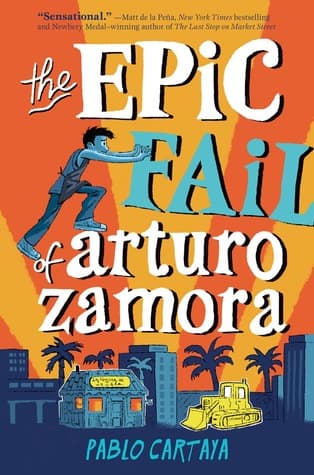
Pablo Cartaya (2017)
Genre
Children's / Young Adult
Reading Time
240 min
Key Themes
See below
Sign in to track this book
When a slick developer threatens his abuela's beloved Miami restaurant, thirteen-year-old Arturo must harness the power of poetry, family history, and a crush on the new girl to save his community from an epic fail.
Thirteen-year-old Arturo Zamora looks forward to a summer of basketball, mango smoothies, and helping at his Abuela’s Cuban restaurant, La Cocina de la Isla, in Miami’s Coconut Grove. His family is a main part of his life, especially his Abuela, who runs the restaurant with strength and love. However, Arturo's usual summer plans change when Carmen, a new girl his age, moves into his apartment complex. Carmen, who likes poetry and is confident, quickly interests Arturo, making him feel nervous and excited. He tries to impress her, often leading to awkward moments, but he wants to get to know her better, even as his family's summer plans for him begin.
Arturo's family's summer plans are interrupted by Wilfrido Pipo, a land developer. Pipo, with his flashy suits and condescending attitude, represents a large corporation and begins buying properties in Coconut Grove. His goal is to demolish the existing buildings, including La Cocina de la Isla, and replace them with a modern high-rise complex called 'Pipo-land.' The Zamora family, especially Abuela, protects their restaurant, which has been a community center for decades. Pipo's first offers are dismissive and insulting, showing he does not value the neighborhood's history or culture.
As Pipo's threat grows, Arturo's family comes together. During a family dinner, his Tío Frank tells stories of their ancestors' strength and their history of fighting for what they believe in, showing that the Zamoras have always been fighters. This talk makes Arturo curious about his heritage. At the same time, Carmen introduces Arturo to the works of José Martí, a Cuban national hero, poet, and revolutionary. Martí's words about freedom, justice, and community speak to Arturo, especially as he sees his family facing a similar fight. He connects Martí's struggles to his family's situation and feels a growing sense of responsibility.
Inspired by Martí and his family's history, Arturo decides he must act. He starts thinking of ways to resist Pipo with Carmen's help. Carmen, with her creative mind and interest in social justice, becomes his main ally. They start by talking to other local business owners and residents, finding that many share their concerns about Pipo's plans. The community's initial fear turns into a decision to fight back. Arturo, despite being shy, finds his voice and starts to lead, driven by his love for his family and his new understanding of their legacy. They decide a public protest is needed to bring attention to their cause.
As the date for Pipo's final offer gets closer, tensions rise. Abuela, usually calm, tells the family a secret: the restaurant is not entirely hers. There is an old, complicated lease agreement that Pipo is using, making their legal standing uncertain. This makes their fight more urgent and desperate. Despite their efforts to organize the community, Pipo's influence and resources seem too much. A meeting with city officials goes poorly, and it seems that Pipo's plans are moving forward, leaving the family and community feeling defeated. Arturo, for the first time, feels the weight of a possible 'epic fail.'
Despite the setback, Arturo does not give up. He and Carmen think late into the night, inspired by Martí's use of words for change. They come up with an idea: a public poetry reading and protest at the restaurant, inviting everyone to share their stories and feelings about La Cocina de la Isla and Coconut Grove. The plan is to create a strong, emotional display of unity and cultural pride that Pipo, who cares about profit, cannot ignore. They believe that if they can show the city council and Pipo the true heart of their community, they might have a chance. They begin rehearsing and spreading the word.
The day of the poetry slam arrives, and the restaurant is full. Arturo, nervous but determined, takes the stage with Carmen. One by one, community members, from children to elderly regulars, share their poems, stories, and memories of La Cocina de la Isla. Abuela, at first hesitant, gives a heartfelt speech about the restaurant's history and its importance as a gathering place. The atmosphere is full of emotion, solidarity, and a strong love for their home. Even Pipo, who shows up with his group, is visibly affected by the community spirit, though he tries to stay detached.
As the poetry reading gains attention, Pipo, feeling his plans threatened, tries to legally shut down the gathering, citing permits and noise ordinances. He sends his lawyers to serve the family with a cease and desist order. However, the quick-thinking community, led by Arturo's Tío Frank and Carmen, finds a loophole: they move the protest across the street to a public park, continuing their demonstration with even more determination. This move frustrates Pipo and shows the community's commitment to their cause, proving they will not be easily intimidated or silenced.
During the protest, Arturo learns something important: Pipo's real name is Felipe de la Paz, and he has a connection to the Zamora family's past. Through a conversation with his Abuela and Tío Frank, Arturo discovers that Pipo's family once owned a small bakery that Arturo's great-grandfather helped during a difficult time. This changes Arturo's view of Pipo, seeing him not just as a villain but as someone who may have forgotten his own roots. This personal connection gives Arturo an idea, realizing that Pipo might not be immune to the appeal of community and history.
Arturo, knowing about Pipo's past, confronts him directly, not with anger, but with a plea to remember where he came from and the value of community. He reminds Pipo of their shared history and the importance of places like La Cocina de la Isla. This personal appeal, along with the public support and media attention from the poetry slam, finally reaches Pipo. Though he does not completely abandon his development plans, Pipo agrees to a compromise: La Cocina de la Isla will be preserved and included in the new development, keeping its original location and cultural importance. The community celebrates their victory, and Arturo shares a triumphant moment with Carmen and his proud family.
The Protagonist
Arturo transforms from a hesitant, somewhat self-conscious teenager into a confident leader who uses his voice and creativity to rally his community.
The Supporting
Abuela moves from a place of quiet despair and resignation about the restaurant's fate to openly embracing and leading the community's fight.
The Supporting
Carmen helps Arturo find his voice and confidence, while also demonstrating her own strength and commitment to community activism.
The Antagonist
Pipo begins as a one-dimensional antagonist but is eventually humanized when his past connection to the community is revealed, leading to a compromise.
The Supporting
Tío Frank consistently supports Arturo, helping him connect to his heritage and providing practical assistance in the community's efforts.
The Supporting
They consistently provide a loving and stable environment for Arturo, supporting his growth and activism.
The Mentioned
Benito remains a consistent friend, providing a backdrop of typical teenage life for Arturo.
The Mentioned
Martí's influence profoundly shapes Arturo's understanding of his heritage and his approach to activism, guiding his transformation.
The novel explores Arturo's journey to understand his Cuban-American identity and his family's heritage. Through Abuela's stories, Tío Frank's anecdotes, and Carmen's introduction to José Martí, Arturo learns about his ancestors' strength and their fight for freedom. This awakening to his past drives his current actions, as he realizes that saving La Cocina de la Isla is not just about a building, but about preserving his family's history, culture, and a piece of his own identity. The restaurant links him to his roots.
“"We're Zamoras, Arturo. We don't back down from a fight, not when it's for something we believe in. It's in our blood."”
A main theme is the strength that comes from a united community. At first, the Zamora family feels alone against Pipo's corporate power. However, as Arturo and Carmen gather their neighbors, local business owners, and regulars of La Cocina de la Isla, they find the power of working together. The poetry slam shows this unity, proving that shared stories, memories, and a common purpose can overcome difficult challenges. The novel states that a community's heart is more valuable than any developer's profit.
“"This isn't just a restaurant. It's our home. It's where we celebrate, where we mourn, where we are family. You can't put a price on that."”
Arturo's personal journey is about finding his voice. Initially shy, he learns to speak his thoughts and feelings, especially when defending his family and community. Inspired by José Martí's use of poetry for revolution, Arturo discovers that words can be powerful. The poetry slam is his platform to speak to power, letting him and his community express their love, anger, and defiance in a way that resonates and influences Pipo. This theme shows the importance of courage in expressing one's beliefs.
“"Words, Arturo, they can build bridges, or they can tear down walls. It all depends on how you use them."”
The struggle to save La Cocina de la Isla from Pipo's development plans shows the conflict between preserving tradition and accepting modernity. The restaurant represents the history, culture, and established community of Coconut Grove. In contrast, Pipo's 'Pipo-land' symbolizes a generic, profit-driven modernity that threatens to erase unique cultural landmarks for upscale development. The novel explores the tension between these two forces, suggesting that real progress can involve combining the old with the new, instead of destroying heritage.
“"He wants to replace our history with glass and steel. He doesn't see the stories in these walls, the life in these streets."”
The Zamora family's Cuban restaurant, serving as the heart of the community and a symbol of heritage.
The restaurant, La Cocina de la Isla, is more than just a setting; it's a central symbol and plot device. It represents the Zamora family's heritage, their cultural identity, and the vibrant community of Coconut Grove. Its threatened demolition drives the entire plot, forcing Arturo to mature and the community to unite. The restaurant is where much of the family interaction takes place, where traditions are upheld, and ultimately, where the community rallies for its survival. It serves as a physical manifestation of everything Arturo is fighting to protect.
The historical figure and his writings, inspiring Arturo's activism and providing thematic depth.
José Martí, a real-life Cuban national hero, functions as a powerful inspirational plot device. Carmen introduces Arturo to Martí's poetry and revolutionary philosophies, which directly influence Arturo's understanding of justice, freedom, and the power of words. Martí's legacy provides Arturo with a historical context for his family's struggles and empowers him to use creative expression (poetry) as a tool for protest. His presence links Arturo's personal fight to a larger historical and cultural narrative of resistance and identity.
A public event where community members share poems and stories, serving as the climax of the resistance.
The poetry slam is a crucial plot device that serves as the climax of the community's resistance. It's the culmination of Arturo and Carmen's efforts to organize and mobilize. This event provides a platform for various community voices to be heard, demonstrating the collective emotional and cultural value of La Cocina de la Isla. It's where Arturo truly finds his voice and leadership, and it's the public display of unity that ultimately sways opinion and forces Pipo de la Paz to reconsider his plans. It visually and emotionally reinforces the theme of collective action and the power of art.
Narratives shared by Abuela and Tío Frank, connecting Arturo to his heritage and inspiring his actions.
The sharing of family stories and oral history is a significant plot device. Abuela and Tío Frank recount tales of their ancestors' struggles and resilience in Cuba, particularly their great-grandfather's acts of kindness and resistance. These stories are not just exposition; they directly inform Arturo's understanding of his heritage and instill in him a sense of purpose and courage. They reveal the 'Zamora' spirit of not backing down, providing Arturo with the historical context and emotional drive he needs to take on Pipo de la Paz. This device underscores the theme of identity and heritage.
“Sometimes you have to fight for what you love, even if it means losing everything.”
— Arturo reflects on his family's struggle to save their restaurant.
“Food is memory. It's history. It's love.”
— Arturo's abuela explains the importance of their family recipes.
“We don't just serve food here. We serve community.”
— Arturo's father describes the role of their restaurant in the neighborhood.
“Poetry isn't just words on a page. It's a heartbeat.”
— Arturo discovers the power of poetry through his crush, Carmen.
“Change is scary, but it's also necessary.”
— Arturo grapples with the threat of a developer changing his neighborhood.
“Our stories are written in the recipes we pass down.”
— Abuela shares family history while cooking.
“Sometimes the quietest voices have the most to say.”
— Arturo learns to listen to his community's concerns.
“Home isn't just a place. It's the people who make you feel like you belong.”
— Arturo realizes what truly makes his neighborhood special.
“Courage isn't about not being afraid. It's about being afraid and doing it anyway.”
— Arturo prepares to speak at a community meeting.
“The smallest actions can start the biggest revolutions.”
— Arturo organizes a protest to save the restaurant.
“Love is the secret ingredient in every dish.”
— Abuela teaches Arturo about cooking with passion.
“We are stronger together than we are apart.”
— The community unites to support the Zamora family.
“Failure isn't the end. It's just a different beginning.”
— Arturo learns from a setback in their campaign.
“Words have power. Use them wisely.”
— Arturo writes poetry to express his feelings and mobilize others.
Ready to see how well you understood this book? Take our interactive quiz with 10 questions.

Dan Gemeinhart
4.5

Kate O'Hearn
4.4

Jeanne Birdsall
4.4

Jen Wang
4.4

Wendelin Van Draanen
4.3

John Marsden
4.3

Chris Van Allsburg
4.3
Jennifer A. Nielsen
4.2