“Eternity is the organization of time-traveling technicians who monitor and alter reality for the benefit of humanity.”
— Explanation of Eternity's purpose early in the novel.

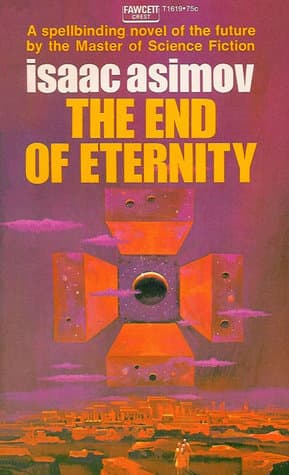
Isaac Asimov (1955)
Genre
Fantasy / Science Fiction
Reading Time
240 min
Key Themes
See below
Sign in to track this book
An Eternal who alters time risks everything when he rewrites history for a forbidden love.
Andrew Harlan, a Technician and Eternal, works in the 24th Century, observing the 482nd Century in Eternity's complex, non-temporal realm. He is skilled but somewhat detached, dedicated to his role in 'Reality Changes' — altering the timeline to prevent bad futures. His mentor is Senior Computer Labran Twissell, who invented the 'Kettle' (time travel technology) and founded Eternity. Twissell often speaks in riddles and seems to have a hidden agenda, frequently testing Harlan's understanding of Eternity's purpose and its limits. Harlan feels some dissatisfaction with his life, finding comfort only in his work.
Harlan is assigned to train a young apprentice, Cooper, in the 24th Century. During this time, he meets Noÿs Lambent, a non-Eternal woman from the 27th Century, brought into Eternity as a secretary. Their relationship quickly becomes romantic, which is forbidden for Eternals, as attachments can affect their objectivity. Noÿs challenges Harlan's views and his acceptance of Eternity's mission. Their secret meetings bring Harlan both joy and worry, as he knows the severe consequences if their affair is discovered, given Eternity's strict rules against emotional involvement.
Eternity plans a major Reality Change that will erase the 27th Century, Noÿs's home, from existence. This means Noÿs will cease to exist. Devastated, Harlan seeks help from Twissell, who is unhelpful. Harlan then approaches Fikri, a Sociologist, hoping to find a way to save Noÿs by manipulating the change. Fikri, however, tells him the change is needed to prevent a bad future for humanity. Harlan, driven by love, decides to act on his own. He secretly moves Noÿs into a hidden, non-temporal 'pocket' of Eternity, hoping to protect her from the coming erasure, a dangerous and unauthorized act.
The Reality Change happens, and Noÿs's original century is erased. Harlan confirms her safety in his hidden refuge. However, a new problem arises: the centuries beyond the 100,000th Century are 'blank' — inaccessible to the Eternals. This anomaly troubles Harlan, as it suggests a flaw in Eternity's understanding of time. He tells Twissell, who seems aware of this 'blank' but offers no clear explanation, instead pushing Harlan to think about Eternity's larger purpose. Harlan starts to suspect there is a deeper secret to Eternity and its beginnings.
Harlan, with Noÿs safely hidden, becomes focused on understanding Eternity's origin and the Kettle. He thinks the blank centuries are a result of Eternity's interference, stopping humanity from inventing its own time travel or exploring space. He believes if he can find the 'Genesis Century' — the century Eternity was founded — he might find answers. He begins to study historical records within Eternity, looking for clues about the first Eternals and their creation. His research is risky, as questioning Eternity's founding principles is seen as wrong.
Harlan eventually confronts Twissell with his findings. Twissell reveals his true plan: he arranged Harlan's actions, including his relationship with Noÿs and hiding her, to achieve a specific result. Twissell explains that Eternity, while preventing disasters, has stifled humanity's progress, leading to a static future where space travel never happens. The 'blank' centuries are a result of this stagnation. Twissell plans to send Harlan to the Genesis Century, not to observe, but to stop Eternity from ever being founded, letting humanity develop naturally and explore the galaxy.
Twissell tells Harlan to travel to the original 24th Century, the Genesis Century, before Eternity was established. His mission is to prevent the invention of the Kettle, the time-travel device that founded Eternity. Harlan is to meet a specific physicist, a key figure in the Kettle's development, and subtly discourage him from his research. Twissell stresses that the change must be small and natural, not a direct intervention that would create paradoxes. Harlan understands the great importance of this task, as it means giving up his own existence as an Eternal and potentially his memories of Noÿs, for humanity's future.
Before Harlan leaves, Noÿs reveals her true identity: she is not from the 27th Century, but from the far future, beyond the 'blank' centuries, a future where humanity has colonized the stars. She was sent back by this future humanity to ensure Eternity's end. She is a 'messenger' from the future, meant to fall in love with Harlan and motivate him to make the changes needed for her future to exist. She explains that the blank centuries are merely the centuries where Eternity *would have* existed, but didn't, in the timeline where Eternity is successfully prevented. This revelation creates a deep emotional and intellectual paradox for Harlan.
Harlan, now fully understanding the grand design and his part in it, travels to the 24th Century. He approaches the physicist, Vikkor Mallansohn, who is about to invent the Kettle. Instead of directly stopping him, Harlan subtly introduces the idea of using the Kettle for energy transfer instead of time travel, suggesting it is a more useful and safer application. He plants the idea that time travel is too dangerous and complex, gently changing Mallansohn's research. This small change is enough to prevent the specific events that would have led to Eternity's founding. The change moves through time.
As Harlan successfully alters the past, Eternity begins to disappear around him. The non-temporal realm, its personnel, and its records fade. The idea of 'Eternity' ceases to be. Harlan finds himself in a new reality, the true 24th Century, where humanity is already exploring space. Noÿs is there, by his side, her memories intact, as she was always a part of this future. They are now part of an expanding human civilization that has embraced the stars, free from the stagnation Eternity imposed. The novel ends with Harlan and Noÿs looking towards a future of many possibilities, having given up Eternity for humanity's true path.
The Protagonist
From a loyal, detached Eternal, Harlan transforms into an agent of change, sacrificing his known reality for love and humanity's future.
The Supporting/Catalyst
From a seemingly vulnerable 'primitive', Noÿs is revealed as a key architect of Eternity's downfall and the harbinger of a new future.
The Supporting/Antagonist (initial perception)/Mastermind
From the creator of Eternity, Twissell becomes its calculated destroyer, guiding others to fulfill his vision for humanity's freedom.
The Supporting
Fikri remains a steadfast upholder of Eternity's principles, serving as a foil to Harlan's emotional motivations.
The Supporting
Cooper remains a static character, representing the typical, uninitiated Eternal.
The Mentioned/Pivotal
His historical actions set the stage for Eternity's existence, and his potential future actions are altered to dismantle it.
The Supporting
Famin remains a static character, representing adherence to Eternity's regulations.
The novel explores whether humanity has free will or if its destiny is set by outside forces, in this case, Eternity. The Eternals believe they are guiding humanity to an optimal future, but Twissell and Noÿs show that their actions have stifled true progress. Harlan's choice to dismantle Eternity represents a strong claim of free will, not just for himself but for all of humanity, letting it make its own path, even with unknown risks. The 'blank' centuries symbolize the predetermined stagnation Eternity caused.
“"Eternity had eliminated all possibility of change, of adventure, of risk, and therefore of progress."”
Harlan's forbidden love for Noÿs Lambent starts his rebellion against Eternity. His willingness to risk everything to save her drives the initial plot. This personal sacrifice then grows when he agrees to dismantle Eternity itself, giving up his entire existence and known reality for humanity's future. Noÿs also makes a great sacrifice by living a lie and planning their relationship for a greater purpose. Their individual love connects with a collective love for humanity's potential, showing that personal connection can inspire grand, selfless acts.
“"He loved her, and because he loved her, he was prepared to destroy the universe."”
Eternity's mission is to create the 'safest' timeline for humanity by removing wars, plagues, and other disasters through Reality Changes. However, the novel argues that this pursuit of perfect safety comes at a high cost: stagnation. By removing all risks and challenges, Eternity removes the reason for innovation, exploration, and true progress. Humanity becomes isolated and never develops space travel. The 'blank' centuries represent the final result of this overprotective approach, where a sterile, unadventurous existence is considered 'optimal.' The book questions if a perfectly safe but unfulfilled existence is truly good.
“"What good is a safe humanity if it is a humanity that does not live?"”
Asimov looks at the philosophical effects of time travel and its impact on reality. Eternity itself is a non-temporal construct, existing 'between' centuries. Reality Changes constantly alter the past, present, and future, making the 'true' timeline fluid. The revelation of the 'blank' centuries, and Noÿs's origin from beyond them, challenges the Eternals' understanding of their own existence and the linearity of time. The novel suggests a cyclical view of time, where a future humanity can influence its own past to ensure its existence, creating a grand, self-fulfilling paradox.
“"Time is not a road, you know. It's a river, and it can be dammed, or diverted, or even run dry."”
A main theme is humanity's ultimate destiny. Eternity's actions lead to a future where humanity stays on Earth, safe but stagnant. Twissell and Noÿs, however, see a different destiny: one of interstellar exploration and colonization. The conflict between these two futures forms the core of the plot. The novel supports the idea that humanity's true potential is in venturing beyond its birthplace, embracing risk and discovery. The 'End of Eternity' is the necessary step for the 'Beginning of Infinity' — a future where humanity reaches its full potential among the stars.
“"The future of humanity is not on Earth, Harlan. It is out there, among the stars."”
The time-travel device that allows Eternals to move between centuries.
The Kettle is the fundamental technological invention that enables the existence of Eternity. It's not a ship but a personal field generator that allows an Eternal to step 'out of' their present century and into Eternity, and then 'into' any other desired century. Its invention by Labran Twissell in the original 24th Century is the genesis point of Eternity. The Kettle's capabilities are central to the plot, as its existence allows for Reality Changes, but its prevention is also the key to dismantling Eternity. It represents both ultimate control over time and the potential for unintended consequences.
The alterations made to the timeline by Eternals to prevent undesirable futures.
Reality Changes are the core function of Eternity. They are calculated interventions in past centuries, designed to subtly alter events to avoid catastrophic outcomes (like wars, plagues, or societal collapse) in future centuries. These changes create ripples through time, resulting in entirely new realities. While seemingly beneficial, the novel reveals that the cumulative effect of countless Reality Changes is the stagnation of humanity. They are a powerful plot device that drives the conflicts and ethical dilemmas of the story, as well as being the very mechanism that Harlan must ultimately undo.
The inaccessible and seemingly non-existent centuries beyond the 100,000th Century.
The 'blank' centuries are a crucial mystery and plot driver. Initially, they are an anomaly that deeply troubles Harlan, suggesting a limitation or flaw in Eternity's power. They represent the unknown and the suppressed future. Later, their true nature is revealed by Noÿs: they are not empty, but rather the centuries that exist in the timeline where Eternity *never was*. They symbolize the unhindered, starfaring future of humanity that Eternity inadvertently prevented. This device creates suspense and provides the ultimate motivation for Twissell and Noÿs's plan, serving as a beacon for humanity's true destiny.
The idea that future events cause past events, creating a self-consistent loop.
The entire premise of the novel relies on a complex bootstrap paradox. Noÿs Lambent, from the far future (which only exists because Eternity is dismantled), travels back in time to ensure Eternity *is* dismantled. Her actions, along with Twissell's manipulations, ensure the very conditions that lead to her own existence. Harlan's mission to prevent Eternity's founding is itself orchestrated by a future that would not exist if Eternity continued. This device creates a mind-bending, self-fulfilling prophecy where the 'end' of Eternity is paradoxically caused by its own future consequences, creating a stable, albeit complex, timeline.
“Eternity is the organization of time-traveling technicians who monitor and alter reality for the benefit of humanity.”
— Explanation of Eternity's purpose early in the novel.
“Reality is that which, when you stop believing in it, doesn't go away.”
— A philosophical reflection by a character on the nature of existence.
“The end of Eternity is the beginning of Infinity.”
— A cryptic statement hinting at the novel's climax and themes.
“No change is too small to be important, and no change is too large to be impossible.”
— Discussed by Eternals regarding their mission to tweak history.
“We are the shepherds of humanity, guiding it away from the cliffs of disaster.”
— A justification for Eternity's interventions in time.
“The greatest danger to Eternity is not from without, but from within.”
— A warning about internal conflicts and flaws in the organization.
“Time is a river, and we are the stones that divert its flow.”
— Metaphor used to describe the role of Eternals in history.
“To know the future is to be trapped by it.”
— A character's insight into the paradoxes of time travel.
“Humanity must be allowed to make its own mistakes, or it will never learn to fly.”
— Argument against excessive manipulation of time by Eternity.
“The end of all our meddling is the silence of a universe without humanity.”
— A grim prediction about the consequences of Eternity's actions.
“Love is the one variable that Eternity cannot calculate.”
— Reflection on how human emotions defy logical control.
“We have become gods, but gods who are afraid of their own creation.”
— A character's critique of Eternity's power and fear.
“The path to the stars is paved with the risks we dare not take.”
— Comment on how safety-focused changes stifle human progress.
“In the end, it is not time that we control, but ourselves.”
— A moral lesson drawn from the events of the novel.
Ready to see how well you understood this book? Take our interactive quiz with 10 questions.
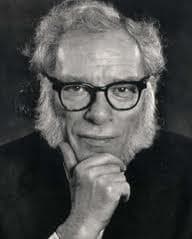
Isaac Asimov was an American writer and professor of biochemistry at Boston University. During his lifetime, Asimov was considered one of the "Big Three" science fiction writers, along with Robert A. Heinlein and Arthur C. Clarke. A prolific writer, he wrote or edited more than 500 books. He also wrote an estimated 90,000 letters and postcards. Best known for his hard science fiction, Asimov also wrote mysteries and fantasy, as well as much non-fiction.







