BookBrief
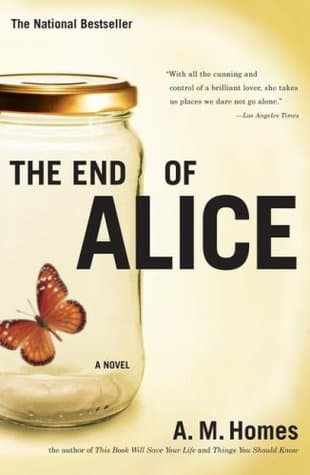
The End of Alice cover
Archivist's Choice

The End of Alice

A.M. Homes

Genre

Literary Fiction / Mystery

Reading Time

12 Minutes

Key Themes

See below

Track Your Reading

Sign in to track this book

Synopsis

An unnamed, imprisoned pedophile, serving time for the murder of a young girl named Alice, begins an unsettling correspondence with a nineteen-year-old college student. Through their letters, the man recounts his past crimes and fantasies, attempting to justify his actions and draw his young correspondent into his twisted worldview. The coed, in turn, reveals her own dark fascinations and desires, creating a disturbing and erotically charged exchange that blurs the lines between victim and accomplice, exploring the depths of obsession and the nature of evil.
Difficulty
Hard
Pacing
Moderate
Mood
Disturbing, unsettling, provocative, dark, psychological

Plot Summary

The Prisoner's Routine

The novel begins with an unnamed male narrator in a maximum-security prison. He describes his cell, his routine, and the mundane, oppressive reality of incarceration. His thoughts often return to the past, specifically to the abduction, abuse, and murder of a young girl named Alice. He recalls these events with chilling detachment, often framing his actions as a natural expression of his desires. The narrative establishes his disturbing psychology, his self-justifications, and his continued fascination with young girls, even from prison. He receives letters, hinting at a connection to the outside world.

Sam's Introduction

The story introduces Sam, a nineteen-year-old college student living a seemingly ordinary suburban life. She has an unsettling interest in true crime and a particular focus on the imprisoned narrator's case. Driven by curiosity, morbid attraction, and perhaps a desire for understanding, Sam starts corresponding with the prisoner. Her initial letters are cautious, but soon reveal a deeper, more troubling engagement with his world and his crimes. She is drawn to the taboo, to the darkness he represents. The letters become a way for her own emerging, disturbing desires and fantasies to surface, mirroring his. Her life outside the letters appears increasingly detached.

The Exchange of Desires

The letters between Sam and the prisoner become more intimate and disturbing. The prisoner, referred to as 'Mr. X' or 'The Man,' finds in Sam a willing confidante and a way to express his desires. He describes his past actions in graphic detail, not as a confession but as a compelling story. Sam, in turn, responds with her own fantasies, questions, and descriptions of her life that suggest a growing identification with Alice, the victim, and an attraction to the power dynamics involved. Their letters create a shared psychological space where their darkest thoughts are exchanged and validated, blurring the lines between perpetrator, victim, and observer.

The Confessions of Mr. X

Through his letters to Sam, the prisoner gives a detailed, raw account of Alice's abduction, the time he spent with her, and her eventual murder. He describes his careful planning, his sense of control, and his internal reasons for his actions. He portrays Alice not as a child victim but as an object of his desires, almost a willing participant in his twisted story. The details are chillingly mundane and clinical, without remorse, emphasizing his psychopathic lack of empathy. He relives the events through his writing, finding satisfaction in recounting them, and Sam's responses encourage this self-indulgent narrative.

Sam's Internal World

As the correspondence continues, Sam's internal world becomes increasingly fragmented and disturbing. She begins to fantasize about being Alice, about experiencing the events the prisoner describes. Her letters show a growing detachment from her own life and an immersion in the dark narrative she shares with the prisoner. She describes her own developing sexuality in ways that echo the prisoner's predatory gaze, blurring the lines between innocence and complicity. Her relationships with her family and boyfriend become superficial, overshadowed by the intense, secret world she shares with the imprisoned man. Her fascination turns into an alarming identification.

The Other Case: The Boy in the Park

Among the accounts of Alice's case, the prisoner subtly introduces details about an earlier, similar crime involving a young boy in a park. This revelation confirms his history as a serial abuser and murderer, showing a pattern of behavior rather than an isolated incident. The details are less explicit but equally chilling, demonstrating the long-standing nature of his pathology. This earlier crime shows the depth of his depravity and his consistent targeting of children.

The Girlfriend's Perspective

The narrative occasionally shifts to the perspective of the prisoner's former girlfriend, who offers an external, though still unsettling, view of his past. Her memories are fragmented, filled with denial and a disturbing willingness to overlook or rationalize his increasingly odd behavior. She recalls his strange tendencies, his possessiveness, and the subtle signs she chose to ignore. Her narrative highlights how those close to perpetrators can be complicit through inaction or willful ignorance. Even after his conviction, she struggles to fully reconcile the man she knew with the monstrous crimes he committed, revealing her own psychological scars.

Sam's Descent

Sam's life continues to unravel as her correspondence with the prisoner consumes her. She becomes more withdrawn, isolated, and preoccupied with the dark fantasies she cultivates. Her academic performance suffers, and her relationships with her family and boyfriend become strained and artificial. She starts to mimic aspects of Alice's life, dressing similarly or visiting places associated with the crime. Her mental state deteriorates, blurring the lines between her identity and Alice's, and between fantasy and reality. She is no longer just observing but actively participating in the psychological world of the crime, becoming a victim in her own right.

The Prisoner's Manipulation

Throughout the correspondence, the prisoner shows a deep understanding of human psychology, especially how to manipulate and control others. He skillfully uses Sam's vulnerabilities, her curiosity, and her desire for connection, drawing her deeper into his world. He offers her a unique form of intimacy, a shared secret that empowers him and isolates her. He praises her understanding, validates her disturbing thoughts, and subtly encourages her identification with Alice, solidifying his psychological hold over her. His letters are not just confessions but tools of continued predation, extending his influence beyond the prison walls.

The Unseen Connection

As the correspondence deepens, subtle hints suggest a potential physical connection or past encounter between Sam and the prisoner, or at least a powerful symbolic one. The prisoner's descriptions of Alice sometimes align uncannily with details of Sam's own life or appearance, leading to an unsettling ambiguity. This raises questions about whether Sam is merely an obsessed fan, or if there is a deeper, more personal link between them that predates the letters. This ambiguity intensifies the psychological horror, suggesting the prisoner's reach extends further than initially perceived, or that Sam is projecting her own trauma onto the narrative.

The Ending's Ambiguity

The novel ends without offering a clear resolution to Sam's fate or the ultimate outcome of the correspondence. Sam's mental state is left in a precarious balance, her identity deeply intertwined with Alice's and the prisoner's narrative. The prisoner remains incarcerated, yet his psychological power extends far beyond his cell. The ending emphasizes the lasting, corrosive impact of such dark obsessions and how trauma and depravity can echo through lives. It leaves the reader with a deep sense of unease, questioning the nature of evil, complicity, and the boundaries of human fascination with the macabre. The 'end of Alice' is open to interpretation, suggesting her story, and its echoes, may never truly end.

Principal Figures

The Narrator / Mr. X / The Man

The Antagonist

He remains unrepentant and unchanged throughout the novel, continuing to express his predatory desires and manipulate others from prison.

Sam

The Protagonist

Sam's initial curiosity morphs into a profound and disturbing obsession, leading to a significant deterioration of her mental state and identity.

Alice

The Supporting

Alice's 'arc' is her re-creation and re-interpretation through the narratives of the prisoner and Sam, constantly shifting in meaning and representation.

The Girlfriend

The Supporting

She remains haunted by her past relationship, grappling with denial and the horrific truth of her former lover's crimes.

Sam's Boyfriend

The Supporting

He remains oblivious to Sam's dark obsession, serving primarily as a static representation of the normalcy she is losing.

Sam's Parents

The Supporting

They remain oblivious to Sam's internal struggles, serving as static background figures.

Themes & Insights

The Nature of Evil and Psychopathy

The novel explores the mind of a psychopathic murderer, showing his lack of empathy, his self-justifications, and his chilling detachment from his horrific actions. It portrays evil not as a monstrous aberration, but as a calculated, internal logic that can exist within an outwardly articulate individual. The prisoner's narrative challenges conventional ideas of remorse and punishment, suggesting that for some, their depravity is an inherent part of their being, making redemption or rehabilitation impossible. It examines how this kind of evil can perpetuate itself through manipulation and vicarious experience.

I was not a monster. I was a man. A man with certain specific desires, a man who acted on them. A man who was true to himself.

The Narrator / Mr. X

Obsession and Morbid Fascination

Obsession is a central theme, primarily through Sam's growing fixation on the prisoner and his crimes. It explores the darker aspects of human curiosity, the lure of the forbidden, and how individuals can be drawn into narratives of violence and depravity. Sam's obsession is a complex mix of intellectual curiosity, sexual awakening, and a disturbing identification with the victim. The novel suggests that such fascinations can be incredibly destructive, blurring the lines between observer and participant, and ultimately consuming the individual from within, leading to a profound loss of self.

I wanted to know everything. Not just the facts, but the feeling. What it felt like to be her. What it felt like to be him.

Sam

The Power of Narrative and Language

The novel shows how narratives, particularly those crafted by a perpetrator, can shape perception and reality. The prisoner uses his letters to construct a self-serving narrative of his crimes, transforming himself from a monster into a misunderstood individual or even an artist of desire. This narrative, delivered through carefully chosen language, manipulates Sam and even the reader. Language is shown to be a tool for both confession and continued predation, demonstrating how words can create a shared psychological space where disturbing fantasies are validated and reality is distorted.

Words are powerful, Sam. They can build worlds, and they can tear them down. They can create a reality that is more real than anything outside your window.

The Narrator / Mr. X

Loss of Innocence and Identity

The novel explores the loss of innocence, both literally through Alice's murder and psychologically through Sam's descent into obsession. Alice's innocence is brutally taken, but Sam's is gradually eroded as she immerses herself in the prisoner's world. Her identity becomes intertwined with Alice's, and her own sense of self becomes fragmented and distorted. The narrative questions what happens when one's identity is defined by a horrific event or a dangerous connection, suggesting that the psychological fallout can be as devastating as the physical act, leading to a spiritual death.

I was Alice. I was him. I was everything that happened in between. There was no me anymore, just the story.

Sam

Plot Devices & Literary Techniques

Epistolary Format

The story is largely told through letters between the two main characters.

The novel predominantly utilizes an epistolary format, with the story unfolding through the exchange of letters between the imprisoned narrator and Sam. This device creates an intense, intimate, and claustrophobic atmosphere, drawing the reader directly into the characters' minds and their disturbing dialogue. It allows for direct access to their unfiltered thoughts and fantasies, intensifying the psychological horror. The gaps between letters also build suspense and allow for the reader to infer the characters' internal states and the passage of time, while emphasizing the isolation and secrecy surrounding their relationship.

Unreliable Narrator

The prisoner's account of events is inherently biased and self-serving.

The primary narrator, the imprisoned man, is profoundly unreliable. His accounts of his crimes are presented with a chilling detachment and self-justification, framing his actions as almost inevitable or even artistic. He manipulates facts and emotions to paint himself in a particular light and to control Sam's perceptions. This unreliability forces the reader to constantly question the truth of his statements and to confront the subjective nature of memory and narrative, particularly from a psychopathic perspective. It deepens the psychological horror by making the reader complicit in deciphering the truth amidst the lies.

Shifting Perspectives

The narrative occasionally shifts to other characters' viewpoints.

While primarily driven by the letters, the novel occasionally intersperses the prisoner's direct narration and Sam's letters with brief sections from other characters, most notably the prisoner's former girlfriend. These shifting perspectives offer momentary breaks from the intense psychological focus on the main duo, providing glimpses into the broader impact of the prisoner's actions and the denial or complicity of those around him. They serve to ground the fantastical horror of the letters in a more 'real' world context, while also highlighting the pervasive nature of the trauma and the difficulty of truly understanding such depravity from an outside vantage point.

Critical analysis

Notable Quotes

Quiz

Test Your Knowledge

Ready to see how well you understood this book? Take our interactive quiz with 10 questions.

10
Questions
~5
Minutes
?
Best Score

Key Questions (FAQ)

'The End of Alice' tells the story of an imprisoned pedophile who begins an intense, erotically charged correspondence with a young woman. Their exchanges reveal and explore obsessive desires, blurring the lines between romance and horror.

About the author

A.M. Homes

A.M. Homes is an American writer of fiction, known for her provocative and often transgressive novels. Her acclaimed works include 'The End of Alice,' 'May We Be Forgiven,' which won the Orange Prize for Fiction, and 'This Book Will Save Your Life.' Homes' writing is characterized by its unflinching exploration of identity, family, and societal norms.







