“The world is a vast and complicated place, and there are a lot of people in it who are not very nice.”
— A general observation about the nature of the world the Baudelaire orphans inhabit.

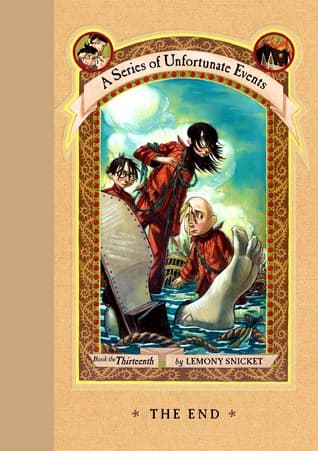
Lemony Snicket (2006)
Genre
Thriller / Science Fiction / Young Adult
Reading Time
240 min
Key Themes
See below
Sign in to track this book
Amidst a raging storm and a suspicious drink, the Baudelaire orphans uncover a haunting secret about their parents in a final, perilous struggle against misfortune.
After the events of 'The Penultimate Peril,' the Baudelaire orphans—Violet, Klaus, and Sunny—are adrift at sea in a diving helmet with Count Olaf. They are shipwrecked on an uncharted island inhabited by castaways and their leader, Ishmael. The islanders live by strict rules of self-sufficiency and avoid outside influence, welcoming the newcomers at first. However, their suspicion of outsiders, especially Olaf, is clear. The Baudelaires quickly notice the islanders' unusual diet of a fermented drink and their reluctance to discuss the past or the outside world, setting an unsettling tone for their arrival.
The Baudelaires receive a tent and observe the islanders' daily routines. They discover that the islanders drink a cloudy, fermented beverage called 'coconut cordial' daily, which seems to calm them and erase their memories of the outside world. Ishmael, the island's leader, is a strong figure who insists on strict adherence to the island's rules, including a ban on anything from the 'Mainland.' He also keeps a large, mysterious book closely guarded. The orphans' scientific curiosity and desire for truth immediately clash with the island's enforced ignorance and Ishmael's control, hinting at deeper secrets.
The orphans befriend a young islander named Friday, who, despite her conditioning, shows a spark of curiosity. She reveals a forbidden cave on the island, a place no islander can enter. The Baudelaires, always curious, decide to explore this cave, believing it might hold clues to the island's mysteries and perhaps their parents' past. This decision marks a turning point, as their search for knowledge directly defies Ishmael's authority and the islanders' passive acceptance, moving them closer to the island's hidden truths and away from its enforced calm.
Entering the forbidden cave, the Baudelaires discover it is a storage place for artifacts from the outside world, specifically items related to V.F.D. They find books, inventions, and a large library, all carefully kept. Most importantly, they uncover a detailed history of V.F.D., including its split and their parents' roles. They also find evidence that Ishmael was once a V.F.D. member and the former headmaster of Prufrock Preparatory School, a shocking revelation connecting the island to their past and the broader V.F.D. story. The cave symbolizes suppressed knowledge and a link to their origins.
Among the artifacts in the cave, the Baudelaires find a glass container holding the Medusoid Mycelium, a highly toxic and fast-spreading fungus. They recognize it as the same fungus that threatened them in 'The Grim Grotto.' They learn that the island's original inhabitants, including their parents, brought it to the island for safekeeping, hoping to find a cure. This discovery raises the stakes, as the fungus is a direct and immediate threat, echoing past dangers and highlighting the continuous cycle of misfortune they face. The fungus represents the pervasive danger that V.F.D. and its conflicts brought.
Ishmael confronts the Baudelaires in the cave, revealing his true identity as the former Headmaster of Prufrock Preparatory School and a disillusioned V.F.D. member. He explains his philosophy of isolation and ignorance, believing it is the only way to escape the world's sorrows and V.F.D.'s endless conflicts. He offers the Baudelaires a place among the islanders, urging them to forget their past and embrace the island's peaceful, though ignorant, existence. This moment highlights the central conflict between knowledge and ignorance, and freedom versus controlled safety, forcing the orphans to make a profound choice.
While the Baudelaires consider Ishmael's offer, Count Olaf acts on his own. He poisons the islanders' coconut cordial with the Medusoid Mycelium, intending to force them to leave the island and gain access to its resources. At the same time, a massive hurricane approaches the island, threatening to destroy everything. The combination of Olaf's malicious act and the impending natural disaster creates a catastrophic situation, intensifying the already dire circumstances and forcing the Baudelaires into a desperate race against time to save the islanders and themselves.
Remembering a past encounter, the Baudelaires realize that horseradish is the antidote to the Medusoid Mycelium. They frantically search for it, eventually finding a stash of horseradish apples. They distribute the antidote to the poisoned islanders. During the chaos of the hurricane and the search for the cure, Count Olaf is gravely injured by a harpoon, accidentally shot by Ishmael. In his final moments, a surprisingly tender side of Olaf appears as he helps deliver Kit Snicket's baby, showing a flicker of humanity before his death. This unexpected act complicates the perception of Olaf as purely evil.
The heavily pregnant Kit Snicket, shipwrecked earlier, washes ashore during the storm. She is dying from the Medusoid Mycelium and the harsh conditions. With Olaf's unexpected help, she gives birth to a baby girl. Before dying, Kit reveals a crucial piece of information: the true location of the sugar bowl, a significant V.F.D. artifact, and that the Baudelaires' parents were not evil, as some V.F.D. members believed. Her death marks a poignant end to a long-standing character and provides some closure regarding the V.F.D. mystery and their parents' legacy.
After the storm passes, the Baudelaires, along with Kit's newborn daughter (whom they name Beatrice, after their mother), are the sole survivors on the island. They spend a year on the island, raising Beatrice and thinking about their past and future. They grapple with the choice of returning to the mainland and the complexities of the adult world or remaining in the island's isolated safety. This period allows them to process their grief, mature, and collectively decide their path forward, symbolizing their transition from helpless orphans to capable, self-reliant individuals.
After a year, the Baudelaires, carrying baby Beatrice, decide to leave the island. They build a small boat and set sail towards the unknown. Their decision to depart signifies their rejection of Ishmael's philosophy of ignorant bliss and their acceptance of the harsh realities and moral ambiguities of the world. They choose to face life's complexities, armed with their knowledge, resilience, and the responsibility of caring for Beatrice. This departure is a strong statement of their growth and their commitment to making their own path, rather than hiding from the world's misfortunes.
The Protagonist
Violet evolves from a protective older sister to a young woman who embraces her inventive spirit to navigate moral complexities and take responsibility for a new life.
The Protagonist
Klaus transitions from relying solely on book knowledge to applying his intellect to real-world moral dilemmas, embracing ambiguity over absolute certainty.
The Protagonist
Sunny develops from an infant with unique biting skills to a toddler who can communicate clearly and contribute culinary and practical solutions, embodying innocence and resilience.
The Antagonist
Count Olaf remains largely villainous, but in his final moments, he displays a surprising act of compassion, complicating his purely evil persona.
The Supporting/Antagonist
Ishmael's arc reveals his past as a V.F.D. member, exposing his philosophy of enforced ignorance as a misguided attempt at peace, ultimately failing to protect his community.
The Supporting
Kit's arc culminates in her giving birth and revealing critical truths about the Baudelaires' parents and V.F.D. before her tragic death, serving as a bridge to a new generation.
The Mentioned
As a newborn, Beatrice's arc is nascent, representing a fresh start and a symbol of hope and responsibility for the Baudelaire orphans.
The Supporting
Friday's arc is brief but significant, as she represents the potential for curiosity and independent thought to break through enforced ignorance.
This theme is central to the entire series, reaching its peak in 'The End.' The island, under Ishmael's leadership, actively promotes ignorance and forgetting as a way to peace, seen in the coconut cordial. The Baudelaires, driven by their love of learning and truth, constantly challenge this idea by seeking information in the forbidden cave. Their final decision to leave the island and face the complexities of the world, rather than embracing blissful ignorance, affirms the value of knowledge, even when it brings pain. The entire island's structure, from the daily cordial to the forbidden cave, shows this conflict.
“''Knowledge is like a library, and the islanders were only allowed to read the first page of every book.'”
The final book explores the moral ambiguities that have run through the series. Count Olaf, the main villain, performs a surprisingly compassionate act by helping Kit Snicket deliver her baby. Conversely, Ishmael, who seems benevolent, is revealed to be a manipulative figure who enforces ignorance. This blurs the lines between good and evil, suggesting that even villains can have moments of humanity, and seemingly good intentions can lead to harmful control. The Baudelaires deal with these complexities, learning that the world is not simply black and white, but a spectrum of moral choices, as seen in Olaf's final moments and Ishmael's deceptive leadership.
“''It is a curious thing, the death of a loved one. We all know that our time in this world is limited, and that eventually all of us will perish. And yet it is always a surprise when it happens to someone we know. It is like walking up the stairs to your bedroom in the dark, and thinking there is one more stair than there is. Your foot falls down, through the air, and there is a sickly moment of dark surprise as you try to readjust your balance.'”
The Baudelaires have endured immense loss, and 'The End' brings more deaths, including Kit Snicket and, indirectly, their parents' legacy. The year they spend on the island, raising baby Beatrice, is a period of quiet grief and reflection. They learn to process their pain not by forgetting, as Ishmael suggests, but by remembering and carrying the lessons and love of those they've lost. Their decision to name Kit's baby Beatrice is a direct act of remembrance, showing that honoring the past helps one move forward. The entire narrative is shaped by Lemony Snicket's own grief, conveyed through his melancholic narration.
“''There are many things that are less lovely than a tree, but there are few things as lovely as a tree that has been through a storm.'”
Despite relentless misfortunes, 'The End' concludes with a bittersweet sense of hope. The Baudelaires, having faced every possible calamity, choose to leave the island and face the world, not out of naive optimism, but with a grounded understanding of its dangers. The birth of Beatrice represents a new beginning, a cycle of life continuing despite deaths and tragedies. While the series emphasizes that misfortunes are unavoidable, it also suggests that resilience, knowledge, and compassion can help one navigate them. The orphans' journey does not end with a perfect resolution, but with the courage to continue their story.
“''The world is a vast and complicated place, and there are many things that are not fair. But there are also many things that are wonderful, and it is up to us to find them.'”
A secluded island representing isolation and a false utopia.
The uncharted island serves as a microcosm of the philosophical conflict between knowledge and ignorance. It's a place where the islanders have chosen to forget the outside world, believing it to be a haven from misfortune. This isolation, enforced by Ishmael, initially appears idyllic but proves to be a form of control that stifles intellectual curiosity and genuine freedom. The island becomes a final testing ground for the Baudelaires, forcing them to choose between blissful ignorance and the harsh realities of the world. It symbolizes an attempt to escape the 'unfortunate events' by simply ignoring them, a solution the Baudelaires ultimately reject.
A deadly fungus that acts as a recurring threat and a catalyst for action.
The Medusoid Mycelium, a highly toxic and rapidly spreading fungus, reappears as a critical plot device. It serves as a direct, immediate threat that forces the Baudelaires to act quickly and apply their combined knowledge (Violet's inventiveness, Klaus's research, Sunny's unique skills) to find a cure. Its reintroduction heightens the stakes and connects the events on the island to their previous adventures, emphasizing the pervasive nature of danger. It also acts as a catalyst for Count Olaf's final, desperate act of villainy, inadvertently leading to his demise and Kit Snicket's tragic end.
A fermented beverage that induces forgetfulness and passive obedience.
The coconut cordial is a crucial symbol of enforced ignorance and control. By consuming this daily beverage, the islanders gradually lose their memories of the outside world and become more compliant with Ishmael's rules. It represents the seductive but ultimately harmful nature of escaping reality through willful oblivion. For the Baudelaires, refusing the cordial is an act of rebellion and a commitment to retaining their memories and their identities. It highlights the theme of knowledge vs. ignorance, showing how easily people can be manipulated when their memories and critical thinking are suppressed.
A hidden repository of knowledge and a link to the past.
The forbidden cave is a symbolic and literal treasure trove of information. It houses artifacts, books, and records related to V.F.D., the Baudelaires' parents, and the true history of the island. It represents the suppressed truth and the inherent human desire to seek knowledge, even when forbidden. The cave is a direct challenge to Ishmael's philosophy of ignorance, as its very existence proves that the past cannot be entirely erased. For the Baudelaires, exploring the cave is an act of defiance and a crucial step in unraveling the mysteries of their past and the V.F.D. schism.
“The world is a vast and complicated place, and there are a lot of people in it who are not very nice.”
— A general observation about the nature of the world the Baudelaire orphans inhabit.
“It is a truth universally acknowledged, that a single man in possession of a good fortune, must be in want of a wife. No, wait, that's the wrong book.”
— A meta-commentary by the narrator, Lemony Snicket, breaking the fourth wall.
“The end of the world is not the end of the world, it is the beginning of the end of the world.”
— A philosophical musing on the nature of endings and new beginnings, particularly relevant to the series' conclusion.
“There are some things that cannot be fixed, and sometimes the best thing to do is to simply let go.”
— The orphans grapple with the overwhelming challenges and losses they face.
“The world is quiet here.”
— A recurring phrase throughout the series, here taking on a poignant meaning in the isolation of the island.
“No matter how much you try to forget, some things just stick with you.”
— The children reflect on their past traumas and memories.
“It is often said that the truth will set you free, but in fact, it is often the truth that will imprison you.”
— The narrator's cynical view on the consequences of uncovering difficult truths.
“The difference between a hero and a villain is often just a matter of perspective.”
— The blurred lines between good and evil, particularly with characters like Count Olaf and the V.F.D.
“A good book can be a comfort, a solace, and a companion.”
— A brief moment acknowledging the importance of literature, a recurring theme.
“Sometimes, the only way to make a decision is to make it and see what happens.”
— The Baudelaire orphans are forced to make difficult choices with uncertain outcomes.
“The greatest trick the devil ever pulled was convincing the world he didn't exist. No, wait, that's the wrong book, too.”
— Another instance of Lemony Snicket's meta-commentary and literary allusions.
“The future is always uncertain, but that doesn't mean we should stop trying to make it better.”
— A glimmer of hope and determination amidst the bleak circumstances.
“There are some words that should never be spoken, and some secrets that should never be revealed.”
— The emphasis on the dangerous nature of information and knowledge within the V.F.D. conflict.
“Even in the darkest of times, there is always a tiny spark of light.”
— A moment of optimism despite the overwhelming challenges faced by the children.
Ready to see how well you understood this book? Take our interactive quiz with 10 questions.
Biography coming soon.







