“It was not a ghost that had killed the girl. It was something else. Something far worse.”
— Lucy's realization about the nature of the threat in the first case.

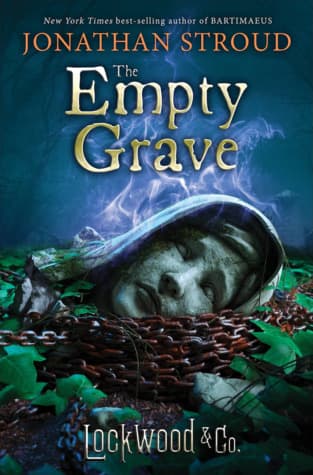
Jonathan Stroud (2017)
Genre
Fantasy / Children's / Mystery / Young Adult
Reading Time
9-10 hours
Key Themes
See below
Sign in to track this book
Lockwood & Co. breaks into Marissa Fittes's mausoleum, uncovering secrets that change their understanding of the past and lead to a climactic battle with spectral and human enemies.
Five months after 'The Creeping Shadow,' Lockwood & Co., with Quill Kipps, break into the Fittes Mausoleum. They want to investigate Marissa Fittes's grave, suspecting her death was faked. They get past booby traps and spectral defenses, including a powerful Type Three ghost, to reach the coffin. Inside, they find silver items and a note suggesting Marissa is alive. The team escapes as Fittes agents arrive, led by Penelope Fittes, who is angry about their intrusion.
Back at Portland Row, the team questions the Whispering Skull, which confirms their suspicions: Marissa Fittes is alive and connected to the Problem, the hauntings in England. The Skull says Marissa has been manipulating events for decades, using the 'Source' of the Problem for her own ends. It also hints at a larger, more dangerous plan involving agencies and artifacts. This news makes the team realize the true size of their enemy.
After the mausoleum raid, Lockwood & Co. are targeted by Penelope Fittes and remnants of the 'Cult of the Bones.' Needing allies, they reluctantly seek out the Golden Blade, a ruthless independent agency run by Steve Rotwell. Rotwell, interested in their findings about Marissa Fittes, agrees to an uneasy alliance. He provides resources and information, but his motives are unclear, and Lucy is wary of his methods.
London experiences powerful psychic attacks, with ghost-locks appearing across the city. Lockwood & Co., with the Golden Blade, investigate. They find these attacks are organized and stronger than typical hauntings, suggesting a coordinated effort. George realizes these are tests for a larger event, and Marissa Fittes is somehow making the Problem worse. Lucy's listening abilities are pushed to their limits as she senses the immense psychic energy.
The Whispering Skull, under pressure, reveals its true identity: it is the ghost of an ancient psychic, who was involved in the initial discovery of the 'Source' of the Problem with Marissa Fittes. It explains that Marissa plans to unleash the Source, merging the worlds of the living and the dead. To stop her, they must enter the Other Side, the realm of the dead, to confront her at the Source. This is a dangerous task, needing great psychic strength and a willingness to risk their souls.
Lockwood, Lucy, and Kipps, guided by the Whispering Skull, use a psychic artifact to open a gateway to the Other Side. They leave George and Holly to guard their physical bodies. The Other Side is a desolate, terrifying place, a vortex of lost souls and psychic energy, where reality is distorted. They face despair and the constant threat of being consumed by spectral entities. Lucy's listening talent guides them to the Source.
Deep within the Other Side, they reach the 'Source' of the Problem. It is not an artifact or a place, but a colossal, ancient psychic entity that Marissa Fittes has been manipulating for decades. They confront Marissa Fittes, who is now a powerful, almost spectral figure, sustained by the Source's energy. She reveals her plan: to 'reset' humanity by unleashing the Source's full power, believing it will purge the world of flaws and create a new society, even if it means widespread death and chaos.
A fierce battle starts between Lockwood, Lucy, Kipps, and the powerful Marissa Fittes. Marissa uses her amplified psychic abilities, channeling the Source, to create illusions and attack them. Lucy's talent lets her see Marissa's manipulations and counter them, while Lockwood's determination keeps them fighting. Kipps provides support. They realize that defeating Marissa is not enough; they must sever her connection to the Source without destroying it, or the consequences could be catastrophic.
In a moment, Lockwood realizes the only way to sever Marissa's connection to the Source without destroying it and causing chaos is to use himself as a conduit. He lets the Source flow through him, overwhelming Marissa's control. This act almost costs him his life, pushing his psychic abilities to their limit. Lucy, seeing Lockwood's sacrifice, is devastated but understands. Marissa Fittes is separated from the Source, her power fading as she is consumed by the forces she sought to control.
Lockwood, Lucy, and Kipps barely make it back to their physical bodies, weakened and traumatized. They find George and Holly waiting. Penelope Fittes and the other agencies deal with the aftermath of Marissa's plan and the destabilized Source. The world has changed, with the Problem still present but altered. Lockwood & Co. are seen as heroes by some, while others, like Penelope, view them with suspicion. The experience leaves a mark on Lockwood and Lucy, deepening their bond and changing their understanding of life, death, and the supernatural.
After things settle, Lockwood talks to Lucy about his past. He says his parents were brilliant, but reckless, psychic researchers who experimented with artifacts. His sister, Jessica, died during one of their experiments, a death Lockwood blames himself for. This trauma led him to suppress his own psychic abilities and hide his family's secrets. Lucy comforts him, understanding his burden, and this shared vulnerability deepens their relationship, leading to a more honest future for Lockwood & Co.
Lockwood & Co. return to Portland Row, their agency changed but stronger. They faced humanity's greatest threat and won, though at personal cost. The Problem remains, but its nature is better understood. Penelope Fittes, though defeated in her mother's schemes, still has power, meaning Lockwood & Co.'s fight is not over. The team, now more united, prepares for an uncertain future, knowing their talents and bond will be essential in challenges ahead.
The Protagonist
Lucy grows from a traumatized, insecure agent into a confident, powerful psychic who embraces her unique talents and deepens her bond with Lockwood.
The Protagonist
Lockwood evolves from a secretive, seemingly carefree leader into a vulnerable, self-sacrificing hero who comes to terms with his past and embraces his true potential.
The Supporting
George remains consistently brilliant and loyal, his character development focusing on his deepening trust in his friends and his role as the agency's anchor.
The Supporting
Holly integrates into the Lockwood & Co. team, proving her worth beyond administrative tasks and becoming a trusted, indispensable member.
The Supporting
Kipps transitions from a bitter rival to a trusted, albeit grumpy, ally and contributor to Lockwood & Co.'s mission.
The Antagonist
Marissa Fittes is revealed as the ultimate orchestrator of the Problem, culminating in her defeat and the unraveling of her grand, destructive plan.
The Antagonist/Supporting
Penelope Fittes is forced to confront the devastating truth about her mother, leading to the collapse of her understanding of the world.
The Supporting
The Skull reluctantly reveals its true identity and history, becoming an essential guide in the final confrontation with Marissa Fittes.
The Supporting
Rotwell acts as a powerful, self-interested ally, his actions serving to further the plot while maintaining his morally gray status.
The Mentioned
Her past death is revealed as the central trauma in Lockwood's life, driving his actions and shaping his character.
The novel explores the characters' understanding of themselves, especially Lucy and Lockwood. Lucy deals with her talents, learning to trust her instincts and abilities, particularly when she goes to the Other Side. Lockwood confronts his facade, revealing the truth about his family and his hidden psychic potential, leading to a more authentic self. Their journey to the Other Side is an internal and external exploration, forcing them to face their fears and true selves.
“'Maybe it was only by going to the darkest places that you found the brightest parts of yourself.'”
'The Empty Grave' explores the lines between life and death more directly than previous books, especially through the journey into the Other Side. The Source represents an ancient, powerful entity connected to both realms. The book questions what it means to be alive, what happens after death, and the ethics of manipulating these boundaries. Marissa Fittes's desire to 'reset' humanity by merging the worlds of the living and the dead makes characters and readers think about the sanctity of life and the natural order.
“'The world of the living and the world of the dead… they’re not so separate as you think. Not anymore.'”
Sacrifice is a main theme, most notably with Lockwood's act of letting the Source flow through him to sever Marissa's connection. This shows that heroism often demands personal cost. The characters constantly face dangerous choices, and the novel explores the consequences of their actions for themselves and the world. Even small decisions, like breaking into the mausoleum, start a chain of events with global effects, showing the weight of responsibility.
“'Some things are worth dying for, Lucy. Some things are worth living for, too.'”
Deception is a theme, from Marissa Fittes's faked death and manipulation of the Problem to Lockwood's secrets about his family. The story constantly challenges what characters (and readers) believe, making them look deeper. The search for truth drives the plot, as Lockwood & Co. uncover lies and the real history of the Problem and its orchestrators. This theme shows the danger of unquestioning belief and the importance of critical inquiry.
“'The world is full of lies, Lucy. Some of them are very old indeed.'”
Despite dangers and disagreements, the bond between Lockwood, Lucy, and George (and later Holly and Kipps) is the series' emotional center. 'The Empty Grave' strengthens this theme as they face their greatest challenge, relying on each other for survival and emotional support. Lockwood's revelation of his past to Lucy solidifies their deep, familial connection, showing that true family is built on trust, shared experience, and loyalty, even in the face of death. Their collective strength allows them to confront Marissa Fittes.
“'We're a team, Lucy. Always. Whatever happens.'”
A terrifying, psychic dimension that is the source of the Problem.
The Other Side is a crucial plot device, representing the spiritual realm where ghosts reside and where the 'Source' of the Problem is located. Its introduction and the characters' journey into it elevate the stakes significantly, moving beyond typical ghost-hunting into existential horror. It serves as the ultimate arena for the climax, a place where psychic abilities are amplified, and the boundaries of life and death are blurred. The descriptions of the Other Side are vivid and terrifying, enhancing the sense of danger and the profound impact on the characters who experience it.
An intelligent, sardonic Type Three ghost providing crucial exposition and guidance.
The Whispering Skull is a unique and indispensable plot device. Trapped in a jar, it acts as both a source of exposition, revealing ancient secrets about the Problem and Marissa Fittes, and a sardonic, often unhelpful, guide. Its direct communication with Lucy, and its eventual revelation of its true identity and history, are pivotal to understanding the antagonist's motives and the path to defeating her. The Skull's cynical voice also provides moments of dark humor, balancing the novel's intense suspense.
The central mystery that drives the entire plot.
The deception of Marissa Fittes's death is the inciting incident and central mystery that propels the narrative. It establishes her as a formidable, manipulative antagonist operating from the shadows, and her 'resurrection' (or rather, her continued existence) completely upends the established understanding of the ghost-hunting world. This device creates a sense of betrayal and forces the characters to question everything they thought they knew about the agencies and the Problem itself, raising the stakes to a global level.
A long-standing mystery that provides character depth and a crucial plot twist.
Lockwood's secretive past, particularly the tragic death of his sister and his suppressed psychic abilities, is a running plot device throughout the series that culminates in 'The Empty Grave.' The slow reveal of these details adds layers to his character, explaining his recklessness and charisma. His hidden psychic power becomes a crucial element in the climax, enabling him to make the ultimate sacrifice. This device provides a satisfying resolution to a long-standing mystery while also showcasing the profound impact of trauma on his character.
The ancient, living psychic entity responsible for the Problem.
The Source is the ultimate MacGuffin and the core of the Problem itself. It's not a simple artifact but a living, ancient psychic entity that Marissa Fittes has been manipulating. The quest to find and understand the Source drives the latter half of the plot, culminating in the journey to the Other Side. Its nature as a powerful, near-sentient being elevates the conflict beyond mere ghost-hunting to a cosmic struggle, giving the characters a truly formidable and existential threat to overcome.
“It was not a ghost that had killed the girl. It was something else. Something far worse.”
— Lucy's realization about the nature of the threat in the first case.
“The problem with being a ghost-hunter is that you spend an awful lot of time around ghosts. And ghosts are, by and large, incredibly irritating.”
— Lockwood's wry observation on the daily grind of their profession.
“We were a team. A small, slightly dysfunctional, but ultimately effective team.”
— Lucy reflecting on the dynamic between herself, Lockwood, and George.
“Some secrets are best left buried. But some, it turns out, refuse to stay down.”
— The overarching theme of the grave's secrets coming to light.
“Fear is a weapon. And sometimes, it's the only one you've got.”
— Lucy's internal thought about using her own fear and sensitivity as a tool.
“The dead don't care about your feelings. They just want what they want.”
— A stark reminder of the relentless nature of the Visitors.
“There are always choices, even when it feels like there aren't any.”
— Lockwood offering encouragement or a philosophical point during a difficult situation.
“The truth, like a ghost, has a way of finding you, no matter how fast you run.”
— The inevitability of confronting the past and its revelations.
“It's not about being brave all the time. It's about being brave when it counts.”
— A character's reflection on the nature of courage in their dangerous line of work.
“The greatest dangers are often those you can't see, or those you refuse to believe in.”
— Highlighting the insidious nature of both supernatural and human threats.
“We were just kids, really. Kids with swords and salt-bombs, facing down the impossible.”
— Lucy's poignant reflection on their youth and the immense responsibility they carry.
“Sometimes, the only way to move forward is to dig up the past, no matter how grim it might be.”
— The necessity of confronting historical injustices or secrets to resolve current problems.
“The empty grave wasn't empty at all. It was full of answers, and a terrible kind of silence.”
— The climactic revelation about the grave's true contents and significance.
“There's a thin line between obsession and dedication. George, as always, danced along it with gusto.”
— Lucy's amused observation of George's intense research methods.
“You can't save everyone. But you can try. And sometimes, trying is enough.”
— A moment of reflection on the limitations and importance of their efforts.
Ready to see how well you understood this book? Take our interactive quiz with 10 questions.
Biography coming soon.







