“There was once a an elephant, who was called Horace, and Horace was having a birthday party.”
— Opening line of the story, introducing Horace and the central event.

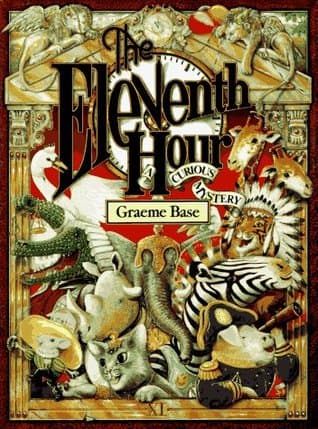
Graeme Base (1988)
Genre
Fantasy / Children's / Creativity / Mystery
Reading Time
30-60 min (for solving the mystery)
Key Themes
See below
Sign in to track this book
Join Horace the elephant's elaborate eleventh birthday costume party to uncover which of his exotic, rhyming guests devoured the magnificent feast, hidden within Graeme Base's sumptuously detailed illustrations and witty verses.
Horace, a magnificent elephant, turns eleven years old. To celebrate, he hosts a lavish costume party at his opulent home. He sends ornate invitations to his diverse animal friends, requesting their presence for a feast and festivities. The invitations mention the eleventh hour as a significant time, and Horace meticulously plans every detail, from the grand decorations to the delectable birthday feast. The stage is set for a joyous celebration with exotic guests from around the world.
As the eleventh hour approaches, Horace's mansion fills with his distinguished guests, all dressed in spectacular costumes. There is a graceful gazelle as an astronaut, a cunning fox as a pirate, a stately lion as a Roman emperor, and many more. Each arrival is a spectacle, with the animals greeting Horace and admiring the grand setting. The atmosphere is full of excitement and anticipation for the party to fully begin. Horace, in his own regal attire, warmly welcomes each of his friends, ensuring everyone feels comfortable and ready for the celebration.
The birthday celebration begins with games and musical performances. Guests play 'Pin the Tail on the Donkey' and 'Musical Chairs,' filling the grand halls with laughter and cheerful shouts. A troupe of monkeys provides lively jazz music, encouraging everyone to dance. Horace circulates among his friends, ensuring everyone has a splendid time. The party is in full swing, creating a festive and joyful atmosphere, completely unaware of the impending mystery.
At the height of the festivities, Horace proudly announces the unveiling of the grand birthday feast. He leads his assembled guests to the dining hall, where a colossal table is laden with an extraordinary array of culinary delights: towering cakes, platters of exotic fruits, savory pies, and numerous other delicacies. The sight is magnificent, designed to impress and satisfy every palate. The guests gasp in admiration at the sheer abundance and artistry of the spread, eagerly anticipating the moment they can begin to partake in the meal.
Just as Horace prepares to invite his guests to begin eating, a collective gasp of disbelief echoes through the dining hall. To everyone's shock and dismay, the magnificent feast has vanished. Every single dish, every cake, every fruit, and every pie has been completely devoured, leaving only empty platters and crumbs. The grandeur of moments before is replaced by stunned silence and confusion. Horace, initially bewildered, quickly realizes a mystery is afoot: someone has eaten the entire birthday feast before it was meant to be served.
Confusion and murmuring sweep through the assembled animals. Each guest looks around, trying to discern who could possibly have committed such an audacious act. Whispers and accusations begin to circulate as friends start to eye each other with suspicion. The festive atmosphere quickly dissipates, replaced by intrigue and a touch of mistrust. Horace, though disappointed, maintains his composure and realizes he must solve this perplexing mystery to salvage his birthday celebration. The party has taken an unexpected turn into a whodunit.
As the story progresses, Graeme Base's detailed illustrations become crucial in solving the mystery. Readers are encouraged to meticulously examine each scene, noticing subtle visual discrepancies, changes in character positions, and small details that might point to the culprit. For instance, some animals might appear in different places than expected, or certain clues, like crumbs or tell-tale objects, might be hidden in plain sight. These visual hints work with the rhyming text, providing a non-verbal layer of information for the observant reader.
The clever rhyming text of 'The Eleventh Hour' offers another layer of clues for the reader detective. Through carefully crafted verses, the narrator provides indirect hints and observations about the guests and the events leading up to the feast's disappearance. These textual clues might describe a character's unusual behavior, an object they were holding, or a particular trait that, when combined with the visual evidence, helps to narrow down the suspects. The text often uses playful language, making the mystery engaging and accessible for young readers while still challenging them to think critically.
The narrative explicitly invites the reader to become the detective. After presenting the initial mystery and providing both visual and textual clues, the book poses a direct challenge to its audience: 'Can *you* solve the mystery of who ate the feast?' This interactive element is central to the book's appeal, encouraging active engagement rather than passive consumption. Readers are prompted to re-examine the preceding pages, cross-reference information, and use their deductive reasoning skills to arrive at a conclusion. The book empowers its readers to be part of the story.
After the reader has had an opportunity to deduce the culprit, the final pages of the book provide the definitive answer to the mystery. It is revealed that the culprit was Joey, a small mouse, who, despite his size, managed to sneakily consume the entire feast by continuously returning to the table throughout the party, unnoticed by the larger guests. The book then meticulously explains how each visual and textual clue, from the slight changes in the illustrations to the subtle hints in the rhymes, pointed towards Joey, validating the efforts of observant readers and providing a satisfying conclusion to the puzzle.
Beyond the mystery of the eaten feast, the title 'The Eleventh Hour' holds a deeper, subtle significance that is hinted at throughout the book and confirmed in the solution. While initially seeming to refer to the time of the party, it also alludes to the fact that Joey, the mouse, was the eleventh guest to arrive at the party. This clever double meaning adds another layer of ingenuity to Graeme Base's storytelling, rewarding readers who pay close attention to every detail, from the character introductions to the numbering of guests. It reinforces the book's theme of hidden details and observation.
The Protagonist
Horace remains largely consistent, demonstrating his graciousness and his ability to host a memorable, albeit mysterious, party.
The Antagonist (The Culprit)
Joey's character is static, serving as the hidden perpetrator whose actions drive the central mystery.
The Supporting
Sir Alistair's role is primarily to provide visual interest and be a potential suspect, without significant personal development.
The Supporting
Lady Ada serves as a vibrant background character, contributing to the rich tapestry of the party without a personal arc.
The Supporting
The Professor's arc is limited to his role as a distinguished guest, designed to blend into the larger mystery.
The Supporting
Captain Bluebeard functions as a colorful background character and a red herring due to his 'cunning' persona.
The Supporting
The monkeys are static background characters, serving to enhance the party's ambiance.
The central theme of the book is the importance of keen observation and logical deduction. Readers are explicitly challenged to scrutinize the detailed illustrations and the nuanced rhyming text to solve the mystery of the missing feast. Every page contains subtle clues—changes in character positions, minute details on costumes, or specific phrases in the verse—that, when pieced together, reveal the culprit. This theme encourages active engagement and critical thinking, as seen in the repeated invitation for the reader to 'look again' at the scenes to find the truth.
“But who could have done it? That's the puzzle, you see! / For the answer, dear reader, depends now on thee!”
This theme explores how initial perceptions can be misleading. The grand, imposing figures like Sir Alistair (the lion) or Captain Bluebeard (the fox) are obvious suspects due to their size or 'cunning' nature, yet the true culprit is the smallest and seemingly most innocuous guest, Joey the mouse. The lavishness of the party itself also masks the quiet, unseen act of theft. The book teaches that one should look beyond superficial appearances and examine hidden details to uncover the truth, challenging stereotypes and preconceived notions.
“The smallest of creatures, so quiet and sly, / Was the one who ate everything, beneath every eye.”
Despite the central mystery, the book portrays the joy and excitement of a grand celebration. Horace's birthday party is a spectacle of costumes, lively music, and games, filled with diverse and exotic characters. The initial scenes emphasize the delight of friendship and festivity, setting a cheerful tone before the mystery unfolds. Even after the feast is discovered missing, the underlying spirit of fun and gathering remains, highlighting the importance of shared experiences and community.
“For the grandest of parties, with friends far and near, / Was the best way to banish all worries and fear.”
Graeme Base's signature style, characterized by incredibly intricate and detailed illustrations, is a core theme itself. The book is designed to be pored over, with every inch of the page offering new discoveries. Beyond the mystery, the artistic richness—the patterns on the walls, the hidden creatures, the elaborate costumes—encourages readers to engage deeply with the visual narrative. This theme celebrates the power of art to tell a story and to invite prolonged, active interaction from the audience, making the book a visual treasure hunt.
“And the cleverest readers, with eyes sharp and bright, / Will find every detail, a wondrous delight.”
Misleading clues or characters designed to distract the reader.
The book employs several red herrings, primarily through its character portrayals and initial visual cues. Large, imposing animals like Sir Alistair (the lion) or the 'cunning' Captain Bluebeard (the fox) are presented in ways that might lead a reader to suspect them, playing on stereotypes of their species. Their prominent placement in illustrations and certain textual descriptions subtly divert attention from the actual culprit. This device challenges the reader to look beyond obvious suspects and delve deeper into the less conspicuous details.
Subtle visual details embedded within the artwork that reveal the truth.
Graeme Base's distinctive artistic style is a key plot device. Each illustration is meticulously detailed and contains numerous subtle clues that, when observed closely, point to the culprit. These clues include changes in character positions between pages, crumbs or food stains appearing near certain characters, the presence of specific objects that relate to the feast, and even the gradual alteration of the feast itself. This device demands active visual engagement from the reader, making the pictures integral to solving the mystery.
The poetic text provides verbal hints and riddles to guide the investigation.
The rhyming text is not just a stylistic choice but a functional plot device that delivers verbal clues. The verses are crafted to offer hints about the events, the characters' behaviors, or specific objects, often in a playful or riddle-like manner. For instance, the text might draw attention to a character's actions without explicitly stating their guilt, or it might subtly emphasize the 'eleventh' aspect, which is critical to the solution. This device works in tandem with the visual clues, requiring careful reading and interpretation.
The story directly addresses and challenges the reader to solve the mystery.
This book uses an interactive narrative device by directly addressing the reader and inviting them to participate in solving the mystery. The narrator explicitly asks questions like 'But who could it be?' and encourages the reader to 'look again.' This breaks the fourth wall, transforming the reader from a passive observer into an active detective. This device enhances engagement, personalization, and provides a sense of accomplishment when the reader successfully deduces the culprit based on the provided clues.
“There was once a an elephant, who was called Horace, and Horace was having a birthday party.”
— Opening line of the story, introducing Horace and the central event.
“All sorts of exotic animals had been invited: a leopard, a lion, a tiger, a bear, a gorilla, a pig, a bat, a vulture, a warthog, a rhinoceros, a dromedary, and even a hippopotamus!”
— Describing the diverse guest list for Horace's party.
“They ate and they ate, and they ate some more. They ate so much that the table was groaning under the weight of it all.”
— Illustrating the abundance of food and the guests' hearty appetites.
“When the clock struck eleven, Horace announced that it was time for the games to begin.”
— The pivotal moment when the main activities of the party are about to start.
“But when they went to open the trunk, they found it was empty! The feast was gone!”
— The discovery of the missing food, initiating the mystery.
“Horace was very upset. 'Who could have done such a thing?' he trumpeted.”
— Horace's reaction to the theft, expressing his distress.
“Each animal had a motive, and each animal had an opportunity.”
— The underlying premise for solving the mystery, hinting at clues for each guest.
“It was a puzzle, a riddle, a mystery waiting to be solved.”
— Emphasizing the interactive nature of the book's mystery.
“Look closely at the pictures, and you will find the clues.”
— Direct instruction to the reader on how to engage with the book's mystery.
“The answers are there, if you only know where to look.”
— Reassurance to the reader that the solution is discoverable through careful examination.
“Every page holds a secret, every detail a hint.”
— Highlighting the intricate design and hidden elements within the illustrations.
“The truth is often hidden in plain sight.”
— A philosophical statement about observation, relevant to the book's mystery.
“It takes a sharp eye and a clever mind to uncover the culprit.”
— Challenging the reader's skills in solving the mystery.
“And so, the mystery of the Eleventh Hour feast remained, for those who dared to solve it.”
— Concluding thought, reinforcing the ongoing challenge for the reader.
Ready to see how well you understood this book? Take our interactive quiz with 10 questions.

Biography coming soon.







