“It was a good thing to be alone with the trees. They were like old friends, always there, always understanding.”
— Little Tree reflects on the comfort of nature after moving in with his grandparents.

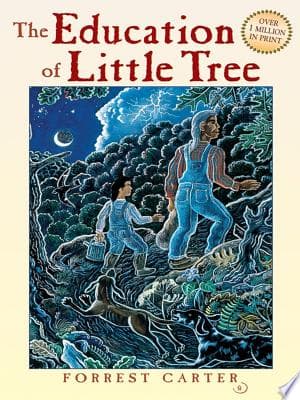
Forrest Carter (2001)
Genre
Children's / Historical Fiction / Young Adult
Reading Time
240 min
Key Themes
See below
Sign in to track this book
During the Great Depression, a young Cherokee orphan learns about nature and life from his grandparents in the Tennessee mountains.
The story begins with five-year-old Little Tree, whose parents have recently died, being brought by his Uncle Andy to live with his Cherokee grandparents, Granma and Granpa, deep in the Tennessee mountains during the Great Depression. Granpa, a half-Cherokee moonshiner and trapper, and Granma, a full-blooded Cherokee woman, welcome him into their simple log cabin. Little Tree quickly adapts to their rustic life, learning about the wilderness and his Cherokee heritage. His grandparents teach him about nature's cycles, how to hunt and fish, and the importance of respecting all living things, which differs greatly from the 'white man's' ways he briefly knew.
Granpa teaches Little Tree the 'Way' of the Cherokee people. This means understanding the land, hunting only what is needed, and living with nature. Little Tree learns to read forest signs, identify plants and animals, and track game. Granpa also teaches him about 'spirit'—the life force in all things—and the importance of self-reliance and honesty. He explains the injustice Native Americans faced and the hypocrisy he sees in some 'white man's' religions and laws, giving Little Tree a deep connection to his heritage and a critical view of the outside world.
Granma's gentle wisdom adds to Granpa's teachings. She teaches Little Tree about love, compassion, and the importance of giving to others. She also patiently teaches him to read using an old Bible and a dictionary, believing that knowledge is power. Granma tells him stories of their ancestors, instilling pride in his Cherokee identity. Through her, Little Tree learns the value of kindness, the joy of simple pleasures, and the strength found in family. Her lessons often include practical skills like gardening and cooking, always with a message of respect and gratitude.
Granpa makes illegal whiskey, which he calls 'mountain dew,' for income. Little Tree helps him, learning about the stills and the secrecy involved. He goes with Granpa on trips down the mountain to trade whiskey, furs, and other goods for necessities like salt, coffee, and ammunition. These trips expose Little Tree to the outside world—towns, merchants, and 'white folks'—giving him a broader view of the differences between their isolated life and society beyond their mountain home. He sees both kindness and prejudice during these trips.
During trips to town, Little Tree meets various 'white folks.' Some are prejudiced, seeing Granpa as a 'squaw man' and Little Tree as an 'Injun.' However, he also meets kind individuals, like Mr. Wine, a Jewish peddler, and the local storekeeper, who treat them with respect. These interactions show the complexities of human nature and challenge Little Tree's understanding of the world beyond his mountain. Granpa often uses these encounters as teaching moments, explaining others' motivations and perspectives, good and bad, without bitterness.
Tragedy occurs when social workers, alerted by a prejudiced neighbor, consider Granpa and Granma unfit guardians due to their 'unconventional' lifestyle and Granpa's moonshining. Little Tree is forcibly removed from his grandparents and placed in a strict orphanage. He struggles with the rigid rules, lack of freedom, and the cold environment. The orphanage represents everything his grandparents taught him to avoid: conformity, lack of spirit, and no connection to nature. He feels deep loss and loneliness, longing for the mountains and his family.
Unable to tolerate the orphanage, Little Tree plans his escape. With an older boy's help, he flees and begins the long journey back to his mountain home. He faces hunger, fear, and the challenges of navigating unfamiliar territory alone. Relying on survival skills Granpa taught him, he perseveres, driven by his love for his grandparents and his longing for the mountains' freedom. His journey shows his resilience and the deep bond he shares with his family and their way of life.
Upon his joyful return, Little Tree resumes his life with Granpa and Granma. He continues to learn their wisdom, developing a deep understanding of how all things connect. He learns more about hunting, trapping, and nature's rhythms. He also experiences the natural cycle of life and death, seeing animals pass and understanding its place in the grand scheme. His time away solidified his appreciation for his unique upbringing, making him more determined to embrace the Cherokee 'Way' and the values his grandparents embodied.
As Little Tree grows, he faces the sorrow of loss. Granma, his gentle teacher, falls ill and passes away. Her death is a deeply impactful event for Little Tree, who struggles with the grief of losing such a central figure. Granpa helps him understand death as a natural part of life's cycle, a transition rather than an end. The family mourns her in their own way, honoring her memory and the lessons she taught, strengthening the bond between Little Tree and Granpa in their shared sorrow.
Not long after Granma's death, Granpa also dies from old age and illness. Little Tree is truly orphaned, experiencing profound loss. Granpa, in his final days, gives his last pieces of wisdom, preparing Little Tree for life without him. The boy, though heartbroken, draws strength from the values and knowledge his grandparents instilled in him. He buries Granpa next to Granma, a poignant farewell, and reflects on the immense legacy they left him, understanding that their spirit and teachings will always be with him.
With both Granma and Granpa gone, Little Tree, now a young man, knows he cannot stay on the mountain alone. He leaves his beloved home, carrying the deep spiritual and practical education he received. He takes with him the Cherokee 'Way,' respect for nature, and lessons of honesty, self-reliance, and love. The story ends with Little Tree reflecting on how his grandparents' teachings shaped him, allowing him to navigate the world with integrity and wisdom, always remembering his roots and the unique education he received in the Tennessee mountains.
The Protagonist
From an innocent orphaned child, Little Tree grows into a wise and resilient young man, deeply rooted in his Cherokee heritage and prepared to face the world with integrity.
The Supporting (Mentor)
Granpa remains a steadfast mentor, imparting his wisdom and preparing Little Tree for life, even in his final moments.
The Supporting (Mentor)
Granma provides consistent love and intellectual guidance, shaping Little Tree's compassionate nature before her peaceful passing.
The Supporting
Uncle Andy serves primarily as a catalyst for Little Tree's new life, his role diminishing after the initial placement.
The Supporting
Mr. Wine remains a consistent, supportive friend, offering external perspective and kindness.
The Antagonist
The social workers act as a force of societal interference, causing the central conflict of Little Tree's removal, then fading from the narrative.
The Supporting
Willow John serves as a childhood companion, embodying the shared cultural background with Little Tree.
The central theme is the deep connection to nature and the traditional Cherokee philosophy of life. Granpa and Granma teach Little Tree to live with the land, respecting all living things, and understanding nature's cycles. This 'Way' emphasizes self-reliance, observation, and a spiritual connection to the earth, contrasting with the materialism and artificiality of the 'white man's' world. Scenes of hunting, trapping, and identifying plants, along with Granpa's explanations of 'spirit' in all things, show this theme.
“''You learn more from the trees than you do from any book.'”
The story includes significant losses, beginning with Little Tree becoming an orphan. His removal to the orphanage, and later the deaths of Granma and Granpa, represent deep grief. However, the narrative emphasizes resilience through these losses. Little Tree's escape from the orphanage and his ability to carry on his grandparents' teachings despite their passing show his inner strength and adaptability. The theme suggests that while loss is inevitable, the lessons learned and the love shared last, shaping character and guiding one's path.
“''It is a good thing to grieve for those who have gone. It helps to keep their spirit alive.'”
The book subtly critiques 'white man's' society and its 'progress' compared to traditional Cherokee values. Social workers, the orphanage, and some prejudiced townsfolk represent flaws in a system that prioritizes conformity, material wealth, and rigid rules over natural wisdom, spiritual connection, and individual freedom. Granpa often articulates this contrast, highlighting the hypocrisy he observes. Mountain life, though simple, is portrayed as rich and fulfilling, while the outside world is often seen as cold, judgmental, and lacking true 'spirit.'
“''When you take in more than you need, you have robbed others of their need.'”
Education, both formal and informal, is a vital theme. Granma painstakingly teaches Little Tree to read and write, emphasizing that knowledge is power and a way to understand the world. The oral tradition of storytelling is equally important. Both Granma and Granpa share stories of their heritage, life lessons, and observations about human nature. These narratives pass on cultural values, history, and wisdom across generations, shaping Little Tree's understanding of his identity and his place in the world. Reading and listening become keys to deeper truths.
“''Books are good, Little Tree, but the real wisdom is in the living.'”
A narrative focused on the psychological and moral growth of the protagonist from youth to adulthood.
The entire novel functions as a Bildungsroman, tracing Little Tree's development from a five-year-old orphan to a young man. His journey is one of profound learning, both practical skills from mountain life and philosophical wisdom from his grandparents. His experiences, particularly the trauma of the orphanage and the grief of losing his family, contribute to his moral and spiritual maturation, shaping his identity and worldview. The narrative concludes with him having fully assimilated the 'Way' and being prepared to face the world as a wise and self-reliant individual.
Characters who highlight the qualities of another character through contrast.
The social workers and the orphanage staff serve as foils to Granpa and Granma. The social workers' rigid adherence to bureaucratic rules and their inability to understand the Cherokee 'Way' highlight Granpa and Granma's deep wisdom, compassion, and natural approach to education. The sterile, impersonal environment of the orphanage starkly contrasts with the warm, nurturing, and free-spirited home Little Tree shares with his grandparents, emphasizing the value of their traditional upbringing and the 'spirit' they embody.
The mountain represents freedom, wisdom, and a sanctuary of traditional values.
The mountain itself is a powerful symbol throughout the book. It represents freedom, self-sufficiency, and a refuge from the perceived corruptions of modern society. It is where Little Tree receives his true education, learning directly from nature and his wise grandparents. The mountain embodies the traditional Cherokee 'Way' – a place of spiritual connection, harmony, and unadulterated existence. Leaving the mountain signifies Little Tree's physical departure, but the enduring lessons ensure the 'mountain' (its values) remains within him.
The entire narrative is presented as a remembrance, implying a framing device of a grown Little Tree looking back.
While not explicitly stated with traditional flashback markers, the narrative's tone and the phrase 'recounts the childhood remembrances' in the book's description strongly imply an overarching flashback structure. The entire story is presented through the nostalgic and reflective lens of an adult Little Tree looking back on his formative years. This perspective allows for the inclusion of philosophical observations and a deeper understanding of events that a child might not fully grasp, lending authority and wisdom to the storytelling.
“It was a good thing to be alone with the trees. They were like old friends, always there, always understanding.”
— Little Tree reflects on the comfort of nature after moving in with his grandparents.
“When you learn to read, you will have a whole new world opened up to you.”
— Grandpa encourages Little Tree to learn how to read, emphasizing the value of education.
“You learn to listen to the land. You learn to listen to the wind. You learn to listen to the trees. You learn to listen to your heart.”
— Grandpa teaches Little Tree about intuition and connecting with nature.
“There are some things you do for money, and some things you do because they are right.”
— Grandpa explains his moral code to Little Tree, distinguishing between necessity and integrity.
“Folks are mostly good, Little Tree. You just have to know how to find it.”
— Grandma shares her optimistic view of humanity, despite the hardships they face.
“When you take from the land, you give back to the land.”
— Grandpa teaches Little Tree about the importance of reciprocity and respect for nature.
“A man without a past is like a tree without roots.”
— Grandpa emphasizes the importance of understanding one's heritage and history.
“There ain't no such thing as a bad child, just a child who hasn't been loved enough.”
— Grandma expresses her compassionate understanding of children's behavior.
“The government is like a big old fat cat, sittin' on a fence, watchin' the mice run around.”
— Grandpa's cynical view of government and its detachment from the common people.
“You don't own the land, Little Tree. The land owns you.”
— Grandpa teaches Little Tree about the spiritual connection and stewardship of the land.
“Books are like windows to other worlds.”
— Little Tree discovers the joy and expansive nature of reading.
“It's a good thing to be lonesome sometimes. It makes you think.”
— Little Tree reflects on the value of solitude for introspection.
“When you die, you go back to the earth, and the earth gives you back to the trees and the flowers.”
— Grandpa's perspective on death as a natural part of the life cycle.
Ready to see how well you understood this book? Take our interactive quiz with 10 questions.

Asa Earl Carter was a 1950s segregationist political activist, Ku Klux Klan organizer, and later Western novelist. He co-wrote George Wallace's well-known pro-segregation line of 1963, "Segregation now, segregation tomorrow, segregation forever", and ran in the Democratic primary for governor of Alabama on a white supremacist ticket. Years later, under the alias of supposedly Cherokee writer Forrest Carter, he wrote The Rebel Outlaw: Josey Wales (1972), a Western novel that led to a 1976 film featuring Clint Eastwood that was adopted into the National Film Registry, and The Education of Little Tree (1976), a best-selling, award-winning book which was marketed as a memoir but which turned out to be fiction.

Dan Gemeinhart
4.5

Kate O'Hearn
4.4

Jeanne Birdsall
4.4

Jen Wang
4.4

Wendelin Van Draanen
4.3

John Marsden
4.3

Chris Van Allsburg
4.3

Jennifer A. Nielsen
4.2