“All art is a way of seeing the world, and there are as many ways as there are artists.”
— David, the young artist, contemplates the nature of art and individual perception.


John Fowles (1974)
Genre
Literary Fiction / Romance
Reading Time
300 min
Key Themes
See below
Sign in to track this book
In the French countryside, an aging artist, surrounded by his two young muses, confronts a visiting journalist about beauty, art, and desire.
David Williams, a thirty-two-year-old abstract painter and critic, travels to Coët in rural Brittany to meet the celebrated eighty-year-old artist, Henry Breasley. David admires Breasley's early realist landscapes. Breasley, living in self-imposed exile for decades, is known for his unconventional life and strong opinions on modern art. David anticipates the meeting with nervousness, aware of Breasley's reputation and his dislike for much of the contemporary art world. He arrives at Breasley's isolated estate, which appears both beautiful and out of time, setting the stage for an encounter that will challenge David's artistic and personal beliefs.
At Coët, David meets the two young women who live with Breasley: Diana, 'the Mouse,' and Anne, 'the Freak.' Diana, beautiful and gentle, is Breasley's main companion and caretaker. Anne, more striking and unconventional, is an artist and Breasley's apprentice and model. David notices the unusual dynamic between the elderly artist and these two young women, sensing affection, dependence, and perhaps more. Their presence adds intrigue to the isolated home, hinting at Breasley's unconventional life and relationships.
Over the next few days, Breasley engages David in long, often confrontational, discussions about art, life, and modern times. Breasley supports a traditional, representational approach to art, emphasizing beauty, skill, and accurate depiction of nature. He criticizes abstract art and much of the modern movement, seeing it as a betrayal of true artistic principles and a sign of societal decline. David, an abstract painter, finds his own beliefs challenged. While he defends his position, Breasley's passionate arguments and strong personality create an internal struggle for David, forcing him to rethink his own artistic philosophy and career.
During one intense conversation, Breasley introduces the 'Ebony Tower' metaphor. He describes it as a dark, sterile, isolated place where modern abstract artists live, cut off from the vibrant, sensual reality of the world and true artistic inspiration. For Breasley, this tower represents the intellectual, self-referential nature of abstract art, which he believes has lost touch with beauty, emotion, and the human condition. He contrasts this with his 'green world' of nature, sensuality, and traditional art values. This metaphor deeply affects David, echoing his own unspoken doubts about his abstract work's relevance, making him wonder if he too is trapped in such a tower.
As David spends more time at Coët, he feels increasingly attracted to Diana, 'the Mouse.' Her quiet grace, natural beauty, and gentle manner captivate him. He observes her interactions with Breasley, noting their tenderness and dependence, which complicates his feelings. David sees Diana as a symbol of the natural, pure beauty Breasley values, and which David feels is missing from his own life and art. His attraction is not just physical; it comes from a deeper longing for a connection to the 'green world' Diana seems to embody, contrasting sharply with his intellectual life as an abstract artist.
Anne, 'the Freak,' offers David a different view of life at Coët. More outspoken and less submissive than Diana, Anne hints at the psychological complexities and manipulation in Breasley's home. She reveals that she and Diana are essentially captives in Breasley's 'green world,' dependent on him and isolated. Anne expresses her artistic frustrations and desire for independence, contrasting with Diana's more accepting nature. Her insights make David realize that Breasley's idyllic retreat also has a darker side, where his strong personality and traditional views control the young women, potentially hindering their development.
Breasley, observant of human nature, notices David's growing attraction to Diana. Instead of jealousy, he subtly encourages it, as if testing David or offering him a choice. He suggests David could stay at Coët, implying he could join their unconventional household and potentially form a relationship with Diana, embracing Breasley's 'green world.' This offer presents David with a profound dilemma: abandon his established life and artistic path for a radically different existence, one that promises a deeper connection to nature and sensuality, but also challenges his identity as an abstract artist and his commitment to his wife, Beth.
David's internal conflict grows. He is tempted by a life with Diana, drawn to her innocence, beauty, and the promise of a more authentic, sensual existence away from the intellectual demands of his abstract art. The 'green world' of Coët, with its apparent freedom and connection to fundamental human experiences, seems to offer a deep escape. However, he is also tied to his marriage to Beth and his career as an abstract painter. He questions if he can truly abandon his identity and responsibilities, or if this temptation is just a fleeting fantasy. The choice represents a fundamental fork in his life's path, forcing him to confront his deepest desires and fears.
Driven by his desire and Breasley's perceived encouragement, David tries to seduce Diana. However, Diana, despite her apparent affection for David, rejects his advances, stating she loves Breasley and is committed to him. This rejection leaves David confused and disappointed. He realizes the depth of Diana's loyalty to Breasley and the true nature of their unique bond, which he had perhaps misunderstood. Humiliated and with his internal conflict unresolved, David abruptly decides to leave Coët. His visit ends in emotional turmoil and artistic uncertainty, leaving him to consider his choices and his path.
David returns to his life in London, to his abstract painting, and to his wife, Beth. The experience at Coët, however, has deeply affected him. He cannot fully shake off Breasley's arguments or the allure of Diana and the 'green world.' He has lingering doubts about his own art, questioning if he is trapped in an 'Ebony Tower' of his own making. The visit has opened a chasm of uncertainty, forcing him to confront the potential sterility of his intellectual life and the possibility of a different, more sensual and connected life he chose to leave behind. His return is not a resolution, but a continuation of his internal struggle.
The Protagonist
David begins as a confident abstract artist but ends with profound doubts about his art and life choices, wrestling with the allure of a different path.
The Antagonist/Mentor
Breasley remains steadfast in his convictions, serving as a static force that profoundly impacts David's development.
The Supporting
Diana remains a consistent figure, a symbol of the 'green world' and unwavering loyalty, acting as a catalyst for David's internal conflict.
The Supporting
Anne's character remains largely consistent, serving as a foil to Diana and a voice of subtle dissent against Breasley's control.
The Mentioned
Beth's role is static, serving as a representation of David's commitments and the life he potentially jeopardizes.
The novella explores the nature of art, contrasting traditional, representational art with modern abstract forms. Breasley advocates for art connected to nature, beauty, and sensuality, seeing abstract art as sterile and self-indulgent ('the Ebony Tower'). David, an abstract painter, must re-evaluate his artistic purpose. The story asks if art should serve intellectual exploration or emotional connection and the depiction of beauty. Breasley's defense of his 'green world' art challenges David's intellectual approach, making him confront the potential emptiness of art divorced from tangible reality, as shown in his internal struggle after leaving Coët.
“''The green world and the ebony tower. That's the choice, David. The choice for all of us, artists or not.'”
This theme is a central conflict between Breasley's 'green world'—a life rooted in nature, sensuality, and immediate experience—and David's intellectual, abstract existence, which Breasley calls the 'Ebony Tower.' Breasley argues for a return to primal instincts and beauty, criticizing modern society's over-reliance on intellect. David is drawn to the natural beauty of Coët and Diana, feeling a pull toward a more authentic, less intellectual life. His internal struggle reflects the broader tension between instinctual life and rational existence, highlighting the sacrifices in either choice.
“''You've chosen the tower, David. You've chosen the mind over the heart, the abstract over the real.'”
The novella explores different forms of freedom and confinement. Breasley's 'green world' appears to offer ultimate freedom from societal rules, yet Anne hints at the psychological confinement of herself and Diana, who depend on Breasley. David, initially believing himself free in his artistic choices, feels confined by his own intellectual 'Ebony Tower' and career expectations. His longing for Diana is a longing for escape from these constraints. The story suggests that true freedom is hard to find and often comes with its own limits, whether physical, emotional, or intellectual.
“''We are all prisoners, David. Some of us just have nicer cells.'”
The isolated estate of Coët, with its natural beauty and unconventional residents, represents an idyllic, almost primitive escape from modern life. David is drawn to this, especially to Diana, who seems untouched by his intellectual and societal pressures. This theme explores the human desire for a simpler, more authentic existence, free from perceived corruptions of civilization. However, Fowles subtly questions this idyll, suggesting that such a retreat can also hide its own forms of control and illusion, as revealed through Anne's cynical view of Breasley's household.
“''Here, time doesn't exist in the same way. You live, you feel, you breathe. That's all.'”
The complex relationships at Coët highlight the intertwined nature of love, lust, and loyalty. David feels intense lust for Diana, which he initially mistakes for a deeper connection. Diana, however, shows unwavering loyalty and a deep, almost filial love for Breasley, rejecting David's advances. Breasley's relationships with Diana and Anne include paternal affection, artistic mentorship, and perhaps a more possessive, even erotic, undertone. The novella examines the boundaries of these emotions, showing how loyalty can be a powerful force, and how lust can mask deeper existential longings, leaving David to grapple with the true meaning of his desires and commitments.
“''Love is not just about wanting, David. It's about being wanted, and belonging.'”
A central, symbolic dichotomy representing opposing philosophies of art and life.
This metaphor is the core structural and thematic device of the novella. The 'Green World' represents Henry Breasley's philosophy: a life and art rooted in nature, sensuality, beauty, and traditional values, lived in harmony with primal instincts. The 'Ebony Tower' symbolizes modern abstract art and the intellectualized, detached existence that Breasley believes is sterile and isolating. This dichotomy frames David's internal conflict, forcing him to choose between two fundamentally different approaches to art, life, and personal fulfillment, making the abstract philosophical debate tangible.
A remote, idyllic estate in Brittany that functions as a self-contained world.
The secluded location of Breasley's estate in rural Brittany serves as a crucial plot device. Its isolation creates a contained environment, allowing Breasley's unconventional lifestyle and philosophical arguments to flourish without external interference. This physical detachment from the modern world reinforces the 'Green World' concept and intensifies David's immersion in Breasley's influence. The isolation also heightens the psychological drama, making David's internal struggle more acute as he is cut off from his familiar surroundings and commitments, amplifying the allure and potential trap of Breasley's world.
Two young women who embody different aspects of Breasley's world and act as catalysts for David's conflict.
Diana ('the Mouse') and Anne ('the Freak') function as more than just characters; they are symbolic plot devices. Diana embodies the idealized, innocent, and sensual beauty of Breasley's 'Green World,' becoming the object of David's intense desire and representing the allure of a simpler life. Anne, with her more cynical and independent perspective, serves as a counterpoint, revealing the potential confinement and manipulation within Breasley's seemingly idyllic existence. Together, they force David to confront the complexities and contradictions of Breasley's philosophy and his own desires, acting as catalysts for his emotional and artistic crisis.
The story is largely filtered through David's thoughts, perceptions, and internal struggle.
While narrated in the third person, the story heavily relies on David's internal monologue and perceptions. This device allows the reader direct access to his intellectual debates, emotional turmoil, and evolving understanding of Breasley's world and his own desires. It emphasizes the subjective nature of his experience and the profound psychological impact of the visit. The filtering of events through David's consciousness highlights his struggle to reconcile his abstract intellectualism with the raw sensuality he encounters, making his journey of self-discovery and doubt the central focus.
“All art is a way of seeing the world, and there are as many ways as there are artists.”
— David, the young artist, contemplates the nature of art and individual perception.
“The greatest freedom is to be oneself.”
— Henry Breasley, the aging artist, reflects on his life and choices.
“Love is not a state of mind, but a journey.”
— David considers the complexities of his relationship with Diana.
“We are all prisoners of our own pasts.”
— A general observation on human nature and the influence of history.
“Beauty is a form of truth.”
— Breasley discusses his aesthetic philosophy with David.
“The artist's job is to make the invisible visible.”
— Breasley defines the role and challenge of an artist.
“Every choice we make closes off a thousand others.”
— David grapples with the consequences of his decisions.
“There is a kind of courage in not knowing where you are going.”
— A reflection on the uncertainty of life and artistic exploration.
“The true artist is always an exile.”
— Breasley explains the inherent isolation of the creative spirit.
“Reality is always more complex than our theories.”
— A general philosophical statement about understanding the world.
“To truly see is to be changed.”
— David's experiences with Breasley and his art alter his perspective.
“Old age is not a defeat, but a different kind of victory.”
— Breasley's perspective on aging and continued artistic output.
“The world is full of ghosts, if you know how to look for them.”
— A metaphorical statement about the lingering presence of the past and unseen influences.
Ready to see how well you understood this book? Take our interactive quiz with 10 questions.
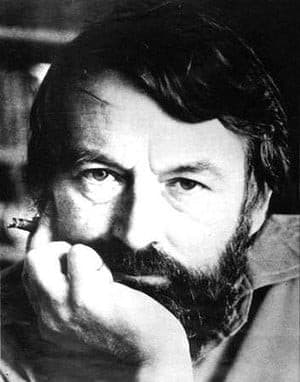
John Robert Fowles was an English novelist of international renown, critically positioned between modernism and postmodernism. His work was influenced by Jean-Paul Sartre and Albert Camus, among others.







