“The Eagle is not a thing to be lost.”
— Marcus reflects on the symbolic importance of the lost Roman eagle standard.

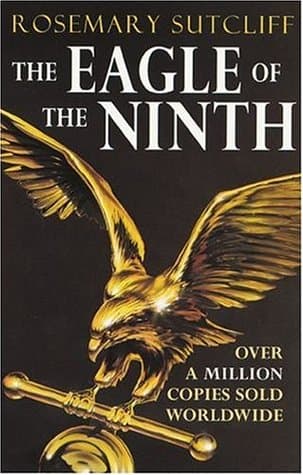
Rosemary Sutcliff (1954)
Genre
Fantasy / Children's / Historical Fiction / Young Adult
Reading Time
360 min
Key Themes
See below
Sign in to track this book
A disgraced Roman centurion, haunted by his father's vanished legion, embarks on a perilous quest beyond Hadrian's Wall to retrieve its lost eagle standard and restore his family's honor.
Marcus Flavius Aquila, a newly commissioned centurion, arrives in Roman Britain, having chosen to serve on the frontier rather than in a safer province. His father, a centurion with the Ninth Legion, disappeared with his entire legion fourteen years prior in the Caledonian wilds, a disgrace that bothers Marcus. He is given command of a small fort at Isca Dumnoniorum (modern Exeter) and proves himself a capable and fair leader, earning the respect of his men. However, during a sudden attack by local British tribesmen, Marcus is severely wounded in the leg, ending his military career. This injury leaves him with a limp and a sense of frustration, as his dream of restoring his family's name through military service is gone.
After his injury, Marcus is sent to recover at his Uncle Aquila's villa in Calleva (Silchester). During his recovery, he struggles with his lost future and his disability. His uncle, a wise and kind man, encourages him to find a new purpose. It is here that Marcus purchases a young British slave named Esca at a slave market, saving him from a cruel master. Initially, their relationship is tense due to their master-slave dynamic, but Esca's quiet loyalty, intelligence, and knowledge of the British land and customs slowly earn Marcus's trust and respect, building a deeper bond that goes beyond their social divide.
While recovering, Marcus begins to hear rumors among the Britons and Roman traders about the lost Eagle standard of the Ninth Legion. The standard, a golden eagle, was the sacred emblem of the legion, and its loss was a dishonor. These rumors suggest that the Eagle was not destroyed but was seen far to the north, beyond Hadrian's Wall, in the hands of a fierce, un-Romanized tribe. Marcus realizes that recovering the Eagle would not only restore his father's and the legion's honor but would also give him a new purpose in life. He decides to undertake a journey into the unknown territories to find it.
Marcus begins to plan his expedition. To avoid suspicion and survive in the hostile territories beyond the Wall, he decides they must travel in disguise. He pretends to be a Greek oculist, Demetrius, a traveling physician, with Esca as his slave and translator. They gather supplies, learn about the northern tribes, and Marcus even learns some basic Greek phrases. Esca's knowledge of the British dialects and his ability to blend in are important to their success. Before departing, Marcus reveals his true intentions to Esca, who, despite the dangers, pledges his loyalty and agrees to accompany him on this quest, driven by his growing bond with Marcus and a sense of adventure.
Marcus and Esca, disguised as Demetrius and his slave, go north, crossing Hadrian's Wall into the lands of Caledonia. They encounter various British tribes, some wary, some hostile, and rely heavily on Esca's language skills and cultural understanding to manage these encounters. Marcus, despite his Roman pride, learns to adapt to the ways of the north and to trust Esca's judgment. They endure harsh weather, difficult terrain, and constant watch against discovery. Their bond deepens as they face shared dangers and rely on each other for survival, blurring the lines of master and slave.
As they travel deeper into the north, Marcus and Esca gather more clues about the Eagle. They hear stories and see carvings that confirm the standard's presence among a powerful and fierce tribe known as the Epidaii, far to the north. They also begin to understand the fate of the Ninth Legion, learning that the legion was ambushed and destroyed, not simply lost, and that the survivors were enslaved or killed. The realization of his father's probable death in battle, rather than a cowardly disappearance, brings Marcus some peace but also strengthens his resolve to recover the Eagle as a final act of respect for his father and his legion.
Marcus and Esca finally reach the territory of the Epidaii, or 'Seal People,' a powerful tribe living by the northern sea. They discover that the Eagle is held by the tribe's chieftain, a revered war trophy. Marcus, still disguised as the oculist, gains entry to the chieftain's dwelling by offering medical services. This allows him to observe the Eagle, confirming its authenticity. The situation is dangerous; discovery would mean death. Esca, using his British heritage, tries to learn more about the tribe's customs and the Eagle's security, all while maintaining their deception. The tension is high as they move closer to their objective.
Seizing a chaotic moment during a tribal feast or celebration, Marcus and Esca execute their plan to steal the Eagle. They are discovered, forcing a desperate flight. They are pursued by the enraged warriors of the Seal People, who consider the Eagle a sacred totem. Marcus, despite his injured leg, pushes himself to his limits, while Esca, with his knowledge of the land, guides them through difficult terrain, using every trick he knows to evade their pursuers. The chase is long and brutal, testing their endurance and their bond.
During their flight, they encounter a former Roman slave, Guern, who offers them passage on his boat. However, Guern, driven by resentment against Rome, betrays them to a group of British warriors. Marcus is captured, and the Eagle is nearly lost again. At this moment, Esca, despite having many opportunities to abandon Marcus and reclaim his freedom, shows his loyalty. He fights to free Marcus, proving that his allegiance is no longer that of a slave but of a friend and comrade. Together, they escape their captors and continue their journey south, closer to Roman territory.
Exhausted and battered, Marcus and Esca finally reach Hadrian's Wall. The moment they cross back into Roman territory, carrying the battered but recognizable Eagle, is one of relief and triumph. They present the Eagle to the Roman authorities, proving the fate of the Ninth Legion and restoring its honor. Marcus, no longer just a disabled centurion, is seen as a hero. His quest is complete, and he has fulfilled his family's legacy in a way no one expected, not through military might, but through courage, determination, and the loyalty of his companion.
With the Eagle recovered, Marcus is offered a new position in the Roman administration, a desk job. However, his most important act is to grant Esca his freedom. Esca, no longer a slave, chooses to remain with Marcus, not out of obligation, but out of friendship and affection. Their journey has created a strong bond, going beyond social barriers. They decide to settle down together, with Marcus taking up farming and Esca by his side. The story concludes with Marcus and Esca, two men from different worlds, having found a new life and a connection in Roman Britain, united by their shared adventure and mutual respect.
The Protagonist
From a rigid Roman soldier seeking military glory, he transforms into a more empathetic and understanding individual who values loyalty and friendship above societal status, finding honor in a non-military quest.
The Supporting
He transitions from a resentful slave to a free man who chooses to stay with Marcus out of genuine friendship, finding his own agency and proving his loyalty.
The Supporting
He remains a steadfast source of wisdom and support, guiding Marcus indirectly towards his true path.
The Supporting
She serves as a catalyst for Marcus's growing understanding of human connection beyond social status, and a friend to both protagonists.
The Supporting
Serves as a plot device to create conflict and test the protagonists' resolve and trust.
The Mentioned
Remains a static antagonist, representing the foreign power that holds the prized artifact.
The Supporting
A minor character who demonstrates the loyalty Marcus inspires.
The Mentioned
His legacy drives Marcus's actions, and his true fate is revealed through the quest.
The novel explores how individuals find their identity outside of predefined roles and where they truly belong. Marcus, stripped of his military career, must find a new identity, one not solely defined by Roman military service. Esca, a Briton enslaved by Romans, deals with his dual identity and where his loyalty truly lies. Their journey together allows them to go beyond their societal labels (Roman soldier, British slave) and find a sense of belonging in their shared purpose and mutual respect, ultimately choosing a life together that defies conventional expectations.
““For the first time in his life, Marcus felt truly free, not from the Empire, but from the burden of what he thought he should be.””
The evolving relationship between Marcus and Esca is central to this theme. Initially bound by master-slave dynamics, their shared danger and reliance on each other create a strong bond of loyalty and deep friendship that goes beyond their social and cultural divides. Esca's commitment to Marcus, even when he could gain his freedom by abandoning him, shows the power of true allegiance. This theme questions Roman societal norms, suggesting that loyalty can be earned through respect and shared experience, rather than solely dictated by status or birth.
““I am a Briton and a free man, but I am your man, Marcus.””
Marcus's entire quest is driven by the desire to restore the honor of his father and the lost Ninth Legion. The loss of the Eagle represents a shame for Rome, and Marcus seeks to redeem this dishonor. His personal honor is also tied to his ability to serve, and when his military career ends, he finds a new path to honor through this dangerous, unofficial mission. The successful recovery of the Eagle brings not just public recognition but also a deep personal sense of redemption for Marcus and his family's name.
““The Eagle, you see, was more than just a standard. It was the soul of the Legion.””
The story shows the differences between Roman and British cultures. Marcus, initially embodying Roman superiority, is forced to understand the ways of the 'barbarian' Britons, relying heavily on Esca's knowledge. The story explores the prejudice and misunderstanding between the two cultures, but also shows how mutual respect and shared humanity can bridge these divides. Esca's perspective offers insights into the British way of life, challenging Marcus's ideas and leading to a more nuanced understanding of the world beyond the Roman frontier.
““He had thought of all Britons as savages, but Esca… Esca was simply Esca.””
A powerful symbol of Roman honor, identity, and the quest's objective.
The golden Eagle standard of the Ninth Legion is the central macguffin and a potent symbol in the novel. For Marcus, it represents the lost honor of his father and the entire legion, driving his perilous quest. For the Roman Empire, its loss signifies a deep shame and a military disaster. For the northern British tribes, it becomes a sacred war trophy, symbolizing their defiance against Roman conquest. Its recovery is not merely a physical act but a symbolic restoration of pride, identity, and a bridging of cultural divides.
A narrative tool to allow protagonists to operate in hostile territory.
Marcus's disguise as a Greek oculist, Demetrius, along with Esca acting as his slave/translator, is a crucial plot device. This deception allows them to travel deep into hostile, un-Romanized territory beyond Hadrian's Wall without immediately being identified as Romans and attacked. It creates constant tension and provides opportunities for Marcus to observe and learn about British customs firsthand, forcing him to shed some of his Roman prejudices. The maintenance of this disguise is vital to their survival and the success of their mission.
A physical limitation that forces a change in the protagonist's path.
Marcus's severe leg injury, sustained early in the novel, serves as a significant plot device. It abruptly ends his military career, shattering his initial dreams of glory and forcing him to seek an alternative path to honor. This disability not only makes his subsequent journey more challenging and perilous but also symbolizes his departure from conventional Roman military service. It compels him to rely on his intellect and the assistance of others, particularly Esca, fostering a deeper bond and a more humble perspective than a fully able-bodied soldier might have developed.
A physical and symbolic barrier between Roman civilization and the unknown wild.
Hadrian's Wall functions as more than just a physical boundary; it is a powerful symbol of the frontier between Roman civilization and the wild, untamed lands of Caledonia. For Marcus, crossing the Wall represents stepping into the unknown, leaving the security of his familiar world behind. It marks the transition from Roman order to British chaos, from known history to uncharted mystery. The Wall emphasizes the danger and isolation of their quest, highlighting the courage required to venture beyond its perceived safety.
“The Eagle is not a thing to be lost.”
— Marcus reflects on the symbolic importance of the lost Roman eagle standard.
“A man can bear what he must bear.”
— Marcus encourages himself during a difficult moment in his quest.
“The Legion is the world, and the world is the Legion.”
— A Roman soldier expresses the all-encompassing nature of military life.
“There is a kind of freedom in being a slave that free men do not know.”
— Esca, a former slave, reflects on his experiences and perspective.
“The gods give; the gods take away; and what is left is for men to make of it.”
— A philosophical observation about fate and human agency.
“It is not the sword that makes the warrior, but the heart behind it.”
— Marcus learns about true strength and character.
“The past is a foreign country; they do things differently there.”
— Reflection on the differences between Roman Britain and the present.
“To lose the Eagle is to lose the soul of the Legion.”
— Emphasizing the deep spiritual significance of the eagle standard.
“A friend is a second self.”
— Marcus describes his bond with Esca.
“The north is a hard master, but a fair one.”
— Comment on the challenging but just nature of the northern frontier.
“We are all exiles in one way or another.”
— A reflective moment on displacement and belonging.
“The wound is the place where the light enters you.”
— Metaphorical insight about growth through suffering.
“Every man has his own frontier to cross.”
— Encouragement about personal challenges and journeys.
“The silence of the mountains is a language of its own.”
— Description of the profound quiet in the northern landscapes.
Ready to see how well you understood this book? Take our interactive quiz with 10 questions.

Biography coming soon.







