“The wind was rising, and the sea was a cold, hard grey, stretching to a horizon that promised nothing but more of the same.”
— Early description of the weather and setting in the Channel Islands.

Jack Higgins (1975)
Genre
Thriller / Historical Fiction / Mystery
Reading Time
350 min
Key Themes
See below
Sign in to track this book
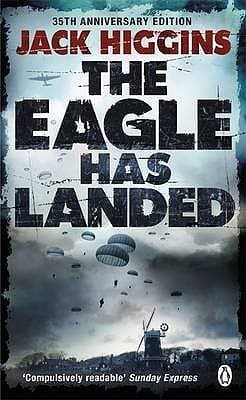
In a World War II thriller, a Nazi commando unit parachutes into an English village to abduct Winston Churchill, forcing townsfolk to become heroes in a desperate fight.
In November 1943, Heinrich Himmler, head of the SS, receives a secret report from Admiral Canaris, his intelligence chief, detailing Winston Churchill's planned visit to the Norfolk village of Studley Constable. Against Canaris's advice, Himmler sees a chance for a propaganda win and orders 'Operation Eagle' – a mission to abduct Churchill. He gives the task to Colonel Max Radl, a brilliant but disgraced Luftwaffe intelligence officer, giving him two weeks. Radl, despite his doubts, begins to plan, understanding the immense stakes.
Colonel Radl, under pressure, finds the right operative: Oberst Kurt Steiner, a decorated paratrooper officer imprisoned on Alderney for trying to save Jewish women from the SS. Radl secures Steiner's release, offering him a chance for redemption and a key role. Steiner, a man of honor, accepts, wanting to serve his country despite his dislike for Nazi ideology. Radl also recruits Liam Devlin, an IRA gunman with knowledge of Britain, along with a unit of paratroopers, all fluent in English and trained in commando tactics.
Steiner's team, disguised as Polish Free Army paratroopers for a training exercise, lands near Studley Constable during a storm. Their cover story allows them to operate without immediate suspicion. Liam Devlin, parachuted in earlier, contacts local Irish sympathizers, getting a safe house and local intelligence. The first part of the operation goes smoothly, with villagers unaware of their new 'allies'. However, the 'Poles'' disciplined and somewhat distant manner starts to bother some observant locals.
The planned deception turns tragic during a church service. A young girl, Jenny Himmler (no relation to Heinrich), sees one of Steiner's men, Corporal Jager, try to rescue another child from a broken water mill wheel. Jager, in his heroic act, accidentally shows his German uniform under his Polish disguise. To keep their cover, Jager's superior, Captain Altmann, shoots Jenny. Other villagers witness this, revealing the Germans' true identities and intentions. The peaceful village is filled with terror and resistance.
After their identities are revealed and Jenny Himmler dies, Steiner and his men consolidate their position. They round up the villagers and barricade themselves in the church, taking everyone hostage. This changes the mission from a covert abduction to a desperate siege. Steiner, despite disliking such measures, knows he must control the population to prevent them from alerting authorities. The villagers, including Pamela Vereker and Father Vereker, are trapped, facing a deadly enemy in their sanctuary.
In London, Colonel Pitts of British Intelligence gets troubling reports from Studley Constable, first dismissed as local quirks. However, Churchill's visit time and the village's sudden silence raise flags. Working with Joanna Grey, an intelligence officer, Pitts pieces together information. They uncover the truth: a German commando unit is in Studley Constable, and Churchill is in danger. Pitts mobilizes a Commando unit, led by Captain Clark, to the village, unaware of the enemy's exact nature or the hostage situation.
Captain Clark's British Commandos arrive at Studley Constable, ready for a fight but not for the entrenched, highly trained German paratroopers. A brutal firefight starts around the church. Steiner's men, using their training and defensive position, cause heavy casualties for the British. The battle is fierce, with losses on both sides. Inside the church, hostages hear the war, while Steiner tries to control the situation and keep his men focused on the objective amid the violence.
As the battle continues around the church, Liam Devlin, using his cunning and local knowledge, slips away. He understands that the main objective – Churchill's abduction – is now at risk if they stay trapped. Devlin, guided by his mercenary principles and loyalty to the mission, heads towards the nearby manor house where Churchill is staying. He plans to complete the mission himself or create a diversion for Steiner. His escape shows the fragmented nature of the German operation and the individual determination of its key players.
After a tough battle, Steiner, with a few remaining men, breaks out of the church and reaches the manor house, following Devlin. He confronts the man he believes to be Winston Churchill, only to find a convincing body double, Colonel Corcoran, put there for security. The real Churchill had left earlier. This discovery shatters Operation Eagle, making all their sacrifices futile. Steiner, faced with this truth, must make a final, desperate decision.
Realizing the mission is a failure and that Colonel Corcoran is a decoy, Steiner, an honorable man, makes a selfless choice. Rather than let the decoy be killed by his desperate men or captured by the British, he protects Corcoran. In a final shootout, Steiner is killed, ending Operation Eagle. His death is a tragic end for a man who, despite serving the Nazi regime, kept a strong moral compass. Liam Devlin, seeing the mission's collapse, escapes into the English countryside, a survivor of the failed plot.
The Protagonist
Steiner begins as a disgraced but honorable officer, forced into a morally ambiguous mission. He ultimately sacrifices himself, not for the Nazi cause, but in an act of personal integrity, protecting a decoy rather than allowing further senseless violence.
The Supporting
Devlin remains largely unchanged, a pragmatic survivor who adapts to circumstances. He successfully navigates the mission's failure, escaping to continue his life as a free agent.
The Supporting
Radl orchestrates the complex mission and faces the consequences of its failure, likely execution for insubordination, despite his efforts.
The Antagonist
Himmler remains a static figure of power and malice, initiating the plot but not directly involved in its execution or resolution.
The Supporting
Pitts moves from initial skepticism to full understanding, orchestrating the British response to the German threat.
The Supporting
Joanna Grey contributes significantly to the uncovering of the plot, demonstrating her competence and importance to the intelligence effort.
The Supporting
Pamela transforms from a seemingly ordinary village girl into a symbol of civilian resistance and courage under duress.
The Mentioned
Jenny's life is tragically cut short, serving as a catalyst for the escalating conflict in the village.
This theme is key to Kurt Steiner's character. He is a professional soldier, bound by duty, yet he dislikes the Nazi regime's atrocities. His actions, like saving Jewish women and protecting the decoy Churchill, show this inner conflict. The novel explores the difficult choices individuals make when professional obligations clash with personal ethics, showing that individual morality can exist even within a monstrous system. Radl also deals with this, following Himmler's orders despite his own doubts about the mission's feasibility and ethics.
““There are some things, Major, that even a professional soldier does not do.””
Operation Eagle relies on deception – German paratroopers disguised as Polish allies. This theme is explored through their careful disguise, fake accents, and attempts to blend in. The initial success of the deception shows how easily appearances can mislead. However, the incident at the water mill, where a German uniform is accidentally seen, breaks this illusion, showing that even careful deceptions are fragile and can be undone by unforeseen events, leading to disaster. The use of a Churchill body double further highlights this theme.
““We are Poles, my friend. Not Germans.””
Despite careful planning by Colonel Radl, the mission quickly falls into chaos and unforeseen events. The accidental exposure of the Germans' identities, Jenny Himmler's death, and the hostage situation are all unpredictable elements that derail the original plan. The novel emphasizes that even perfectly conceived military operations can be undone by small human errors or random chance. The discovery of the Churchill double reinforces this, showing how intelligence can be flawed and plans based on incorrect assumptions, leading to immense sacrifice for no gain.
““No plan survives first contact with the enemy.””
The villagers of Studley Constable, initially quiet, show courage and resilience against the German invaders. Figures like Pamela Vereker and Father Vereker resist their captors, despite being unarmed civilians. Their determination to protect each other and alert authorities shows that heroism is not only for soldiers. Their collective bravery in the face of overwhelming force highlights the spirit of ordinary people in extraordinary circumstances, making them unlikely heroes in the war effort.
““We are English, sir. And we will not be bullied.””
The novel subtly criticizes the fanaticism of figures like Himmler, whose ambition for a propaganda coup leads to a costly and pointless mission. While Steiner and Radl are professional soldiers, Himmler's ideological zeal starts the entire operation. The ultimate failure of Operation Eagle, due to a body double and unforeseen complications, shows the futility of grand, ideologically driven schemes when faced with the realities of war and counter-intelligence. The loss of life on both sides for a non-existent target powerfully illustrates this theme.
““A spectacular coup, Radl. A propaganda victory that will echo through history.””
Winston Churchill's presence as the central, sought-after object.
The 'MacGuffin' in this story is Winston Churchill himself. The entire plot revolves around the German commandos' mission to abduct him. However, the twist reveals that the 'Churchill' at the manor is a body double, making the true MacGuffin the *idea* of Churchill's presence, rather than the actual person. This misdirection serves to drive the plot forward and create tension, even though the ultimate object of desire turns out to be a decoy, leading to the mission's tragic futility.
The audience knows the Germans are disguised, while the villagers do not.
Dramatic irony is heavily employed, particularly in the early stages of the German infiltration. The audience is aware that Steiner's men are German paratroopers disguised as Polish allies, while the unsuspecting villagers of Studley Constable welcome them as comrades. This creates a pervasive sense of tension and unease, as the reader anticipates the inevitable moment when the deception will be uncovered, and the peaceful village will descend into conflict. The irony heightens the suspense, making every interaction between the Germans and the villagers fraught with unspoken danger.
The initial focus on the church as the main battleground, distracting from the true target.
The siege of the church, where Steiner's men hold the villagers hostage and engage in a prolonged firefight with British Commandos, acts as a red herring. While it's a significant and intense part of the plot, it distracts both the British forces and, to some extent, the reader, from the true, albeit mistaken, objective: the manor house where 'Churchill' is staying. Liam Devlin's escape from the church to pursue the target independently helps to shift the focus, revealing that the church siege, while critical for survival, was not the ultimate point of the mission.
The historical framing of the 'discovery' of the mission's details.
While not a first-person unreliable narrator, the book employs a subtle form of this device through its historical framing. The story is presented as a 'reconstruction' of a highly secret, almost mythical event, pieced together years later. This framing device creates a sense of mystery and suggests that the 'official' history might be incomplete or misleading. It allows for dramatic license and encourages the reader to question the absolute truth of the events, hinting that the full story of such a covert operation might never be fully known, adding to the intrigue and legend surrounding Operation Eagle.
“The wind was rising, and the sea was a cold, hard grey, stretching to a horizon that promised nothing but more of the same.”
— Early description of the weather and setting in the Channel Islands.
“There are some men who are born to be soldiers, and some who are born to be leaders. And then there are a very few who are born to be both.”
— Reflecting on the character and abilities of Colonel Kurt Steiner.
“It was a foolish thing to do, but then, most brave things are.”
— Commenting on a risky decision made by one of the characters.
“You can always tell a professional, even when he's pretending not to be.”
— A character observing the disguised German paratroopers.
“The only thing worse than a plan that fails is no plan at all.”
— Discussing the meticulous planning of the mission.
“War is a dirty business, and no one gets out of it with clean hands.”
— A reflection on the moral compromises inherent in conflict.
“He had the kind of eyes that had seen too much, and forgotten nothing.”
— Description of Liam Devlin, hinting at his past experiences.
“Sometimes, the simplest solution is the one that no one expects.”
— Reflecting on a clever tactical move during the operation.
“Fear can make a man do strange things, but courage can make him do even stranger.”
— Observing the reactions of different individuals under pressure.
“The best way to hide something is in plain sight.”
— A principle applied by the German commandoes in their infiltration.
“History, like war, is written by the victors. But the truth, sometimes, has a way of leaking out.”
— A meta-commentary on the historical record and the events of the book.
“He knew the smell of death, and it was in the air, cold and metallic, like old blood.”
— A soldier's sensory perception of an impending or recent battle.
“There are no heroes in war, only survivors and the dead.”
— A cynical but realistic view expressed by a weary character.
“The world was full of men who talked, and a few who did.”
— A contrast drawn between verbose officials and decisive operatives.
“He had a way of looking at you as if he knew all your secrets, and found them mildly amusing.”
— Describing the enigmatic and perceptive nature of Liam Devlin.
Ready to see how well you understood this book? Take our interactive quiz with 10 questions.
Biography coming soon.







