“The lagoon was like a vast eye, lidless and unblinking, reflecting the immense, empty sky.”
— Describing the desolate, flooded landscape.

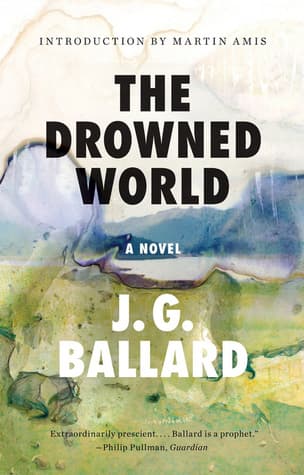
J.G. Ballard (1962)
Genre
Thriller / Fantasy / Science Fiction
Reading Time
180 min
Key Themes
See below
Sign in to track this book
In a flooded, tropical London of 2145, a biologist and his team navigate a city of giant iguanas and albino alligators, slowly changing psychologically and physically as Earth returns to a Triassic past.
The novel opens in 2145, with biologist Dr. Robert Kerans and his team stationed in a lagoon that was once central London. Due to solar radiation and global warming, the polar ice caps have melted, submerging most landmasses and transforming the world into a tropical, Triassic-era environment. Kerans, along with psychiatrist Dr. Bodkin and Beatrice Dahl, a mysterious woman living in the ruins, observe the new ecosystem of giant iguanas, albino alligators, and dense vegetation. Their expedition is part of a larger UN operation to survey the drowned world, but Kerans feels an increasing pull towards the landscape, a sense of belonging that unnerves his colleagues.
Kerans and his team go on a routine alligator hunt, a dangerous but necessary task to maintain some order in their area. During this time, Kerans begins to experience vivid, disturbing dreams and an attraction to the sun and heat. Dr. Bodkin notes these psychological changes, observing similar, though less intense, symptoms in the rest of the team. The constant humidity, the silence broken only by jungle sounds, and the presence of the environment begin to erode their grip on their former identities, pulling them back to a more primitive state of consciousness.
Colonel Riggs arrives with his military contingent, tasked with evacuating the last remaining inhabitants from the drowned city before its final abandonment. Riggs represents the fading authority of human civilization, trying to impose order and rationality on a world that has largely rejected it. While some are ready to leave, Kerans, Beatrice, and even Bodkin show a strong reluctance, feeling an almost spiritual connection to the transformed landscape. Riggs struggles to understand their attachment, viewing it as a psychological breakdown rather than an adaptation or evolution.
Driven by curiosity and a growing connection to the past, Kerans ventures deeper into the submerged ruins of London. He explores ancient buildings, finding relics of a lost civilization buried beneath silt and vegetation. These explorations are not just physical; they are psychological, triggering deeper regressions into a collective unconscious. He encounters remnants of human culture, now alien and distorted by the new environment, reinforcing his belief that humanity is being drawn back to its reptilian origins, shedding the complexities of modern civilization.
As Riggs prepares for the final evacuation, his equipment and supplies are sabotaged. While the culprit is not explicitly identified, there is a strong implication that the environment itself, or those influenced by it, are resisting the departure. Frustrated and unable to maintain control, Riggs is forced to withdraw with most of his remaining personnel, leaving Kerans, Beatrice, and a few others behind in the drowned city. This departure cuts the last ties to the outside world and speeds up the characters' immersion into the landscape.
Following Riggs's withdrawal, a new force arrives in the lagoon: Strangman, a ruthless, pirate-like figure, and his crew of albino natives. Strangman is a self-proclaimed 'white hunter,' exploiting the resources of the drowned world and its remaining inhabitants. He establishes a base in the deserted hotel, bringing violence and chaos to the unstable environment. Strangman's arrival represents a new threat, not from nature, but from a depraved form of human civilization that has adapted to the new world by embracing its most predatory instincts, further complicating the struggle for survival and identity.
Strangman and his crew begin draining the lagoons and destroying the ecosystem, seeking to extract valuable resources and assert their dominance. This destruction offends the natural order that Kerans has come to respect. Strangman captures Kerans and Beatrice, holding them captive and trying to force Kerans to reveal the secrets of the drowned world. Strangman embodies a destructive human impulse, a desire to conquer and exploit, contrasting sharply with Kerans's evolving desire to merge with the environment. Beatrice, meanwhile, remains enigmatic, her loyalties and motivations unclear.
Kerans, aided by Beatrice, escapes Strangman's captivity. As they flee, a massive deluge, a natural cataclysm, strikes the lagoon. The rising waters and torrential rains engulf Strangman's camp, washing away his enterprise and most of his crew. This event can be seen as the environment itself retaliating against Strangman's exploitation, a strong assertion of nature's dominance. The deluge further isolates Kerans and Beatrice, deepening their immersion in the primal world and reinforcing the novel's central theme of humanity's insignificance in the face of overwhelming natural forces.
After the deluge, Kerans, now completely free from his former identity and civilization, decides to journey southward, deeper into the drowned world. This is a deliberate act of regression, a conscious choice to embrace his evolving primal instincts and follow the path of the sun. He leaves Beatrice behind, understanding that his journey is a solitary one, a final surrender to the primordial forces that have reshaped the planet and his own psyche. His journey is less about survival and more about fulfilling a deep, ancestral urge, a return to humanity's biological origins.
Kerans continues his southward journey, shedding the last remnants of human civilization and consciousness. He becomes one with the dense jungle, the teeming wildlife, and the suffocating heat. His physical and psychological transformation is complete; he is no longer Dr. Robert Kerans, but a part of the drowned world itself, a biological echo of a forgotten past. He is last seen disappearing into the landscape, his fate ambiguous but his assimilation absolute, marking a profound and unsettling conclusion to his personal odyssey and the novel's exploration of humanity's destiny in a post-apocalyptic world.
The Protagonist
Kerans transforms from a detached scientist to a fully assimilated, primal being, shedding his human identity to merge with the drowned world.
The Supporting
Beatrice remains consistently adapted to the new world, serving as a stable, if mysterious, presence who subtly influences Kerans's journey.
The Supporting
Bodkin initially resists the regression but eventually experiences his own subtle psychological shifts, acknowledging the environment's profound impact.
The Antagonist/Supporting
Riggs attempts to exert control and evacuate, but ultimately fails, forced to retreat and acknowledge the environment's dominance.
The Antagonist
Strangman arrives to exploit the environment but is ultimately consumed by the very forces he sought to control, highlighting nature's ultimate power.
The novel explores psychological regression, suggesting that humanity, when faced with environmental change, reverts to more primitive states of consciousness. Dr. Kerans's vivid dreams of ancient seas and Triassic landscapes, his attraction to the sun and heat, and his eventual decision to journey deeper into the jungle show this. The characters shed layers of civilized identity, revealing deeper, ancestral drives. This regression is not necessarily negative, but an inevitable, natural response to the altered world, a return to humanity's biological 'womb,' as seen when Kerans feels a strong sense of belonging to the landscape.
“Each one of us has a submerged sun, a primordial sun that we are trying to reach. It’s the original sun of our consciousness.”
Ballard presents nature as a powerful, indifferent force capable of both destruction and renewal. The drowned world is a result of catastrophic environmental change, yet it is simultaneously a teeming ecosystem. The novel shows how nature reclaims human civilization, turning skyscrapers into coral reefs and cities into lagoons. This duality is evident in the relentless heat and humidity that breaks down human resolve, but also in the lush, fertile jungles that emerge. The deluge that destroys Strangman's camp is a destructive force, yet it also cleanses the land, allowing a new, natural order to reassert itself, highlighting nature's cyclical power.
“The cities became the first coral reefs, their towers and plazas the breeding grounds for new species of fish and insect life.”
The novel shows the collapse of human civilization and the erosion of individual and collective identity. The submerged cities are reminders of a lost world, and the few remaining humans struggle to maintain their former ways of life. Colonel Riggs represents the desperate attempt to cling to order and rationality, but his efforts are ultimately futile. Characters like Kerans and Beatrice shed their societal roles and embrace new identities shaped by the environment. The novel suggests that identity is not fixed but intertwined with one's environment, and when that environment changes, so does the self. The very names of the characters seem to lose meaning as they regress.
“In the end, we are all products of the sun, and the sun is a brutal master.”
A theme is humanity's changing perception of its place in the cosmos, moving from a dominant species to an insignificant one. The drowned world shows humanity's inability to control or fully comprehend the vast forces of nature. The characters are dwarfed by the scale of the environmental transformation and the ancient, reptilian life forms that now dominate. Kerans's journey southward is a literal and metaphorical descent into a more primal existence, accepting humanity's role as just another species in an indifferent universe. This challenges anthropocentric views, suggesting that humanity is a transient phase in Earth's long geological history.
“He felt like a man in a dream, watching the slow, inexorable return of the Triassic age.”
The global warming and flooding that creates the drowned world.
The environmental cataclysm of melting ice caps and rising temperatures is the foundational plot device. It sets the entire stage for the novel, creating the unique, submerged, and tropical London. This device is not merely a backdrop but an active force, driving the plot by forcing humanity into extreme adaptation or extinction. It triggers the psychological regressions, the conflicts over evacuation, and the emergence of new forms of human behavior, making the environment itself a central character and antagonist.
Vivid, unsettling dreams experienced by Kerans and others.
Kerans's increasingly vivid and unsettling dreams and visions of ancient seas, reptilian life, and primal landscapes serve as a key plot device for illustrating his psychological regression. These dreams are not just internal experiences; they are portents and reflections of the external world's influence, blurring the lines between conscious and subconscious reality. They propel Kerans deeper into his fascination with the drowned world, guiding his actions and reinforcing the novel's central theme of humanity's return to its biological origins. They are a direct manifestation of the environment's impact on the human psyche.
Kerans's symbolic and literal journey deeper into the drowned world.
Kerans's decision to embark on a solitary journey southward, deeper into the heart of the drowned world, is a crucial plot device. It signifies his complete surrender to the primal forces and his final break from human civilization. This journey is both literal, taking him into unexplored, more ancient territories, and metaphorical, representing his full psychological assimilation. It provides a definitive, albeit ambiguous, ending to his arc, solidifying the novel's themes of regression and humanity's ultimate place within an indifferent, powerful nature.
“The lagoon was like a vast eye, lidless and unblinking, reflecting the immense, empty sky.”
— Describing the desolate, flooded landscape.
“Time, like a river, had reversed its flow, carrying them back to a primeval dawn.”
— Reflecting on the temporal regression of the environment and the characters.
“The true anamnesis was not of the past, but of the future.”
— Dr. Kerans pondering the psychological effects of the drowned world.
“We are all seeking to return to the womb, to the amniotic security of the primal sea.”
— A recurring theme about the characters' subconscious desires.
“The sun was a malevolent eye, staring down at the drowned world, stripping it bare.”
— Describing the intense heat and light of the new environment.
“The ultimate landscape is not the one we see, but the one we carry within us.”
— A philosophical reflection on internal and external landscapes.
“The city had not been drowned by water, but by time.”
— Considering the ruins of the submerged city and their significance.
“He felt a curious sense of liberation, as if the drowning of the world had also drowned his past.”
— Kerans' psychological state as he adapts to the new world.
“The alligators were the true inhabitants, the ancient gods of this new, primeval earth.”
— Acknowledging the dominance of the new fauna in the drowned world.
“Civilization was merely a thin crust over a deeper, more ancient reality.”
— A commentary on the fragility of human constructs in the face of natural forces.
“The heat was a living thing, a palpable entity that pressed down on them.”
— Experiencing the oppressive climate of the tropical drowned world.
“He felt a strange, compelling need to go south, deeper into the sun and the drowned world.”
— Kerans' inexplicable drive to move further into the heart of the altered landscape.
“The jungle was a vast, green lung, breathing in the heat and exhaling a humid silence.”
— Describing the encroaching, vibrant vegetation.
“The world was being reborn, not into a new future, but into an ancient past.”
— A summary of the book's central theme of environmental and temporal regression.
Ready to see how well you understood this book? Take our interactive quiz with 10 questions.

Biography coming soon.







