“Mahout was the real deal. Not a man. A force. A storm.”
— Nailer reflects on Mahout's presence and power.

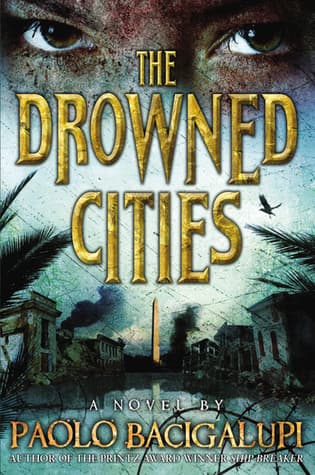
Paolo Bacigalupi (2012)
Genre
Fantasy / Science Fiction / Young Adult
Reading Time
4-6 hours
Key Themes
See below
Sign in to track this book
In a future America scarred by war and floods, a young refugee must choose between saving her friend from soldiers or finding her own freedom, all while protecting a hunted war beast.
Mahlia, a 'half-breed' abandoned by her mother, and Mouse, a small, mute boy, live in a fragile jungle sanctuary near the Drowned Cities. They scavenge for food and avoid the constant dangers of warring groups. Mahlia cares for Mouse, seeing him as her only family. They navigate the dangerous landscape, marked by old war remnants and the threat of soldiers. They are self-sufficient, relying on their wits and knowledge of the terrain to survive, always hiding from militias. Their existence demands constant watchfulness, and trust is a luxury.
While scavenging, Mahlia and Mouse find a severely wounded 'half-man,' a bioengineered super-soldier named Tool. He is large and powerful, but gravely injured. Mahlia, against her initial judgment and Mouse's fear, decides to help him. She tends to his wounds with her limited herbal knowledge, and Tool slowly recovers. His presence adds a new danger to their already uncertain lives, as such creatures are valuable to military groups.
As Tool recovers, Mahlia learns more about him. He is a genetically engineered soldier, a 'loosed' weapon designed for war but now a rogue asset. He explains he was part of a unit but became independent after a traumatic event. His former masters, the Army of the Drowned Cities, hunt him, especially a soldier named Cutter. Tool's presence attracts unwanted attention, and Mahlia realizes the immense danger they are in. His powerful, yet sometimes childlike, personality slowly endears him to Mahlia and Mouse, despite the risks.
Cutter's soldiers, relentlessly pursuing Tool, eventually find them. In a brutal ambush, the children are separated from Tool. Mouse, small and vulnerable, is captured. Mahlia sees the horrific event, feeling despair and helplessness. Tool, despite his strength, is cornered and wounded again, barely escaping. Mouse's capture shatters Mahlia's world, forcing her to face their grim reality and impossible choices. Her focus shifts from survival to rescuing her friend.
After Mouse's capture, Mahlia is desperate to save him. Tool, still recovering, tries to talk her out of it, explaining the danger of confronting armed soldiers. He suggests they flee, but Mahlia's loyalty to Mouse is strong. She refuses to abandon him, seeing him as her only family. She begins to form a reckless plan, despite her own fear and lack of combat experience. Love and a fierce sense of responsibility drive her into a direct confrontation with the forces she has always avoided.
Mahlia, aided by a reluctant but loyal Tool, sets out to infiltrate Cutter's guarded military camp. Tool, with his knowledge of military tactics and strength, proves essential. They navigate the dangerous perimeter, avoiding patrols and traps. Inside, they see the harsh realities of the soldier boys' lives, their brutality, and the despair of their captives. Mahlia's courage is tested as she faces the threat of discovery and death. Their stealthy approach is vital, as a direct fight would be suicidal.
Mahlia and Tool find Mouse, imprisoned and traumatized, but alive. As they prepare for the rescue, they make a shocking discovery: Mouse is not just a boy; he is a 'bio-bomb,' a weaponized child engineered to explode. This changes everything, adding an urgent, terrifying dimension to their mission. Cutter plans to detonate Mouse as a weapon. The rescue now involves freeing Mouse and preventing a catastrophic explosion. This discovery forces Mahlia to grapple with the true nature of the war and the horrific methods used.
With the shocking truth of Mouse revealed, Mahlia and Tool execute a desperate escape. They free Mouse, but their presence is detected, and Cutter and his soldiers chase them. The jungle becomes a deadly maze as they try to outmaneuver their pursuers. Tool uses his combat skills to protect Mahlia and Mouse, fighting in brutal skirmishes. The stakes are incredibly high, as Mouse's detonation would kill him and devastate a wide area. Their flight is a desperate race against time and overwhelming odds.
The pursuit ends in a brutal confrontation between Tool and Cutter. Cutter, driven by a personal vendetta against Tool and the desire to retrieve his weapon, fights Tool fiercely. The battle is savage, showing the raw power of the bioengineered soldier against the cunning of the human commander. Tool, despite his injuries, fights with primal fury, fueled by his bond with Mahlia and Mouse. Mahlia watches, helpless but determined, as her protector fights for their lives, understanding Tool's immense personal sacrifice.
In a climactic act, Tool makes a sacrifice to ensure Mahlia and Mouse's escape and safety. He defeats Cutter, but not without severe, possibly fatal, injuries. His actions allow Mahlia and Mouse to get away from the immediate threat. Mahlia, now burdened by Tool's sacrifice and Mouse's true nature, guides Mouse towards an uncertain future. They head towards a rumored safe haven, the 'Free Towns,' hoping to find peace and a chance at a normal life, changed forever by their experiences and the bonds they formed.
The Protagonist
Mahlia transforms from a cautious survivor to a determined protector, learning to trust and fight for those she loves, ultimately becoming a beacon of hope for Mouse.
The Supporting
Mouse remains largely a victim throughout the story, but his survival and the revelation of his true nature drive the central conflict and Mahlia's character development.
The Protagonist/Supporting
Tool evolves from a solitary, cynical survivor to a protector willing to sacrifice himself for Mahlia and Mouse, rediscovering his sense of purpose and humanity.
The Antagonist
Cutter remains a static antagonist, driven by his mission and brutal nature until his eventual defeat.
The Supporting
Nail's arc is subtle; he expresses doubts about the war, hinting at a potential for change or disillusionment, but remains within the military structure by the end.
The Mentioned
Doc Eye serves as a background antagonist, his influence felt through the consequences of his creations rather than direct action.
The Mentioned
General Caroa is a background figure, embodying the larger political and military structures of the Drowned Cities.
The novel shows how war strips people of their humanity, turning children into soldiers (like Nail) and weapons (like Mouse). Constant violence and scarcity force characters to make difficult moral choices, blurring the lines of right and wrong. Tool, an engineered weapon, struggles with his identity, while Mahlia fights to keep her empathy amid the brutality. The Drowned Cities themselves show this theme, once lively places now ruins from endless conflict.
““They made us to kill. They made us to fight. They made us to be tools.””
At its core, the story explores strong loyalty forged in extreme situations. Mahlia's devotion to Mouse drives her dangerous journey, making her risk everything for her friend. Similarly, Tool, initially cynical, develops deep loyalty to Mahlia and Mouse, leading to his ultimate sacrifice for their survival. These acts of loyalty contrast with the widespread betrayal and self-interest in the war-torn world, showing the lasting power of human connection.
““You don’t abandon family. Not ever.””
Mahlia, as a 'half-breed,' and Tool, as a 'half-man,' both deal with being outsiders. Dominant groups see them as 'other,' leading to prejudice and danger. Tool's struggle to accept his engineered nature while developing humanity is central to his story. Mouse's identity as a weaponized child further complicates this theme, as his existence is defined by a horrific purpose. The novel explores what it means to be human in a world that defines individuals by their usefulness or perceived difference.
““I am not like them. I am not human. I am a tool.””
Despite the grim setting and constant threats, the story offers a glimmer of hope for a better future. Mahlia and Mouse's search for a safe haven, the 'Free Towns,' symbolizes this hope. Their ability to survive against great odds, to find compassion and connection amid desolation, shows the resilience of the human spirit. The story suggests that even in the darkest times, the will to live, to protect loved ones, and to seek a better world can endure.
““There are places, Mahlia, where the war doesn’t touch. Where people live free.””
A seemingly innocent child revealed to be a weapon of mass destruction.
Mouse's true nature as a bio-bomb is a major plot twist that dramatically raises the stakes of the narrative. It transforms him from a vulnerable ward into a ticking time bomb, forcing Mahlia and Tool to not only rescue him but also prevent a catastrophic detonation. This device amplifies the dehumanizing aspect of the war, where even children are weaponized, and creates intense suspense as the characters race against time to disarm or escape the threat.
A post-apocalyptic setting that serves as a constant backdrop of ruin and conflict.
The Drowned Cities themselves function as a significant plot device. Their ruined, waterlogged landscape, filled with the debris of past wars and the active conflict of the present, creates a hostile and dangerous environment. This setting constantly reminds the characters and reader of the futility and destruction of war, influencing their decisions and limiting their options. It also provides a unique, treacherous terrain that complicates travel and escape, adding to the challenges Mahlia and Tool face.
The bioengineered nature of Tool, providing unique abilities and internal conflict.
Tool's status as a genetically engineered 'half-man' is a crucial plot device. His enhanced strength, resilience, and sensory perception provide the practical means for Mahlia and Mouse to survive and fight back against their adversaries. However, his engineered nature also creates internal conflict, as he grapples with his identity as a weapon versus his developing humanity. This device allows for exploration of themes of identity, purpose, and the ethical implications of advanced biotechnology in warfare.
“Mahout was the real deal. Not a man. A force. A storm.”
— Nailer reflects on Mahout's presence and power.
“The world was a place of hunger and violence. It always had been.”
— Tool's cynical view of the world's inherent nature.
“Sometimes you have to break things to make them better.”
— A common sentiment in the chaotic, rebuilding world.
“It’s not about what you are, it’s about what you do.”
— A lesson learned about identity and action in the Drowned Cities.
“Hope was a dangerous thing, but it was also the only thing.”
— Characters grapple with the necessity and peril of hope.
“The past was a ghost, always there, always watching.”
— The lingering impact of past events and the drowned cities.
“You can’t run from who you are. Not forever.”
— Characters confronting their true nature or past.
“The cities were just bones now, picked clean by the tides and time.”
— A description of the ruined, submerged urban landscapes.
“Life found a way, even in the ruins. Especially in the ruins.”
— The resilience of nature and humanity in a broken world.
“Every choice had a price. Every alliance a hidden cost.”
— The harsh realities of survival and political maneuvering.
“The world had drowned, but the people hadn’t.”
— A stark reminder of human endurance despite environmental catastrophe.
“He moved like a shadow, a whisper of violence.”
— A description of Tool's agile and dangerous nature.
“Sometimes the only way to save something is to let it go.”
— A difficult lesson about sacrifice and moving forward.
“The future wasn't written. It was built, brick by broken brick.”
— An optimistic view of agency and reconstruction amidst chaos.
Ready to see how well you understood this book? Take our interactive quiz with 10 questions.

Biography coming soon.







