“She was a dressmaker, not a magician.”
— Tilly's practical view of her skills, despite the transformative power of her dresses.

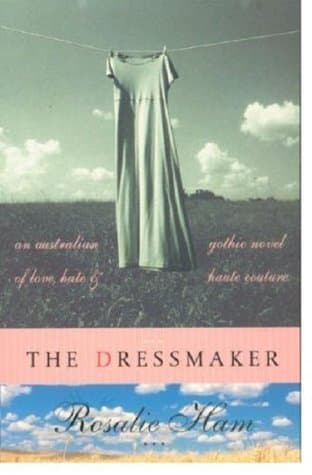
Rosalie Ham (2000)
Genre
Historical Fiction / Romance
Reading Time
300 min
Key Themes
See below
Sign in to track this book
Armed with a sewing machine and Parisian haute couture, a wronged dressmaker returns to her dusty Australian hometown to stitch a dazzling path of revenge through the very women who once cast her out.
Myrtle 'Tilly' Dunnage, a sophisticated dressmaker, returns to the remote Australian town of Dungatar after twenty years abroad, mostly in Parisian haute couture houses. She comes back to care for her ailing, eccentric mother, Molly, known as 'Mad Molly' by the townspeople, who lives in a dilapidated house on a hill. Tilly was banished from Dungatar as a child after being accused of murdering Stewart Pettyman, the son of the town's prominent councilor. Her return stirs up resentment and fear among the townspeople, who eye her with suspicion and hostility, believing her to be cursed or a murderer.
Despite the town's initial animosity, Tilly's talent for dressmaking soon becomes clear. Her first client is Gertrude Pratt, a plain woman who wants a dress for the local dance to impress William Beaumont. Tilly creates a stunning green gown that transforms Gertrude, making her the belle of the ball and catching William's eye. This success sparks a trend, and other women, including the snobbish Elsbeth Beaumont and the manipulative Mona, begin to seek out Tilly's services. Her creations not only change their appearances but also give them new confidence, slowly chipping away at the town's prejudice against her.
Amidst the town's hostility, Tilly forms a friendship with Sergeant Farrat, the local policeman, who secretly loves fabrics and fashion. He becomes her confidante and a source of local information. More significantly, Tilly develops a romantic relationship with Teddy McSwiney, a kind and handsome local football hero whose family is also seen as outcasts. Teddy, unlike the others, sees Tilly for who she is and genuinely cares for her. Their blossoming romance offers Tilly a sense of belonging and happiness she hasn't known, and he encourages her to confront her past.
Wanting to understand her past and clear her name, Tilly investigates the circumstances surrounding Stewart Pettyman's death. She has fragmented memories of the incident, as she was a child at the time. Sergeant Farrat, with his access to official records and local gossip, helps her piece together the events. The townspeople, particularly the Pettyman family and their allies, resist any re-examination of the past, reinforcing the idea that Tilly was solely responsible. This search for truth becomes a central motivation for Tilly, intertwining with her desire for revenge.
Molly's health worsens, made worse by her eccentric lifestyle and the town's ostracization. Before her death, Molly begins to regain some clarity and reveals important information to Tilly. She confesses that she knew Tilly's father's identity and that many townspeople harbored dark secrets and hypocrisies. Molly's fragmented revelations about the past, particularly surrounding Stewart Pettyman's death, fuel Tilly's growing understanding of the injustice she suffered and Dungatar's collective guilt. Her death leaves Tilly feeling more alone but also more determined in her mission.
Just as Tilly begins to find happiness and a sense of belonging with Teddy McSwiney, tragedy strikes. Teddy, trying to prove his love and trust by jumping into a silo of sorghum, a feat he had done many times before, suffocates. His death devastates Tilly, shattering her hopes for a future in Dungatar. The town, instead of offering solace, blames Tilly again, viewing her as cursed. This senseless loss, coupled with the continued animosity and the unresolved mystery of her past, pushes Tilly over the edge, turning her earlier desire for justice into a burning need for revenge.
Following Teddy's death, Tilly's demeanor shifts from wanting reconciliation to a cold, calculated pursuit of vengeance. She meticulously plans her retribution, using her dressmaking skills as her main tool. She continues to make stunning dresses for the townswomen, but now with a subtle, manipulative twist, often designed to expose their hypocrisies or contribute to their downfall. She uses her knowledge of their secrets, gathered from Molly and Sergeant Farrat, to strategically target those who wronged her, particularly the Pettyman family and their allies. Her revenge is not just about justice but about making them pay for their collective cruelty.
The annual Dungatar Eisteddfod becomes the stage for much of Tilly's revenge. Many townswomen, dressed in Tilly's latest creations, participate in the competition. However, Tilly subtly manipulates events, ensuring that the dresses, while beautiful, also contribute to the humiliation of their wearers. For example, she designs a dress for Mona that leads to her public downfall. The competition exposes the pettiness, vanity, and rivalries among the townspeople, highlighting their true characters beneath their respectable appearances. Tilly observes their reactions with detached satisfaction.
Sergeant Farrat, encouraged by Tilly, begins to openly embrace his love for women's clothing, especially luxurious fabrics. Tilly makes him a beautiful red velvet gown, which he secretly wears. During the climax of the Eisteddfod, while the town is distracted, Farrat, in his red gown, tries to move the large, unstable stage set for the performance. In a tragic accident, the set collapses, killing him instantly. His death is another blow to Tilly, as he was one of her few true allies, and it shows Dungatar's harsh, unforgiving nature, even for those who try to find beauty and authenticity.
With the help of Sergeant Farrat's posthumous notes and her own recovered memories, Tilly finally remembers the full truth: Stewart Pettyman, a sadistic child, had sexually assaulted her. In self-defense, she pushed him, and he fell, hitting his head on a barrel and dying. The town, led by his powerful parents, covered up his true nature and blamed Tilly. Armed with this knowledge and fueled by grief and anger, Tilly sets her ultimate plan in motion. She orchestrates a final, spectacular act of revenge, setting fire to Dungatar after ensuring most of the townspeople are at the football grand final, leaving them with nothing but the ashes of their hypocrisy and cruelty.
The Protagonist
Tilly transforms from a hopeful but wary outsider seeking truth and acceptance into a determined avenger, ultimately finding a dark form of justice by destroying the town that destroyed her.
The Supporting
Molly's arc involves a brief period of lucidity before her death, allowing her to impart crucial information to Tilly, facilitating the uncovering of the truth.
The Supporting
Teddy's arc is cut short by a tragic accident, serving as a catalyst for Tilly's transformation from seeking justice to enacting revenge.
The Supporting
Sergeant Farrat's arc involves embracing his true identity with Tilly's help, only to meet a tragic, ironic end.
The Supporting
Gertrude rises from social obscurity to prominence through Tilly's dresses, only to become arrogant and hypocritical, ultimately falling victim to Tilly's revenge.
The Antagonist
Evan Pettyman remains a villain throughout, his past crimes fueling Tilly's revenge, leading to his ultimate downfall.
The Supporting
Marigold slowly gains clarity and agency through Tilly's influence, allowing her to confront her husband before her death.
The Supporting
William marries into social prominence but remains a largely passive character, manipulated by the women around him.
The main theme is Tilly's quest for retribution against the town that wronged her. Initially, she seeks justice and to clear her name, but after Teddy's death and continued animosity, her goal shifts to calculated revenge. The novel explores the blurred lines between these concepts, questioning whether Tilly's destructive actions are a righteous reclaiming of power or a descent into cruelty mirroring her tormentors. Her final act of burning Dungatar shows this theme, a scorched-earth policy of retribution for decades of injustice, malice, and personal loss. It highlights the destructive nature of unchecked anger but also the catharsis of reclaiming agency.
““Pain will no longer be a punishment, but a memory, then a gift.””
Tilly's dresses transform the women of Dungatar, both externally and internally. Gertrude Pratt's change from plain to glamorous, securing her marriage, is a prime example. The theme also explores deeper identity. Tilly herself changes from a hopeful outsider to a vengeful architect of destruction. Sergeant Farrat's embrace of his true identity through Tilly's encouragement highlights the liberating aspect of self-acceptance. The dresses act as a metaphor for identity, showing how it can be fabricated, concealed, or revealed, and how external changes can reflect or mask internal truths. The transformations are not always positive, often revealing the wearer's underlying vanity or hypocrisy.
““They couldn’t be themselves in public, so they were someone else.””
Dungatar is a town full of hypocrisy and prejudice. The seemingly respectable citizens, particularly the Pettyman family, hide dark secrets, engage in illicit affairs, and spread cruel gossip, all while pretending to be morally superior. Tilly and Molly are branded as outcasts and murderers, while the true perpetrators of abuse and injustice remain unpunished and respected. The town's collective memory is selective, conveniently forgetting their own involvement in Tilly's suffering. This theme shows the destructive power of small-town mentality, where fear of the 'other' and a rigid social hierarchy lead to systemic injustice and cruelty. Tilly's revenge is, in part, a response to this widespread hypocrisy.
““Everyone knew everything about everyone but no one ever dobbed anyone in.””
Fashion is not just a backdrop but a powerful force and a character itself. Tilly's haute couture dresses are instruments of power, able to elevate social status, ignite desire, and even help with revenge. The garments act as a catalyst for change within the town, drawing out hidden desires and exposing underlying insecurities. They provide a way for Tilly to gain access and influence, even among those who despise her. The dresses symbolize transformation, allure, and control, showing how external appearance can change perception and reality, and how art can be used as a tool for manipulation or liberation.
““With a bolt of fabric, a sharp pair of scissors and a sewing machine, Tilly could transform lives.””
Tilly's status as an outcast allows her unique perspective and freedom of action.
Tilly's role as an outsider, banished from Dungatar as a child and returning as a sophisticated stranger, is crucial. It allows her to observe the town's hypocrisy and cruelty with a detached, critical eye, unburdened by loyalty to its social norms. This outsider status also fuels her motivation for revenge, as she has nothing to lose and no social standing to protect. Her unique perspective, combined with her Parisian fashion skills, makes her an unpredictable and powerful force, capable of disrupting the established order and enacting justice (or revenge) from the fringes.
Tilly's fragmented memories of Stewart Pettyman's death create suspense and drive her investigation.
Tilly's inability to fully recall the events surrounding Stewart Pettyman's death serves as a significant plot device. These memory gaps create suspense, making both Tilly and the reader question her guilt and the true nature of the incident. Her quest to recover these lost memories propels much of the narrative, leading her to confront the townspeople and piece together the truth. The eventual recovery of her memories, revealing Stewart's predatory nature and her self-defense, is a pivotal moment that justifies her subsequent vengeful actions and shifts the reader's perception of her culpability.
The dresses represent transformation, power, and the superficiality of appearance.
The dresses Tilly creates are more than just garments; they are powerful symbols. They represent transformation, as seen in Gertrude Pratt's social ascent. They symbolize power, giving the wearer confidence and influence. They also highlight the superficiality and hypocrisy of Dungatar, as the women use the dresses to project an image of respectability while harboring dark secrets. Ultimately, the dresses become instruments of Tilly's revenge, subtly designed to expose flaws, create social upheaval, and lead to the downfall of her enemies. They are a weaponized art form, reflecting the beauty and danger Tilly herself embodies.
Dungatar's isolation fosters gossip, prejudice, and a rigid social hierarchy.
The setting of Dungatar, a small, isolated, and insular Australian town, is a crucial plot device. Its remoteness contributes to the townspeople's narrow-mindedness, their reliance on gossip, and their intense prejudice against outsiders like Tilly and Molly. The lack of external influence allows a rigid, unforgiving social hierarchy to flourish, where secrets are tightly kept, and injustices are easily perpetuated and covered up. This isolation intensifies the drama and the impact of Tilly's return and subsequent revenge, as there is no escape from the collective judgment or the consequences of her actions.
“She was a dressmaker, not a magician.”
— Tilly's practical view of her skills, despite the transformative power of her dresses.
“A dress can change a woman's life.”
— Tilly's belief in the power of fashion to alter perception and destiny.
“Everyone knew everything about everyone, but no one ever said a word.”
— Describing the suffocating silence and unspoken truths in Dungatar.
“Pain will always find you, but you can choose to make it useful.”
— Tilly's resilient philosophy on dealing with past trauma and hardship.
“They had never seen anything like it. It was like watching a butterfly emerge from a chrysalis.”
— The town's reaction to Gertrude's stunning transformation in a Tilly dress.
“Sometimes you have to burn it all down to start again.”
— Tilly's ultimate act of revenge and liberation from Dungatar.
“Dungatar was a place of secrets, whispered behind cupped hands and drawn curtains.”
— Highlighting the pervasive nature of gossip and hidden truths in the town.
“She dressed as if she was going to a party, even if it was only to the general store.”
— Describing Tilly's unwavering commitment to style and elegance.
“The past is a monster that devours the present.”
— Tilly grappling with the lingering effects of her past and the accusations against her.
“There's no justice in the world, only consequences.”
— A cynical view on the outcomes of actions in Dungatar, often unfair.
“Love is a dangerous thing in a small town.”
— The tragic romance between Tilly and Teddy, doomed by the town's prejudices.
“She had come back to clear her name, but instead, she had only stirred the pot.”
— Tilly's initial intentions upon returning to Dungatar versus the reality of her impact.
“The clothes were a shield, a disguise, a declaration.”
— Reflecting on the multifaceted role of Tilly's creations for her clients and herself.
“Revenge is a dish best served with exquisite tailoring.”
— A witty summary of Tilly's subtle yet powerful method of getting even.
Ready to see how well you understood this book? Take our interactive quiz with 10 questions.