“The past is a story we tell ourselves, and the future is a story we hope to tell.”
— General reflection on time and narrative.

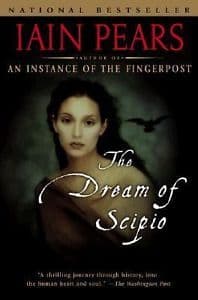
Iain Pears (2002)
Genre
Literary Fiction / Historical Fiction / Mystery / Philosophy
Reading Time
12-14 hours
Key Themes
See below
Sign in to track this book
Across three tumultuous centuries in Provence, three men grapple with love, loyalty, and the nature of civilization, all while haunted by an ancient philosophical text that challenges their every choice.
In 5th-century Gaul, Manlius Hippomanes, a Roman aristocrat and poet, works as a high-ranking official in the failing Roman administration. He is influenced by the Neo-Platonic philosophy of his mentor, Sophia, and struggles with the moral problems of his position. As Visigothic invasions threaten the province, Manlius is caught between his loyalty to Rome, his love for Sophia, and the political schemes of figures like the ambitious Galla. He is tasked with protecting the region, but internal conflicts and overwhelming external threats constantly undermine his efforts. His story begins with an urgent mission to secure a peace treaty, showing the empire's desperate state.
The 14th-century narrative introduces Olivier de Noyen, a talented poet living in Avignon during the height of the Black Death. He works for Cardinal de Tassigny and is secretly in love with the Cardinal's niece, Rebecca. Olivier is also interested in ancient texts, especially a manuscript of 'The Dream of Scipio' which he must translate. As the plague devastates Provence, Olivier sees immense suffering and moral decay, questioning God and humanity. He becomes involved in a conspiracy with the Cardinal and the wealthy merchant, Jean de Poitiers, who wants to profit from the crisis. His intellectual pursuits clash with the grim reality of the pandemic.
The 20th-century story follows Julien Barneuve, a brilliant classicist living in Provence during World War II. He initially collaborates, believing that working with the Vichy regime is the best way to protect French culture and its people. Julien is in love with Julia, a Jewish woman, and his actions are often driven by a desperate desire to protect her. He works for the collaborationist government, using his academic skills to justify their policies, while secretly helping the Resistance. His moral compromises are constantly tested by his friend Marcel, a committed Resistance fighter, and by the harsh realities of the occupation. He researches the historical figures of Manlius and Olivier, finding parallels to his own time.
Manlius's political career becomes more complex. He must make difficult decisions, often compromising his Neo-Platonic ideals to maintain some order in Gaul. The Roman Emperor and various local factions, including the ambitious Galla, pressure him. Galla sees an opportunity for personal power amidst the chaos. Manlius grapples with the idea of 'necessary evil' as he navigates alliances and betrayals. His relationship with Sophia deepens, but her philosophical purity contrasts with the harsh realities of his political life. He makes choices that will haunt him, particularly concerning a Roman city's fate.
As the Black Death rages, Olivier's love for Rebecca becomes central. He tries to protect her from the plague and societal breakdown, while continuing his work for Cardinal de Tassigny. Olivier's research into 'The Dream of Scipio' reveals hidden meanings and connections to the past. He discovers that the text itself has been altered or misinterpreted, and that its true message might offer comfort or guidance in their desperate situation. The Cardinal's true intentions regarding the manuscript and Jean de Poitiers's opportunistic schemes become clearer, drawing Olivier into a dangerous web of deceit and ambition.
Julien's role as a collaborator grows, requiring him to write propaganda and participate in Vichy policies. He justifies his actions as a way to protect culture and his beloved Julia, but the moral cost is immense. His friendship with Marcel is strained by their opposing views on resistance. Julien's research into Manlius and Olivier shows similarities to his own situation, making him question if he is a hero or a villain. He is forced to make increasingly difficult choices, including betraying his principles for Julia's survival, leading to a critical decision about a list of Jewish residents.
Manlius faces the final collapse of Roman authority in Gaul. He must negotiate with the Visigoths, making a deal that ensures the survival of some Roman citizens but at a terrible cost to his honor and ideals. His relationship with Sophia changes because of his choices, as she struggles to reconcile his actions with his philosophical teachings. Manlius's internal conflict peaks as he deals with the burden of leadership in a world without clear moral answers. He eventually plans a strategy that saves many lives but labels him a traitor to some.
Olivier confronts Cardinal de Tassigny and Jean de Poitiers, exposing their self-serving plots amidst the plague. He realizes how 'The Dream of Scipio' has been used and misused throughout history, its message twisted to serve various agendas. The truth about Rebecca's past and her connection to the 'Dream' also comes out. Olivier's journey becomes one of seeking and preserving truth in a world overwhelmed by lies and despair. He must decide whether to expose the Cardinal, risking his own life and Rebecca's safety, or to protect what little good remains.
As World War II ends, Julien Barneuve is questioned about his collaborationist activities. He must explain his choices, writings, and relationship with Julia. The moral ambiguities of his actions are revealed, and he struggles to justify them to his accusers and to himself. His research into Manlius and Olivier continues, as he tries to understand how historical figures navigated similar ethical problems. The fate of Julia and Marcel, and the war's lasting impact on Provence, deeply affect him. He reflects on truth, memory, and history's burden.
The novel concludes by connecting the three stories. It shows the lasting impact of 'The Dream of Scipio' on Manlius, Olivier, and Julien, revealing how the text's philosophical questions about duty, virtue, and engagement versus neutrality resonate across centuries. Each man, in his own time, deals with love, betrayal, and the collapse of civilization. The ending emphasizes how history repeats itself, and how individuals must make similar moral choices under different circumstances. The true authorship and purpose of 'The Dream of Scipio' are explored, prompting the reader to consider truth and the human condition.
The Protagonist (5th Century)
Manlius begins as an idealist but is forced to compromise his principles to ensure the survival of his people, becoming a tragic figure burdened by necessary evils.
The Supporting (5th Century)
Sophia remains steadfast in her philosophical beliefs, serving as a moral compass, though she ultimately experiences the disillusionment of seeing her ideals tested by Manlius's actions.
The Protagonist (14th Century)
Olivier evolves from a somewhat naive scholar to a more cynical but determined seeker of truth, willing to expose corruption even at personal risk.
The Supporting (14th Century)
Rebecca's hidden past is gradually revealed, shaping her identity and her relationship with Olivier, as she learns to trust and protect herself.
The Protagonist (20th Century)
Julien descends into moral compromise for love, only to face the devastating personal and societal repercussions of his actions, forcing him to confront the true cost of his choices.
The Supporting (20th Century)
Julia's fate remains uncertain, serving as a powerful symbol of the human cost of war and the sacrifices made for love.
The Antagonist/Supporting (14th Century)
The Cardinal's manipulative schemes are gradually exposed by Olivier, revealing his true nature as a self-serving opportunist.
The Supporting (20th Century)
Marcel remains steadfast in his commitment to the Resistance, serving as a moral counterpoint to Julien's compromises and eventually suffering the consequences of his actions.
The Antagonist/Supporting (5th Century)
Galla's pursuit of power intensifies with the chaos of the collapsing empire, as she leverages every opportunity to secure her own position.
The novel explores the question of what virtue means, especially during crises. Each main character faces situations where their moral principles are tested, forcing them to make difficult compromises. Manlius betrays his ideals to save his people, Olivier struggles with exposing corruption versus personal safety, and Julien collaborates to protect his lover and culture. The book suggests that virtue is not always absolute, but often a complex balance between personal integrity and the greater good. This appears in Manlius's decision to make a pact with the Visigoths, seen as a betrayal by some, but a necessity for survival by others.
“Power without wisdom is tyranny; wisdom without power is pointless.”
Central to all three stories is 'The Dream of Scipio', an ancient Neo-Platonic text. The novel shows how ideas, preserved in writing, can last for centuries, influencing individuals and societies. The text is interpreted, misinterpreted, and even manipulated across different eras, highlighting its lasting power and the human tendency to shape narratives to fit their own needs. Olivier's discovery of the text's true history, and Julien's academic pursuit of its origins, show the impact that philosophical works can have on human thought and action, even when their original context is lost or distorted.
“A book is not a book until it is read, and the words in it are not words until they are understood.”
Each story includes a central love story that is deeply connected to the larger historical crisis. Manlius's love for Sophia, Olivier's for Rebecca, and Julien's for Julia drive many of their most important decisions and sacrifices. These relationships show how personal affections can motivate heroic acts and lead to profound moral compromises. The lovers often represent what the main characters are fighting to protect, and their fates are tied to their world's survival. Julien's collaboration, for example, is primarily driven by his desperate desire to save Julia from the Holocaust.
“What are we to do but live, and love, and protect what little we can?”
By presenting three different historical periods, the novel emphasizes repeating patterns in human history: the rise and fall of civilizations, the struggle between order and chaos, and ongoing questions of morality and survival. The main characters, though separated by centuries, face similar problems regarding duty, betrayal, and the preservation of culture. The parallels between the Roman Empire's collapse, the Black Death, and WWII suggest that while circumstances change, human nature and its challenges remain consistent. Julien's research into Manlius and Olivier explicitly makes these connections, showing the reader history's echoes.
“There are no new questions, only new contexts in which to ask them.”
The main characters are all intellectuals—a poet, a philosopher, a classicist—and the novel examines their role and responsibilities during societal collapse. It questions whether knowledge and wisdom are valuable in times of chaos, or if they are luxuries that must be abandoned for practical survival. Manlius struggles to apply philosophy to governance, Olivier uses his intellect to uncover truth during the plague, and Julien tries to protect culture through collaboration. The book explores the tension between academic detachment and active involvement with the world's problems.
“What use is learning when the world is burning?”
Three separate historical storylines that mirror and comment on each other.
The novel employs three distinct narrative threads, each set in a different century (5th, 14th, 20th), which are interwoven throughout the book. These narratives are not strictly chronological in their presentation but are presented in alternating chapters or sections. This device allows the author to draw explicit and implicit parallels between the characters' dilemmas and the societal crises they face, reinforcing the theme of history's cyclical nature. The constant shifting between eras encourages the reader to compare and contrast the moral choices and historical contexts.
An ancient Neo-Platonic text that serves as a central unifying element and philosophical touchstone.
The titular 'Dream of Scipio' is a fictionalized ancient text, inspired by Cicero's work, which acts as a literal and metaphorical link between the three time periods. In each era, the manuscript is discovered, studied, or manipulated, representing the enduring power of ideas and the human struggle with philosophical questions of duty, fate, and the soul. Its interpretations evolve and are sometimes corrupted, highlighting how texts can be used to justify various agendas across history. It is both a physical object and a philosophical concept driving the plot.
Characters' motivations and actions are presented with complex ethical shades, and their accounts may not be entirely objective.
Pears deliberately crafts characters whose choices are rarely black and white, forcing the reader to grapple with the complexities of virtue and compromise. The narrative often presents events from the limited perspective of each protagonist, hinting at information they might not possess or truths they might be unwilling to fully confront. This creates a sense of uncertainty and challenges the reader to form their own judgments, mirroring the philosophical dilemmas faced by the characters themselves. The motivations for their 'good' or 'bad' acts are often deeply personal and intertwined.
The novel uses specific historical events and figures to draw parallels across different eras.
Beyond the general historical settings, the novel makes specific allusions and creates deliberate parallels between events and characters across the centuries. For example, the collapse of Roman authority, the plague's devastation, and the Nazi occupation all serve as backdrops for similar moral crises. The characters themselves, particularly Julien, explicitly recognize these historical echoes, using the past to understand their present. This device reinforces the theme of history's cyclical nature and the timelessness of fundamental human struggles.
“The past is a story we tell ourselves, and the future is a story we hope to tell.”
— General reflection on time and narrative.
“A man who thinks he knows everything learns nothing. A man who thinks he knows nothing learns everything.”
— Character discussing the nature of wisdom and learning.
“Love is not a decision, it is a recognition.”
— A character reflecting on the nature of love.
“What is truth, after all, but a story we agree to believe?”
— A character musing on the subjective nature of truth.
“The greatest prison is the fear of what others think.”
— A character discussing personal freedom and societal pressure.
“Every age thinks it's the end of the world, and every age is wrong.”
— A historical perspective on human anxieties across different eras.
“Memory is a treacherous thing. It takes what it wants, and leaves the rest to rot.”
— A character reflecting on the unreliability of memory.
“We are all prisoners of our own assumptions, and it is a rare man who can break free.”
— A philosophical observation on human bias and self-limitation.
“To truly understand an age, you must understand its fears.”
— A historian's approach to interpreting different historical periods.
“The past is not dead. It is not even past.”
— A timeless statement on the enduring influence of history.
“Reason can only take you so far. After that, you must trust your instincts.”
— A character contemplating the limits of pure logic.
“There are no new questions, only new ways of asking them.”
— A reflection on the cyclical nature of philosophical inquiry.
“A good story, well told, is the closest we come to immortality.”
— A character's appreciation for the power of storytelling.
“The world is full of signs, if only you know how to read them.”
— A character's belief in hidden meanings and connections.
Ready to see how well you understood this book? Take our interactive quiz with 10 questions.

Biography coming soon.







