“The dragonets are coming.”
— The prophecy that drives the story, foretelling the arrival of five dragonets who will end the war.

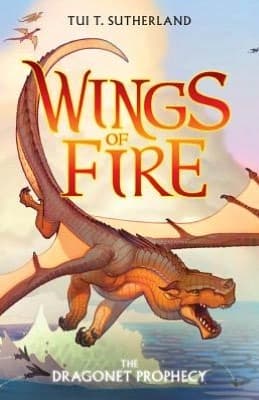
Tui T. Sutherland (2012)
Genre
Fantasy / Children's / Young Adult
Reading Time
240 min
Key Themes
See below
Sign in to track this book
Five young dragons, raised in secret to fulfill a prophecy and end a generations-long war, escape their predetermined destiny only to discover that the world outside their cave is far more dangerous and complicated than any foretelling could have predicted.
For six years, Clay, a MudWing, along with Tsunami, a SeaWing, Glory, a RainWing, Starflight, a NightWing, and Sunny, a SandWing, have lived in a hidden cave. Their guardians, Kestrel (SkyWing), Dune (SandWing), and Webs (SeaWing), are harsh and secretive. They constantly remind the dragonets of the Dragonet Prophecy, which says the dragonets will choose the next SandWing queen and end the war. Clay, the largest and most protective, often acts as a buffer between his friends and their strict captors. The dragonets want freedom and to know about their true families, especially Tsunami, who often questions Kestrel's authority. They do not know about the war or the world outside their cave.
After a particularly brutal training session where Kestrel threatens Sunny, the dragonets decide they cannot stay. Tsunami finds a hidden tunnel leading out of the cave. Despite the dangers, they promise to stick together and escape. They navigate the dark, winding tunnels and eventually emerge into the open air. The world is far different and more dangerous than they imagined. They escape because they want to find their own tribes and understand their origins, not to blindly follow a prophecy forced on them. This act of defiance starts their true journey.
Soon after their escape, a SkyWing patrol finds the dragonets. They try to fight, but their inexperience and the SkyWings' numbers lead to their capture. They are taken to the SkyWing palace, a place with grand architecture but also great cruelty. Here, they are presented to Queen Scarlet, the ruler of the SkyWings. She is interested in the prophecy and sees a chance for entertainment and political gain. She decides to make the dragonets fight each other and other captives in her arena for her court's amusement.
In Queen Scarlet's arena, Clay must fight a scavenger, then a much larger IceWing named Fjord. His MudWing scales resist fire, allowing him to survive the fights, though the violence upsets him. During their captivity, the dragonets learn more about the war and the different tribes. Queen Scarlet reveals that Glory, thought to be a SkyWing, is actually a RainWing, a tribe considered lazy and useless. This makes her an 'unacceptable' dragonet for the prophecy. This revelation further complicates the prophecy and endangers Glory, as Scarlet sees her as a defect.
While imprisoned, Clay meets Peril, Queen Scarlet's champion. Peril is a SkyWing with a rare condition: her scales constantly burn, incinerating anything she touches. Peril is initially cold and distant, shunned by her own tribe, but she becomes strongly attached to Clay. His fireproof scales are the only ones she can touch without harming him. She helps Clay survive his arena battles, often by subtly interfering or giving information. Their unusual friendship becomes important for the dragonets' survival, as Peril's loyalty to Clay starts to change her allegiance to Queen Scarlet.
Queen Scarlet, wanting to test the prophecy, arranges for Clay to fight a group of MudWings in the arena. To his shock, these MudWings are his siblings – five dragons hatched from the same clutch, led by his bigwing, Reed. He learns that his egg was sold to the Talons of Peace by his mother, a common practice among MudWings with large clutches. This reunion is bittersweet; he finds his family but realizes he was a commodity. This encounter affects Clay deeply, making him question his identity and the sacrifices made for the prophecy. The MudWings, however, are proud of him, accepting him as one of their own.
The dragonets, along with their new ally Peril, plan to escape the SkyWing palace. They free themselves from their cells and navigate the palace. During the escape, they find their former guardian Kestrel, who is also imprisoned by Scarlet. Kestrel reveals she was captured trying to get the dragonets back. She confesses her past as a former SkyWing soldier and her tragic history, including the death of her own dragonets. Peril, torn between her loyalty to Clay and her fear of Scarlet, helps them by creating diversions and dealing with guards. Her actions are often impulsive and destructive.
As they make their final push to escape, Kestrel confronts Queen Scarlet, allowing the dragonets to get away. Kestrel is killed by Scarlet, sacrificing herself to protect the dragonets. This is a final act of redemption. As the dragonets flee the palace, a group of SkyWings and IceWings allied with Scarlet ambush them. The battle is fierce, and the dragonets must fight for their lives. Peril, angry at Scarlet's cruelty and her growing bond with Clay, turns against her queen. She unleashes her deadly fire on the attacking dragons, creating a path for the dragonets to escape.
The dragonets successfully escape the SkyWing kingdom, leaving behind the burning palace and the battle's chaos. They are shaken by the events and Kestrel's death but united by their shared experience. Peril chooses to stay and face the consequences of her actions. The five dragonets are finally free. They decide their next step will be to find Tsunami's tribe, the SeaWings, hoping for safety and answers there. They realize that the prophecy might not be as simple as they were told, and their journey to find their families and understand their roles in the war has only just begun.
The Protagonist
Clay evolves from a docile, obedient dragonet to a protective leader, learning to use his strength for defense and to trust his own moral compass over the prophecy's demands.
The Protagonist
Tsunami learns to channel her rebellious energy into effective leadership, realizing that true strength lies not just in defiance but in strategic thinking and protecting her friends.
The Protagonist
Glory sheds her passive demeanor, embracing her RainWing identity and hidden strengths, proving her worth as a valuable and capable member of the prophecy dragonets.
The Protagonist
Starflight begins to find courage in his intellectual strengths, slowly overcoming his timidity and realizing that knowledge can be a powerful tool for survival.
The Protagonist
Sunny maintains her optimism and kindness, becoming a quiet but firm moral center for the group, showing that strength comes in many forms.
The Supporting
Kestrel's character develops from a purely antagonistic figure to a tragic, sympathetic one, ultimately finding redemption through self-sacrifice.
The Supporting
Dune remains largely static, a symbol of the war's weariness and the cynicism it breeds.
The Supporting
Webs's character arc is one of increasing fear and eventual abandonment of his duties, highlighting the pressure of the prophecy.
The Antagonist
Queen Scarlet remains a consistently cruel and unyielding antagonist, her actions driving much of the conflict in the first book.
The Supporting
Peril begins as a tool of the antagonist but develops a conscience and loyalty to Clay, leading her to betray her queen and seek a new path.
The Supporting
Reed's character is consistent, representing family and acceptance for Clay.
A main theme is the conflict between the dragonets' predetermined 'destiny' to fulfill the prophecy and their desire for free will. The dragonets are raised in captivity, constantly told their purpose, yet they want to make their own choices. Tsunami's constant rebellion, Clay's desire to protect his friends over the prophecy's demands, and Glory's feeling of being an 'unacceptable' dragonet all show this struggle. The book questions if a prophesied future is truly unavoidable or if individuals can choose their own fate. It suggests that true heroism comes from choice, not force.
“Maybe we don't have to choose anyone. Maybe we could just... end the war our own way.”
Each dragonet struggles with their identity, especially concerning their tribe and the prophecy. Clay questions what it means to be a MudWing when he was sold as an egg. Tsunami wants to know about her SeaWing heritage. Glory feels like an outcast as a RainWing among SkyWings. Sunny, a SandWing, feels she does not fit the 'fierce' stereotype. Their journey to find their families is a quest for self-discovery and a place where they truly belong. It shows how important it is to understand one's background and find acceptance, both from others and within oneself, outside of predetermined roles.
“I'm a MudWing, but I don't feel like I belong with them. I don't feel like I belong anywhere, really.”
The book shows the impact of the long SandWing war, even through the eyes of dragonets who have only heard about it. The scarred land, the constant fear, Queen Scarlet's cruelty, and the tired cynicism of characters like Dune all remind readers of war's cost. The dragonets see firsthand the violence, loss, and dehumanization that war brings. This makes them question the prophecy's purpose to end it. It stresses that war causes suffering across all tribes, not just the warring ones, and that peace is greatly needed.
“This is what war does. It takes everything and everyone you love.”
The bond between the five dragonets is the emotional core of the story. Despite their tribal differences and individual struggles, their loyalty to each other is strong. Clay's protectiveness, Tsunami's fierce defense of her friends, and Sunny's unifying optimism all show the strength of their friendship. This theme is further explored through Peril's growing loyalty to Clay, which leads her to betray Queen Scarlet. The book suggests that these chosen family bonds are more powerful and meaningful than tribal affiliations or prophesied destinies, giving the dragonets the courage and support needed to face their challenges.
“We're a team. We stick together, no matter what.”
A central prophecy dictating the dragonets' purpose.
The Dragonet Prophecy is the driving force behind the entire plot. It foretells the coming of five dragonets from different tribes who will choose the next SandWing queen and end the war. This prophecy acts as both a source of hope and a burden for the dragonets, shaping their upbringing and dictating their initial purpose. It creates a sense of predetermined destiny that the dragonets constantly struggle against, providing the primary conflict between free will and fate. The ambiguity and manipulation surrounding the prophecy are also key elements, hinting that its true meaning may be different from what the Talons of Peace believe.
A secluded, controlled environment for the dragonets' upbringing.
The hidden cave serves as the initial setting and a symbolic prison for the dragonets. It represents their sheltered, controlled existence, devoid of true freedom and knowledge of the outside world. This isolated environment fosters their bond with each other but also fuels their yearning for escape and self-discovery. The contrast between the dark, cramped cave and the vast, dangerous world outside highlights their transformation from naive captives to independent adventurers. The cave also symbolizes the Talons of Peace's attempt to control destiny, which ultimately fails.
A gladiatorial combat setting used to showcase the brutality of the world.
Queen Scarlet's arena is a significant plot device that thrusts the dragonets into the harsh realities of Pyrrhia's war-torn society. It forces them into violent situations, testing their resolve and revealing their individual strengths and weaknesses. The arena serves as a microcosm of the larger war, showcasing tribal prejudices, Queen Scarlet's cruelty, and the desperate struggle for survival. It also introduces key characters like Peril and Clay's MudWing siblings, furthering the plot and developing character relationships under extreme pressure.
A unique physical trait that drives character interaction and plot points.
Peril's unique ability to burn everything she touches is a powerful plot device. It immediately establishes her as a dangerous yet tragic figure, isolated by her own nature. Her burning touch directly facilitates her bond with Clay, as his fireproof scales are the only ones she can touch without harm, making their relationship unique and intimate. This ability also makes her a formidable weapon for Queen Scarlet and, later, a crucial asset in the dragonets' escape, demonstrating how a perceived weakness can be a source of immense power. It symbolizes her internal conflict and her struggle for acceptance.
“The dragonets are coming.”
— The prophecy that drives the story, foretelling the arrival of five dragonets who will end the war.
“I don't want to be a hero. I just want to be a dragon.”
— Clay, the MudWing dragonet, expressing his desire for a normal life rather than fulfilling the prophecy.
“We're not just dragonets. We're the dragonets of destiny.”
— Tsunami, the SeaWing dragonet, asserting their importance and role in the prophecy.
“Sometimes the bravest thing you can do is ask for help.”
— Starflight, the NightWing dragonet, reflecting on vulnerability and courage.
“I'm not a monster. I'm a dragon.”
— Glory, the RainWing dragonet, defending her identity against prejudice.
“The world is bigger than the prophecy.”
— Sunny, the SandWing dragonet, reminding others that there is more to life than their destined roles.
“We have to stick together. That's the only way we'll survive.”
— Clay emphasizing the importance of unity among the dragonets in the face of danger.
“Fear is just a feeling. It doesn't have to control you.”
— Tsunami encouraging her friends to overcome their fears during a tense moment.
“Every dragon has a story. Even the ones we think we know.”
— Starflight musing on the complexity of characters and hidden depths.
“The sky is full of wings, but only ours matter.”
— Glory reflecting on the uniqueness and significance of the dragonets' journey.
“Home isn't a place. It's the dragons you're with.”
— Sunny expressing that family and companionship define home more than location.
“We were born for this, but we can choose how we live it.”
— Clay reconciling destiny with free will and personal choice.
“In the dark, even the smallest light can guide you.”
— Starflight using his NightWing abilities to find hope in difficult situations.
“Strength isn't about size. It's about heart.”
— Tsunami defending Clay's courage despite his perceived weaknesses.
Ready to see how well you understood this book? Take our interactive quiz with 10 questions.

Biography coming soon.







