“War doesn't determine who is right. War determines who remains.”
— Rin reflects on the brutal nature of conflict and survival.

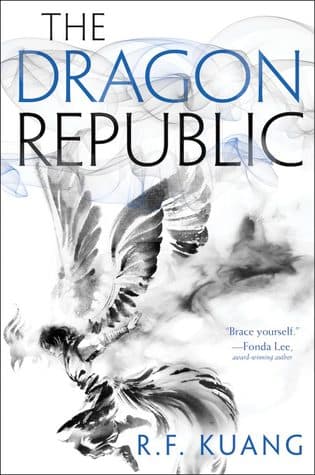
R.F. Kuang (2019)
Genre
Fantasy / Historical Fiction
Reading Time
1370 min
Key Themes
See below
Sign in to track this book
Haunted by genocide and fueled by opium, the shaman-warrior Rin joins a warlord's bloody quest for a republic, only to discover that her vengeance and love for Nikan may demand an even greater, more monstrous sacrifice.
After destroying Sinegard with the Phoenix, Rin is an outcast, hunted by the Hesperians and feared by her own people. She is addicted to opium, trying to quiet the Phoenix's urges and the trauma of her actions. With Kitay, who worries about her drug use, she finds safety in the southern provinces. Their journey leads them to the Dragon Republic, a new movement led by the Dragon Warlord, Sanzang. Sanzang offers Rin a place in his army, seeing her as a powerful weapon against Empress Su Daji and the growing Hesperian influence. Rin, wanting revenge against Su Daji and still wanting to protect Nikan, reluctantly accepts, despite her distrust of Sanzang's reasons and her own struggles with the Phoenix.
Rin joins the Dragon Republic's campaign to gain power in the southern provinces. She commands troops alongside Nezha, who also joined Sanzang's cause after his father died. Their first victories are quick, but they soon meet the Hesperian military, who are helping the Empress's loyalists. Rin sees the clear reality of Hesperian weapons – advanced rifles, cannons, and steamships – which make traditional Nikanese warfare useless. She struggles to adapt, often using the Phoenix's power, which worries Kitay and Nezha. The Hesperians, led by Master Vaisra and the missionary June, also bring their own beliefs, trying to convert Nikanese to their monotheistic faith, which makes the political situation more complex.
The Dragon Republic's advance ends with the siege of Mugen, a port city defended by a strong Hesperian fleet. Rin and Nezha lead the attack, but the Hesperian navy is too powerful. The Republic's forces suffer many losses. Desperate to break the stalemate, Rin, under the influence of opium and the Phoenix's whispers, decides to use its full power. She channels immense destructive energy, destroying the Hesperian fleet and causing widespread damage. While they win, the act leaves Rin deeply traumatized and separates her further from Kitay, who sees her descent into violence. Nezha is also horrified by the scale of her power and the cost of their victory.
After the victory at Mugen, the Dragon Republic marches on the capital, Chulu. Empress Su Daji, weakened by southern losses and betrayal, is quickly overthrown. Rin finally confronts Su Daji, but her long-awaited revenge feels empty. With the Empress removed, Sanzang shows his true plans: not just to restore Nikan, but to end the imperial system entirely and create a meritocratic Republic, an idea from Hesperian ideals. He starts taking apart old power structures and making reforms, which surprises and worries many, including Rin, who had imagined a different future for Nikan. Kitay, however, is cautiously hopeful about the Republic's potential for good.
As Sanzang's Republic takes hold, Rin sees its darker side. The 'meritocratic' system often favors the educated elite, many of whom have Hesperian education or sympathies, while common people and traditional Nikanese values are ignored. Sanzang's reliance on Hesperian advisors and technology grows, and he starts persecuting those who practice shamanism or old customs, seeing them as superstitious barriers to progress. Rin, still haunted by the Phoenix and struggling with her opium addiction, grows more disappointed with Sanzang's methods. She sees him as another tyrant, though one who speaks of freedom and progress. Her distrust of him deepens, fueled by Kitay's warnings and her own observations of injustice.
Sanzang's Republic faces strong opposition from the northern warlords, who refuse to accept his authority and see his reforms as an attack on Nikanese tradition. Rin is again called to lead troops, fighting against former allies and her own people. The conflict is brutal, marked by guerrilla warfare and the Republic's superior, Hesperian-supplied military. Rin feels increasingly alone, torn between her loyalty to Kitay and Nezha, her duty to Nikan, and her growing moral objections to Sanzang's rule. The Phoenix, always present, continues to demand blood, making Rin's choices difficult as she navigates the complex political and moral situation.
Nezha, initially a strong supporter of Sanzang and the Republic, starts to question the Warlord's increasingly authoritarian rule and his disregard for Nikanese heritage. His family's history and his own principles conflict with Sanzang's Hesperian-influenced policies. This internal conflict ends with Nezha trying to betray Sanzang, or at least undermine his power, to guide the Republic toward a more balanced path. Rin, discovering Nezha's actions, is forced into a tragic confrontation with her former friend. Their clash is emotional and physically damaging, showing the deep ideological divisions within Nikan and the personal sacrifices demanded by war and politics. The result changes both characters deeply.
Master Vaisra, the Hesperian diplomat, reveals the true reason for Hesperia's involvement in Nikan. Their help to Sanzang was not selfless; it was a planned move to gain control of Nikanese resources and set up a puppet government. Hesperia issues an ultimatum, demanding economic concessions and political influence that would effectively turn Nikan into a Hesperian colony. Sanzang, despite his initial idealism, finds himself trapped, his Republic dependent on Hesperian technology and military support. This revelation destroys Rin's last hopes in Sanzang's vision and confirms her belief that Nikan must fight for its true independence, even if it means fighting against former allies.
Faced with the Hesperian threat and Sanzang's involvement, Rin makes a clear choice: she will not be a tool for any group. She rejects both the Hesperian colonizers and Sanzang's flawed Republic. Seeing that Nikan's survival depends on a force that can stand against the technologically superior Hesperians, Rin fully embraces the power of the Phoenix, overcoming her fear and addiction. This decision marks a complete change, as she lets go of her personal demons to become a weapon for Nikan's freedom. She understands that the path ahead will involve great destruction and personal sacrifice, but she is ready to pay any price for her country's freedom.
Having fully committed to the Phoenix, Rin starts to gather those who still believe in a truly independent Nikan. She collects remaining shamans, disappointed soldiers, and common people who resent both Hesperian interference and Sanzang's perceived betrayal. Rin realizes that true liberation means fighting not just the Hesperians, but also Sanzang's Republic, which has become a tool of foreign powers. The stage is set for an even greater, more brutal conflict, where Rin, using the terrifying power of the Phoenix, will lead Nikan into a desperate fight for its independence against a world that wants to control it. Her journey of vengeance has become a war for national survival, with Rin as its destructive, unforgiving champion.
The Protagonist
Rin descends further into the Phoenix's power, battling addiction and disillusionment, ultimately choosing to fully embrace her destructive capabilities for Nikan's liberation.
The Supporting
Kitay struggles to keep Rin grounded and humane, ultimately accepting her path while maintaining his own moral integrity and intellectual perspective.
The Supporting
Nezha moves from Republic loyalist to a conflicted figure attempting to guide Nikan, ultimately clashing violently with Rin over their differing visions.
The Antagonist
Sanzang transforms from a revolutionary idealist into a pragmatic, authoritarian leader who compromises Nikan's sovereignty for his vision of modernization.
The Mentioned
The Phoenix's power is increasingly embraced by Rin as she sheds her inhibitions, becoming a more potent and integral part of her identity.
The Antagonist
Su Daji's reign ends with her overthrow, marking the symbolic end of the old imperial order.
The Supporting
Vaisra steadily reveals Hesperia's true, exploitative intentions, escalating their demands on Nikan.
The Supporting
June consistently advocates for Hesperian cultural and religious dominance, reinforcing the colonial threat.
Rin's journey shows how power, especially divine and destructive, can corrupt. Her use of the Phoenix, first for revenge against Su Daji, slowly changes her into something less human. Her opium addiction is a symbol of her attempt to control this power, but it ultimately fails. This theme also applies to Sanzang, whose initial ideals for a Republic are warped by his pursuit of power, leading him to authoritarianism and compromise with Hesperia. The book always questions if any victory is worth the moral cost.
“Perhaps the gods were not merciful. Perhaps they were just. Perhaps they were just cruel.”
A main theme is the deceptive nature of Hesperian colonialism. Unlike the Mugenese, who invade with force, Hesperia uses 'soft power' – offering technology, economic aid, and a new religion, all while slowly weakening Nikan's independence and culture. Master Vaisra's manipulations and Sanzang's reliance on Hesperian support show how foreign influence can be more dangerous than open invasion, leading to a loss of identity and self-determination. The fight against Hesperia becomes a fight for Nikan's very essence.
“They didn't want to conquer Nikan. They wanted Nikan to conquer itself, for them.”
Characters struggle with their identity in a Nikan that is changing greatly. Rin, a peasant girl turned shaman, struggles with her humanity versus the Phoenix, and her place in a world that fears her. Nezha, an aristocrat, must balance his family's history with the Republic's new order. Sanzang tries to create a new Nikanese identity based on Hesperian ideals, alienating those who hold to tradition. The conflict between old Nikanese ways and new Hesperian influences makes characters question who they are and where their loyalties lie.
“What was Nikan, if not its gods? What was Nikan, if not its history?”
The book clearly shows the terrible human cost of long conflict. Beyond the battlefield, characters suffer from trauma, addiction, and moral compromise. Rin's opium use is a direct result of the terrible acts she commits. The revolution, while promising freedom, brings widespread destruction, famine, and internal conflict. Sanzang's Republic, meant to be a symbol of hope, quickly becomes authoritarian and violent, showing that even a 'just' war can lead to unintended and horrific results, and that revolution often destroys its own leaders.
“War was not a game. It was a meat grinder, and everyone went in.”
There are no clear heroes or villains in 'The Dragon Republic.' Rin, while fighting for Nikan, commits terrible acts. Sanzang, despite his vision for a better Nikan, becomes a tyrant. Nezha's attempts at reform lead to betrayal. Even the Hesperians, though colonialist, genuinely believe they are bringing progress. The story consistently makes characters and readers face difficult choices and the lack of easy answers, showing that good intentions can lead to disaster, and that survival often requires morally difficult actions.
“There were no good men in war. There were only winners and losers.”
A magical system and source of immense, destructive power.
Shamanism, specifically Rin's connection to the Phoenix, serves as the primary magical system and a potent plot device. It grants Rin destructive capabilities far beyond conventional warfare, allowing her to turn the tide of impossible battles. However, it comes at a great cost: the Phoenix's power is addictive, psychologically tormenting, and morally corrupting. It represents the raw, ancient power of Nikan, contrasting sharply with the Hesperian's technological might, and forces Rin to confront the ethical implications of wielding such devastating force.
A symbol of Rin's trauma and an attempt to suppress her powers.
Rin's opium addiction is a crucial plot device, serving as both a coping mechanism for her trauma and a physical manifestation of her struggle to control the Phoenix. The drug dulls her senses and suppresses the god's urges, but it also weakens her and makes her vulnerable. It highlights her internal conflict and her desperate attempt to cling to her humanity in the face of overwhelming power and guilt. The addiction also mirrors the broader theme of Nikan's vulnerability to foreign influences, as opium is often associated with colonial exploitation.
A force for modernization and a symbol of foreign dominance.
Hesperian technology, including advanced firearms, cannons, and steamships, acts as a significant plot device by creating a stark power imbalance in Nikan. It renders traditional Nikanese warfare obsolete and forces the Dragon Republic to adapt or perish. This technological superiority is a key tool for Hesperian influence, allowing them to exert control without direct military occupation. It symbolizes the threat of modernization without sovereignty and the challenge Nikan faces in preserving its identity against a technologically advanced colonizer.
A political philosophy promoting modernization, clashing with tradition.
Sanzang's Dragon Republic, with its Hesperian-inspired ideals of democracy, meritocracy, and modernization, functions as a central plot device. It provides the initial motivation for many characters, including Rin and Nezha, to fight against the old imperial order. However, as the story progresses, the Republic's ideology is revealed to be flawed and authoritarian, suppressing traditional Nikanese culture and relying on foreign powers. This ideological conflict creates deep divisions within Nikan and forces characters to choose between different visions for their country's future.
Representing traditional Nikanese resistance and decentralized power.
The Northern Warlords serve as a plot device to illustrate the fragmented nature of Nikanese power and the resistance to Sanzang's centralized Republic. They represent the more traditional, conservative elements of Nikanese society who reject Hesperian influence and the radical changes proposed by Sanzang. Their ongoing resistance forces the Dragon Republic to fight on multiple fronts, highlighting the internal divisions within Nikan and complicating the struggle for national unity and independence against foreign powers.
“War doesn't determine who is right. War determines who remains.”
— Rin reflects on the brutal nature of conflict and survival.
“Power is not control at all—power is strength, and giving that strength to others.”
— A discussion on leadership and the true meaning of power.
“The only way to win a war is to become something worse than your enemy.”
— Rin grapples with the moral compromises of warfare.
“History is written by the survivors.”
— Commentary on how narratives are shaped by those who endure.
“You cannot build a republic on a foundation of corpses.”
— A critique of the violent methods used to establish the new republic.
“Fear is a tool. The moment you become scared is the moment you stop thinking.”
— Advice on maintaining clarity and control in dangerous situations.
“Sometimes the only way to stay sane is to go a little mad.”
— Rin's coping mechanism in the face of overwhelming trauma.
“Loyalty is a currency, and everyone has a price.”
— Observation on the transactional nature of allegiances in the war.
“The gods are not kind. They are hungry, and they eat what we feed them.”
— Reflection on the dangerous relationship between humans and deities.
“You can't change the world without getting your hands dirty.”
— Acknowledgment of the necessary evils in revolutionary efforts.
“Hope is a fragile thing, but it's the only thing stronger than fear.”
— A moment of resilience amidst despair and conflict.
“The line between monster and hero depends on who is telling the story.”
— Exploration of how perspective shapes judgment in war.
“Power corrupts, but so does powerlessness.”
— Insight into how both extremes can lead to moral decay.
Ready to see how well you understood this book? Take our interactive quiz with 10 questions.

Biography coming soon.







