“Just make a mark and see where it takes you.”
— The teacher encourages Vashti to start drawing.

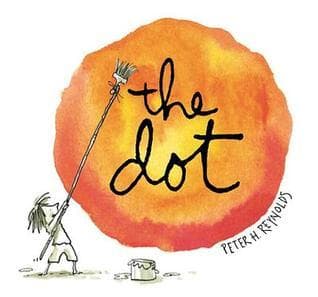
Peter H. Reynolds (2003)
Genre
Children's / Creativity
Reading Time
5 min
Key Themes
See below
Sign in to track this book
A single dot on a blank page helps a young girl move past self-doubt to artistic discovery and self-expression, showing that creativity starts with one mark.
Art class has ended, and all the other students have gone, but Vashti stays in her chair, looking at a blank paper. She is frustrated because she thinks she cannot draw. Her teacher comes over, seeing her problem. Vashti says she cannot make anything, sure she is not an artist and has nothing to put on the paper. The blank page seems to make her feel worse, strengthening her self-doubt and making her feel less capable than her classmates who made art.
Instead of scolding Vashti, her teacher gives her a simple piece of advice. She tells Vashti, 'Just make a mark and see where it takes you.' This invitation changes the focus from making a perfect drawing to simply starting. Vashti, still feeling annoyed, jabs her pen onto the paper, making a single, small dot. She says, 'There!' as if to prove she cannot do art and this is all she can make.
The teacher picks up Vashti's paper with the dot and looks at it. Instead of judging it, she asks Vashti to sign her name on it. Vashti, confused by this request for what seems like an unimportant 'artwork,' does so. The next week, when Vashti comes back to art class, she is surprised to see her dot, signed by her, framed and hanging on the wall behind her teacher's desk. This act of approval changes the dot from a mark of frustration into a recognized piece of art.
Seeing her dot displayed makes Vashti think about it differently. She realizes that if a single dot can be art, then perhaps she can do more. She thinks, 'Hmmph! I can make a better dot than that!' This thought starts her curiosity and a challenge within her. She decides to try making different kinds of dots, moving past her initial anger and self-doubt. The framed dot becomes a starting point for her creative journey.
Inspired, Vashti begins to experiment. She gets her paint set and starts making dots of all colors. She paints small dots, large dots, bright dots, and subtle dots. She even makes dots that are circles within circles, or dots that are part of a bigger design. Her first anger has been replaced by playful exploration and a growing happiness in the creative process. Her art supplies, once scary, now become tools for discovery.
Vashti's experiments lead to an impressive piece. She paints a very large dot by not painting a dot at all, but by painting a blue dot surrounded by a yellow dot, creating the look of a huge, bright dot in the middle. This painting shows her growth and her ability to think creatively beyond just a 'dot.' It is the result of her new confidence and artistic expression, showing her journey from a single jab to a complex design.
The school has an art show, and Vashti's many dot creations, including her large, layered dot painting, are displayed clearly. Her work gets attention and praise from students, teachers, and parents. People are impressed by the variety, creativity, and amount of her dot art. Vashti, once a hesitant artist, now stands proudly by her work, enjoying the positive attention and recognition for her art.
During the art show, a small boy comes up to Vashti, looking at her art with admiration. He tells her he wishes he could draw like her, showing the same kind of self-doubt Vashti once had. Vashti, remembering her own journey and her teacher's kindness, smiles. She gives the boy a piece of paper and a pen, repeating her teacher's words: 'Make your mark.' She then asks him to sign his name on his single, careful line, beginning his own creative journey.
The Protagonist
Vashti transforms from a self-doubting, frustrated child who believes she cannot draw into a confident, prolific artist who inspires others.
The Supporting
She consistently acts as a supportive and inspiring guide, demonstrating the impact of a good mentor.
The Mentioned
He is introduced as a new individual seeking artistic guidance, beginning his own journey.
The main theme is about finding one's creativity. Vashti first thinks she has no art talent, but her teacher's simple suggestion, 'make a mark,' opens her up to self-expression. The book shows that creativity is not just for big works but can begin with a simple action, like a dot. Vashti's journey from an angry poke to many kinds of dot art shows how freeing it is to let oneself explore and create without fear of being judged.
“Just make a mark and see where it takes you.”
The role of a supportive mentor is important in Vashti's change. The art teacher's kind way, her choice not to criticize, and her act of framing Vashti's first dot are all strong acts of encouragement. This theme shows how positive support and belief from another person can help someone overcome self-doubt and find hidden talents. Without her teacher's gentle guidance, Vashti might have stayed stuck, never seeing her potential. The theme is repeated when Vashti helps the little boy.
“She picked up the paper and stared at the little dot. 'Hmmmm.'”
Vashti's first problem comes from self-doubt and the belief that she 'cannot draw.' Her blank paper represents her internal block. The story shows how a small brave act (making the dot) and outside approval (the framed dot) can lessen these feelings. As Vashti gains confidence, her self-doubt goes away, letting her experiment freely and find happiness in creating. The book suggests that often, the biggest obstacle to creating is our own limiting beliefs.
“I can't draw. I just CAN'T draw!”
The whole story depends on the idea that even the smallest start can lead to something important. The 'dot' itself is a symbol of this. What seems unimportant and angry at first, when recognized and encouraged, grows into diverse artistic expression. This theme tells readers not to be scared by a big task but to simply 'make a mark' – to take that first small step – knowing it can lead to unexpected and wonderful results.
“That one little dot marks the beginning of Vashti’s journey of surprise and self-discovery.”
Represents the starting point of creativity and potential.
The dot is the central symbol of the story. Initially, it represents Vashti's frustration and perceived lack of talent. However, once framed by her teacher, it transforms into a symbol of validation, potential, and the courage to begin. As Vashti creates more dots, it symbolizes her growing confidence, exploration, and the infinite possibilities that can stem from a single, simple mark. It signifies that any small action can be the genesis of something great.
Symbolizes creative paralysis and the fear of failure.
The blank piece of paper at the beginning of the story is a powerful symbol of Vashti's creative block and her fear of not being 'good enough.' It represents the intimidating void that many aspiring creators face when confronted with the expectation to produce something. The blankness highlights her initial state of inaction and self-doubt before her teacher's intervention. Overcoming the blank page is the first step in her artistic journey.
A plot device that provides external validation and transforms perception.
The act of the teacher framing Vashti's single, initial dot is a crucial plot device. It's not just a decorative act; it's a profound gesture of validation and recognition. By framing the dot, the teacher elevates it from a mere scribble to a piece of art, fundamentally changing Vashti's perception of her own mark and, by extension, her own capabilities. This external validation is the catalyst that inspires Vashti to explore her creativity further.
Vashti's interaction with the little boy mirrors her own beginning.
The ending scene, where Vashti encourages a young boy with similar self-doubt, mirrors the beginning of the story. This parallelism demonstrates Vashti's complete transformation from a student needing encouragement to a confident artist providing it. It highlights the cyclical nature of mentorship and inspiration, showing how the lessons learned can be passed on, extending the theme of creative empowerment beyond just Vashti's personal journey.
“Just make a mark and see where it takes you.”
— The teacher encourages Vashti to start drawing.
“I can't draw.”
— Vashti's initial frustration with art.
“Sign it.”
— The teacher asks Vashti to sign her dot drawing.
“It's a polar bear in a snowstorm.”
— Vashti humorously describes her blank paper.
“If I can make little dots, I can make big dots, too.”
— Vashti gains confidence and experiments.
“The dot was just the beginning.”
— Vashti's realization about her creative journey.
“You don't have to be an artist to make art.”
— Implied message about creativity being accessible.
“She made a dot. Not just any dot—a Vashti dot.”
— Narration highlighting Vashti's unique creation.
“Maybe I can't draw, but I can sign my name.”
— Vashti's small step toward engagement.
“Her dots grew and changed and became something new.”
— Describing Vashti's evolving artwork.
“A dot can be a starting point for anything.”
— The book's central theme about beginnings.
“The teacher smiled and said nothing.”
— The teacher's supportive, non-judgmental response.
“I can make dots in all colors.”
— Vashti explores with different materials.
“It's amazing where a dot can lead you.”
— Reflection on Vashti's creative journey.
Ready to see how well you understood this book? Take our interactive quiz with 10 questions.

Biography coming soon.

Dan Gemeinhart
4.5

Kate O'Hearn
4.4

Jeanne Birdsall
4.4

Jen Wang
4.4

Wendelin Van Draanen
4.3

John Marsden
4.3

Chris Van Allsburg
4.3

Jennifer A. Nielsen
4.2