“Midway upon the journey of our life I found myself within a forest dark, for the straightforward pathway had been lost.”
— The opening lines of Inferno, describing Dante's spiritual crisis.

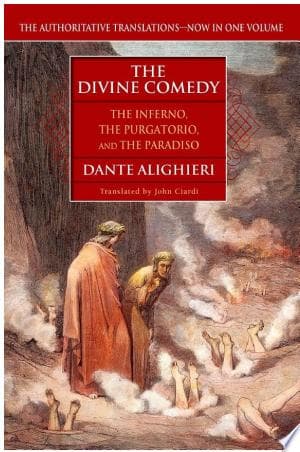
Dante Alighieri (2003)
Genre
Fantasy / Spirituality / Philosophy
Reading Time
1500 min
Key Themes
See below
Sign in to track this book
Join Dante as he travels through Hell, Purgatory, and Paradise on a quest for divine love and salvation.
On the night before Good Friday in 1300, Dante Alighieri gets lost in a dark wood, which represents his spiritual confusion and sin. He tries to climb a hill for salvation but is stopped by three beasts: a leopard (lust), a lion (pride), and a she-wolf (avarice). These push him back into the darkness. Just as he gives up hope, the ghost of the Roman poet Virgil appears. Virgil says Beatrice, Dante's beloved, sent him from Heaven to guide Dante. He suggests a journey through Hell and Purgatory. After that, Beatrice will lead Dante through Paradise, since Virgil, a pagan, cannot enter Heaven.
Dante, at first unsure, accepts Virgil's help. They pass through Hell's gate, which has the words, 'Abandon all hope, ye who enter here.' First, they see the Vestibule, where the 'neutrals' — those who did neither good nor evil — are punished by chasing a banner forever and being stung by wasps and flies. Next, they cross the Acheron River, ferried by Charon, to Limbo, Hell's First Circle. Here live unbaptized infants and good pagans, including philosophers, poets, and heroes like Homer, Ovid, and Virgil. They have no physical pain but feel eternal sorrow, wanting a God they can never know.
As they go deeper, Dante and Virgil meet Minos, who judges the damned by coiling his tail to show the circle of Hell. They go through the Circles of Incontinence: the Second (Lust), where souls are caught in a storm; the Third (Gluttony), where Ciacco talks about Florence's political problems amid icy rain and mud; and the Fourth (Avarice and Prodigality), where misers and spendthrifts push heavy weights forever. They then pass through the muddy Styx, where the wrathful fight and the sullen gurgle under the surface. After a hard trip through the City of Dis, guarded by fallen angels and Furies, they enter the Sixth Circle (Heresy), where heretics lie in flaming tombs. The Seventh Circle (Violence) has three rings: against neighbors (in boiling blood), against self (as trees), and against God, nature, and art (on burning sands).
With Geryon, a monster that represents fraud, they go down to the Eighth Circle, Malebolge ('Evil Pouches'). This is a series of ten ditches for those who committed simple fraud. Here, Dante sees panders and seducers whipped by demons, flatterers in excrement, simoniacs buried headfirst in rock with flaming feet, sorcerers with twisted heads, corrupt politicians in boiling pitch, hypocrites in lead cloaks, thieves tormented by snakes, fraudulent counselors in flames, and schismatics mutilated and healed repeatedly. After this trip, they reach the Ninth Circle, Cocytus, a frozen lake where those who committed treachery are held. This circle has four rings: Caina (traitors to family), Antenora (traitors to country), Ptolomea (traitors to guests), and Judecca (traitors to lords and benefactors).
At Hell's center, in Judecca's deepest part, Dante and Virgil face Lucifer, a monstrous three-headed devil frozen in ice up to his waist. Lucifer chews on the three greatest traitors: Judas Iscariot, Brutus, and Cassius. His flapping wings create the icy winds that keep Cocytus frozen. To leave Hell, Virgil guides them down Lucifer's hairy side, past Earth's center, where gravity changes. They then climb a long, dark passage, coming out on the other side of the world, just before dawn on Easter Sunday, to see the stars again. This marks their escape from Hell and the start of their journey to Purgatory.
Leaving Hell, Dante and Virgil are on the shores of Mount Purgatory, an island mountain in the southern hemisphere. Cato of Utica, Purgatory's guardian, greets them and tells them how to get ready for the climb. Here, Dante's face is cleaned of Hell's grime, and he is given a rush belt. They then enter Ante-Purgatory, where souls who put off repenting wait to begin purification. These include the excommunicated, the lazy, those who died violent deaths without last rites, and careless rulers. Dante meets people he knows, including Manfred of Sicily and Sordello, who lead them to the valley of negligent princes.
An angel guides Dante and Virgil into Purgatory. Dante has seven 'P's (for 'peccatum' or sin) written on his forehead, one for each deadly sin. They climb the seven terraces, each for one of the seven deadly sins, from most to least severe: Pride, Envy, Wrath, Sloth, Avarice/Prodigality, Gluttony, and Lust. On each terrace, souls do specific penances that counter their sin. For example, the proud carry heavy stones, the envious have their eyes sewn shut, and the gluttonous are always hungry and thirsty. As Dante passes each terrace, an angel removes one 'P' from his forehead, meaning he is purified.
After climbing the seven terraces, Dante and Virgil arrive at the Earthly Paradise, the Garden of Eden, at Mount Purgatory's top. Here, Dante meets Matilda, a woman who explains the garden's beauty and the two rivers, Lethe (which erases sin's memory) and Eunoë (which brings back good deeds' memory). As a procession symbolizing the Church approaches, Virgil, having finished his role as a guide for human reason, quietly leaves. Suddenly, Beatrice comes down from a chariot, veiled and grand. Her arrival marks a change. She strongly scolds Dante for straying from virtue after her death, making him cry and truly repent.
Purified by Lethe and strengthened by Eunoë, Dante is ready to go to Paradise. Beatrice, who represents divine revelation and theology, guides him. They go through the nine celestial spheres of Ptolemaic cosmology. In the First Sphere (the Moon), Dante meets souls who broke their vows. In the Second (Mercury), he sees those who sought honor but were just. In the Third (Venus), he sees souls whose love was earthly. In the Fourth (the Sun), he is surrounded by theologians and wise men, including Thomas Aquinas and St. Bonaventure, who discuss divine wisdom and God's creation.
Dante and Beatrice continue their climb. In the Fifth Sphere (Mars), Dante sees Christian warriors and martyrs, forming a shining cross. In the Sixth Sphere (Jupiter), he meets just rulers and judges, who form an eagle, symbolizing divine justice. In the Seventh Sphere (Saturn), he finds contemplative souls, going up and down a golden ladder. Beyond the planetary spheres, they reach the Eighth Sphere (the Fixed Stars), where Dante is tested on Faith, Hope, and Charity by St. Peter, St. James, and St. John. Finally, they reach the Ninth Sphere (the Primum Mobile), the outermost sphere that moves all others, where Dante sees the angelic orders moving around a central light.
Leaving the Primum Mobile, Dante and Beatrice go to the Empyrean, the Tenth and final sphere. This is not a physical place but a realm of pure light and thought, God's true home, with angels and the blessed. Here, Beatrice becomes her most beautiful, then, having brought Dante to the edge of divine vision, she takes her place in the Celestial Rose, a large, multi-layered amphitheater of blessed souls. St. Bernard of Clairvaux becomes Dante's last guide, leading him to see God directly. Dante's mind is overwhelmed by the mystery of the Trinity and the Incarnation, a vision of unity and love that he cannot fully understand. His will finally matches divine love, and his journey ends in peace and spiritual fulfillment.
The Protagonist
Dante transforms from a lost, fearful sinner into a spiritually enlightened individual who has witnessed the entirety of the afterlife and achieved union with Divine Love.
The Supporting
Virgil faithfully guides Dante through the dangers and lessons of Hell and Purgatory, fulfilling his divine mission before gracefully departing at the threshold of Paradise.
The Supporting
Beatrice guides Dante from the earthly realm into the celestial, revealing divine truths and ultimately leading him to the threshold of the Beatific Vision.
The Antagonist
Lucifer remains a static, eternally punished figure, serving as the ultimate symbol of sin's consequence.
The Supporting
Francesca remains eternally bound in the whirlwind of lust, serving as a poignant example of the consequences of uncontrolled desire, and a catalyst for Dante's pity.
The Supporting
Ugolino remains in eternal, gruesome vengeance, a stark warning of the depths of treachery and its punishment.
The Supporting
St. Bernard facilitates Dante's final, ultimate spiritual experience, guiding him to the direct vision of God.
The Supporting
Matilda serves as a serene guardian and explainer of the Earthly Paradise, preparing Dante for his ultimate purification and the arrival of Beatrice.
The Supporting
Cato remains a steadfast and symbolic guardian, enforcing the rules of spiritual purification at the entrance to Purgatory.
Divine justice is key in The Divine Comedy, especially in the Inferno. Punishments in Hell are not random; they fit the sin, a concept called 'contrapasso' — 'by suffering you learn.' For example, the lustful are always swept by a storm, like their uncontrolled passions in life. The gluttonous lie in freezing mud, like their indulgence in earthly pleasures. The treacherous are frozen in ice, like their cold betrayal. This idea continues in Purgatory, where penances directly counter the sin (e.g., the proud carry heavy stones to humble them). In Paradise, souls live in spheres according to their virtues, showing God's justice in rewarding goodness.
“Justice moved my high maker; / Divine Power made me, / And Wisdom and Primal Love.”
The whole story is an allegory of spiritual redemption. Dante's initial state of being 'lost in a dark wood' means he strayed from righteousness. His trip through Hell makes him face sin and its results, leading to a deeper understanding of evil. Purgatory shows the hard work of purification and repentance, where the soul actively tries to get rid of sinful habits. Paradise means reaching spiritual enlightenment, union with God, and happiness. This journey is a universal comparison for the human soul's ability to repent, grow, and find salvation through divine grace.
“To get out of the dark, into the clear, / I climbed towards the light upon a hill.”
This theme is shown by Dante's two main guides: Virgil and Beatrice. Virgil, who represents human reason and classical philosophy, can guide Dante through Hell and Purgatory's moral and intellectual challenges, up to where human intellect cannot understand divine mysteries. But to go to Paradise and understand God, Dante needs Beatrice, who symbolizes divine grace, revelation, and theology. This difference shows Dante's belief that reason is important for moral guidance and understanding the natural world, but faith and divine help are needed for salvation and true spiritual enlightenment. The change from Virgil to Beatrice marks the shift from earthly to heavenly knowledge.
“But since I am not able to go there, / The Lady who now guides you will prepare / A worthier guide, for she is more than I.”
Love is a varied and constant theme. Earthly, often sinful, love is in Hell, like Francesca and Paolo's tragic passion, which led to their damnation. In Purgatory, love drives both sin (misguided or too much love) and repentance (love for God). In Paradise, love becomes the main divine principle. The whole universe moves because of divine love, and blessed souls are united in a perfect, harmonious love for God. Beatrice, as Dante's beloved, becomes a symbol of this divine love, leading him to its source. The journey ends with Dante understanding that 'the Love that moves the sun and other stars' also guides his own will.
“Love, which absolves no loved one from loving, / Seized me so strongly with his charm that, / As you can see, he does not yet desert me.”
Dante's Divine Comedy explores how much language, especially poetry, can and cannot describe the inexpressible. As a poet, Dante often struggles to find words to convey Hell's horrors, Purgatory's beauty, and especially Paradise's glory. He often calls on the Muses and says his own 'fantasy' cannot fully capture his visions. The poem itself shows the poet's goal to use Italian to create a work with epic scope and theological depth, making the language more important and showing its ability for deep expression. Through talking with other poets like Virgil, Statius, and Sordello, Dante also thinks about poetry's history and purpose.
“My mind, which was entirely rapt, / Was now fixed on a single point / Of my desire, and my will was fixed.”
The entire poem functions as an extended allegory, where characters, places, and events represent abstract ideas.
The Divine Comedy is a masterwork of allegory. Dante's journey is not just a literal trip through the afterlife but a symbolic representation of the human soul's struggle with sin, repentance, and salvation. The 'dark wood' symbolizes spiritual confusion, the three beasts represent major sins (lust, pride, avarice), and Virgil embodies human reason. Each circle of Hell and terrace of Purgatory allegorically depicts the nature and consequences of specific sins, while Paradise allegorizes the virtues and the journey towards divine knowledge. This layered meaning allows the poem to function as both a literal narrative and a profound theological and moral treatise.
A specific three-line rhyme scheme that gives the poem a continuous, linked structure.
Dante invented and famously employed 'terza rima' (third rhyme) for The Divine Comedy. This interlocking rhyme scheme follows an ABA BCB CDC pattern, and so on. This structure creates a sense of continuous forward movement, driving the narrative relentlessly onward. The linked nature of the rhymes also reflects the interconnectedness of divine justice, the layers of the afterlife, and the theological arguments within the poem. It is a highly disciplined and challenging form that allowed Dante to achieve both poetic beauty and intellectual rigor, providing a unique musicality and flow to the extensive narrative.
The pervasive use of the numbers three and nine, reflecting Christian theology and the structure of the cosmos.
The numbers three and nine are profoundly symbolic throughout the Comedy, reflecting the Christian Trinity and medieval cosmology. The poem is divided into three canticles (Inferno, Purgatorio, Paradiso). Each canticle, with the exception of Inferno having 34 cantos (to make a total of 100 with the introductory canto), has 33 cantos. Hell has nine circles, Purgatory has nine parts (Ante-Purgatory, seven terraces, and Earthly Paradise), and Paradise has nine celestial spheres plus the Empyrean. Dante is blocked by three beasts, guided by three guides (Virgil, Beatrice, St. Bernard), and experiences visions of the Trinity. This numerical symbolism reinforces the poem's theological framework and its intricate, divinely ordered structure.
The narrative begins in the middle of the protagonist's story, specifically in the middle of his life.
The Divine Comedy begins 'in medias res,' Latin for 'in the midst of things.' Dante states, 'Midway upon the journey of our life / I found myself within a forest dark.' This opening immediately plunges the reader into Dante's spiritual crisis without extensive prologue, mirroring the suddenness of his predicament. This technique creates immediate engagement and mystery, allowing the backstory of how Dante became lost to unfold gradually through his reflections and the revelations of his guides. It also positions the journey as a pivotal turning point in an already established life, rather than a starting point, emphasizing its redemptive purpose.
Extensive references to classical mythology, history, philosophy, and biblical texts.
Dante's work is rich with allusions, drawing heavily on classical literature (especially Virgil, Ovid, and Lucan), Roman history, Greek philosophy (Aristotle), and, most importantly, Christian scripture and theology. These allusions serve multiple purposes: they establish Dante's intellectual authority, enrich the narrative with layers of meaning, and place his spiritual journey within a vast cultural and religious context. For instance, the presence of mythological figures like Charon and Minos in Hell or Cato in Purgatory integrates classical tradition into a Christian worldview, demonstrating Dante's synthesis of ancient wisdom with medieval theology. This intertextuality invites readers to engage with a broad spectrum of human knowledge.
“Midway upon the journey of our life I found myself within a forest dark, for the straightforward pathway had been lost.”
— The opening lines of Inferno, describing Dante's spiritual crisis.
“Abandon all hope, ye who enter here.”
— The inscription above the gate of Hell.
“The darkest places in hell are reserved for those who maintain their neutrality in times of moral crisis.”
— Often attributed to Dante, though not a direct quote, it reflects the sentiment about the 'neutrals' in the Vestibule of Hell.
“Love, that absolves no one beloved from loving, seized me so strongly with his charm that, as you see, it has not left me yet.”
— Francesca da Rimini speaking in Canto V of Inferno about her love for Paolo, which led to their damnation.
“Consider your origin; you were not made to live like brutes, but to follow virtue and knowledge.”
— Ulysses's speech in Canto XXVI of Inferno, urging his men to sail beyond the known world.
“There is no greater sorrow than to recall a happy time when miserable.”
— Francesca da Rimini's famous line in Canto V of Inferno.
“He who sees a need and waits to be asked is a poor almsgiver.”
— Canto XVII of Purgatorio, discussing the nature of love and charity.
“The more a thing is perfect, the more it feels both good and bad.”
— Canto VII of Purgatorio, discussing the nature of the soul and its sensitivity.
“From a little spark may burst a mighty flame.”
— Canto I of Paradiso, referring to the potential of small beginnings.
“The love that moves the sun and the other stars.”
— The final line of Paradiso, concluding the entire Divine Comedy.
“The path to paradise begins in hell.”
— An overarching theme of the entire work, as Dante must descend through Hell to reach Purgatory and then Paradise.
“O human race, born to fly upward, why at a little wind dost thou fall down?”
— Canto XII of Purgatorio, lamenting humanity's tendency to succumb to earthly desires.
“Beauty awakens the soul to act.”
— Canto V of Paradiso, in the sphere of Mercury, discussing the influence of divine beauty.
“Nature is the art of God.”
— Canto X of Paradiso, reflecting on the divine order and creation.
Ready to see how well you understood this book? Take our interactive quiz with 10 questions.
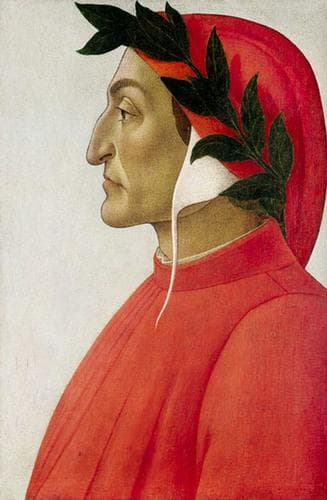
Dante Alighieri, most likely baptized Durante di Alighiero degli Alighieri and often referred to as Dante, was an Italian poet, writer and philosopher. His Divine Comedy, originally called Comedìa and later christened Divina by Giovanni Boccaccio, is widely considered one of the most important poems of the Middle Ages and the greatest literary work in the Italian language.







