“I am the Dice Man. I am the man who has given up control of his life to the dice.”
— The protagonist, Luke Rhinehart, introduces his radical philosophy of letting dice decide his actions.

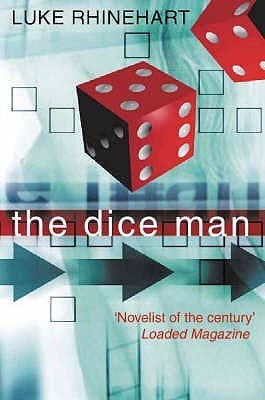
Luke Rhinehart (1971)
Genre
Thriller / Psychology / Philosophy
Reading Time
12-15 hours
Key Themes
See below
Sign in to track this book
A psychiatrist gives his decisions to a dice roll, starting a chaotic experiment that questions fate, free will, and sanity.
“I am the Dice Man. I am the man who has given up control of his life to the dice.”
— The protagonist, Luke Rhinehart, introduces his radical philosophy of letting dice decide his actions.
“The dice giveth and the dice taketh away.”
— Reflecting on the unpredictable outcomes of his dice-based decisions.
“If you can't decide, let the dice decide.”
— A practical mantra Luke uses to justify his reliance on randomness in daily choices.
“The only way to deal with an unfree world is to become so absolutely free that your very existence is an act of rebellion.”
— Luke argues that his dice-driven life is a form of liberation from societal constraints.
“I am not a man; I am a dice.”
— Luke's declaration of his transformed identity, blurring the line between human and object.
“The dice have taught me that there is no such thing as a wrong decision.”
— A lesson Luke learns from embracing randomness, challenging conventional morality.
“Life is a game, and the dice are the only honest players.”
— Luke's cynical view of human hypocrisy, contrasting it with the impartiality of chance.
“To be free, one must first surrender to chaos.”
— A philosophical insight from Luke's experiments with relinquishing control.
“The dice do not judge; they only decide.”
— Highlighting the non-moral nature of his method, freeing him from guilt.
“I have become the ultimate existentialist: I act, therefore I am.”
— Luke connects his dice philosophy to existentialist thought, emphasizing action over essence.
“In randomness, I found my true self.”
— A paradoxical realization that giving up control led to self-discovery.
“The world fears the dice because it fears the truth of its own randomness.”
— Luke critiques society's aversion to acknowledging the role of chance in life.
“Every throw is a leap into the unknown, and that is where life begins.”
— Encouraging embrace of uncertainty as the essence of living fully.
“I am not responsible for what the dice command; I am only responsible for obeying.”
— Luke's justification for abdicating personal responsibility in his actions.
Ready to see how well you understood this book? Take our interactive quiz with 10 questions.

Biography coming soon.







