“Some people are just born to be buried.”
— Reflecting on the grim fate of many characters in the region.

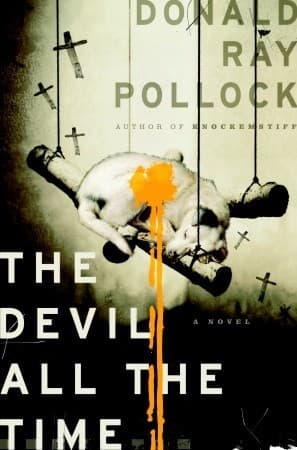
Donald Ray Pollock (2011)
Genre
Thriller / Historical Fiction / Mystery
Reading Time
350 min
Key Themes
See below
Sign in to track this book
In the rural South after WWII, an orphaned son of a disturbed veteran navigates a world of killers, fanatic preachers, and his own violent nature, all while seeking justice and peace.
Willard Russell, a veteran scarred by World War II, returns to Coal Creek, West Virginia. He marries Charlotte, and they have a son, Arvin. When Charlotte gets terminal cancer, Willard's already strong faith becomes a desperate obsession. He builds a 'prayer log' in the woods, where he sacrifices animals—squirrels, dogs, and his own pet dog Jack—believing these blood offerings will make God save Charlotte. Despite his increasingly violent rituals, Charlotte dies, leaving Willard devastated and Arvin orphaned and traumatized by his father's actions.
In Meade, Ohio, Carl and Sandy Henderson are a husband-and-wife serial killer team. Carl, a photographer, picks up male hitchhikers, often ex-military, pretending to offer a ride. Sandy, who seems quiet, goes with him. In a secluded spot, Sandy seduces the victims, and Carl photographs them in compromising positions before they are brutally murdered. Their ritual includes a final photo of the dead person, a grim trophy. They clean their crime scenes carefully, leaving no trace, and continue their deadly journey, driven by an unspoken hunger.
Roy LaRoue, a traveling preacher who handles spiders during sermons, travels the rural South with his crippled, guitar-playing companion, Theodore. Roy's sermons are fiery and unpredictable, often featuring his belief that he can bring the dead back to life. After a sermon where he tries to resurrect a dead woman, he accidentally kills his wife, Helen, by pouring a jar of spiders over her head in a misguided attempt at faith healing. Fleeing the law, Roy and Theodore continue their strange journey, with Theodore's quiet loyalty bordering on obsession for the unstable preacher.
After Willard's suicide following Charlotte's death, Arvin moves in with his paternal grandmother, Emma Russell, in Knockemstiff, Ohio. Emma also takes in Lenora LaRoue, the orphaned daughter of Roy and Helen LaRoue, after Roy abandons her. Arvin and Lenora grow up together, forming a deep, sibling-like bond. Arvin, still affected by his father's extreme faith and violence, often protects Lenora from bullies and the harshness of their poor surroundings, showing a simmering aggression.
A new preacher, Preston Teagardin, arrives in Knockemstiff, quickly charming the religious community with his looks and smooth sermons. Preston is a predatory and manipulative man who targets vulnerable young women. Lenora, deeply religious and naive, becomes fond of Preston and helps him at the church. Preston exploits her innocence, convincing her that their secret meetings are part of a divine plan. He sexually abuses her, destroying her faith and spirit, believing he can act without consequences due to his perceived holy status.
Overwhelmed by guilt, shame, and Preston Teagardin's betrayal, Lenora's fragile world collapses. She believes she is tainted and, unable to reconcile her faith with the injustice she suffered, she takes her own life. Her death devastates Arvin, who sees it as a direct result of Preston's wickedness. Fueled by quiet, burning rage and a deep sense of justice, Arvin decides to avenge Lenora. He confronts Preston Teagardin, shoots him dead in the church, and then flees, becoming a fugitive.
Sheriff Lee Bodecker, Sandy Henderson's brother, is a corrupt lawman who has taken bribes and ignored various illegal activities in Meade for years. He is also involved in his sister's murders, though he claims not to know the full extent. After Arvin kills Preston Teagardin, Bodecker, already under pressure from an upcoming election and scrutiny of his ethics, pursues Arvin. He sees catching Arvin as a way to improve his image and distract from his own worsening corruption, unknowingly leading him toward his family's dark secrets.
As Arvin flees through the rural landscape, he hitchhikes to avoid capture. Carl Henderson picks him up, unaware of Arvin's identity or his recent act of violence, seeing him as another potential victim. Carl starts his usual routine, trying to lure Arvin to a secluded area. However, Arvin, hardened by his past and suspicious, senses the danger. The encounter quickly turns violent. Arvin, in self-defense, kills Carl Henderson, unknowingly ending the serial killer's reign of terror.
Upon finding Carl's body, Sandy Henderson is consumed by grief and a desire for revenge. She learns Arvin Russell is responsible for her husband's death and sets out to find him. Meanwhile, Sheriff Bodecker, still pursuing Arvin, tries to cover up his involvement in his sister's crimes and his general corruption. Sandy, Arvin, and Bodecker meet in a tense, violent confrontation in the woods. Sandy tries to kill Arvin, but Arvin, again in self-defense, kills Sandy. Sheriff Bodecker then arrives, confronts Arvin, but Arvin also kills Bodecker, ending the corrupt line.
Having killed Carl and Sandy Henderson, and Sheriff Bodecker, Arvin is left alone, covered in blood, and deeply conflicted. He thinks about the cycle of violence that has marked his life and the lives of those around him, from his father's extreme sacrifices to the predators he met. He recognizes the darkness within himself, the capacity for violence he has inherited and developed. With no clear path forward, Arvin continues to drift, a survivor haunted by his past, carrying the weight of his actions, and wondering if he can ever escape the 'devil all the time' that seems to fill his world.
The Protagonist
Arvin transforms from a traumatized child into a man who, though trying to be good, is repeatedly forced to commit violent acts in the name of justice or self-preservation, becoming a reflection of the brutal world he inhabits.
The Supporting
Willard descends from a devout, traumatized veteran into a man consumed by a twisted interpretation of faith, culminating in his suicide.
The Antagonist
Carl remains a static character, a predator whose reign of terror is abruptly ended by Arvin.
The Antagonist
Sandy remains a static character, a killer who seeks revenge for her husband's death, leading to her own demise.
The Supporting
Roy's trajectory is one of delusion and flight, culminating in his disappearance after his wife's death, leaving a lasting impact on his daughter.
The Supporting
Lenora's arc is one of tragic innocence, from a hopeful, devout girl to a broken victim of exploitation, leading to her suicide.
The Antagonist
Preston's arc is one of unchecked predation, ending abruptly with his murder by Arvin.
The Antagonist
Bodecker's arc is one of escalating corruption and self-preservation, leading to his demise at Arvin's hands.
The Supporting
Emma remains a steadfast figure, providing a moral anchor for Arvin and Lenora amidst their turbulent lives.
The novel shows how religious devotion, taken to extremes or twisted by human depravity, can lead to violence, exploitation, and moral decay. Willard Russell's sacrificial prayers become gruesome acts of animal cruelty, while Roy LaRoue's sermons lead to his wife's accidental death. Most chillingly, Preston Teagardin uses his position as a preacher to manipulate and abuse Lenora, showing how faith can be perverted to justify terrible acts. The story suggests that even the desire for salvation can be a source of deep evil.
“Some people were just born to be buried.”
Violence is common throughout the novel, often inherited or repeated in a seemingly endless cycle. Willard's wartime trauma and extreme acts of faith influence Arvin's own capacity for violence. Arvin, while often acting out of justice or self-preservation, becomes part of this cycle, killing those who have wronged him or others. The serial killers Carl and Sandy Henderson represent senseless, predatory violence, while Sheriff Bodecker's corruption is maintained through intimidation. The story suggests that escaping this cycle is nearly impossible in the bleak rural South.
“He always said that there was a lot of good in people, but you had to kill a lot of them to find it.”
A main theme is the constant threat predators pose to the innocent and vulnerable. Lenora LaRoue, with her strong faith and naive nature, becomes a tragic victim of Preston Teagardin's sexual exploitation. The hitchhikers picked up by Carl and Sandy Henderson are innocent people seeking passage, only to be brutally murdered. Arvin, though hardened, often finds himself in situations where he must defend himself against those who want to harm him. The novel paints a grim picture where innocence is rarely protected and often becomes a target for the inherent evil in the world.
“He knew that the world was full of evil, and that it was a constant struggle to keep it from taking over.”
The characters in the novel rarely fit neatly into good or evil categories. Arvin, despite committing multiple murders, is often driven by a strong, though violent, sense of justice. Even the 'good' characters are flawed and capable of extreme acts. The story challenges the reader to consider the complexities of morality in a world where survival often demands difficult choices. True redemption seems rare, as characters are constantly pulled back into cycles of violence and despair, and their actions often have unintended, devastating results.
“You could pray to God and still wind up in the ditch.”
The novel is set after World War II, showing how the trauma of war, seen in Willard Russell's experiences, directly affects future generations. The bleak, poor setting of rural Ohio and West Virginia also contributes to a sense of inherited hardship and desperation. Characters are often haunted by their parents' actions or the decay around them, suggesting that the past is not just a background but an active force that dictates their present and limits their future. The wrongs of the parents are passed down to the children.
“He would never understand the devil that was in his father, nor the one that seemed to follow him wherever he went.”
Multiple character storylines converge over time.
The novel employs a non-linear narrative structure, following several distinct character arcs across different locations and time periods before gradually bringing them together. This device creates suspense as the reader anticipates how these seemingly disparate lives will eventually intersect. It emphasizes the interconnectedness of fate and the pervasive nature of evil within the story's world, highlighting how seemingly unrelated acts of violence and faith ultimately converge into a single, tragic tapestry.
A physical manifestation of twisted faith and sacrifice.
Willard Russell's 'prayer log' serves as a powerful symbol of his perverted faith and the extreme lengths to which he goes in his desperate attempt to save his wife. The log, initially a place of fervent prayer, becomes a site of brutal animal sacrifices, representing the dark, violent underbelly of religious extremism. It foreshadows the cycle of violence and the corrupting nature of faith that will permeate Arvin's life and the wider narrative, becoming a physical reminder of inherited trauma and misguided devotion.
An all-knowing, often detached, and cynical narrative voice.
The novel uses an omniscient narrator who possesses complete knowledge of all characters' thoughts, actions, and fates. This narrative voice is often detached, bleak, and infused with a sense of fatalism and cynicism, particularly regarding human nature and the pervasive presence of evil. This allows the story to shift perspectives seamlessly, providing insights into the motivations of both protagonists and antagonists, and reinforcing the novel's overarching themes of moral decay and the inescapable nature of violence.
A pervasive sense of dread and impending doom.
Pollock masterfully uses atmospheric descriptions of the desolate, impoverished landscapes of rural Ohio and West Virginia to create a constant sense of dread and foreshadowing. The grim settings, coupled with the characters' troubled inner lives, contribute to an oppressive mood that hints at the tragic events to come. This pervasive darkness suggests that violence and despair are inherent to the environment, making the characters' struggles seem almost predetermined and their fates inevitable.
“Some people are just born to be buried.”
— Reflecting on the grim fate of many characters in the region.
“Arvin understood that his father had been trying to buy God's love, but it was just like trying to buy the love of a woman who didn't want you.”
— Arvin reflecting on his father's desperate religious rituals and sacrifices.
“He knew that God didn't care about the good or bad in people, only whether they believed.”
— Reverend Preston Teagardin's twisted view of divine judgment.
“There was a lot of sin in the world, and most of it wasn't even fun.”
— A cynical observation on the nature of evil and human behavior.
“It seemed to Arvin that the world was nothing but a series of traps.”
— Arvin's growing disillusionment with life and the circumstances he faces.
“He often thought that the difference between a good man and a bad one was not much at all.”
— A character's reflection on the thin line between good and evil.
“The devil all the time.”
— The recurring theme of pervasive evil and suffering throughout the lives of the characters.
“He was a man who believed in the power of prayer, but only if you prayed with a gun in your hand.”
— Describing a character's pragmatic and violent approach to faith.
“Every day was a struggle, a fight against the devil, and sometimes the devil won.”
— A general statement about the constant battle against malevolent forces in the characters' lives.
“There were too many ghosts in the world, and most of them were still alive.”
— A somber reflection on the lingering presence of past traumas and their impact on the living.
“He just wanted to do what was right, but what was right seemed to change with every sunrise.”
— Arvin's internal conflict and confusion about morality in a corrupt world.
“The truth was, he didn't care about anybody but himself, and maybe that was the only way to survive.”
— A character's cynical justification for their self-serving actions.
“God would forgive him, he was sure of that, because God always forgave the faithful, no matter what they did.”
— Reverend Preston Teagardin's self-serving interpretation of divine forgiveness.
“The dead don't care about justice, only the living do.”
— A grim realization about the futility of seeking justice for those who have already perished.
Ready to see how well you understood this book? Take our interactive quiz with 10 questions.

Donald Ray Pollock is an American author known for his gritty, darkly humorous fiction often set in the rural American South. His debut short story collection, "Knockemstiff," won the PEN/Bingham Prize for Debut Fiction. Pollock's first novel, "The Devil All the Time," was adapted into a film and cemented his reputation for visceral storytelling and unflinching portrayals of troubled characters.







