
BookBrief
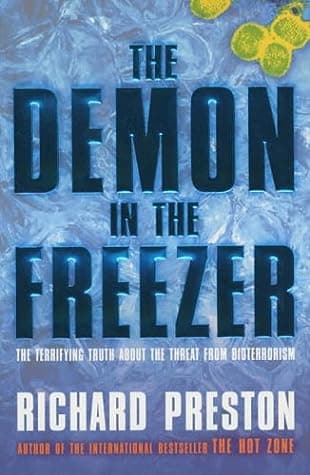
The Demon in the Freezer cover
Archivist's Choice

The Demon in the Freezer

Richard Preston (2002)

Genre

Thriller / History / Health / Science

Reading Time

240 min

Key Themes

See below

Track Your Reading

Sign in to track this book

After 9/11, a US virologist races to stop weaponized smallpox, brought back from storage and possibly made into a super-virus.

Core Idea

Richard Preston's "The Demon in the Freezer" examines humanity's complex relationship with smallpox. The disease is officially gone, but it lives on in high-security freezers and in the minds of biodefense experts. The book says that smallpox is still a threat, even though it was eradicated. This is because it could be released by accident or used in bioterrorism. This situation has led to a global discussion about keeping the virus in labs, the need for research, and the ethics of making such a pathogen into a weapon. Preston shows the link between science, international politics, and the ongoing danger of a disease coming back. He questions what eradication truly means when the 'demon' can still be woken up.
Reading time
240 min
Difficulty
Medium
✓ Read this if...
You are fascinated by the intersection of virology, bioterrorism, public health policy, and the ethical dilemmas of modern science, presented with the tension of a thriller.
✗ Skip this if...
You prefer fictional thrillers over non-fiction accounts of scientific and historical events, or find detailed descriptions of diseases and biodefense topics unsettling.

Core idea

The central argument and framework that powers the entire book.

Richard Preston's "The Demon in the Freezer" examines humanity's complex relationship with smallpox. The disease is officially gone, but it lives on in high-security freezers and in the minds of biodefense experts. The book says that smallpox is still a threat, even though it was eradicated. This is because it could be released by accident or used in bioterrorism. This situation has led to a global discussion about keeping the virus in labs, the need for research, and the ethics of making such a pathogen into a weapon. Preston shows the link between science, international politics, and the ongoing danger of a disease coming back. He questions what eradication truly means when the 'demon' can still be woken up.

At a glance

Reading time

240 min

Difficulty

Medium

Read this if...

You are fascinated by the intersection of virology, bioterrorism, public health policy, and the ethical dilemmas of modern science, presented with the tension of a thriller.

Skip this if...

You prefer fictional thrillers over non-fiction accounts of scientific and historical events, or find detailed descriptions of diseases and biodefense topics unsettling.

Key Takeaways

1

The Ghost of Smallpox

Eradicated, but not gone: the persistent threat of a weaponized historical plague.

Quote

The smallpox virus now resides, officially, in only two high-security freezers... But the demon in the freezer has been set loose.

Smallpox, eradicated in 1979, remains a threat because it could be used as a bioweapon. Even though it was eliminated globally, the virus still exists in official labs (CDC in Atlanta, Vector in Siberia) and, more concerning, in suspected illegal stashes held by hostile countries. The book shows scientists' fear that this contagious and deadly pathogen could be weaponized or genetically changed into a 'superpox' that existing vaccines cannot stop. This threat means constant watchfulness and research are needed, even for a virus though...

Supporting evidence

The existence of official smallpox stocks at the CDC and Vector, contrasted with the strong suspicion of illegal holdings by states like Iraq and North Korea, highlights the dual nature of its eradication – a public health triumph shadowed by a bioweapons nightmare.

Apply this

Understand that 'eradicated' does not mean 'extinct' when it comes to biological agents, especially those with historical weaponization potential. Support funding for biodefense research and international treaties aimed at securing and destroying all remaining dangerous pathogens.


smallpox-eradicationbioweaponsviral-resurrection
2

The Anthrax Wake-Up Call

The 2001 anthrax attacks exposed critical gaps in national biodefense preparedness.

Quote

The first major bioterror event in the United States... was a clarion call for scientists who work with 'hot' agents to find ways of protecting civilian populations against biological weapons.

The anthrax attacks of October 2001 were a harsh wake-up call for the United States, showing that bioterrorism was a real danger. This event caused a major rethinking of national security, shifting attention and money towards biodefense. Before 9/11 and the anthrax letters, the US biodefense system was scattered and lacked funding. The attacks revealed weaknesses in public health response, intelligence gathering, and the creation of defenses. The book describes the urgent, often disorganized, response at places like USAMRIID, showing ...

Supporting evidence

USAMRIID going into 'Delta Alert' on September 11th and activating emergency response teams immediately following the anthrax letters illustrates the rapid, high-stakes pivot in national security priorities and the sudden urgency thrust upon biodefense scientists.

Apply this

Recognize that preparedness for 'black swan' events, especially in biodefense, requires sustained, proactive investment, not just reactive measures after an attack. Advocate for robust public health infrastructure and rapid-response capabilities.

anthrax-attacksbioterrorismnational-biodefense
3

The Ethical Tightrope of Biodefense

Scientists grapple with the moral complexities of studying deadly pathogens to protect against them.

Quote

Jahrling is leading a team of scientists doing controversial experiments with live smallpox virus at CDC... what may be at stake if his last bold experiment fails.

The book explores the ethical problems scientists like Peter Jahrling face when they work with the 'demons' they are trying to control. Bringing back live smallpox virus for research, even with top security, carries big risks and causes intense debate. Is it right to bring back an eradicated, deadly pathogen, possibly creating new dangers, to develop a defense? This conflict between the need to protect humanity from bioweapons and the risks of handling such agents is a main point. The book asks: at what point does defensive research a...

Supporting evidence

Peter Jahrling's team conducting 'controversial experiments with live smallpox virus at CDC' directly illustrates the ethical tightrope walked by biodefense researchers. The mere act of reawakening the virus is a high-stakes gamble.

Apply this

Engage in informed discussions about the ethics of 'dual-use research' – scientific work that can be used for both benevolent and malevolent purposes. Support stringent oversight and international cooperation to minimize risks while enabling crucial defensive research.

dual-use-researchbioethicspathogen-containment
4

USAMRIID: The Biodefense Epicenter

Fort Detrick's complex history as both a bioweapons hub and a biodefense vanguard.

Quote

Richard Preston takes us into the heart of Usamriid, the United States Army Medical Research Institute of Infectious Diseases at Fort Detrick, Maryland, once the headquarters of the U.S. biological weapons program and now the epicenter of national biodefense.

USAMRIID at Fort Detrick is a key, though historically complex, part of the US biodefense plan. Its past as the center of the US biological weapons program casts a long shadow, but its current role is only about protection. This shows a big change: from making offensive biological weapons to leading defensive countermeasures. The book presents USAMRIID as a high-stakes place where top scientists, like Peter Jahrling, work fast to create vaccines and treatments for the world's most dangerous pathogens. It is where advanced science meet...

Supporting evidence

The description of USAMRIID as 'once the headquarters of the U.S. biological weapons program and now the epicenter of national biodefense' encapsulates its complex history and current critical role.

Apply this

Understand the importance of dedicated research institutions like USAMRIID in protecting against biological threats. Support the ongoing funding and security measures necessary for such facilities to operate effectively and safely.

usamriidfort-detrickbiodefense-research
5

The Race Against Superpox

Genetic engineering's potential to create vaccine-resistant bioweapons demands urgent countermeasures.

Quote

Jahrling is haunted by the thought that biologists in secret labs are using genetic engineering to create a new superpox virus, a smallpox resistant to all vaccines.

One of the most frightening possibilities in the book is that hostile groups could genetically engineer a 'superpox' virus. This is not just about bringing back an old threat; it is about making the danger much worse. A smallpox strain made to resist existing vaccines would cancel out decades of public health successes and make current defenses useless. This situation puts huge pressure on scientists like Jahrling to create new antivirals and vaccines. This task requires understanding the virus at a genetic level and predicting possib...

Supporting evidence

The specific fear haunting Jahrling—that 'biologists in secret labs are using genetic engineering to create a new superpox virus, a smallpox resistant to all vaccines'—underscores the advanced and evolving nature of the bioweapons threat.

Apply this

Support international efforts to monitor and regulate genetic engineering research to prevent its misuse. Invest in advanced scientific research to predict and counter potential engineered biothreats before they emerge.

superpoxgenetic-engineeringantiviral-development
6

The Human Element of Hot Science

Behind the biohazards are dedicated, often eccentric, scientists driven by a profound sense of duty.

Quote

Peter Jahrling, the top scientist at Usamriid, a wry virologist who cut his teeth on Ebola, one of the world’s most lethal emerging viruses...

Preston makes the often-unknown world of biodefense human. Through people like Peter Jahrling, a virologist who worked on Ebola, the book shows the extraordinary individuals working at the forefront of this dangerous science. These are not anonymous researchers but dedicated professionals, often with unique personalities, who face big personal risks and work pressures. Their work needs not only brilliant scientific minds but also great courage, toughness, and a strong sense of responsibility to protect humanity. The book captures thei...

Supporting evidence

The detailed characterization of Peter Jahrling, including his personality and his experience 'cutting his teeth on Ebola,' brings a crucial human dimension to the highly technical and dangerous field of virology and biodefense.

Apply this

Appreciate the human cost and dedication involved in high-stakes scientific research, especially in fields like biodefense. Support programs that attract and retain top scientific talent in these critical areas.

virologyscientific-dedicationbiodefense-personnel
7

Secrecy and Security

The extreme measures required to contain biological threats and the implications of ORCON clearance.

Quote

Peter Jahrling... has ORCON security clearance that gives him access to top secret information on bioweapons.

The world of biodefense is very secret, which is necessary given how catastrophic the agents involved can be. The book shows this through Peter Jahrling's ORCON security clearance, which gives him access to highly secret information on bioweapons. This level of secrecy shows the government's efforts to control sensitive information and keep it from falling into the wrong hands. However, it also brings up questions about transparency, public oversight, and the possibility of important information being kept separate. The security rules...

Supporting evidence

Jahrling's ORCON security clearance, granting him access to 'top secret information on bioweapons,' exemplifies the extreme levels of secrecy and control surrounding biodefense intelligence and research.

Apply this

Understand the delicate balance between necessary national security secrecy and public transparency in areas of high public risk. Advocate for robust internal oversight mechanisms within classified biodefense programs.

orcon-clearanceclassified-informationbiosecurity
8

The Ongoing FBI Investigation

The complex, protracted nature of bioterror investigations and the pursuit of accountability.

Quote

Preston reports, in unprecedented detail, on the government’s response to the attacks and takes us into the ongoing FBI investigation.

The book gives a rare look into the detailed and often difficult world of bioterrorism investigations, focusing on the FBI's efforts to track the anthrax attacks. Unlike regular crimes, bioterrorism leaves a unique and complex forensic trail, involving not just crime scene analysis but also microbiology, disease study, and national security intelligence. Preston's detailed account of the 'ongoing FBI investigation' shows how painstaking and multi-faceted these cases are. It reveals the difficulties of finding attackers, understanding ...

Supporting evidence

Preston's 'unprecedented detail' on the 'ongoing FBI investigation' into the anthrax attacks, based on interviews with top-level agents and Dr. Steven Hatfill, demonstrates the depth and complexity of these forensic and intelligence operations.

Apply this

Appreciate the unique challenges of investigating bioterrorism and the need for specialized, interagency cooperation. Support resources for forensic science and intelligence gathering in the context of biological threats.

fbi-investigationbioterrorism-forensicsintelligence-gathering
9

The Unseen Enemy

Biological weapons represent a threat that is invisible, insidious, and uniquely terrifying.

Quote

The demon in the freezer has been set loose. It is almost certain that illegal stocks are in the possession of hostile states...

Biological weapons are different from conventional or nuclear threats because they are often invisible, silent, and can spread secretly before their effects are even known. This makes them especially terrifying. The 'demon in the freezer' comparison perfectly describes this unseen, hidden danger. Unlike a bomb, a virus can copy itself and spread quickly, turning people into unknowing carriers. The book highlights the psychological effect of such a threat, where fear and uncertainty can be as harmful as the pathogen itself. This requir...

Supporting evidence

The description of smallpox as 'the demon in the freezer' that 'has been set loose' encapsulates the invisible, insidious nature of biological threats, which can emerge from hidden sources and spread silently.

Apply this

Cultivate critical thinking and avoid panic when faced with public health crises. Support robust public health communication strategies that balance transparency with reassurance during biological threats.

invisible-threatpathogen-spreadpublic-health-communication

Critical analysis

Notable Quotes

Smallpox is the worst disease ever to afflict humanity.

Opening statement about the historical impact of smallpox.

The demon in the freezer is smallpox, and it is waiting.

Metaphorical description of stored smallpox samples as a lurking threat.

A single case of smallpox would be a global emergency.

Discussion of the disease's potential for rapid spread and modern vulnerability.

The virus is a masterpiece of malevolent evolution.

Description of smallpox's biological efficiency and lethality.

We eradicated smallpox from the wild, but we kept it alive in laboratories.

Reflection on the irony of preserving the virus after its eradication.

Bioterrorism is not a future threat; it is a present reality.

Warning about the use of biological agents in contemporary conflicts.

The smallpox vaccine is a story of both triumph and tragedy.

Acknowledgment of the vaccine's success and its side effects.

In the wrong hands, smallpox could be the ultimate weapon.

Speculation on the virus's potential as a bioweapon.

The World Health Organization's eradication campaign was a feat of human cooperation.

Praise for the global effort to eliminate smallpox.

Viruses do not respect borders.

Comment on the global nature of infectious disease threats.

We are playing with fire by keeping smallpox samples.

Critique of the decision to retain the virus in storage.

The memory of smallpox is fading, and with it, our vigilance.

Concern about complacency as generations forget the disease's horrors.

A bioterror attack with smallpox would collapse healthcare systems.

Prediction of the catastrophic impact of a smallpox outbreak today.

Science gave us the power to eradicate smallpox, and science keeps it alive.

Observation on the dual role of science in controlling and preserving the virus.

Quiz

Test Your Knowledge

Ready to see how well you understood this book? Take our interactive quiz with 10 questions.

10
Questions
~5
Minutes
?
Best Score

Key Questions (FAQ)

The book is a nonfiction thriller that explores bioterror threats, focusing on the 2001 anthrax attacks and the ongoing danger of smallpox. It follows scientists at USAMRIID as they work to defend against biological weapons, detailing secret research and government responses.

About the author




