“They say that the Declaration is a gift, a chance to live forever. But what is forever without freedom?”
— Anna, reflecting on the government's promise of immortality through the Declaration.

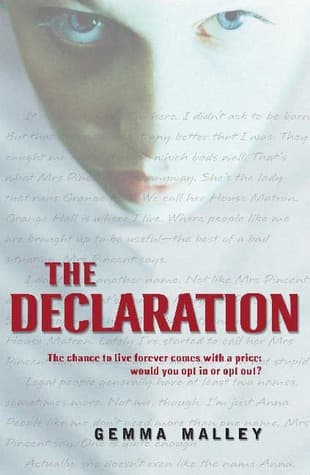
Gemma Malley (2007)
Genre
Fantasy / Science Fiction / Young Adult / Romance
Reading Time
320 min
Key Themes
See below
Sign in to track this book
In a future where eternal youth requires a signed declaration and children are 'Surplus' outlaws, Anna navigates a world where defying the law means choosing between a forbidden life and an unnatural immortality.
Anna Covey, a sixteen-year-old Surplus, lives a bleak existence in Grange Hall, an institution for illegal children. She has been there since she was five, constantly reminded of her 'crime' of being born after the Declaration was signed, which outlawed natural birth in favor of Longevity drugs. Her days are filled with hard labor, indoctrination, and the constant threat of 're-education' for any disobedience. Anna, like all Surpluses, is taught to despise her parents for bringing her into existence and to look forward to the day she can contribute to society by working for the 'Legals' (those who signed the Declaration) and eventually 'expire' (die) to make way for them. She secretly holds onto a tattered drawing of a house, a relic from her past, though she doesn't understand what it means.
The monotony of Grange Hall is broken by the arrival of Peter Bradley, a new Surplus. Unlike the other children who accept their fate, Peter openly questions the system and the teachings of Mrs. Pincent, the cruel matron of Grange Hall. He claims his parents loved him and were not selfish, a concept completely new to Anna. Peter's defiant attitude and his insistence that there's a world beyond Grange Hall, where children are cherished, slowly begins to change Anna's beliefs. He shows her a small, forbidden book of children's stories, sparking curiosity and doubt in her.
Peter shares stories from his book with Anna, tales of families and love that contradict everything she has been taught. He reveals that his parents were 'Undergrounders,' people who secretly lived outside the Longevity system and believed in natural life. This information is new and dangerous. Anna is drawn to Peter's hope and his vision of a different future. During a rare supervised outing to a 'Legal' park, Peter tries to show Anna a glimpse of the outside world, pointing out houses and people, further fueling her growing doubts about Grange Hall's narrative.
Peter wants freedom and devises an escape plan. He tries to convince Anna to join him, but her fear and indoctrination keep her from fully committing. Peter tries to escape alone but is caught by the Guardians. As punishment, he undergoes 're-education,' a process that erases memories and makes the recipient docile. Anna is devastated by his change, feeling immense guilt for not helping him. Though physically present, the Peter she knew is gone, replaced by a compliant, emotionless boy. This event strengthens Anna's fear of challenging the system.
Years later, Anna and Peter, along with other Surpluses, are released from Grange Hall to work as servants for Legals. Anna is assigned to the kind but lonely Mrs. Sharpe, a wealthy Legal who lives in a grand house. Peter is assigned to the cruel and demanding Mrs. Grout. While working for Mrs. Sharpe, Anna experiences a bit of freedom and luxury she never imagined. She learns about the Legals' world, observing their endless pursuit of youth and their fear of death. Mrs. Sharpe, in her own way, shows Anna a glimmer of human connection, though their relationship remains limited by their societal roles.
One day, while cleaning Mrs. Sharpe's attic, Anna discovers a hidden box containing old photographs and documents. She finds pictures of a younger Mrs. Sharpe with a man and a baby – a baby that looks exactly like a young Anna. She also finds a letter addressed to her, revealing that Mrs. Sharpe is her biological mother, and the man in the photos is her father. The house in her tattered drawing is her childhood home. This revelation shatters Anna's understanding of her identity and her past. Mrs. Sharpe, feeling guilt and loneliness, confesses the truth, explaining that she and Anna's father, an Undergrounder, had tried to hide Anna but were eventually caught.
Mrs. Sharpe further reveals that Peter Bradley is Anna's biological brother. His 're-education' wasn't permanent; he had faked it to survive. He, too, had been trying to find his family. Anna, now with a true sense of her identity, begins to communicate secretly with Peter. They piece together fragmented memories and information, realizing that their parents were important figures in the Underground movement, fighting against Longevity. They decide they must escape the system completely and find their parents, who they believe are still alive and in hiding, perhaps in the 'Unwound' (the wild, unmanaged lands outside the cities).
With Mrs. Sharpe's reluctant help, Anna and Peter plan their escape. Mrs. Sharpe provides them with supplies, money, and directions to a hidden meeting point. They make a daring break from their Legal households, evading Guardians and security cameras. Their journey takes them through the desolate, dangerous outskirts of the city, where they encounter the harsh realities of life outside the controlled environment. They face hunger, fear, and the constant threat of being discovered, but their determination to find their parents and a life of freedom keeps them going. They rely on their wits and their growing bond to survive.
After days of hard travel, Anna and Peter find a hidden community in the Unwound – a small, strong group of Undergrounders who have rejected Longevity and live self-sufficiently. The community members cautiously welcome them, recognizing the children's family name. The Undergrounders reveal that Anna and Peter's parents were leaders in their cause, respected for their courage and their vision of a world where natural life was valued. They learn that their parents were captured and imprisoned, but their legacy lives on through the resistance movement. This community offers them a safe place and a sense of belonging.
Anna, now strengthened by her heritage and the love of her brother and the Underground community, decides to confront Mrs. Pincent. She returns to Grange Hall, not as a frightened Surplus, but as a defiant individual. She exposes Mrs. Pincent's cruelty and the injustices of the system to the other Surpluses, planting seeds of rebellion. Though she cannot dismantle the entire system alone, her act of defiance inspires others. Anna and Peter choose to stay with the Undergrounders, dedicating themselves to their parents' cause and working towards a future where children are no longer illegal, and humanity embraces its natural cycle of life and death, rather than an artificial immortality.
The Protagonist
From a brainwashed, fearful Surplus, Anna transforms into a courageous and determined individual who reclaims her identity and fights for a world where children are valued.
The Protagonist/Love Interest
Peter maintains his rebellious spirit throughout his ordeal, becoming a beacon of hope and a vital partner in Anna's quest for truth and freedom.
The Antagonist
Mrs. Pincent remains a static antagonist, unwavering in her commitment to the system and her cruelty towards the Surpluses.
The Supporting
Mrs. Sharpe moves from a guilt-ridden, passive observer to an active participant in her children's escape, seeking redemption for her past choices.
The Mentioned/Supporting
His influence, though primarily through memory and legacy, inspires Anna and Peter to continue the fight for natural life.
The Supporting
Mrs. Grout remains a static character, embodying the self-indulgence and cruelty of certain Legals.
The Supporting
The Guardians serve as a constant external threat, enforcing the societal norms and laws.
The Supporting
The Undergrounders represent a static counter-culture, providing a goal and a future for the protagonists.
The novel explores identity through Anna's journey. Raised to believe she is a 'Surplus' and a 'mistake,' Anna's sense of self is initially defined by the oppressive system. The arrival of Peter and the revelation of her true parentage make her question everything she knows. She moves from passively accepting her assigned identity to actively seeking and embracing her true heritage as the child of Undergrounders. This theme is central to her development, as she sheds the shame imposed upon her and finds strength in her origins.
““You are not a Surplus. You are a miracle.””
The book examines the ethics of a society that values artificial immortality over natural life. The 'Declaration' and the Longevity drugs create a world where children are outlawed, and the natural cycle of birth and death is suppressed. The Undergrounders support the right to natural existence, arguing against the pride of eternal life. This theme questions what it means to live and whether endless life at the cost of new life is a moral choice. Anna and Peter's fight is about reclaiming this right for future generations.
““They want to live forever, but they’ve forgotten how to live at all.””
The society in 'The Declaration' is authoritarian, with the Longevity system enforcing strict control over its citizens. Grange Hall is an example of this oppression, using indoctrination and punishment to break the spirits of Surpluses. The theme of rebellion is introduced through Peter's defiance and later embraced by Anna. The Underground movement represents a larger, organized rebellion against the state, showing the human spirit's desire for freedom and justice in the face of tyranny.
““They can lock up our bodies, but they can’t lock up our minds.””
In a world where children are illegal and family units are dismantled, family and love become a powerful, subversive force. Anna's initial lack of understanding about her parents' love, contrasted with Peter's unwavering belief in his, drives much of the early story. The discovery of their sibling bond and Mrs. Sharpe's confession emphasize the lasting nature of familial love. The Undergrounders, who form new, chosen families, further emphasize the human need for connection and belonging, challenging the sterile, individualistic nature of the Longevity society.
““Having a child is the greatest act of defiance.””
Memory is important in Anna's journey. Her fragmented memories of her early childhood, especially the drawing of the house, help her uncover the truth about her past. 'Re-education,' which aims to erase memories and enforce a manufactured truth, shows how memory shapes identity and resistance. Peter's ability to fake re-education and retain his memories shows the human mind's resilience against manipulation. The search for truth about their origins drives both Anna and Peter throughout the story.
““They can make you forget, but they can’t make you un-live it.””
The foundational law outlawing natural birth and establishing Longevity.
The Declaration is the central plot device, serving as the inciting incident for the entire dystopian society. It's a legal document that demands citizens sign away their right to have children in exchange for Longevity drugs and eternal life. This single act creates the 'Legal' class and the 'Surplus' class, driving the core conflict of the novel. It represents the state's control over human biology and morality, setting the stage for the oppression and rebellion that follow. Its existence directly dictates the lives of all characters.
The scientific means to eternal youth and life.
Longevity drugs are the technological innovation that enables the dystopian society's existence. They are the 'fountain of youth' that everyone craves, making natural death and aging obsolete for those who sign the Declaration. These drugs symbolize humanity's hubris and fear of death, creating a sterile, static world devoid of new life. Their availability is the carrot that motivates compliance with the Declaration, and their effects (or lack thereof for Surpluses) underscore the class divide and the moral questions posed by the book.
The institution for indoctrinating 'Surplus' children.
Grange Hall functions as a symbolic and literal prison for Surplus children. It is a key setting that establishes the harsh, dehumanizing conditions under which Anna and Peter are raised. It serves as a tool for ideological control, where children are systematically stripped of their individuality, family connections, and sense of self-worth. The rules, punishments, and daily routines within Grange Hall are plot devices that illustrate the extent of the state's oppression and act as a catalyst for Anna's eventual rebellion.
Symbolic objects representing truth, memory, and hope.
Anna's tattered drawing of a house is a powerful symbol of her lost memories and true identity. It's a tangible link to her past, which she unconsciously clings to, representing the truth buried beneath years of indoctrination. Peter's forbidden book of children's stories serves a similar purpose, offering glimpses of a world where children are cherished and families exist. Both objects are plot devices that spark curiosity, challenge the official narrative, and ultimately guide Anna and Peter towards the truth about their origins and the possibility of a different future.
A method of memory suppression and behavioral modification.
'Re-education' is a chilling plot device used by the authorities to punish and control defiant Surpluses. It involves a process that erases memories and makes the recipient compliant and docile. This device highlights the dystopian regime's ultimate control over the minds of its citizens. Peter's feigned re-education demonstrates his intelligence and resilience, turning a tool of oppression into a means of survival. It also raises questions about the nature of memory, identity, and free will in a totalitarian state.
“They say that the Declaration is a gift, a chance to live forever. But what is forever without freedom?”
— Anna, reflecting on the government's promise of immortality through the Declaration.
“We are not just numbers in a system. We are people, with dreams and hopes that deserve to be lived.”
— Peter encouraging Anna to resist the oppressive regime.
“Love is the one thing they can't control, the one thing that makes us truly alive.”
— Anna realizing the power of her feelings for Peter.
“The Longevity drug doesn't give you life; it steals it, one day at a time.”
— A critique of the society's reliance on anti-aging treatments.
“In a world where everyone lives forever, no one really lives at all.”
— A philosophical observation about the consequences of immortality.
“Fear is their greatest weapon, but courage is ours.”
— Peter motivating others to stand up against the authorities.
“Sometimes the smallest acts of rebellion are the most powerful.”
— Anna learning to challenge the system in subtle ways.
“We were born to die, and in that, we find our purpose.”
— A character embracing the natural cycle of life.
“The Declaration promises safety, but it demands your soul in return.”
— Warning about the cost of conforming to societal norms.
“Hope is a dangerous thing in a world that wants you compliant.”
— Reflecting on the risks of dreaming in a controlled society.
“They call us Surpluses, but we are the future they fear.”
— A defiant statement from the younger generation.
“True freedom isn't given; it's taken, with every breath we choose to fight.”
— A rallying cry for resistance against the establishment.
“In the silence of obedience, we lose our voices. In rebellion, we find them.”
— Emphasizing the importance of speaking out.
Ready to see how well you understood this book? Take our interactive quiz with 10 questions.







