“The world is full of interesting coincidences, but only a fool would base his plans on them.”
— Fandorin's observation about chance and strategy.

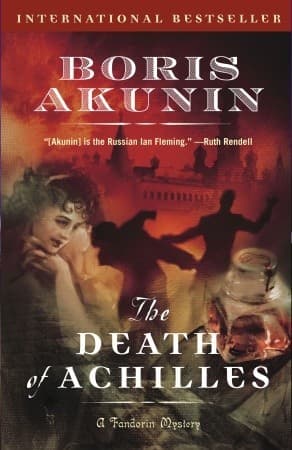
Boris Akunin (2006)
Genre
Thriller / Historical Fiction / Mystery
Reading Time
6-7 hours
Key Themes
See below
Sign in to track this book
In 1882 Moscow, the detective Erast Fandorin uncovers deceit and passion around a war hero's suspicious death, leading him from a hotel armchair to a mysterious singer's boudoir.
In 1882, Erast Fandorin returns to Moscow with his Japanese manservant, Masa, after years abroad. They check into the 'Dusot' hotel. There, Fandorin learns that his former comrade-in-arms, General Michel Sobolev – a celebrated hero known as 'Achilles' – has died suddenly in his room. The official cause is a heart attack. Fandorin, with his sharp observational skills, immediately senses something wrong about the scene. The general's body is in an armchair, seemingly at peace, but Fandorin's intuition is triggered by subtle inconsistencies, such as a tea glass's position and the room's tidiness. These details do not fit the image of a man suffering a fatal cardiac event.
Fandorin begins his unofficial investigation, questioning hotel staff and reviewing the circumstances. His inquiries lead him to Wanda, a beautiful and enigmatic singer described as 'not exactly a courtesan.' General Sobolev had been secretly involved with her. It is revealed that Sobolev died not in his hotel room, but in Wanda's bed, after a night together. The body was then discreetly moved back to the hotel to avoid scandal. Wanda is initially uncooperative, but Fandorin's persistent yet polite questioning, combined with his reputation, eventually gets more information. This paints a picture of Sobolev's final hours that contradicts the official story and deepens the mystery.
As Fandorin investigates, he discovers that General Sobolev, despite his public image as a straightforward military hero, led a complex double life. He was not only romantically involved with Wanda but also secretly connected to a shadowy political organization. Fandorin suspects that Sobolev's death was not a mere heart attack, but a carefully planned assassination, possibly linked to his involvement with this group. The investigation uncovers layers of political intrigue and hidden agendas. This suggests Sobolev might have been about to expose something important, making him a target for powerful, unseen forces within Moscow's elite.
Fandorin, using his exceptional deductive reasoning and historical knowledge, connects Sobolev's death to two other recent, seemingly natural deaths: a prominent industrialist and a high-ranking bureaucrat. He notices a pattern: all three men were seemingly healthy, died suddenly of 'natural causes,' and were involved in interconnected circles of influence. Fandorin theorizes that a single, highly skilled assassin is responsible, using a method that leaves no trace of foul play. This realization changes the case from a simple murder to a complex hunt for a professional killer. This killer operates with chilling precision and an almost undetectable method, challenging Fandorin's investigative skills.
Drawing on his knowledge of history and mythology, Fandorin sees parallels between the current assassinations and Achilles' death in the Trojan War. He theorizes that the killer is not just eliminating targets but is following a specific, perhaps symbolic, plan. The 'Achilles' code suggests that the victims represent key figures whose elimination would weaken a larger 'body' or system. This insight allows Fandorin to anticipate the killer's next moves and understand the deeper, ideological motivations behind the killings. He moves beyond mere political or personal vendettas to a more profound, almost philosophical, pattern of destruction.
Through painstaking investigation, Fandorin uncovers a key detail: the assassin operates with two distinct personalities, almost like twins. One persona is a meticulous, almost invisible killer, while the other is a charismatic, manipulative figure who can infiltrate social circles. This 'twin' theory explains the contradictory clues and the assassin's ability to be both an unseen operative and a charming socialite. Fandorin realizes he is pursuing not one, but two aspects of a single, highly dangerous individual, making the hunt even more complex as he deals with his adversary's psychological intricacies.
Fandorin's relentless pursuit eventually unmasks the assassin: a former associate from his past, known as 'Ahimas.' Ahimas is a brilliant, ruthless individual who holds a deep-seated grudge against Fandorin and the system he represents. This revelation is a personal blow to Fandorin, forcing him to confront a ghost from his past. Ahimas's motive is not just political; it is a deeply personal vendetta, fueled by perceived injustices and a desire for revenge. This makes the confrontation between the two men not just a battle of wits, but a clash of ideologies and personal histories.
Knowing Ahimas's methods and his personal vendetta, Fandorin devises a clever trap. He uses himself as bait, knowing that Ahimas will want to confront and defeat him. The confrontation happens in a carefully chosen location, designed to neutralize Ahimas's advantages. It is a tense, intellectual duel, where Fandorin must outsmart a highly intelligent and dangerous adversary, relying on his psychological insight and martial arts skills. The scene is a high-stakes chess match, with both men anticipating each other's moves, ending in a dramatic showdown that tests Fandorin's limits.
In a climactic struggle, Fandorin defeats Ahimas, ending his reign of terror. However, the victory comes at a cost. Fandorin is deeply affected by the encounter, both physically and emotionally. The confrontation forces him to re-evaluate his own past and the nature of evil. While justice is served, the experience leaves a lasting mark on Fandorin. It highlights society's dark side and the personal sacrifices inherent in his chosen path. The immediate threat is gone, but the psychological scars remain, adding another layer to Fandorin's complex character.
Even with Ahimas defeated, the novel ends with a sense that the political and social issues that fueled his actions remain unresolved. Fandorin understands that while he has stopped one assassin, the underlying corruption and discontent within Russian society persist. The ending suggests that peace is fragile, and new threats will emerge. Fandorin's return to Moscow, initially hoped to be a quiet homecoming, has instead plunged him into a complex world of intrigue and danger. This sets the stage for future challenges and solidifies his role as a protector against the shadows lurking beneath the Russian Empire's surface.
The Protagonist
Fandorin's arc in this book sees him confront a ghost from his past, forcing him to re-evaluate his own history and the personal cost of his dedication to justice.
The Supporting
Masa remains a steadfast and loyal companion, his arc reinforcing his unwavering dedication to Fandorin.
The Mentioned/Catalyst
Sobolev's arc is revealed posthumously, as Fandorin uncovers the true complexity of his life and the circumstances of his death.
The Supporting
Wanda's arc involves her moving from guarded secrecy to a more open, albeit still cautious, assistance to Fandorin.
The Antagonist
Ahimas's arc culminates in a direct confrontation with Fandorin, where his plans are thwarted and his reign of terror ends.
The Supporting
Nikolai Alexeevich's arc shows his evolution from skepticism to a cautious acceptance and reliance on Fandorin's unique investigative methods.
The Supporting
Prokhor's arc is limited, primarily serving to facilitate plot progression through information delivery.
The Mentioned
Their collective arc serves as the core mystery Fandorin must unravel, revealing the assassin's pattern and motives.
This theme explores how public personas and official stories often hide complex, often darker, realities. General Sobolev's death, at first called a heart attack, is a prime example; his heroic image conceals a secret life of illicit affairs and political intrigue. Fandorin consistently challenges surface-level explanations, removing layers of deception to find the truth. The assassin, Ahimas, also uses this theme, making his murders look like natural deaths. He exploits society's readiness to accept convenient explanations over uncomfortable truths. This theme shows how fragile reputation is and how hidden motives are common in Russian society.
““The truth, Erast Petrovich, is rarely as simple as it seems on the surface. And Moscow, my dear friend, is a city of many surfaces.””
The novel often puts Fandorin's pursuit of individual justice against the state's desire for public order and to avoid scandal. The Moscow police, represented by Nikolai Alexeevich, first prioritize keeping the 'natural death' story to prevent social unrest and protect powerful figures' reputations. Fandorin, however, is driven by a personal code that demands the truth, no matter the consequences. This conflict highlights the tension between official convenience and moral duty. It suggests that true justice often requires disrupting established order and challenging comfortable lies, as seen in Fandorin's insistence on investigating Sobolev's death despite the official pronouncement.
““There is the law, Erast Petrovich, and then there is what is convenient. Most men prefer the latter.””
The past plays a significant role in shaping the present for individuals and society. Fandorin himself is haunted by personal tragedies, which contribute to his melancholic nature. More importantly, the assassin, Ahimas, is a figure from Fandorin's own past, driven by a deep-seated vendetta from old grievances. This theme suggests that unresolved conflicts and injustices from the past return, demanding resolution. The political intrigue also draws on historical resentments and power struggles, showing how past events continue to influence present actions and motivations, creating a cycle of revenge.
““The past, Erast Petrovich, is never truly dead. It merely sleeps, waiting for its moment to awaken.””
This theme explores contradictions within individuals and society, especially through the 'twin' assassin concept. General Sobolev, a public hero, leads a private life of moral ambiguity. The assassin, Ahimas, embodies this duality most strikingly, operating with two distinct personas – one meticulous and unseen, the other charismatic and manipulative. This duality suggests that individuals are rarely simple and that good and evil, public and private, often coexist within the same person. Fandorin's own internal struggles, balancing his stoicism with moments of vulnerability, also reflect this theme, emphasizing the complex and often contradictory nature of human existence.
““Every man, Erast Petrovich, is a theater of shadows and light. And sometimes, the shadows play the leading role.””
Misleading clues designed to divert the investigation.
The initial 'heart attack' diagnosis for General Sobolev serves as the primary red herring, designed to mislead both the official police and the reader. This misdirection is reinforced by the discreet moving of the body, which further complicates the true circumstances of death. Other smaller red herrings, such as the initial suspicion cast on Wanda or certain political factions, are strategically placed to divert Fandorin's attention, making his eventual discovery of the true killer and method more impactful. These devices highlight Fandorin's superior deductive reasoning in seeing beyond the obvious.
Information presented as fact is later revealed to be manipulated or incomplete.
While not a first-person narrator, the 'official' narrative and initial reports act as an unreliable source of information that Fandorin must painstakingly deconstruct. The police's immediate acceptance of a natural death, and the carefully constructed scene, are presented as the 'truth' to the reader, only for Fandorin to expose their flaws. This device creates suspense and allows the reader to experience the investigative process alongside Fandorin, challenging preconceived notions and revealing how easily truth can be distorted or hidden by those in power or by a cunning killer.
A seemingly impossible problem is solved by an unexpected, often implausible, intervention (subverted).
The novel frequently presents Fandorin with seemingly insurmountable obstacles and a killer who appears almost omniscient. However, rather than an external, implausible intervention, the 'solutions' always stem from Fandorin's own extraordinary intellect, knowledge, and deduction. The subversion lies in the fact that while Fandorin's insights might appear almost miraculous, they are always meticulously earned through hard work, keen observation, and deep historical understanding, avoiding a true 'deus ex machina' and reinforcing his brilliance as a detective.
Hints or clues about future events or revelations.
Subtle hints about General Sobolev's double life, the existence of a secret political society, and the assassin's unique methods are carefully woven throughout the early chapters. Fandorin's initial unease about the 'natural' death, the slight inconsistencies in the crime scene, and the mention of other unexplained deaths all foreshadow the larger conspiracy and the nature of the killer. This device builds suspense and allows astute readers to piece together clues alongside Fandorin, enhancing the mystery and the satisfaction of the eventual revelations.
“The world is full of interesting coincidences, but only a fool would base his plans on them.”
— Fandorin's observation about chance and strategy.
“There are two kinds of people in the world: those who divide people into two kinds, and those who don't.”
— A philosophical musing, demonstrating Fandorin's nuanced view.
“A true gentleman never hurries, but he is never late.”
— Fandorin's personal code of conduct regarding punctuality and composure.
“The path to enlightenment is often paved with good intentions and bad decisions.”
— Fandorin reflecting on the consequences of actions, even well-meaning ones.
“It is not enough to find the truth; one must also know what to do with it.”
— A key theme in Fandorin's investigations, highlighting the ethical dimension of discovery.
“Memory is a treacherous thing. It preserves what it wishes and discards the rest.”
— Fandorin's thoughts on the unreliability of witness testimony and personal recollection.
“The greatest mysteries are often hidden in plain sight.”
— A detective's insight into the nature of clues and observation.
“Fear is a powerful motivator, but it rarely leads to wise decisions.”
— Fandorin analyzing the psychological state of those involved in the case.
“Even the most carefully constructed lie has a crack somewhere.”
— Fandorin's confidence in uncovering deception.
“Life is a game of chess, and one must always think several moves ahead.”
— Fandorin's strategic approach to solving crimes and navigating life.
“Sometimes, the most important thing is not who committed the crime, but why.”
— Fandorin's emphasis on motive as a crucial element of justice.
“The past is never truly dead; it merely waits for an opportune moment to resurface.”
— A reflection on the enduring impact of history and past events on the present.
“A man's true character is revealed not in moments of comfort, but in moments of challenge.”
— Fandorin's assessment of people under pressure.
“Every person carries a secret, and every secret is a potential weapon.”
— Fandorin's understanding of human vulnerability and the power of hidden knowledge.
Ready to see how well you understood this book? Take our interactive quiz with 10 questions.

Boris Akunin is a celebrated Russian novelist and translator, best known for his Erast Fandorin detective series, which includes the acclaimed novel "The Death of Achilles." His works masterfully blend historical detail with intricate plotting, earning him international recognition and a dedicated readership. Akunin's writing often explores themes of identity, morality, and the complexities of Russian history.







