“The moon was closer to Earth than it had ever been in human history, and it was going to stay that way.”
— Opening line describing the catastrophic event that changes the world.

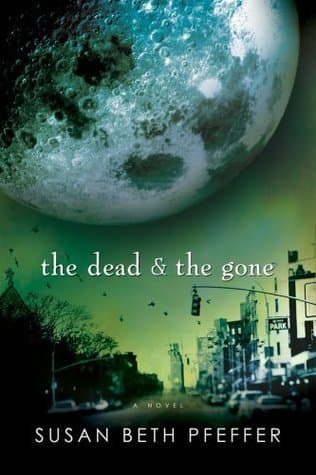
Susan Beth Pfeffer (2008)
Genre
Fantasy / Science Fiction / Young Adult
Reading Time
7 hr
Key Themes
See below
Sign in to track this book
After an asteroid strike changes the moon and causes tsunamis in New York City, seventeen-year-old Alex Morales must navigate a city in chaos, protect his younger sisters, and deal with his parents' disappearance while hoping to survive.
Seventeen-year-old Alex Morales wakes up in his family's Manhattan apartment to chaos. News reports confirm an asteroid has hit the moon, moving it closer to Earth and changing its orbit. This event, called 'the impact,' immediately causes huge tidal waves that destroy coastal areas, including parts of New York City. Alex's parents, Mami and Papi, are not home when the disaster happens; Mami is at work, and Papi is at a meeting. Alex, with his younger sisters, Julie and Briana, must deal with the immediate aftermath: power outages, no running water, and scary uncertainty about his parents. The city quickly becomes panicked and lawless as resources disappear and communication fails.
Days turn into weeks, and Alex's parents do not come back. The initial hope fades as the family faces the sad truth of their disappearance. Alex, though young, takes on the role of head of the family, focusing on survival for Julie, a religious Catholic, and Briana, who is very young. They ration their shrinking food supplies, boil water from the building's pipes, and try to keep some normalcy. Alex tries hard to find his parents, going out into the increasingly dangerous streets of Manhattan, which are now full of looters, desperate people, and constant violence. He meets Mr. Radley, a neighbor who offers some advice and limited help, but Alex is mostly on his own.
As weeks pass, the food supply in the Morales apartment runs very low. Alex's attempts to find food become more dangerous and frequent. He finds that the city's supermarkets have been completely looted, and the remaining food is either bad or hoarded. He searches abandoned stores and eventually joins a dangerous food line at a local church, where he sees how desperate and ruthless others are. The lack of clean water also becomes a serious problem, leading to widespread illness. Alex's ability to find solutions is constantly tested as he tries to keep his sisters fed and healthy, often making hard moral choices to ensure their survival.
Alex and his sisters start attending services at a local Catholic church, St. Vincent de Paul, led by Father Miguel. The church becomes a main place for the struggling community, offering spiritual comfort and the only organized food distribution. Alex, at first doubtful of religion, feels drawn to the community and practical help from Father Miguel. He starts volunteering at the church, helping to give out food and keep order, which gives him a temporary sense of purpose beyond just surviving. Father Miguel gives advice and a moral guide, encouraging Alex to keep his faith and hope, even when things are very bad.
After months of chaos, the U.S. Army arrives in Manhattan, setting up a more organized system for food distribution and trying to restore order. This brings a brief bit of hope to Alex and the other survivors. The military provides MREs (Meals Ready-to-Eat) and some medical supplies. Alex continues his work at the church, helping the soldiers. However, this time of relative stability is short. The army's resources are spread thin, and it becomes clear their presence is temporary. The initial relief soon turns into the realization that the long-term future for New York City, and the world, remains bleak.
In a moment of unexpected joy and deep sadness, Alex's mother, Mami, suddenly returns to the apartment. She is very thin, traumatized, and seriously ill, but alive. Her return brings great relief to Alex and his sisters, but her story is devastating. She confirms that Papi did not survive the initial tidal wave. He was caught in the disaster and is presumed dead. Mami also tells about the terrible conditions outside Manhattan and her desperate struggle to survive. Her return brings both comfort and a harsh dose of reality, confirming the family's loss and the ongoing struggle they face.
The harsh living conditions, lack of good food, and dirty water affect the family's health. Briana, the youngest sister, gets very sick with a fever and stomach problems. With no doctors or medicine, Alex and Mami are desperate. They try home remedies and pray for her to get better, but Briana's condition quickly worsens. Alex is tormented by his inability to protect his sister and feels the huge weight of his responsibilities. The fear of losing another family member is strong, showing the brutal reality of their post-apocalyptic life where even basic medical care is a luxury.
Despite their efforts, Briana dies. Her death breaks the already fragile Morales family. Alex is filled with grief and guilt, feeling he failed to protect his youngest sister. Mami is devastated, her spirit seemingly broken by the losses. Julie, though very sad, finds comfort in her strong faith, believing Briana is now in heaven. After this tragedy, Alex realizes he must continue to fight for his remaining family. He feels a renewed, grim determination to protect Julie and Mami, understanding that giving up is not an option, even as the world around them crumbles.
As winter comes, conditions in Manhattan get much worse. The cold is unbearable, and food supplies are almost gone. The military announces a partial evacuation, giving priority to those who can work on farms in other areas, as food production has become the main goal for the surviving government. Father Miguel encourages Alex and his family to take this chance. Making the heartbreaking decision to leave their home and the graves of Papi and Briana, Alex, Mami, and Julie sign up for the evacuation. They pack what little they have, facing an unknown future but holding on to the hope of finding a place where they can truly rebuild their lives, even if it means leaving everything familiar behind.
The Protagonist
Alex transforms from a typical teenager to a hardened, responsible survivor, finding strength and purpose in protecting his family, despite immense personal loss.
The Supporting
Julie maintains her strong faith throughout the ordeal, which becomes a source of comfort for herself and her family, even after profound loss.
The Supporting
Briana remains an innocent child, her vulnerability and eventual death serving as a poignant symbol of the world's harshness.
The Supporting
Mami endures immense trauma and loss, transforming from a missing figure to a broken but resilient survivor who finds strength in her remaining children.
The Mentioned
Papi's story arc is tragically cut short by the initial disaster, making him a symbol of the world lost.
The Supporting
Father Miguel serves as a steadfast moral and spiritual guide, providing stability and hope for the community and Alex.
The Supporting
Mr. Radley remains a consistent voice of pragmatic, if cynical, survival advice for Alex.
The heart of 'The Dead and the Gone' is Alex's commitment to his family. After his parents disappear, he immediately takes on the role of protector and provider for his younger sisters, Julie and Briana. Every choice he makes, from finding food to volunteering at the church, is about ensuring their survival and well-being. The theme shows strongly through his sadness over his father's presumed death, his search for his mother, and his attempts to save Briana when she gets sick. Even after Briana's death, his responsibility shifts to protecting Julie and Mami, showing how strong family ties are in extreme situations.
“What mattered was that I was still alive, and Julie was still alive, and Briana was still alive. And I was responsible for them.”
The novel has themes of loss and grief, both individual and shared. Alex's biggest personal losses are his father's disappearance and presumed death, his mother's trauma, and the death of his youngest sister, Briana. Beyond these personal tragedies, the characters constantly deal with losing their old lives, their city, and the stable world they knew. Not being able to properly mourn or bury the dead, and the constant threat of more loss, creates a lasting feeling of sadness. Julie's faith provides a different way to process grief, while Alex's grief often appears as a grim determination to survive for those left.
“I wondered if I would ever be able to stop counting the dead. I wondered if the dead would ever stop counting me.”
Faith is important, mainly through Julie's strong Catholicism and Father Miguel's spiritual advice. Julie finds comfort and strength in her prayers and belief in God, even as tragedies increase. Her faith acts as a moral guide and a source of hope for the family. Alex, at first not religious, deals with his own doubts and cynicism, especially with so much suffering. However, his interactions with Father Miguel and seeing the church community's strength challenge his view. The theme shows how faith can give comfort and purpose, but also how it can be tested and questioned when faced with huge devastation.
“Julie always said God had a plan. I wondered if this was it. If this was God's plan.”
The harsh truth of survival fills the story. Alex's ability to find solutions is constantly tested as he navigates a falling society. He learns to find food, boil dirty water, and move through the dangerous streets of Manhattan. The struggle for basic needs like food, water, and heat becomes a daily fight, forcing characters to make hard choices and adapt to extreme conditions. The theme shows people's ability to endure and be clever when pushed to their limits, but also the moral compromises and loss of humanity that can happen in the fight for survival. The constant search for supplies and safe places shows how fragile civilization is.
“Survival wasn't about being smart. It was about being lucky, and being desperate enough to do whatever it took.”
The novel balances between hope and despair. The initial chaos and loss push Alex and his family toward despair, but small moments of hope appear, such as Mami's return, the army's arrival, or the community at Father Miguel's church. These moments of hope are often short, quickly followed by new tragedy, like Briana's death. The theme explores the human spirit's ability to find reasons to keep going, even when surrounded by great suffering. Alex's final decision to leave Manhattan with his remaining family, despite the unknowns, represents choosing future hope over present despair.
“Hope was a dangerous thing, but it was all we had left.”
Provides an intimate, immediate, and subjective view of the apocalypse through a teenager's eyes.
The story is told entirely from Alex Morales's first-person perspective. This narrative choice immerses the reader directly into Alex's emotional and physical struggles, allowing for an intimate understanding of his fears, responsibilities, and moral dilemmas. It limits the reader's knowledge to only what Alex experiences or learns, effectively mirroring the characters' isolation and uncertainty in a world where information is scarce. This subjectivity heightens the emotional impact of the events, making the reader feel Alex's desperation, grief, and occasional glimmers of hope as if they were their own.
A constant source of tension and a driving force for character action and difficult choices.
The steady and unavoidable depletion of food, clean water, fuel, and medical supplies is a central plot device. This creates constant tension and forces Alex and his family to make increasingly desperate and morally compromising decisions. The scarcity of resources drives much of the plot, from Alex's dangerous scavenging missions to the reliance on the church for food distribution, and ultimately, the decision to leave Manhattan. It vividly illustrates the breakdown of society and the brutal realities of survival, making the threat of starvation and illness a tangible and ever-present antagonist.
Serves as the initial catalyst for Alex's transformation and a source of prolonged emotional suspense.
The immediate disappearance of Alex's parents after the lunar impact is a crucial plot device. It instantly thrusts Alex into the role of caregiver and leader, forcing him to mature rapidly. Their absence creates a prolonged period of suspense and hope, with Alex clinging to the possibility of their return. Papi's eventual confirmed death and Mami's traumatic return provide significant emotional beats, solidifying the family's loss and altering their dynamic. This device effectively highlights the sudden and profound fragmentation of family units in a catastrophic event and underscores the theme of responsibility.
A symbol of community, hope, and moral guidance in a collapsing world.
Father Miguel's church serves as a powerful symbol and a practical hub for the struggling community. It represents a bastion of order, compassion, and spiritual solace amidst the widespread chaos and despair. As a plot device, it provides Alex with a temporary sense of purpose, a source of organized food distribution, and a moral compass through Father Miguel. The church offers a counterpoint to the lawlessness outside, demonstrating the resilience of human connection and faith, and providing a focal point for the community's dwindling hope.
“The moon was closer to Earth than it had ever been in human history, and it was going to stay that way.”
— Opening line describing the catastrophic event that changes the world.
“We're all going to die, but we don't have to die like animals.”
— Alex's determination to maintain humanity in the face of disaster.
“God doesn't care about us anymore. If He ever did.”
— Alex questioning faith after the deaths and devastation.
“You do what you have to do to survive. That's the first rule.”
— Reflecting on the harsh realities of post-apocalyptic life.
“I'm not a hero. I'm just trying to keep my sisters alive.”
— Alex's humble view of his role as protector.
“Hope is a dangerous thing. It makes you weak.”
— A moment of cynicism about clinging to optimism.
“The dead are gone, but the gone are still here.”
— Reflecting on loss and the lingering presence of the missing.
“We used to worry about homework and dates. Now we worry about food and water.”
— Contrasting pre- and post-disaster teenage concerns.
“Sometimes the only way to stay sane is to pretend everything is normal.”
— Coping mechanism in the midst of chaos.
“Fear is a luxury we can't afford anymore.”
— Alex pushing past terror to take necessary actions.
“In the end, it's not about who you were, but who you become.”
— Reflection on personal transformation under extreme circumstances.
“The world didn't end with a bang, but with a slow, starving whimper.”
— Describing the gradual collapse of society after the initial event.
“Love isn't enough to keep someone alive, but it's enough to make you try.”
— The driving force behind Alex's efforts to protect his sisters.
Ready to see how well you understood this book? Take our interactive quiz with 10 questions.

Biography coming soon.







