“Dear Duncan, Not cool, man. You know how important it is for crayons to stay in the box. Now I'm stuck to a kite! And it's not even a cool kite. Come get me!”
— Maroon Crayon's postcard to Duncan, complaining about being stuck to a kite.

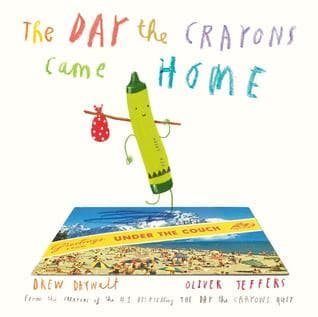
Drew Daywalt (2015)
Genre
Fantasy / Children's / Creativity
Reading Time
10 min
Key Themes
See below
Sign in to track this book
Duncan's crayons, each with a funny, sad story of being lost, broken, or dryer-shrunk, send him postcards asking for a colorful rescue back to their box.
The story begins with Duncan getting a postcard from Maroon Crayon. Maroon explains his problem: he was used for a 'bloody monster' drawing, then fell behind the sofa, was sat on by Duncan's dad, and broke in half. Maroon asks Duncan to get him, stressing his broken state and the shame of being left behind. This letter sets the book's playful tone, showing crayons as living things with their own complaints and a wish to return to Duncan's crayon box.
Next, Duncan hears from Turquoise Crayon, who describes a difficult trip through the laundry. He recounts being left in a pair of Duncan's smelly socks, going through the washing machine, and then getting his head stuck to the sock in the dryer. Turquoise's letter, with a drawing of his current state, shows the daily dangers crayons face and their weakness to human carelessness. He desperately wants to be saved from his fabric prison and returned to the crayon box.
Duncan gets a postcard from Neon Red Crayon, written from 'The Grand Canyon Hotel.' Neon Red explains he was taken on vacation, used to draw the Grand Canyon, and then accidentally left behind. He expresses his loneliness and the distance from Duncan and the other crayons. This letter introduces the idea of crayons being forgotten in different places, showing their longing for home and the safety of the crayon box, no matter how far they've gone.
A touching letter comes from Pea Green Crayon. He admits he ran away because he felt unwanted, saying 'no kid likes peas.' He is now hiding under old newspapers, feeling neglected. Pea Green's letter touches on feelings of not being good enough and wanting a purpose, as he hopes to be used for something other than just peas. His plea for Duncan to find him shows a deep need for acceptance among the other crayons.
Duncan then hears from Peach Crayon, who has a rather unusual injury. He was left on the floor and partly eaten by Duncan's baby brother, leaving a big bite mark. Peach Crayon's letter is a funny but serious request for rescue, showing the dangers of being a crayon in a house with a curious toddler. This event further shows the various, often unexpected, dangers that happen to crayons in a child's home.
Brown Crayon writes to Duncan from an outdoor problem: he is stuck to a kite string, tangled in a tree. He expresses his frustration at not being able to color and his wish to return to the crayon box. Brown Crayon's letter adds another type of 'lost' crayon, showing those that end up outside and exposed to the weather, unable to do their job until Duncan rescues them.
White Crayon sends a letter, explaining his unique problem: he was used to draw a snowman on white paper, and now he feels invisible and lost in the snow outside. He complains that he cannot be seen and therefore cannot be found, showing the irony of his color. White Crayon's plea is a clever play on his properties, highlighting the difficulty of being found when one blends perfectly with the environment.
Black Crayon writes a dramatic letter, explaining that he was left uncapped in the sun and has completely dried out. He describes feeling 'crispy' and 'brittle,' unable to draw anymore. Black Crayon's letter is a desperate request for moisture or some way to be fixed, showing the importance of taking care of art supplies and how neglect affects their ability to work.
Duncan receives a letter from several Orange Crayons. They explain that they are 'extra' orange crayons, separated from their original box and now feeling lost and without a purpose. Their letter highlights the problem of duplicate or unused crayons, showing their desire for a home and a chance to be part of Duncan's creative work, even if they are not his main set.
Overwhelmed by the letters and the problems of his lost and neglected crayons, Duncan decides to act. Instead of just trying to fit them all into the old box, he builds a new, multi-tiered, and organized crayon box. This clever solution provides a special place for every crayon, including the broken ones, the extras, and those with unique needs. This act shows Duncan's empathy and creativity in solving a complex problem.
Duncan's new crayon box is a marvel of organization, with separate sections and even a 'lost and found' area for the most troubled crayons like Maroon and Turquoise. Every crayon, from the previously lost to the forgotten, now has a spot. This final act brings great joy to all the crayons, fulfilling their deepest wish for a home and a sense of belonging. The story ends with the crayons happily in their new, perfect home, ready for new adventures.
The Protagonist
Duncan evolves from passively receiving complaints to actively and creatively solving the crayons' problems, demonstrating growth in responsibility and problem-solving.
The Supporting
Maroon Crayon starts broken and lost, and finds a place of belonging and care in Duncan's new crayon box.
The Supporting
Turquoise Crayon is rescued from a laundry mishap and given a safe, clean home.
The Supporting
Neon Red Crayon returns from a distant, accidental exile to the comfort of home.
The Supporting
Pea Green Crayon, initially feeling unwanted, finds acceptance and a place to belong within the new crayon system.
The Supporting
Peach Crayon recovers from a 'bite' and finds a secure spot in the new box.
The Supporting
Brown Crayon is freed from an outdoor entanglement and brought back to the safety of the crayon box.
The Supporting
White Crayon, initially invisible and lost, is found and given a clear place in the new organization.
The Supporting
Black Crayon, dried out and unusable, finds a place in the new box, awaiting potential rehydration or care.
The Supporting
The 'extra' Orange Crayons, initially feeling superfluous, are welcomed into Duncan's comprehensive new crayon system.
The main theme is Duncan's empathy for his art supplies and his responsibility as their owner. Each crayon's letter details a unique problem, from Maroon Crayon's broken state to Pea Green's feelings of being unwanted. Duncan does not ignore their complaints; instead, he takes them seriously, showing a deep understanding of their 'feelings.' His act of building a custom crayon box shows his commitment to caring for all his crayons, proving that even objects can inspire duty and compassion. This teaches young readers the importance of caring for their belongings and understanding different viewpoints.
“You know, the one that got sat on by your dad? Half of me is still under the sofa. You HAVE to come get me!”
Many crayons express a strong desire for a 'home' and a purpose. Pea Green Crayon ran away because he felt unloved and unused, while Neon Red Crayon felt lonely far from home. Even the 'extra' Orange Crayons long for a place in Duncan's collection. The crayons' stories show a universal desire for inclusion and the satisfaction that comes from having a role. Duncan's new crayon box directly addresses this need, providing a secure, organized space where every crayon, regardless of condition or perceived usefulness, feels valued and has a place, ready to help with his art.
“You never use me! I know darn well that no kid likes peas. I ran away.”
Faced with many crayon problems—broken, lost, dried out, or feeling unloved—Duncan does not just try to cram them back into the old box. Instead, he finds an innovative solution: a new, multi-tiered crayon box with special compartments, including a 'lost and found.' This shows the power of creative thinking to solve complex challenges. His solution is not just useful but also thoughtful, recognizing the unique needs and 'personalities' of each crayon. It encourages readers to think creatively when facing difficulties, turning problems into an chance for clever design.
“So Duncan built them a NEW crayon box. A BIGGER one. A BETTER one.”
The book makes crayons seem human, giving them distinct personalities and letting them tell their 'adventures' and misfortunes. From Turquoise Crayon's accidental laundry trip to Peach Crayon being partly eaten by a baby, the stories show the various, often funny, dangers and problems everyday objects face in a child's home. This theme encourages children to look at their own belongings differently, imagining the secret lives and challenges their toys and tools might encounter, which encourages both imagination and perhaps a greater appreciation for their possessions.
“My head is stuck to one of your stinky socks after we both went through the dryer together.”
The story is told through a series of postcards and letters written by the crayons.
The entire narrative unfolds through a collection of postcards and letters sent by various crayons to Duncan. This epistolary format allows each crayon to voice its unique complaint, personality, and predicament directly to the reader. It creates a sense of immediacy and intimacy, as readers 'hear' the crayons' woes in their own words. This device is crucial for character development, as the distinct voices and concerns of each crayon are vividly conveyed, making their plight more engaging and humorous.
Inanimate crayons are given human-like qualities, emotions, and the ability to communicate.
The crayons are fully anthropomorphized, possessing thoughts, feelings, desires, and the ability to write letters. They feel neglected, lost, broken, and yearn for purpose and a home. This device is fundamental to the story's charm and humor, allowing children to connect with the crayons on an emotional level. It transforms simple art supplies into relatable characters with distinct personalities, making their problems understandable and their rescue by Duncan meaningful.
The illustrations play a critical role in conveying the crayons' predicaments and emotions.
While the text is essential, the illustrations by Oliver Jeffers are integral to the storytelling. Each letter is accompanied by a visual depiction of the crayon's state or location, often with humorous detail (e.g., Turquoise Crayon stuck to a sock, Maroon Crayon broken in half). These illustrations enhance the humor, clarify the situations described in the letters, and add emotional depth, making the crayons' plights more vivid and immediate for young readers. The visuals are not merely decorative but advance the narrative and characterization.
A series of problems (lost crayons) are presented, leading to a single, overarching solution.
The plot follows a clear problem-solution structure. Each letter from a crayon presents a new 'problem' or predicament. These individual problems accumulate, creating an overarching challenge for Duncan. The narrative then culminates in a single, comprehensive solution—Duncan building a new, improved crayon box—that addresses all the previously presented issues. This structure provides a satisfying resolution and reinforces the theme of creative problem-solving.
“Dear Duncan, Not cool, man. You know how important it is for crayons to stay in the box. Now I'm stuck to a kite! And it's not even a cool kite. Come get me!”
— Maroon Crayon's postcard to Duncan, complaining about being stuck to a kite.
“Dear Duncan, Remember when you used to draw with me every day? Now I'm all stubby and broken. My tip is gone! I'm stuck in the couch cushions. Send help!”
— Pea Green Crayon's postcard to Duncan, lamenting his broken state and being lost in the couch.
“Dear Duncan, You left me in your sock! A sock! I smell like feet and old cheese. My color is fading. Please rescue me!”
— Glow-in-the-Dark Crayon's postcard, expressing disgust at being left in a sock.
“Dear Duncan, Being a crayon is hard work. Being a broken crayon is even harder. My head fell off. My body is in pieces. I'm lonely. Come find me.”
— Neon Red Crayon's postcard, detailing its broken state and loneliness.
“Dear Duncan, I was trying to draw a beautiful sunset for your mom. But then I rolled under the dresser. It's dusty and dark here. And there's a giant dust bunny staring at me. Help!”
— Brown Crayon's postcard, describing being lost under a dresser and encountering a dust bunny.
“Dear Duncan, I'm at the beach! I drew a wonderful sandcastle. But then the tide came in and I almost floated away! Now I'm stuck in the sand. I miss my box.”
— Aqua Crayon's postcard, recounting an adventure at the beach that went wrong.
“Dear Duncan, I'm pretty sure I'm in a dog's mouth. I don't know whose dog. It's slobbery. Send help. Immediately.”
— Tan Crayon's urgent postcard, fearing for its safety in a dog's mouth.
“Dear Duncan, I'm the one you used to draw all the tiny details with. Now I'm just a tiny stub. And I'm stuck to a sticky note. I can't draw anything like this!”
— Miniature Crayon's postcard, expressing frustration at its diminished size and being stuck.
“Dear Duncan, You left me in the garden. It rained. I'm all soggy and my paper is peeling off. I look like a sad, wet noodle. Get me out of here!”
— Golden Crayon's postcard, complaining about being left outside in the rain.
“Dear Duncan, I got rolled up in your homework. I'm trapped in your backpack. It smells like old lunches and gym socks in here. I want to go home!”
— Gray Crayon's postcard, describing being trapped in Duncan's backpack.
“Dear Duncan, Remember all those times you drew monsters with me? Well, now I'm stuck to a monster drawing. A really scary one. I'm actually a little scared myself.”
— Monster Green Crayon's postcard, finding itself stuck to a scary monster drawing.
“Dear Duncan, I'm so glad to be home! But just so you know, being stuck to a toy car and racing down the driveway was NOT my idea of a vacation.”
— Burnt Sienna Crayon's postcard, expressing relief at being home but complaining about its adventure.
“Dear Duncan, You're the best! Thanks for finding us all. Now we can get back to doing what we do best: coloring!”
— A collective message from the crayons, grateful to be reunited with Duncan.
Ready to see how well you understood this book? Take our interactive quiz with 10 questions.

Drew Daywalt is the acclaimed author of the bestselling children's book "The Day the Crayons Quit" and its sequel, "The Day the Crayons Came Home." His imaginative stories, often characterized by humor and a unique voice, have resonated with young readers and parents worldwide, making him a prominent figure in contemporary children's literature.







