“He was a professional. He had been paid to do a job. He would do it.”
— Describing the Jackal's ruthless professionalism.

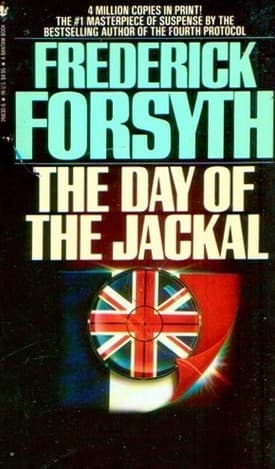
Frederick Forsyth (1971)
Genre
Thriller / Historical Fiction / Mystery
Reading Time
450 min
Key Themes
See below
Sign in to track this book
An anonymous assassin, known as the Jackal, plans to kill France's President Charles de Gaulle, while intelligence agencies try to find him and stop the assassination.
In August 1962, the Organisation Armée Secrète (OAS), a French right-wing group against Charles de Gaulle's Algerian independence policy, attempts to kill the President near Petit-Clamart. Colonel Jean-Marie Bastien-Thiry leads the ambush, but de Gaulle's car, a Citroën DS, withstands the gunfire and escapes. The French government then cracks down on the OAS, capturing and executing many leaders, including Bastien-Thiry. The remaining OAS leaders, in exile and facing collapse, decide they need a new plan. Antoine Argoud, Marc Rodin, and René Montclair choose to hire an untraceable, foreign assassin to kill de Gaulle, seeing it as their last chance to change France's political future.
Marc Rodin, the OAS's chief of operations, goes to Vienna to meet a contact who introduces him to the assassin. The assassin, a tall, blond Englishman, agrees to the contract for half a million dollars, half paid upfront and half upon completion. He refuses to give his name, asking to be called 'The Jackal.' The Jackal warns the OAS that he will cut off contact if any details of his plan are leaked. He immediately starts his planning: researching de Gaulle's security, finding possible assassination dates and places, and creating a strategy to avoid detection and ensure success. He demands complete secrecy and freedom to work without interference.
Despite the Jackal's strict secrecy rules, the OAS's money problems force them to rob banks in France to get the first payment. A robbery goes wrong, leading to the capture and torture of an OAS member, Victor Wolenski, by the French Sûreté. Wolenski reveals that the OAS hired a foreign assassin to kill de Gaulle, code-named 'Chacal' (Jackal). This vague information alarms the French government. President de Gaulle's aide, Commissioner Claude Lebel, a quiet but smart detective, leads the secret investigation to find and stop the Jackal. A huge, unprecedented manhunt begins, under pressure to keep it secret from the public.
While Lebel's team works fast, the Jackal carries out his plan. He travels to Genoa, Italy, to order a custom-made, powerful sniper rifle and special exploding bullets from a gunsmith. He then goes to Belgium and France, using different aliases and disguises. He gets forged identity documents from a skilled forger in Brussels and later from an unsuspecting provincial Frenchman, planning his escape routes and backup spots. He studies de Gaulle's public appearances, finding a possible chance during an upcoming Liberation Day ceremony in August, where de Gaulle will present medals in a public square. His preparations are thorough, leaving nothing to chance.
Commissioner Lebel, working with his assistant Caron and intelligence agencies across Europe, starts to piece together the Jackal's identity and movements. Through careful detective work, cross-referencing passport applications, and working with British intelligence (Colonel Rolland of Special Branch), Lebel finds the Jackal's true identity: Charles Calthrop, a British killer. He tracks Calthrop's movements from Italy to Belgium and then into France, realizing the assassin is already in the country. Pressure on Lebel grows as the possible assassination date nears, and the search expands to every police force in France, still under strict orders of secrecy about the target.
As Lebel gets closer, the Jackal shows his efficiency and adaptability. He kills a Danish tourist to steal his passport and car, using the new identity to enter France undetected. Later, he seduces Colette de Montpelier, a lonely aristocratic woman, at her chateau, using her as a temporary hideout and for transport. When he realizes she has seen a part of his hidden rifle, he kills her to keep his operation secret. These actions show his lack of conscience and his focus on his mission, making him a dangerous and elusive enemy for Lebel and the Sûreté.
With the search closing in, the Jackal takes on his most complex disguise. He shaves his head, dyes his hair, and pretends to be a disabled French veteran named Duggan, using crutches and a limp, with a stolen identity card. He travels by train to Paris, blending with vacationers and veterans. This disguise allows him to pass heightened security checks and roadblocks around the capital. His plan is to find a good spot near the Liberation Day parade route, where President de Gaulle will appear, and carry out the assassination from there, unnoticed.
Lebel and his team are sure the Jackal is in Paris and plans to strike during the Liberation Day ceremony. They have found his likely target location: a building overlooking the parade route. Lebel orders a city-wide lockdown, with every police officer, gendarme, and plainclothes agent searching for the assassin, focusing on anyone matching the Jackal's description or his disguises. The pressure is immense as de Gaulle's public appearance approaches. Lebel focuses completely, knowing failure is not an option and the fate of France depends on him.
On Liberation Day, the Jackal, hidden in a rented room at the top of an apartment building, disguised as a disabled veteran, puts together his rifle. He waits for de Gaulle's motorcade. As de Gaulle steps out of his car to present medals, the Jackal aims. He fires, narrowly missing de Gaulle's head as the President bends to kiss a veteran. At that moment, Commissioner Lebel, who had figured out the Jackal's likely position, bursts into the room with a gendarme. The gendarme fires, killing the Jackal before he can fire a second, decisive shot. The assassination attempt is stopped, and de Gaulle remains unaware of how close he was to death.
Afterward, British intelligence identifies the Jackal's body as Charles Calthrop. The French government keeps the assassination attempt a secret, reporting only that a 'foreign mercenary' was killed. The OAS leadership, waiting for news, learns of the failure and their assassin's death. Their last desperate plan failed, and with no money and leaders, the organization collapses. Commissioner Lebel, a quiet hero, returns to his normal life, the only one truly aware of the danger he stopped. The incident becomes a state secret, keeping de Gaulle's legacy untarnished by this near-disaster.
The Antagonist
He begins as an anonymous, almost mythical figure, meticulously planning and executing his mission, only to be identified and ultimately killed by Commissioner Lebel.
The Protagonist
From an unknown commissioner, he rises to become the unsung hero who saves President de Gaulle, validating his quiet, methodical approach to policing.
The Supporting
He remains steadfast and oblivious to the specific threat, continuing his duties while unknowingly being protected from a deadly plot.
The Supporting
He initiates the plot by hiring the Jackal, only to see his desperate plan fail, leading to the final collapse of the OAS.
The Supporting
He provides critical intelligence to Lebel, aiding the identification of the Jackal, and remains a key supporting figure in the international investigation.
The Supporting
He serves as Lebel's steadfast right-hand man, assisting him throughout the entire investigation.
The Supporting
She is briefly a romantic interest for the Jackal, then becomes an unwitting witness and subsequent victim, underscoring his ruthlessness.
The Mentioned
His capture inadvertently reveals the OAS's plot to hire the Jackal, thus setting Lebel's investigation in motion.
The Mentioned
His capture and subsequent confession are the catalyst for the French government's awareness of the plot.
The book shows the professionalism of both the Jackal and Commissioner Lebel. The Jackal's focus on planning, disguise, and execution, and Lebel's persistent, careful investigation, show two dedicated professionals. Both characters are driven by their tasks, showing how far people will go to reach their goals. The Jackal's cold way of killing is like Lebel's careful pursuit, making the story a conflict of professional wills.
“For the Jackal, the killing of a human being was a craft, an exercise in applied mechanics, and no more.”
Secrecy is important for both the Jackal and the French government. The Jackal uses many fake names and disguises to avoid being found. At the same time, the French government, especially Lebel, must conduct the manhunt in secret to avoid public panic and to keep the Jackal from knowing how close they are. This constant interplay of hidden identities, false information, and the need to keep the plot secret creates much of the story's tension, showing the weaknesses and strengths of intelligence operations.
“The greatest danger lay not in the failure of the killing itself, but in the capture of the killer.”
The book explores how one determined person, the Jackal, can threaten a nation by targeting its leader. The OAS's attempt to change history through assassination shows how fragile political power is and how one act of violence can disrupt society. The large resources the French state uses to protect de Gaulle show the constant watch needed to keep stability against such threats, showing how close society can come to disorder from one well-planned plot.
“That a single man, a foreigner, could so nearly succeed in altering the course of a nation's history was a thought that caused his blood to run cold.”
The novel contrasts the slow nature of large government systems with the quick actions of individuals. While Lebel wins, he constantly deals with slow bureaucracy, conflicts between agencies, and strict rules. The Jackal, however, is a lone person, free from such limits, giving him freedom and speed. This dynamic shows the challenges of state security in responding to individual and secret threats, showing how personal effort and cleverness can sometimes beat large official structures.
“The French security services were a vast, sprawling, interlocking web of different departments, each with its own jurisdiction and jealous of its prerogatives.”
The Jackal's character shows how extreme violence can make people less human. He sees human life, his own and his victims', only as tools or obstacles. His murders of Colette de Montpelier and the Danish tourist show a complete lack of empathy. This theme shows how pursuing a violent goal can remove a person's humanity, turning complex moral choices into simple problems to solve, highlighting the chilling detachment of a professional killer.
“He felt nothing for her, not even regret. She had seen, therefore she had to die.”
Alternating focus between the Jackal's preparations and Lebel's investigation.
The novel employs a dual perspective, meticulously following the Jackal's journey and preparations for the assassination in parallel with Commissioner Lebel's painstaking investigation to identify and intercept him. This structure builds immense suspense, as the reader is privy to both sides of the cat-and-mouse game, understanding the immediate threat and the slow, methodical efforts to counter it. It allows for a comprehensive view of the plot, showing the intricate details of both the hunter and the hunted, and constantly raising the stakes as their paths inevitably converge.
The relentless countdown to the assassination attempt.
The entire narrative is driven by a relentless ticking clock, building towards the predetermined date of President de Gaulle's public appearance in August. From the moment the Jackal is hired, the reader is aware of the finite timeframe, creating escalating tension and urgency. Each chapter and scene brings the story closer to the climactic confrontation, with Lebel racing against time to identify and stop the Jackal before the deadline, and the Jackal racing to complete his preparations. This device is crucial for maintaining the thriller's high-stakes atmosphere.
Extensive, realistic descriptions of tradecraft, bureaucracy, and historical context.
Forsyth's writing is characterized by an extraordinary level of meticulous detail, from the precise mechanics of forging passports and assembling a sniper rifle to the intricacies of police procedures and intelligence gathering across multiple countries. This verisimilitude lends immense credibility to the fictional plot, making it feel entirely plausible and grounded in reality. The historical backdrop of the OAS and de Gaulle's France is also rendered with great accuracy, immersing the reader in a believable world where such a plot could genuinely unfold, enhancing the sense of realism and danger.
The Jackal's anonymity and the government's secret investigation.
For much of the novel, the Jackal operates as an almost mythical, anonymous figure, known only by his code name. This anonymity makes him a terrifying, elusive threat. Conversely, Lebel's investigation is conducted under strict secrecy from the public and even from President de Gaulle himself. This 'unseen threat' device amplifies the tension, as the danger is both pervasive and hidden, creating a sense of vulnerability and isolation for those aware of the plot, while the general populace remains blissfully unaware of the peril they face.
Subtle hints and misdirections that build suspense.
The novel employs subtle foreshadowing, such as early mentions of de Gaulle's public appearances or the resilience of his car, to hint at future plot points. It also uses red herrings, with Lebel's team pursuing various false leads or suspects that momentarily divert the investigation, adding to the complexity and realism of the manhunt. These techniques keep the reader engaged, guessing, and constantly re-evaluating the unfolding events, contributing to the overall suspense and intricate plotting of the narrative.
“He was a professional. He had been paid to do a job. He would do it.”
— Describing the Jackal's ruthless professionalism.
“The problem with democracy, as with any system, was that it was run by people.”
— A reflection on the fallibility of systems, even democratic ones.
“A man who knew what he wanted and was prepared to do anything to get it was a formidable opponent.”
— Referring to the Jackal's unwavering determination.
“The most dangerous animal is the one that has nothing to lose.”
— A general observation that applies to the Jackal's desperate situation.
“For the first time, he felt a flicker of fear. Not for himself, but for the job.”
— The Jackal's focus on his mission above personal safety.
“There are some people who are born to kill, and others who are born to be killed.”
— A cynical view on human nature and destiny, particularly in the context of the plot.
“The greatest weapon against terrorism is not force, but intelligence.”
— A key theme emphasized by Commissioner Claude Lebel's approach.
“He moved through the crowd like a shark through a shoal of fish, unseen, unheard, but always present.”
— Illustrating the Jackal's stealth and predatory nature.
“The silence of the night was broken only by the sound of his own breathing.”
— Building suspense as the Jackal makes his final preparations.
“Every man has his price, and every woman her weakness.”
— A cynical, world-weary observation made by one of the characters.
“The details, the tiny, insignificant details, were what made the difference between success and failure.”
— Highlighting the meticulous planning of both the Jackal and Lebel.
“He had no friends, no family, no ties. He was a ghost, a shadow, a number.”
— Describing the Jackal's complete detachment and anonymity.
“History, in the end, was written by the survivors.”
— A reflection on the outcome of conflicts and the victors' narratives.
“The world was a chessboard, and he was a pawn, but a very dangerous pawn.”
— The Jackal's self-perception in the grand scheme of his mission.
Ready to see how well you understood this book? Take our interactive quiz with 10 questions.

Biography coming soon.







