“Man remembers only what he wants to remember.”
— Mankurt's inability to remember his past.

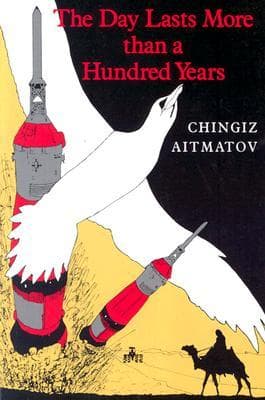
Chingiz Aitmatov (1983)
Genre
Historical Fiction / Science Fiction
Reading Time
730 min
Key Themes
See below
Sign in to track this book
A man in the Kazakh steppes struggles with ancient traditions and cosmic encounters, reflecting the Soviet Union's conflict between its earthly roots and celestial goals.
The novel begins with the death of Yerzhan Buran, an old railway worker and Yedigei's close friend. Buran dies at Boranly-Buranny station, a remote outpost in the Sary-Ozek steppes. Yedigei, a fellow railway worker and the main character, takes responsibility for burying Buran according to Kazakh traditions. He decides to transport Buran's body to the ancient Ana-Beiit cemetery, a sacred burial ground for their clan. This journey is difficult due to the vast, desolate landscape and the challenges of finding a camel and a vehicle. As Yedigei prepares, he reflects on his long friendship with Buran and the changing world, setting a thoughtful tone for the story.
Yedigei, with Buran's widow, Zaripa, their son, and other mourners, begins the difficult journey across the Sary-Ozek steppes. He uses his camel, Karanar, to pull a cart carrying Buran's coffin. The journey symbolizes a return to their roots and a defiance of modern conveniences that have separated them from their heritage. Along the way, Yedigei tells stories from his past and his people's history, especially the legend of the Mankurt. The physical hardship of the journey reflects the emotional weight of their task and the cultural struggle to preserve traditions against Soviet-era modernization and neglect.
As Yedigei and the funeral procession near the Ana-Beiit cemetery, a military cordon stops them. The area around the ancient burial ground is a restricted zone because it is near a top-secret Soviet space launch facility, the Cosmodrome. This obstacle is a blow to Yedigei, who sees the denial of access to their ancestral land as a deep insult and a violation of their cultural rights. The military personnel, firm in their duty, refuse to allow the burial, citing national security. This confrontation shows the clash between traditional values and the impersonal power of the state.
At the same time as Yedigei's earthly journey, an international space mission called 'Parity' is underway from the Cosmodrome. This joint Soviet-American venture includes Soviet cosmonaut Sabitjan and American astronaut David Morrison. The mission's goal is to contact an alien civilization discovered on the planet Lesnaya Grud. The space narrative is told through official reports and internal monologues, detailing the preparations, launch, and initial stages of their interstellar journey. This parallel story contrasts ancient customs on Earth with cutting-edge scientific efforts aiming for the stars.
During the journey and his reflections, Yedigei vividly recalls and shares the legend of the Mankurt. This ancient tale describes how the Zhuan'zhuan tribe would capture prisoners and turn them into 'mankurts' by shaving their heads, fitting a wet camel hide cap (shiri) over their scalps, and leaving them in the sun. The shrinking hide would cause extreme pain, leading to memory loss and turning the captives into mindless slaves, devoted to their masters and without a past, family, or identity. The most poignant part of the legend is a mother who tries to reclaim her son, only to be killed by him because he no longer recognizes her. This legend serves as a strong metaphor for the dangers of historical amnesia and cultural assimilation.
The 'Parity' spacecraft reaches the distant planet Lesnaya Grud. The international crew, overcoming initial anxieties and technical challenges, communicates with the sentient beings on the planet. The aliens, described as technologically advanced and living in harmony with their environment, share their knowledge and culture with the human visitors. This encounter is humanity's first direct interaction with extraterrestrial life. The details of their communication and initial understanding of the alien society are presented as a sign of hope for interspecies cooperation and understanding, contrasting sharply with earthly conflicts.
After successful contact with Lesnaya Grud, a serious decision is made on Earth by a joint Soviet-American committee. Fearing that the alien civilization's advanced knowledge and different societal values could destabilize earthly societies and ideologies, the committee decides to prevent the 'Parity' crew from returning. A network of satellite-based 'boomerangs' creates an invisible barrier around Earth, isolating the space travelers and Lesnaya Grud from their home planet. This act of betrayal and paranoia highlights humanity's fears of the unknown and its struggle with control and power, even at a cosmic level.
Faced with the military cordon, Yedigei remains determined. He argues with the soldiers, asserting the sacred right of burial and the importance of tradition. Despite his efforts, the soldiers are firm. Yedigei, unwilling to leave his friend in an unmarked grave or with a disrespectful burial, decides to bury Buran on a nearby hillock, as close to the forbidden Ana-Beiit cemetery as possible. This act is a strong statement of defiance against state authority and a testament to his loyalty to his friend and cultural heritage, even against great odds.
The 'Parity' crew, still in orbit, learns of the decision to prevent their return and the 'boomerang' system. The realization that their governments have abandoned them, seeing them as a threat rather than heroes, is devastating. They are stranded in space, unable to return to Earth. This revelation forces the cosmonauts and astronauts to face the realities of political maneuvering and the fragility of trust, even with monumental scientific achievement. Their situation highlights themes of betrayal and the ethical dilemmas of power.
After Buran's improvised burial, Yedigei is filled with grief and disillusionment. He reflects on his long life in the Sary-Ozek steppes, his friendship with Buran, and the changes he has seen. His camel, Karanar, remains by his side, a steadfast companion. Karanar symbolizes the connection to nature and tradition. Yedigei's thoughts move between personal memories and broader concerns about the loss of cultural heritage and humanity's future. Yedigei and Karanar standing alone in the vast steppe represents the individual's enduring spirit against the indifferent forces of progress and state power.
Yedigei returns to Boranly-Buranny station, his heart heavy but his spirit intact. He continues his work as a railwayman, a solitary figure in the expansive Sary-Ozek. Memories of Buran, the legend of the Mankurt, and the confrontation at the Cosmodrome stay with him. The story ends with Yedigei's quiet resilience, a testament to the enduring human spirit and the importance of remembering one's roots as the world moves forward. The vastness of the steppe and the endless railway tracks become metaphors for life's journey and the passage of time, leaving the reader with a sense of both loss and hope for preserving cultural memory.
The Protagonist
Yedigei maintains his core values and traditions despite external pressures, becoming a symbol of enduring cultural memory.
The Supporting
His death catalyzes the main earthly conflict, though he is physically absent.
The Supporting
Karanar remains a constant, loyal companion, symbolizing the enduring spirit of the steppe.
The Supporting
Abutalip's life is tragically cut short by state repression, serving as a cautionary tale.
The Supporting
Sabitjan undergoes the transformation from an explorer to an abandoned exile in space.
The Supporting
Zaripa endures the loss of her husband and the denial of a proper burial with quiet dignity.
The Supporting
Morrison, like Sabitjan, transitions from an explorer to an abandoned exile in space.
The Mentioned
Their historical actions serve as a cautionary legend against the loss of memory.
This is the central theme, explored through the legend of the Mankurt and Yedigei's struggle to bury Buran. The Mankurt legend shows the horror of losing memory and identity, a fate Yedigei fears for his people. The Soviet state's suppression of Abutalip's writings and the military's denial of access to the ancestral Ana-Beiit cemetery are modern examples of this 'mankurtization.' Yedigei's efforts to remember and retell stories, and his determination to give Buran a proper burial, are acts of resistance against historical amnesia and the erasure of cultural heritage. The 'boomerang' system isolating the cosmonauts further highlights the theme of deliberate forgetting and control over information.
“A man without a memory of the past is a Mankurt.”
The novel shows the clash between ancient Kazakh traditions and the impersonal, often oppressive, forces of Soviet modernity and state control. Yedigei's journey to Ana-Beiit is a deeply traditional act, rooted in cultural and spiritual beliefs. This clashes with the military's cold, bureaucratic refusal of access to the cemetery, a restricted zone for a modern space launch facility. The state's suppression of individual expression (Abutalip's fate) and its decision to isolate the 'Parity' crew from Earth demonstrate the state's power to dictate lives and values, often at the expense of human dignity and heritage. The railway, a symbol of modernity, is also Yedigei's livelihood, showing the complex integration of the two.
“Man is not just a body, he is also a spirit. And the spirit has its own laws.”
This theme is explored through the parallel space narrative. The 'Parity' mission represents humanity's ambition and scientific curiosity, reaching out to alien civilizations. However, this cosmic encounter also exposes humanity's fears, paranoia, and desire for control. The decision to isolate the cosmonauts, fearing contamination from an alien culture, reveals a deep-seated distrust, even when faced with the potential for universal understanding. This contrasts with Yedigei's grounded, yet deep, connection to his earthly heritage, suggesting that humanity must first resolve its earthly conflicts and memories before it can truly embrace its place in the wider cosmos.
“What is the worth of a man who forgets his own mother?”
The deep bond between Yedigei and Buran is the emotional core of the earthly narrative. Yedigei's commitment to giving his friend a proper burial, despite obstacles, shows deep loyalty. This extends to his relationship with his camel, Karanar, a steadfast companion. Loyalty is also tested and betrayed in the cosmic storyline, where the cosmonauts are abandoned by their own governments. The theme highlights the importance of personal connections and fidelity in a world dominated by impersonal forces and political maneuvering, suggesting these bonds are crucial for maintaining one's humanity.
“A friend is a man who knows all about you and still loves you.”
Yedigei is a storyteller, and the novel is woven with his recollections and the ancient legends he shares. The legend of the Mankurt is not just a tale but a powerful allegory, warning against the dangers of forgetting. Yedigei uses these stories to preserve cultural memory, transmit wisdom, and understand his changing world. Storytelling is presented as a vital human effort, a way to connect generations, maintain identity, and resist forces that seek to erase the past. The narrative structure, moving between personal memory, historical legend, and futuristic reports, highlights the power of stories.
“Without memory, a man is like a bird without wings.”
Two distinct storylines, one earthly and one cosmic, unfold simultaneously.
The novel employs two parallel narratives: Yedigei's terrestrial journey to bury Buran and the 'Parity' space mission. These seemingly disparate plots serve to highlight contrasting aspects of humanity's existence – its deep roots in tradition and its boundless ambitions in space. The constant juxtaposition of ancient steppe customs with advanced space technology creates a powerful thematic resonance, allowing the author to explore themes of memory, identity, and humanity's place in the cosmos from multiple perspectives. The eventual thematic convergence of isolation and control further strengthens the impact of this device.
An ancient Kazakh legend embedded within the narrative, serving as a powerful allegory.
The legend of the Mankurt is a story within a story, recounted by Yedigei. This ancient tale of memory erasure and identity loss functions as a potent allegory for the novel's central themes. It acts as a prism through which to view the dangers of cultural assimilation, political repression (as seen in Abutalip's fate), and the general erosion of historical memory. The legend provides a timeless, mythical framework that amplifies the contemporary struggles faced by the characters, making the abstract concept of memory loss tangible and horrifying.
Yedigei's loyal camel, representing tradition, endurance, and connection to nature.
Karanar, Yedigei's beloved camel, is a profound symbolic figure. He embodies the enduring spirit of the Sary-Ozek steppes, the traditional way of life, and the deep, almost spiritual, connection between humans and nature. His loyalty and resilience mirror Yedigei's own steadfastness in upholding traditions. In a world increasingly dominated by machines and impersonal state forces, Karanar represents an unyielding link to the past, a silent witness to the changing times, and a source of comfort and strength for Yedigei.
The ancestral burial ground, symbolizing sacred heritage and contested memory.
The Ana-Beiit cemetery is more than just a burial ground; it is a powerful symbol of ancestral heritage, cultural identity, and collective memory. Its very name, meaning 'Mother-Grave,' evokes a deep connection to the past and the land. The military's transformation of the area into a restricted zone for a cosmodrome creates a direct conflict between traditional reverence for the dead and modern state priorities. The denial of access to Ana-Beiit becomes a tangible representation of the state's attempt to sever ties with the past and control the narrative of history.
“Man remembers only what he wants to remember.”
— Mankurt's inability to remember his past.
“The memory of a man is like an ocean. It contains everything, but only a small part of it is visible on the surface.”
— Exploring the depths of human memory.
“And when a man ceases to be a man, he becomes a weapon.”
— The transformation into a Mankurt.
“There are no former wars. Every war continues to live in the memory of those who survived it.”
— Reflecting on the lasting impact of conflict.
“A legend lives as long as there are people who remember it and tell it.”
— The importance of oral tradition and cultural heritage.
“The earth is not a platform for us to stand on, but a living being that breathes and feels.”
— Kazangap's reverence for nature.
“Each man carries his own personal universe within him.”
— Exploring individuality and inner worlds.
“The past is not dead, it is not even past.”
— The lingering presence of history and tradition.
“To forget one's past is to become a slave to the present.”
— The danger of losing one's historical memory.
“The sky is a mirror of the earth, and the earth is a mirror of the sky.”
— The interconnectedness of the cosmos and nature.
“True freedom is not the absence of chains, but the ability to choose your own chains.”
— Debating the nature of freedom and destiny.
“A man without memory is a man without a future.”
— The tragic fate of the Mankurt and its implications.
“The most terrible thing is not death itself, but the death of memory.”
— Emphasizing the importance of remembrance over physical demise.
“Even a stone has a memory, if only we knew how to read it.”
— Suggesting that history and stories are embedded everywhere.
Ready to see how well you understood this book? Take our interactive quiz with 10 questions.

Chingiz Aitmatov was a Kyrgyz writer whose works often explored the intersection of tradition and modernity in Central Asia. His novel "The Day Lasts More Than a Hundred Years" is a poignant examination of memory, identity, and the impact of Soviet-era policies. Aitmatov's writing is celebrated for its lyrical prose and deep humanism.







