“Perfick!”
— Pop Larkin's favorite exclamation of approval and contentment.

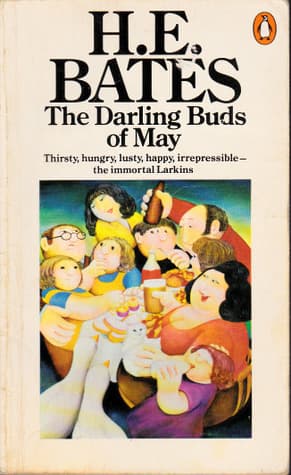
H.E. Bates (1961)
Genre
Historical Fiction
Reading Time
180 min
Key Themes
See below
Sign in to track this book
A tax clerk discovers freedom and joy when he falls for a country family's unconventional, fun-loving charm.
Mr. Cedric Charlton, a meticulous but timid tax inspector, is sent to investigate the Larkins, a family living an unconventional, tax-evading life in rural Kent. He arrives at their picturesque farm on a May day, immediately clashing with their carefree life. Pop Larkin, the patriarch, and his wife, Ma, greet him with hospitality, offering endless food, drink, and warmth. Cedric, initially determined to do his duty, finds himself disarmed by their kindness and the sensory overload of their indulgent life. His professional resolve begins to weaken upon encountering their unhurried world.
Despite his intentions to conduct an audit, Cedric is quickly drawn into the Larkins' chaotic life. He is given large meals, much alcohol, and the constant company of the Larkin children. Pop and Ma skillfully avoid his tax questions with charm and distraction, never refusing to cooperate but always finding a reason to postpone serious business. Cedric, increasingly uncomfortable with his official role, finds himself enjoying the food and the family's company. His strict adherence to rules begins to melt under the influence of their lifestyle, especially the appeal of their eldest daughter, Mariette.
Cedric is captivated by Mariette Larkin, the beautiful, free-spirited eldest daughter. Her natural charm, looks, and uninhibited nature contrast with the women he usually meets. Their interactions become flirtatious, and Cedric's professional boundaries blur. He starts to see the Larkins' 'tax evasion' not as a crime, but as part of their unburdened way of life. His internal conflict grows as his desire for Mariette increases, making it impossible for him to pursue his official duties with conviction. He is torn between his professional obligation and his growing personal feelings.
Pop Larkin takes the entire family, including Cedric, to the local fair. The outing is fun, with Pop winning prizes and everyone enjoying fairground treats and games. Amidst the lively atmosphere, Cedric, smitten and overwhelmed by the Larkins' joy, proposes to Mariette. She accepts. This decision solidifies his break from his former life and fully brings him into the Larkin family. The engagement is met with approval from Pop and Ma, who see Cedric as a suitable addition to their family.
Cedric's new happiness is briefly overshadowed by Mariette's other suitors. These include the handsome local farmer, Monty, and a dashing, older gentleman known as the Brigadier. Their presence highlights Mariette's popularity and free spirit, causing Cedric a moment of insecurity. Pop and Ma, however, treat these rival suitors with their usual good-natured indifference, confident in Mariette's choice. Cedric realizes that being part of the Larkin family means accepting a less conventional approach to relationships and life.
As days pass, Cedric changes. He sheds his stiff suits for comfortable clothes, abandons his schedules, and embraces the Larkins' philosophy of living for the moment. He starts to enjoy farm work, learns to appreciate good food and drink without restraint, and adopts a more relaxed attitude toward money and conventions. The family renames him 'Charlie', showing his complete assimilation. His former life as a tax clerk seems a distant memory, replaced by a joyful existence filled with laughter and love. He feels more alive and content than before.
Despite his transformation, the Larkins' tax affairs remain. Pop and Charlie, now a united front, decide to handle it in their own way. They write a creative and somewhat evasive letter to the tax office, admitting to a relaxed approach to financial record-keeping but assuring them that everything is, in their own fashion, in order. The letter, drafted with Pop's charm and Charlie's new relaxed attitude, relies on goodwill and artful dodging rather than strict adherence to the law.
To celebrate Mariette and Charlie's engagement, the Larkins host a party, inviting friends and acquaintances from the village. The event is a Larkin affair: overflowing with food, drink, music, and revelry. Villagers like Miss Pilchester and the Brigadier attend, marveling at the Larkins' generosity and spirit. The party is a public declaration of Mariette and Charlie's upcoming marriage and solidifies Charlie's place in the community. It is a joyous celebration of love, family, and the Larkin way of life, with everyone contributing to the festive atmosphere.
As the story ends, Charlie and Mariette are in love and looking forward to their wedding. Charlie has fully embraced his new identity and the Larkin lifestyle, shedding all traces of his former existence. He looks forward to a future filled with abundance, joy, and the charm of his new family. The book ends with optimistic expectation, promising a wedding and a lifetime of happiness for the couple, rooted in the idyllic world of the Darling Buds of May. The tax situation, while not conventionally resolved, has faded, a minor detail compared to the richness of life.
The Protagonist
Pop remains largely unchanged, serving as the stable, joyful anchor of the family whose lifestyle transforms those around him.
The Protagonist
Ma remains a constant, loving presence, embodying the nurturing spirit of the Larkin home.
The Protagonist
Mariette finds love and commitment with Cedric, choosing a partner who embraces her family's lifestyle.
The Protagonist
Cedric undergoes a complete transformation from a rigid tax clerk to a free-spirited, joyful 'Charlie' who embraces the Larkin lifestyle and finds love.
The Supporting
The Brigadier's role remains consistent as a friendly, slightly bewildered observer and participant in the Larkin's lives.
The Supporting
Her character remains static, serving as a representation of conventional society interacting with the Larkins.
The Mentioned
Angela Snow's character is not developed; she is primarily a background figure.
The Supporting
Monty's role is limited to being a brief rival for Mariette's affections, ultimately losing out to Cedric.
The Supporting
Their role remains consistent as a collective, contributing to the vibrant family dynamic.
The main theme is the Larkins' uninhibited, free-spirited life contrasting with society's conventions, especially as seen in Cedric Charlton. The Larkins disregard tax laws, embrace pleasure, and prioritize happiness over societal expectations. Cedric's change from a rule-bound tax clerk to 'Charlie' shows the appeal and freedom of living outside conventional norms. The book suggests that true happiness can be found by embracing spontaneity and joy, rather than strictly following societal rules.
““They live as many of us would like to live if only we had the guts and nerve to flout the conventions.””
The Larkins' life is full of abundance — food, drink, children, and joy. They enjoy sensory pleasures, constantly eating, drinking, and celebrating. This theme is clear in descriptions of Ma's meals, Pop's generous spirit, and the atmosphere of plenty on their farm. It contrasts with Cedric's initial sparse existence, eventually drawing him into a world where indulgence is celebrated. The book champions a joyous embrace of life's material pleasures.
““Perfick!””
Cedric Charlton's journey from a tax man to the jovial 'Charlie' is the core of this theme. His initial identity is defined by his profession and rules, but through the Larkins, he discovers a new, more authentic self. He sheds his old persona, embracing a life of spontaneity, love, and connection to nature. This change suggests that identity can evolve when exposed to different ways of living, leading to greater personal fulfillment. His renaming shows his complete adoption of a new way of being.
““He was no longer Mr. Charlton. He was Charlie.””
At its heart, the novel celebrates love and family. The Larkins, despite their unconventional habits, are devoted to one another. Pop and Ma have a strong bond, and their love extends to their children. The growing romance between Cedric and Mariette is the central plot, ending in their engagement. The family provides a strong, supportive, and joyful environment that transforms Cedric, highlighting the power of familial love and acceptance.
““He had never known such happiness. It was like living in a perpetual party.””
The Kent countryside provides a contrast to Cedric's urban world. The Larkins' farm, with its natural beauty, produce, and unhurried pace, represents an escape from the pressures of city life and government. The conflict between Cedric's tax duties and the Larkins' rural existence highlights the theme. The book romanticizes rural life, presenting it as a place where happiness and freedom can flourish, untouched by modern administration.
““The air was full of the scent of hawthorn and wild roses.””
A character from one environment is placed into a completely alien one.
This device is central to the narrative, with Cedric Charlton, the fastidious tax inspector from the structured world of bureaucracy, being dropped into the chaotic, free-spirited, and abundant world of the Larkin family. His discomfort, initial attempts to maintain his professional demeanor, and eventual transformation provide much of the story's humor and character development. The contrast between his original environment and the Larkins' home highlights their unique qualities and drives the plot forward.
Characters who highlight each other's contrasting qualities.
The novel uses foil characters to emphasize the distinct qualities of the main protagonists. Cedric Charlton, with his rigidity, timidity, and adherence to rules, serves as a perfect foil for Pop Larkin, who is jovial, confident, and utterly disregardful of conventions. This contrast not only provides humor but also underscores the core thematic conflict between freedom and convention, making Cedric's eventual transformation more impactful. Mariette also acts as a foil to Cedric's initial reserved nature, drawing him out of his shell.
Vivid descriptions appealing to the five senses.
H.E. Bates employs rich sensory imagery, particularly focusing on food, drink, and the natural beauty of the Kent countryside. Descriptions of Ma's enormous, delicious meals, the scent of the orchards, the taste of Pop's potent cocktails, and the sounds of laughter immerse the reader in the Larkins' world of abundance and pleasure. This device is crucial in conveying the overwhelming and intoxicating nature of their lifestyle, which ultimately seduces Cedric and the reader alike. It highlights the hedonistic theme.
Comedy derived from absurd circumstances and eccentric personalities.
The novel is steeped in humor, largely stemming from the clash between Cedric's serious mission and the Larkins' carefree approach to life, as well as the eccentricities of the Larkin family themselves. Pop's ingenious evasions, Ma's boundless hospitality, and Cedric's increasingly bewildered reactions create numerous comedic situations. The humor is gentle and warm, inviting the reader to laugh with the characters rather than at them, reinforcing the book's lighthearted and optimistic tone.
“Perfick!”
— Pop Larkin's favorite exclamation of approval and contentment.
“The Larkins lived in a world of their own making, a world where money was of no importance, where the only things that mattered were food, drink, and the love of family.”
— Description of the Larkin family's philosophy.
“When the going gets tough, the tough get going.”
— Pop Larkin encouraging his family during a minor crisis.
“There's nothing like a good meal to put things right.”
— Maudie Larkin preparing one of their lavish feasts.
“We don't need money to be happy. We've got each other.”
— Pop Larkin explaining their lifestyle to a visitor.
“The world is full of beautiful things if you just take the time to look.”
— Mariette Larkin admiring the countryside.
“A little bit of what you fancy does you good.”
— Pop Larkin justifying their indulgent lifestyle.
“Family is the most important thing in the world.”
— Pop Larkin reflecting on their close-knit relationships.
“Why worry about tomorrow when today is so perfect?”
— Pop Larkin dismissing concerns about the future.
“Life is for living, not for counting pennies.”
— Pop Larkin explaining their carefree attitude toward finances.
“The best things in life are free: love, laughter, and sunshine.”
— Mariette Larkin enjoying a simple day with her family.
“We may not have much, but we have everything we need.”
— Maudie Larkin contentedly surveying their home and family.
“Happiness is a choice, and we choose it every day.”
— Pop Larkin explaining their positive outlook on life.
“A full belly and a happy heart—that's all anyone really needs.”
— Pop Larkin after one of their abundant meals.
Ready to see how well you understood this book? Take our interactive quiz with 10 questions.

Biography coming soon.







