“The man in black fled across the desert, and the gunslinger followed.”
— The iconic opening line of the series, establishing the core pursuit.

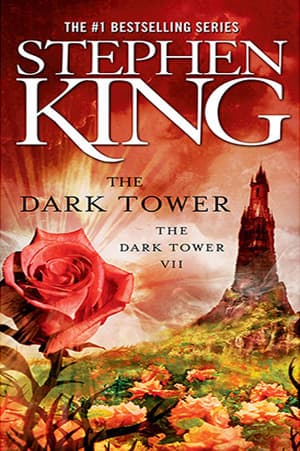
Stephen King (2004)
Genre
Fantasy / Science Fiction
Reading Time
25-30 hours
Key Themes
See below
Sign in to track this book
In the final act, Roland the gunslinger must navigate a collapsing multiverse and confront the Crimson King to reach the Dark Tower, the center of all reality, and complete his decades-long quest.
The story opens with Roland Deschain, Eddie Dean, and Jake Chambers in a dystopian New York City, having followed Susannah Dean through a door from the Dixie Pig. Susannah, now possessed by the demon Mia and pregnant with Mordred, is held in the restaurant, which acts as a center for various dark forces. Roland and his ka-tet must navigate the city's dangers, including 'low men' and other creatures, to reach the Dixie Pig and save Susannah. Their journey is dangerous, forcing them to use their gunslinger skills and wits to survive the urban wasteland, all while trying to understand Mia's plan and the Crimson King's involvement. They learn that Mia intends to give birth to Mordred in a sacred place, further complicating their mission.
Inside the Dixie Pig, Susannah, under Mia's influence, is taken to a birthing chamber. Roland, Eddie, and Jake, having fought their way through the creatures of the Dixie Pig, arrive just as Susannah gives birth to Mordred Deschain, a spider-human hybrid with great power. Mordred immediately kills Mia, fulfilling his parasitic nature. The gunslingers engage in a desperate battle against the remaining creatures and try to understand the newborn Mordred's true loyalty. Amidst the chaos, they escape the Dixie Pig, but Mordred, now free, becomes a formidable and unpredictable threat, destined to be either Roland's son or his ultimate downfall. The ka-tet must regroup and plan their next move, knowing Mordred is now a living weapon.
Following their escape from the Dixie Pig, the ka-tet finds itself in a new location, a desolate Maine landscape. They encounter Calvin Tower, a bookseller from one of Roland's previous trips, who is being targeted by the Crimson King's forces because of a plot of land he owns. In an attempt to protect Tower and secure the land — which holds a key to the Breakers' prison — Eddie Dean sacrifices himself, taking a bullet intended for Tower. His death is a devastating blow to Roland and Jake. Susannah, still recovering from Mordred's birth and struggling with her identity, is affected, and the ka-tet's unity is again fractured.
After Eddie's death, Roland and Jake continue their journey. They discover that Stephen King, the author of their own story, is in danger. King, living in the 'real world' of Maine, is about to be hit by a van, an event that would erase the Dark Tower series from existence. Roland and Jake intervene, saving King's life. However, Jake pushes King out of the way and is himself hit by the van, dying in Roland's arms. Jake's death is a heartbreaking moment, fulfilling a prophecy and further isolating Roland. His sacrifice ensures the story continues, but leaves Roland with an even heavier burden of loss as he presses on towards the Tower.
Grief-stricken and feeling increasingly alienated from Roland's single-minded quest, Susannah makes a difficult decision. Guided by a vision and a desire for a different life, she uses a magical door to cross into an alternate reality. In this new world, she finds parallel versions of Eddie Dean and Jake Chambers, who, though not the same as her fallen ka-tet members, offer her a chance at a new beginning and a life free from the relentless pursuit of the Dark Tower. Her departure leaves Roland alone, further emphasizing the sacrifices made and the loneliness of his journey. It represents a break from the ka-tet's original mission, allowing her a measure of peace.
Now truly alone, Roland continues his journey towards the Dark Tower. He encounters Patrick Danville, a young man held captive by the villainous Dandelo. Patrick has an extraordinary ability: whatever he draws becomes real, and whatever he erases ceases to exist. Roland rescues Patrick, recognizing the immense power he holds. Patrick's abilities are crucial as they continue their journey, as he can draw solutions to obstacles and erase threats. Their bond forms quickly, with Patrick offering Roland a new kind of companionship, though with a different dynamic than his previous ka-tet. Patrick's existence highlights the meta-fictional elements of the narrative.
Roland and Patrick finally reach Algul Siento, the prison where the Breakers, psychics forced to destroy the beams that hold the multiverse together, are held captive. They discover that the Crimson King's forces are actively breaking the final beam. A fierce battle ensues, with Roland using all his gunslinger skills against the enemies. Patrick uses his drawing abilities to aid in the fight, creating weapons and erasing obstacles. Roland frees the remaining Breakers, who, now free, begin to restore the damaged beams. This confrontation is a key moment, as it directly impacts the stability of all realities and brings Roland closer to the Crimson King's ultimate plan.
Having secured the Breakers' freedom, Roland and Patrick continue their ascent towards the Dark Tower itself. They find the Tower under siege by the Crimson King, who, now completely insane, is attempting to breach its defenses. The King is trapped on a balcony, throwing 'sneetches' (explosive grenades) at the Tower, causing damage to its structure. Roland understands that he must confront the King to gain entry to the Tower. The scene is surreal and dangerous, emphasizing the King's derangement and the ultimate stakes of Roland's quest. Patrick's unique abilities are essential in dealing with the King's erratic and destructive attacks.
Roland realizes that the Crimson King, while formidable, is a broken and mad figure. He understands that a direct gunslinger confrontation might not be the most effective way to deal with him. Instead, Roland instructs Patrick Danville to use his unique artistic power. Patrick draws the Crimson King exactly as he is, then erases him from the page, effectively erasing him from existence. This act is a powerful and unconventional resolution to the conflict with the primary antagonist. It highlights the meta-fictional nature of the story and the power of creation and destruction through art, clearing the path for Roland's final ascent.
With the Crimson King defeated, the path to the Dark Tower is clear. Roland, weary but resolute, prepares for his final ascent. He instructs Patrick Danville to remain outside, as the Tower's secrets are meant for him alone. Patrick, understanding the moment, reluctantly agrees. Roland enters the Tower, a place of immense power and mystery, the nexus of all realities. His journey has reached its culmination, and the reader anticipates the ultimate revelation. The Tower itself is described as a grand, ancient structure, both inviting and forbidding, holding the answers to Roland's lifelong quest.
Roland climbs the seemingly endless stairs of the Dark Tower. Each floor holds echoes of his past, visions of people he has loved and lost, and significant moments from his long journey. He passes through various chambers, each containing symbols and memories relevant to his quest. Finally, he reaches the very top room. Inside, he finds a single door. As he approaches it, a powerful, unseen force compels him forward. The room is not a place of ultimate rest or resolution in the way he might have imagined. Instead, it is a point of beginning, a cyclical trap he has been in countless times before.
As Roland opens the door at the top of the Dark Tower, he is immediately transported back to the beginning of his journey, finding himself in the desert, pursuing the Man in Black. This is a shocking and cyclical ending, revealing that Roland has been on this quest countless times before. However, there is one crucial difference: this time, he possesses the Horn of Eld, which he had neglected to retrieve in previous iterations. This detail suggests a slight alteration to the cycle, perhaps offering a glimmer of hope for a different outcome in this new, yet familiar, journey. The ending emphasizes themes of fate, redemption, and eternal recurrence.
The Protagonist
Roland's arc is cyclical, ending where it began, but with the addition of the Horn of Eld, suggesting a potential for a different, more complete journey in the next iteration.
The Supporting
Eddie evolves from a cynical addict to a heroic gunslinger who ultimately sacrifices himself for the quest, finding purpose and love along the way.
The Supporting
Susannah integrates her personalities, becomes a gunslinger, faces immense personal trials, and ultimately chooses a path away from Roland's quest to find peace and a new family.
The Supporting
Jake repeatedly dies and is reborn into the quest, ultimately sacrificing himself heroically to save Stephen King, ensuring the story's continuation.
The Antagonist
Mordred is born with a singular purpose to kill Roland, relentlessly pursuing him until his own death, fulfilling his role as a dark, fated antagonist.
The Antagonist
The Crimson King's arc culminates in his ignominious defeat, erased by Patrick Danville, ending his millennia-long reign of terror and obsession with destruction.
The Mentioned
King is saved from a fatal accident by Jake's sacrifice, ensuring the continuation of the Dark Tower narrative and allowing Roland to complete his quest.
The Supporting
Patrick is rescued and uses his unique abilities to aid Roland in defeating the Crimson King and clearing the path to the Tower, then remains outside as Roland enters.
The Supporting
Mia serves as a vessel for Mordred's birth, fulfilling her desire for motherhood before being immediately killed by Mordred himself.
The central theme revolves around 'ka,' a form of destiny or fate that binds individuals together and dictates their path. Roland's journey is a perpetual cycle, a punishment and a chance for redemption. The ending, where Roland returns to the beginning of his quest, reinforces this cyclical nature, suggesting he is forever bound to the Tower until he learns a lesson or makes a different choice. The presence of the Horn of Eld in his possession in the final iteration offers a glimmer of hope for breaking the cycle, or at least progressing further. The ka-tet's bonds, though broken by death and separation, are also part of this grand design.
“''Go then, there are other worlds than these.''”
The journey to the Dark Tower is paved with loss and sacrifice. Roland loses his entire ka-tet — Eddie, Jake, and Susannah (who departs) — each death or departure deeply affecting him, yet he is compelled to continue. Eddie's heroic death protecting Calvin Tower and Jake's sacrifice to save Stephen King are examples of this theme. These losses highlight the brutal cost of Roland's quest and the harsh realities of their world. Despite the pain, the characters repeatedly choose to sacrifice for the greater good of the Tower or their companions, underscoring their courage and loyalty.
“''Long days and pleasant nights.''”
Stephen King blurs the line between author and character, making himself a figure within the narrative. The existence of the Dark Tower and all realities depends on King's ability to write the story. Patrick Danville's power to create and erase reality through drawing further emphasizes the power of creative acts. This meta-fictional approach highlights how stories shape our understanding of reality and how creation can influence destiny. The narrative acknowledges its own fictionality, inviting readers to consider the nature of storytelling itself and its role in shaping existence.
“''For King, it was no longer a question of whether or not the story was 'real.' The story was real. It was his life.''”
While Roland's cycle continues, the subtle change (the Horn of Eld) offers a hint of redemption. Throughout his journey, Roland grapples with his past actions, particularly his abandonment of the Horn of Eld and the sacrifices he has made. The cyclical nature of his quest can be seen as an ongoing opportunity for redemption, to make different choices and perhaps achieve a more complete or peaceful ending. The forgiveness he extends to others, and the forgiveness he seeks for himself, are integral to his character development, even if the ultimate resolution remains elusive.
“''He had come to the Tower, and it was beautiful, but the beauty was a lie.''”
The conflict between Roland's ka-tet and the Crimson King's forces is a clear manifestation of good versus evil. The Crimson King represents pure chaos and destruction, seeking to dismantle all realities. Roland, though flawed, embodies order and preservation, striving to protect the Tower and the beams. The introduction of Mordred, a creature of both Roland's and the Crimson King's essence, complicates this, exploring the potential for darkness within even heroic lineage. The fight is not just physical, but a cosmic struggle for the balance of the multiverse.
“''The world had moved on.''”
The nexus of all realities, Roland's ultimate goal.
The Dark Tower is the physical and metaphysical center of all universes. It is the destination of Roland's quest and the anchor of existence. Its stability is maintained by the Beams, which are being destroyed by the Crimson King's forces. Reaching the Tower is Roland's singular obsession, and it represents both salvation and a terrifying, cyclical truth. The Tower itself is a character, a silent observer and orchestrator of Roland's destiny, holding the ultimate answers to his questions.
Destiny and the group bound by it.
'Ka' refers to destiny or fate, the unseen force that binds events and individuals together. 'Ka-tet' is a group of people bound by ka, destined to travel together and share a common fate. This concept explains the seemingly random coming together of Roland, Eddie, Susannah, and Jake, and their unwavering loyalty despite immense hardships. It serves as a powerful narrative device to justify their interconnectedness and the sacrifices they make for each other and the quest.
A family heirloom whose absence represents Roland's past failures.
The Horn of Eld is a significant relic, a battle horn belonging to Roland's ancestor, Arthur Eld. Roland famously left it behind after the Battle of Jericho Hill, a decision that has haunted him throughout his quest. Its absence symbolizes his past failures, his ruthlessness, and his single-minded obsession with the Tower at the expense of his companions. Its presence in Roland's hand at the very end of the final book, as he re-enters the cycle, suggests a crucial change and a potential for a different outcome in his perpetual journey.
A single rose in a vacant lot, representing the Dark Tower itself.
The Rose is a physical manifestation of the Dark Tower in other realities, specifically in New York City. It appears as a single, delicate rose growing in a vacant lot, protected by a magical barrier. It is a symbol of the Tower's vulnerability and its connection to all worlds. Its protection is crucial to the stability of the multiverse, and its destruction would mean the collapse of all realities. The Rose serves as a tangible link between Roland's world and ours, emphasizing the interconnectedness of all things.
Psychics forced to destroy the Beams that support the Tower.
The Breakers are powerful psychics, kidnapped and imprisoned by the Crimson King's forces at Algul Siento. They are forced to use their mental abilities to attack and destroy the Beams, the twelve cosmic forces that hold the Dark Tower and all realities together. Their work threatens to unravel the entire multiverse. Roland's mission to free them is critical to saving all existence. They represent the exploitation of power for destructive ends and the vulnerability of the fundamental structure of reality.
“The man in black fled across the desert, and the gunslinger followed.”
— The iconic opening line of the series, establishing the core pursuit.
“Go then, there are other worlds than these.”
— Spoken by Jake Chambers to Roland, a poignant moment of understanding and sacrifice.
“Long days and pleasant nights.”
— A common greeting and farewell among gunslingers, signifying respect and hope.
“Thankee sai.”
— A formal and respectful way of saying 'thank you' in the Mid-World dialect.
“The world has moved on.”
— A recurring phrase indicating the decay and change of Roland's world.
“And the world gave way to the sound of his voice.”
— Describing Roland's powerful and commanding presence when he speaks.
“It was the first time Roland had ever seen a train.”
— Highlighting the cultural clash and wonder of Roland encountering technology from Jake's world.
“There's a reason for everything.”
— A philosophical statement often pondered or asserted by characters, especially Roland.
“The wheel of ka turns.”
— A reference to the concept of 'ka' (destiny or fate) in Roland's world.
“He kills with his heart, not his hand.”
— A description of Roland's unique and deadly skill as a gunslinger, emphasizing precision and intent.
“The greatest mystery of all is the human heart.”
— A reflection on the complexities of human emotion and motivation.
“Ka is a wheel. Its one purpose is to turn. And in the turning it brings us back to where we started.”
— A deeper explanation of 'ka' and its cyclical nature, hinting at the series' ending.
“But the Tower... the Tower is the nexus of all possible worlds.”
— Explaining the central importance of the Dark Tower to the multiverse.
“He who loves the Dark Tower, let him not look back.”
— A warning about the unwavering commitment required for the quest, and the dangers of regret.
Ready to see how well you understood this book? Take our interactive quiz with 10 questions.

Stephen Edwin King is an American author of horror, supernatural fiction, suspense, crime, science-fiction, and fantasy novels. Described as the "King of Horror", his books have sold more than 350 million copies as of 2006, and many have been adapted into films, television series, miniseries, and comic books. King has published over 65 novels/novellas, including seven under the pen name Richard Bachman, and five non-fiction books. He has also written approximately 200 short stories, most of which have been published in book collections.







