“The Dark Tide rises, and with it comes the shadow of despair.”
— Opening line of the novel, setting the ominous tone.

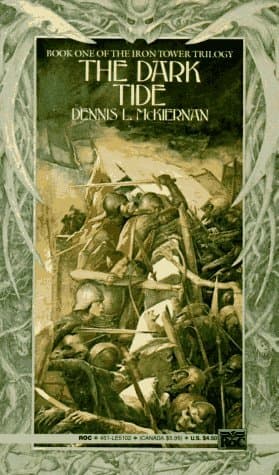
Dennis L. McKiernan (1984)
Genre
Fantasy
Reading Time
608 min
Key Themes
See below
Sign in to track this book
An unnatural winter and a creeping blizzard threaten to consume the land. A tiny Warrow named Tuck must brave a world too large and dangerous for his kind to answer the High King's call, only to find himself swallowed by a monstrous war that scatters his companions and may doom them all.
The story opens in the peaceful Boskydells, home to the Warrows, a small, peace-loving folk. An unnaturally severe and prolonged winter descends upon the land, causing hardship and unease. This harsh weather comes with rumors of the evil sorcerer Modru stirring in the far north, consolidating his power and amassing an army of foul creatures. Among the Warrows, Tuck Underbank, a young Thornwalker, feels a growing sense of foreboding. When the official summons arrives from the High King, requesting aid from all free peoples, the elders of the Boskydells decide to send a group of their best Thornwalkers, including Tuck, to join the High King's forces. This decision ends their isolation and begins their involvement in the coming war.
Tuck, along with his companions Purl, Danner, and other Thornwalkers, sets out from the Boskydells. Their journey is hard, marked by bitter cold, deep snow, and the constant threat of Modru's scouts and creatures. They travel through once-familiar places now changed by the unnatural winter, meeting other free peoples also making their way to the High King's stronghold. Along the way, they see the widespread devastation and fear that Modru's influence is spreading across the land. The Warrows, despite their small size, are resilient and resourceful, using their keen senses and knowledge of the wild to navigate the dangerous terrain. Their destination is the High King's fortress, a place of hope against the encroaching darkness, where the forces of good are gathering for a desperate stand.
Upon reaching the High King's fortress, Tuck and his companions face a grim reality. The stronghold is busy with warriors from various races – Men, Elves, Dwarves, and others – all preparing for the conflict. The Warrows, initially underestimated due to their size, are eventually given roles in the defensive strategy. Tuck, Purl, and Danner find themselves among seasoned warriors, feeling both awe and fear. They observe the High King, a figure burdened by the responsibility of leading his people against an overwhelming enemy. Tensions are high among the different races, but the common threat of Modru forces an uneasy alliance. The Warrows, with their unique skills and spirit, begin to find their place, though the scale of the impending war is daunting.
As preparations for war intensify, a new and terrifying phenomenon emerges: the Dimmendark. This is not merely a blizzard, but a supernatural expanse of lightless, soul-crushing cold and darkness that spreads across the land, consuming light and hope. Its advance is slow but relentless. The Dimmendark cripples communication, obscures vision, and saps the morale of the defenders. Tuck and his friends see its terrifying power firsthand, realizing this is more than just a military campaign; it is a battle against an encroaching, unnatural evil that threatens to engulf their world. The Dimmendark is a tangible sign of Modru's malevolence, making the fight even more desperate.
The first major assault by Modru's forces finally comes, and the scale of the enemy horde is terrifying. Goblins, Orcs, Wraiths, and other monstrous creatures swarm towards the High King's defenses, their numbers seemingly endless. The battle is brutal and chaotic, a desperate struggle against overwhelming odds. The Warrows, including Tuck, find themselves in the thick of combat, using their agility and courage to fight alongside the larger warriors. Despite their initial successes, the sheer volume and ferocity of Modru's creatures begin to take their toll. Casualties mount rapidly, and the defenders are pushed to their limits. The Dimmendark further complicates the battle, making it difficult to see, communicate, and coordinate defenses, turning the battlefield into a nightmarish labyrinth of shadow and violence.
As the battle rages, Modru's strategy becomes clear: to overwhelm the defenders through sheer numbers and relentless assault. The High King's forces, despite their bravery, are slowly being driven back. A critical breach in the defenses occurs, leading to panic and a desperate, disorganized retreat. In the chaos of the withdrawal, under the gloom of the Dimmendark, Tuck and his companions are separated. Purl, Danner, and other Warrows are scattered amidst the fleeing soldiers and pursuing monsters. Tuck finds himself cut off from his friends, lost and alone in the swirling darkness and confusion of the collapsing front lines. The situation appears dire, and the fate of his companions, and the entire war effort, hangs precariously as the dark tide threatens to engulf them all.
After the catastrophic retreat, Tuck Underbank is alone, lost in the chaotic aftermath of the battle and the gloom of the Dimmendark. He evades pursuing Goblins and Orcs, relying on his Warrow stealth and knowledge of the wild, honed by his Thornwalker training. His immediate goal is survival, but a deep worry for his friends, Purl and Danner, bothers him. He journeys through the desolate, snow-covered landscape, encountering pockets of Modru's forces and skirmishing with them when necessary. The journey is full of danger, starvation, and crushing loneliness, forcing Tuck to mature rapidly and rely on his own wits and courage in the face of despair. He sees the full horror of Modru's conquest, strengthening his resolve to somehow fight back.
Meanwhile, Purl and Danner, along with a few other surviving Warrows and scattered warriors from other races, are in their own desperate struggle for survival. They manage to stick together, but are cut off from the main retreating forces and surrounded by Modru's creatures. They are forced to hide, constantly on the move, seeking refuge in the harsh wilderness. Their journey is one of constant evasion, narrow escapes, and dwindling hope. Purl, with his practical nature, tries to keep their spirits up, while Danner, the more cautious, plans their movements. They encounter the brutality of Modru's forces and the unforgiving nature of the Dimmendark, reinforcing their understanding of the immense evil they face. Their ultimate goal is to rejoin the High King's forces or find a safe haven.
As Tuck continues his solitary and dangerous journey, he eventually encounters small, scattered groups of free folk who have also survived the initial onslaught and are attempting to resist Modru's advance. From these encounters, he learns fragmented but vital information: the High King's forces, though severely battered, have not been entirely broken, and there are whispers of a new plan or a desperate hope for a turning point. These encounters, though brief, reignite a spark of hope in Tuck's heart and give him a renewed sense of purpose. He realizes that even though the Dimmendark seems to be winning, resistance is not futile. He begins to actively seek ways to contribute, to find his way back to the main fight, or to find his friends, driven by the desire to not let Modru win.
The book concludes with the Dimmendark continuing its spread, casting a pall of physical and spiritual darkness over the land. Modru's victory seems imminent, and the forces of good are scattered, demoralized, and fighting for survival. Tuck, Purl, and Danner remain separated, each facing their own challenges, their fates uncertain. While there are glimmers of hope and the resolve of the free peoples remains unbroken, the immediate future is bleak. The 'dark tide' of Modru's evil and the Dimmendark threatens to engulf everything. The story ends with the understanding that this is merely the beginning of a larger conflict, and the struggle for the soul of the world has just begun, with the Warrows playing an unexpected but important role in the unfolding epic.
The Protagonist
Tuck transforms from a curious, somewhat naive Warrow into a hardened survivor and a determined combatant against Modru's evil, finding his true purpose amidst chaos.
The Supporting
Purl maintains his steadfast nature but grows in resilience and resourcefulness, proving to be a reliable and hopeful presence in dire circumstances.
The Supporting
Danner's caution is tested by the realities of war, forcing him to act decisively and demonstrating his quiet courage.
The Antagonist
Modru's power grows exponentially, successfully launching his invasion and spreading the Dimmendark, establishing his dominance in this initial phase of the conflict.
The Supporting
The High King grapples with immense pressure and the initial failures of war, maintaining a desperate hold on his forces and seeking any hope for resistance.
The Supporting
The Elders make the difficult but necessary decision to break with tradition and send their young to war, acknowledging the global threat.
The Mentioned
These commanders face the impossible task of defending against Modru, experiencing the collapse of their lines and the desperation of retreat.
The Antagonist
As Modru's instruments, they successfully overwhelm the initial defenses, pushing back the free peoples and spreading terror.
The Warrows, particularly Tuck, begin the story in peaceful innocence, living in their sheltered Boskydells. The unnatural winter and the summons from the High King shatters this tranquility, forcing them to confront a world far more dangerous and brutal than they ever imagined. Their journey to war, their participation in the battles, and the spread of the Dimmendark show a loss of that innocence, replaced by the realities of conflict and the burden of duty to a world larger than their own.
“"The Boskydells had known peace for generations, but that peace now seemed a fragile thing, easily shattered by the encroaching shadows from the north."”
Modru's evil is not just a military threat but a corrupting force embodied by the Dimmendark. This lightless blizzard symbolizes the spiritual and physical despair that Modru seeks to inflict upon the world. It drains hope, obscures vision, and creates an environment where fear thrives. The story explores how this overwhelming evil tests courage and resilience, pushing characters to the brink of despair. The 'dark tide' itself represents the relentless, seemingly unstoppable nature of this malevolent force.
“"The Dimmendark was not merely a storm; it was a shroud woven of Modru's malice, stealing light and hope with its every icy breath."”
A central theme is the unexpected courage displayed by the small and seemingly insignificant Warrows when confronted by an enemy of immense power and numbers. Despite their fear and physical disadvantage, characters like Tuck, Purl, and Danner rise to the challenge, fighting valiantly alongside larger races. Their resilience in the face of Modru's horde, their refusal to give up even when separated and lost, shows that true courage is not the absence of fear, but the willingness to act despite it, even when victory seems impossible.
“"Though their stature was small, the hearts of the Warrows burned with a fire that defied the encroaching chill."”
The bonds of friendship and loyalty are important to the Warrows' survival and morale. Tuck, Purl, and Danner's camaraderie is a source of strength, and their separation is a significant emotional blow. The theme extends to the uneasy alliances formed between the different races fighting Modru, showing that unity, despite differences, is essential for resistance. Even in the chaos of battle and retreat, the desire to find and protect one's companions drives many of the characters' actions, offering a counterpoint to the pervasive darkness.
“"To be separated from his friends felt like a wound deeper than any blade, for their fellowship was the warmth against the growing cold."”
A supernatural, lightless blizzard symbolizing Modru's encroaching evil.
The Dimmendark is a critical plot device that serves multiple functions. Physically, it is an unnaturally cold, light-absorbing blizzard that spreads across the land, obscuring vision, hindering travel, and making combat chaotic. Symbolically, it represents Modru's growing power and the spiritual darkness he casts over the world, draining hope and morale. It is a constant, tangible manifestation of the antagonist's influence, escalating the stakes and creating a pervasive sense of dread. Its relentless spread acts as a ticking clock, emphasizing the urgency of the war.
A narrative device highlighting themes of underestimated heroism and resilience.
The Warrows' small size and peaceful nature are central to their characterization and their role in the plot. It serves as a device to underscore their unexpected courage and resilience when thrust into a war against monstrous foes. Their initial underestimation by other races highlights the theme that heroism is not defined by physical might but by spirit and determination. Their unique perspective, agility, and keen senses, often overlooked, become crucial advantages in the chaotic battles and desperate escapes, emphasizing that even the smallest can make a significant difference.
A harbinger of Modru's power and a significant environmental antagonist.
The unnaturally harsh and prolonged winter that grips the land at the beginning of the story is more than just a setting detail; it is an active plot device. It serves as the initial sign of Modru's stirring power and influence, demonstrating his ability to corrupt even nature itself. The extreme cold and snow create immense hardships for travel and survival, forcing the Warrows out of their comfortable lives and into a perilous journey. It foreshadows the greater darkness to come (the Dimmendark) and establishes the grim, unforgiving atmosphere of the conflict.
A narrative technique to heighten tension, demonstrate individual growth, and expand the narrative scope.
The separation of Tuck, Purl, and Danner during the catastrophic retreat is a key plot device. It immediately ratchets up the tension and sense of desperation, as each character must now face the dangers alone or in smaller, vulnerable groups. This forces individual growth and resourcefulness in each Warrow, as they can no longer rely on the collective strength of their immediate fellowship. It also allows the narrative to explore different facets of the war and different dangers through multiple perspectives, broadening the reader's understanding of the scale of Modru's invasion and the widespread devastation.
“The Dark Tide rises, and with it comes the shadow of despair.”
— Opening line of the novel, setting the ominous tone.
“Even the smallest light can pierce the deepest darkness.”
— A character's encouragement during a hopeless moment.
“In war, there are no victors, only survivors.”
— Reflection on the aftermath of a battle.
“The past is a ghost that haunts us all, but the future is a choice we make.”
— Dialogue about overcoming past traumas.
“Fear is the weapon of the Dark Lord, but courage is our shield.”
— A rallying speech before a confrontation.
“Magic is not a tool to be wielded lightly, for it carries a price.”
— Warning about the dangers of sorcery.
“Friendship is the strongest armor against the tides of evil.”
— Emphasizing the bond between companions.
“The land remembers the blood spilled upon it, and it cries out for justice.”
— Description of a cursed battlefield.
“To lead is to bear the weight of many souls upon your shoulders.”
— A leader's burden during a crisis.
“In the silence between heartbeats, destiny is decided.”
— Moment of tension before a critical decision.
“The stars may guide us, but it is our own will that lights the path.”
— Philosophical musing on fate and free will.
“Evil thrives not in power, but in the indifference of good men.”
— Critique of inaction in the face of darkness.
“A single act of kindness can unravel a thousand curses.”
— Highlighting the power of compassion.
“The sea does not forgive, nor does it forget.”
— Metaphor for the relentless nature of conflict.
Ready to see how well you understood this book? Take our interactive quiz with 10 questions.







