“The past is a stubborn thing. It doesn't want to change.”
— Apollo reflecting on his past mistakes and the nature of time.

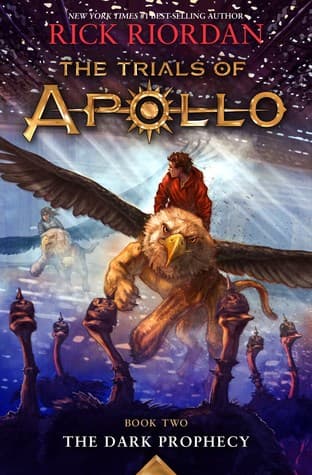
Rick Riordan (2017)
Genre
Fantasy / Children's / Young Adult
Reading Time
6-8 hours
Key Themes
See below
Sign in to track this book
Stripped of his godhood and trapped in a mortal body, Apollo must navigate Indianapolis, evade a Roman emperor, and rescue his demigod master from a sinister stepfather, all while dealing with his weaknesses and the constant threat of death.
Apollo, still in the mortal body of Lester Papadopoulos, arrives in Indianapolis in a garbage truck, sent by Zeus to find the next Oracle. He is immediately attacked by blemmyae but is saved by Emmie and Josephine, a blind girl and her partner. They take him to the Waystation, a hidden sanctuary for demigods and mythical creatures run by Emmie and Jo, who are immortal huntresses from Diana's ancient retinue. Here, Apollo learns that Meg McCaffrey, his demigod master who betrayed him to Nero, is also in Indianapolis, serving Nero's agenda. The Waystation offers temporary safety, but Nero's presence creates danger.
At the Waystation, Lester meets its community. He meets Georgina, a young demigod who communicates through cryptic messages, and Britomartis, the goddess of nets, who lives there. Most importantly, he meets Leo Valdez and Calypso, who arrived on Festus, the bronze dragon, also seeking the Oracle. Calypso, now mortal, struggles to adjust to the human world. Lester learns the next Oracle is Trophonius, located beneath the city. The Waystation itself is a former safe house for runaway slaves, now a sanctuary for demigods, showing its protectors' compassion.
Meg McCaffrey eventually appears at the Waystation, but she is changed. Under Nero's powerful influence, she is more aggressive and less in control, often speaking his rhetoric. She reveals that Nero has built a network of control in Indianapolis, using his corporate empire to oppress people and capture demigods. Her presence creates tension, as Lester still needs her as his master, despite her past betrayal and current loyalty to Nero. Lester realizes that freeing Meg from Nero's psychological hold is necessary for his quest and for Meg's well-being.
Georgina, the young prophet, delivers a new prophecy about a poisoned grove and a serpent's lair. This indicates the Oracle of Trophonius is not only hidden but also corrupted. Lester, Leo, Calypso, Meg, Emmie, and Josephine interpret the prophecy to mean they must find a specific grove of sacred trees Nero has defiled, which is the key to the Oracle. Their search leads them to the Indianapolis Zoo, where Nero has a base. The group prepares for a dangerous infiltration, knowing Nero's forces will be strong and the environment hostile due to the corruption.
The heroes enter the Indianapolis Zoo, encountering Nero's armed security, the 'Germani.' They move through the zoo, using their skills. Inside, they discover Nero has desecrated the ancient Grove of Dodona, a sacred site, turning it into an industrialized garden of genetically modified, carnivorous plants and enslaved dryads. The grove is a symbol of Nero's disregard for nature. The dryads, once protectors, are forced to serve Nero, their life force drained to power his experiments. This discovery strengthens the heroes' resolve to stop Nero.
Following clues, Lester and Meg enter the Oracle of Trophonius, beneath the desecrated grove. The experience is terrifying and dreamlike, as the Oracle is a dark, fear-inducing entity. Trophonius is a chthonic deity who speaks through fear. Nero has been feeding the Oracle his paranoia, corrupting its prophecies for his gain. Lester and Meg confront their deepest fears, enduring psychological torment to receive a fragmented prophecy about a 'serpent's sting' and a 'tower of lies.'
After the Oracle experience, Meg's memories of her stepfather, Nero, become clearer and more painful. She remembers his cruelty and manipulation, how he killed her father and forced her into his service. This memory, combined with the Oracle's influence, strengthens her resolve. She confronts Nero, rejecting his control and siding with Apollo and the Waystation. This defiance is a turning point for Meg, freeing her from Nero's control. Nero is enraged by her betrayal, escalating the conflict.
Enraged by Meg's defection and the heroes' interference, Nero attacks the Waystation. He brings an army of Germani and powerful magical creatures. A fierce battle follows, with Lester, Leo, Calypso, Emmie, Josephine, and other Waystation residents fighting to protect their sanctuary. Despite their efforts, Nero's forces are strong. The Waystation is damaged, and the heroes are pushed to their limits. Nero is forced to retreat, but he leaves destruction and promises to return, showing the conflict is not over. This battle highlights Nero's power.
After Nero's attack, the Waystation is in ruins, but its inhabitants are mostly safe. The heroes tend to the wounded and begin repairs. With Nero's influence weakened and Meg's connection severed, the Oracle of Trophonius is partly cleansed. Georgina, now clearer, delivers a new prophecy pointing to the next trial: 'The tower of lies awaits, where the emperor's final gambit plays.' This indicates the third emperor and final Oracle are in a new, dangerous place. The heroes realize their quest is far from over, and the next challenge will be even more dangerous.
With the Oracle of Trophonius secured (for now) and Meg committed to their cause, Lester, Meg, Leo, and Calypso prepare to leave Indianapolis. The Waystation, though damaged, will recover under Emmie and Josephine's care. The experience has strengthened the group's bond, especially between Lester and Meg, who now trust each other more. They decide to travel together, united in their mission to stop Triumvirate Holdings and restore Apollo's godhood. The next quest's destination is hinted at, suggesting a journey to a Roman stronghold and a confrontation with another emperor. The quest continues, with higher stakes.
The Protagonist
Transforms from a self-absorbed, arrogant god into a more compassionate, self-sacrificing mortal, learning the true meaning of heroism and friendship.
The Supporting
Breaks free from Nero's psychological control, confronting her past trauma and choosing to fight for good and her true friends.
The Supporting
Continues to be a reliable and supportive friend, adapting to new challenges while helping Calypso adjust to her mortal life.
The Supporting
Learns to cope with the challenges of mortality, finding strength and purpose in her new life and relationship with Leo.
The Supporting
Continues to provide unwavering support and sanctuary, embodying resilience and hope in the face of danger.
The Supporting
Remains a steadfast protector and partner, providing strength and practical support to the Waystation and the quest.
The Antagonist
Remains a powerful and manipulative antagonist, focused on maintaining control and punishing those who defy him, ultimately retreating but not defeated.
The Supporting
Her prophetic abilities become clearer as the Oracle is cleansed, providing vital guidance for the quest.
The Mentioned
Remains a quirky, supportive presence at the Waystation, occasionally offering divine insight.
Redemption is central to Apollo's journey. Stripped of his godhood, he faces his past arrogance and learns humility. His quest is not just about regaining powers, but proving he deserves them. This shows when he risks danger for others, especially Meg, despite his mortal state. Meg also seeks redemption, breaking free from Nero's influence and fighting for good, choosing friends over past loyalties. Their journey shows that true heroism comes from selfless acts and moral courage, as when Lester risks his life in the Oracle of Trophonius for Meg.
““I had been a god for millennia. I’d had all the power in the world. But it was only now, as a mortal, that I understood what it meant to be truly brave.””
The book explores abuse and the long path to recovery, mainly through Meg McCaffrey. Nero's psychological manipulation and physical abuse of Meg are clear, showing how trauma can bind a victim to their abuser. Meg's struggle to break free from Nero, remember her past, and trust others is painful but ultimately triumphant. The Waystation, with Emmie and Josephine's support, is a safe space for healing. This theme helps understand Meg's actions and her defiance against Nero, showing the strength needed to overcome deep trauma.
““Nero had twisted her mind for years. It was amazing she had any sanity left.””
The novel explores the corrupting influence of unchecked power. Nero shows this abuse of power, using his resources to dominate and terrorize. His rule in Indianapolis is a small example of a tyrannical empire, where fear maintains control. In contrast, Apollo, without his divine power, learns to value cooperation, friendship, and moral leadership. The Triumvirate emperors, with their desire for absolute control, contrast with the Waystation's community and protection, highlighting how power can be used for oppression or for good.
““Power. It was all Nero cared about. And he would destroy anything, anyone, to keep it.””
The idea of 'found family' and community strength is a major theme, seen in the Waystation. This sanctuary, run by Emmie and Josephine, offers a safe place for demigods and mythical beings with nowhere else to go. It provides belonging, protection, and support, sharply contrasting with the danger outside. The relationships formed within the Waystation—between Emmie, Josephine, Georgina, and eventually Apollo, Leo, and Calypso—show how chosen bonds can be stronger than blood ties. This community provides emotional and physical strength, proving essential in the fight against Nero.
““The Waystation was more than just a safe house. It was a home. A true home, built on love and trust.””
Nero's desecration of the Grove of Dodona highlights an environmental theme. His actions, turning a sacred natural space into a grotesque, industrialized garden of carnivorous plants, symbolize humanity's destructive impact on nature. The suffering of the enslaved dryads further emphasizes this, showing the connection between mythical creatures and their natural habitats. This theme underscores the importance of protecting the environment and respecting sacred natural sites, contrasting the reverence of Demeter's children (like Meg) with Nero's destructive use.
““He had taken something ancient and beautiful, something sacred, and turned it into a mockery. A twisted, unnatural garden of death.””
A hidden sanctuary for demigods and mythical creatures, serving as a base of operations.
The Waystation functions as a crucial safe haven and a central hub for the protagonists. It provides shelter, resources, and a sense of community for Apollo and his allies, contrasting with the hostile outside world controlled by Nero. As a former Underground Railroad station, its history reinforces themes of sanctuary and protection for the vulnerable. It's where the main characters gather, strategize, and recover, making it indispensable for the progression of the quest. Its eventual attack by Nero underscores its importance and the stakes of the conflict.
A corrupted prophetic site that delivers terrifying, fear-inducing prophecies.
The Oracle of Trophonius serves as a major plot driver, being the second Oracle Apollo must find and cleanse. Unlike other Oracles, it is dark and feeds on fear, making its prophecies difficult and psychologically damaging to receive. Its corruption by Nero directly impacts the clarity of its visions and the mental state of those who consult it, particularly Meg and Georgina. Cleansing it is vital for the quest's success, as it provides crucial, albeit harrowing, guidance for the next stage of Apollo's journey and is tied to Meg's recovery from trauma.
The magical bond between Meg and Apollo, giving her power over him, even against her will.
The master-servant bond between Meg and Apollo is a central plot device that creates both conflict and narrative tension. It forces Apollo, the former god, into a position of subservience, highlighting his vulnerability and dependence on a mortal. Initially, this bond is used by Nero to control Apollo through Meg. However, as Meg struggles against Nero's influence, the bond becomes a symbolic representation of her internal conflict and her eventual defiance. Breaking free from Nero means choosing to use her power over Apollo for good, thus transforming the bond into a tool for their shared quest.
A sinister corporation run by the three Roman emperors, serving as the overarching antagonist.
The Triumvirate Holdings is the umbrella organization for the three Roman emperors (Nero, Commodus, Caligula) and serves as the overarching antagonistic force in the series. In 'The Dark Prophecy,' Nero's branch of the Triumvirate manifests as a corporate empire that subtly controls Indianapolis, providing a modern, insidious face to ancient tyranny. This device allows the emperors to exert power not just through brute force but through economic and social manipulation, making them a more complex and pervasive threat than traditional mythological monsters. It sets up the larger conflict that Apollo must resolve across multiple books.
Cryptic messages and drawings from a young demigod that guide the heroes.
Georgina, the young prophetic demigod, acts as a living conduit for the Oracle's messages. Her cryptic prophecies, often delivered through drawings or fragmented speech, serve as vital clues for Apollo and his companions. This device allows for exposition and foreshadowing in a mysterious and engaging way, driving the plot forward by revealing the next steps or dangers. Her vulnerability and the difficulty in interpreting her messages underscore the perilous nature of the quest and the corruption affecting the Oracle, making her an important, if fragile, source of information.
“The past is a stubborn thing. It doesn't want to change.”
— Apollo reflecting on his past mistakes and the nature of time.
“Being a god is easy. Being human is hard.”
— Apollo grappling with his mortality and the challenges of human existence.
“Hope is a powerful thing. It can keep you going when everything else is gone.”
— Apollo finding strength in hope amidst dire circumstances.
“Sometimes the greatest strength is not in fighting, but in enduring.”
— Apollo learning the value of patience and resilience.
“You can't outrun your destiny, no matter how fast you are.”
— Apollo realizing the inevitability of his prophetic path.
“Fear is a liar. It tells you what you can't do, not what you can.”
— Apollo encouraging himself or others to overcome their fears.
“Even a god can fall. It’s getting back up that matters.”
— Apollo reflecting on his demotion and the importance of resilience.
“True power isn't about how many people you can command, but how many you can inspire.”
— Apollo understanding the nature of true leadership.
“The greatest heroes are often the ones who don't even realize they are heroes.”
— Apollo observing the selfless actions of his mortal companions.
“Sometimes you have to break a few rules to do the right thing.”
— Apollo making difficult choices for the greater good.
“Laughter is a weapon, too. It can disarm your enemies and strengthen your friends.”
— Apollo finding humor in difficult situations.
“The future is not set in stone. It's written in the choices we make today.”
— Apollo contemplating free will versus predestination.
“Even in the darkest times, there is always a flicker of light.”
— Apollo holding onto optimism despite overwhelming challenges.
Ready to see how well you understood this book? Take our interactive quiz with 10 questions.

Biography coming soon.







