BookBrief
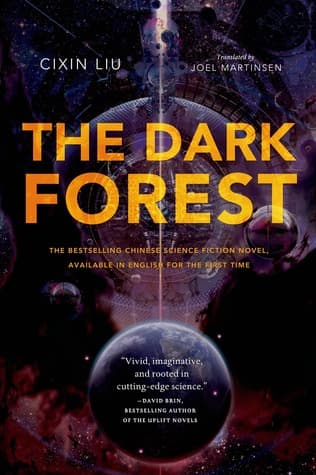
The Dark Forest cover
Archivist's Choice

The Dark Forest

Liu Cixin (2008)

Genre

Fantasy / Science Fiction

Reading Time

600 min

Key Themes

See below

Track Your Reading

Sign in to track this book

With humanity's every thought exposed to an alien invasion force centuries away, a select few must craft secret strategies hidden within their own minds, even from their own kind, to save a doomed Earth.

Synopsis

Earth faces a Trisolaran invasion in four centuries, but sophons give the aliens complete access to human information, making all defense strategies known. To counter this, the United Nations starts the Wallfacer Project. It gives four individuals many resources to devise secret strategies entirely within their minds, hidden from both humanity and Trisolaris. Among them is Luo Ji, an obscure sociologist targeted for assassination by the Trisolarans, showing his unwitting importance. While the other Wallfacers pursue complex, large-scale plans, Luo Ji, through intuition and a near-death experience, formulates the "Dark Forest" theory: any civilization revealing its existence in the cosmos will be immediately destroyed by others as a self-preservation measure. He uses this theory to develop a credible threat against Trisolaris, showing he can broadcast the location of their home world to the universe, inviting its destruction. This leads to a delicate balance of power, where Luo Ji becomes the "Swordholder," maintaining fragile deterrence. When a new, less decisive Swordholder takes over, the Trisolarans try to invade. Luo Ji's final act of demonstrating the Dark Forest principle by revealing a star's location forces a new, desperate peace, ensuring humanity's survival at a heavy cost.
Reading time
600 min
Difficulty
Medium
Pacing
Variable
Mood
Philosophical, Suspenseful, Bleak, Grand, Strategic
✓ Read this if...
You enjoy hard science fiction, intricate strategic thinking, philosophical explorations of humanity's place in the cosmos, and a bleak but ultimately hopeful outlook on interstellar conflict.
✗ Skip this if...
You prefer character-driven narratives over plot and ideas, or find dense scientific concepts and a slow initial build-up tedious.

Plot Summary

The Wallfacer Project and Luo Ji's Unwilling Ascension

Four centuries before the Trisolaran fleet arrives, humanity is in despair. Sophons have infiltrated all technology, making any defense strategy visible to the enemy. To combat this, the Wallfacer Project starts, giving four individuals many resources and autonomy to devise secret, deceptive strategies known only to themselves. Three Wallfacers are prominent figures: Frederick Tyler, a former US Secretary of Defense; Manuel Rey Diaz, a Venezuelan former president; and Bill Hines, a British neuroscientist. The fourth, Luo Ji, an obscure Chinese astronomer and sociologist, is a baffling choice. He is initially confused by his role and unmotivated. However, the Trisolarans immediately identify him as their primary threat, sending a 'droplet' to assassinate him. Earth's defense systems narrowly stop the attack. This inexplicable targeting confirms his importance, despite his own confusion.

Luo Ji's Retreat and the Seeds of an Idea

Luo Ji uses his Wallfacer privileges for personal gain. He creates a secluded, idyllic life for himself and a woman he names Zhuang Yan, who matches the ideal woman he once described to his former colleague, Ye Wenjie. He builds a beautiful home and family, trying to escape the impending doom. During this period, he remembers a conversation with Ye Wenjie years prior. She introduced him to cosmic sociology – a field based on two axioms: 1) Survival is the primary need of civilization, and 2) Civilization continuously grows and expands, but the total matter in the universe remains constant. This abstract discussion, initially dismissed by Luo Ji, slowly begins to grow in his subconscious, hinting at a truth about interstellar relations.

The Wallfacers' Plans Unfold and Luo Ji's Slumber

Frederick Tyler begins building a massive, secret space fleet, seemingly for Earth's defense, but secretly intending to defect to Trisolaris to preserve human civilization. Manuel Rey Diaz starts a plan to develop advanced nuclear weapons, ostensibly for Earth, but with a hidden purpose of self-destruction to deny resources to the invaders. Bill Hines focuses on developing a brain-computer interface, claiming it's for enhanced combat, but secretly aiming to control soldiers' minds. Meanwhile, Luo Ji, frustrated by his lack of inspiration and the constant threat, decides to enter hibernation for two centuries. Before doing so, he leaves a single, cryptic instruction: to detonate a series of nuclear bombs at specific coordinates in space, seemingly without strategic value. This action confuses the United Nations and his escorts, further cementing his enigmatic reputation.

Two Centuries Later: A Changed World and Awakening

Luo Ji awakens two centuries later, during the 'Great Resurgence.' Humanity has achieved incredible technological feats, including space cities, fusion power, and advanced space fleets. However, sophons still make direct military confrontation impossible. He learns that the other Wallfacers have been exposed and their plans thwarted. Frederick Tyler was assassinated by his own forces after his defection plot was revealed. Manuel Rey Diaz was forced to activate his self-destruct mechanism, killing himself and his forces after his true intent was discovered. Bill Hines's plan to control soldiers' minds was also exposed, leading to his disgrace and mental collapse. Luo Ji is now the last Wallfacer, still without a clear strategy, and humanity's hope decreases as the Trisolaran fleet draws nearer.

The Dark Forest Theory Emerges

After seeing the failures of the other Wallfacers and thinking about his conversation with Ye Wenjie, Luo Ji begins to understand the implications of cosmic sociology. He realizes that the two axioms, combined with the presence of sophons and the Trisolarans' immediate targeting of him, point to a conclusion: the 'Dark Forest' theory. In this theory, every civilization in the universe is like a hunter in a dark forest, armed with a gun. They must hide their presence to survive, because any detected civilization is a potential threat that must be eliminated immediately to prevent it from becoming a more powerful threat later. This explains the Trisolarans' ruthlessness and their desire to silence him before he could articulate this concept.

The Curse of the Universe and Luo Ji's Revelation

Luo Ji understands that his cryptic instruction to detonate bombs at specific coordinates two centuries prior was an unconscious attempt to test the Dark Forest theory. He realizes that if he could broadcast the existence and location of a star to the universe, other civilizations would destroy it, even if he didn't know how. He uses his Wallfacer authority to broadcast the coordinates of a specific star, 187J3X1, into deep space. He then publicly announces his 'curse,' declaring that this star will be destroyed. This act, while seeming nonsensical to humanity, is a direct challenge to the Trisolarans, showing humanity's new understanding of interstellar survival and the potential to weaponize this knowledge against them.

The Trisolaran Response and the Deterrence Strategy

The Trisolarans, recognizing the danger of Luo Ji's discovery, confirm his theory by destroying star 187J3X1 with a 'photoid,' a relativistic weapon. This act, witnessed by humanity, validates Luo Ji's 'Dark Forest' theory and his 'curse.' Humanity is terrified but also empowered by this new understanding. Luo Ji proposes a new defense strategy: 'Dark Forest Deterrence.' Humanity will threaten to broadcast the coordinates of the Trisolaran homeworld to the entire universe if the Trisolaran fleet attacks Earth. This would guarantee the destruction of both civilizations by other, unknown forces, creating a fragile but effective mutual assured destruction. The Trisolarans, valuing their own survival, are forced to accept this deterrence.

The Swordholder and the Brink of Annihilation

With the Dark Forest Deterrence in place, Luo Ji becomes the 'Swordholder,' the sole individual with the authority and means to activate the broadcast to destroy Trisolaris. His life becomes a constant vigil, a burden of responsibility. He lives in isolation, maintaining the broadcast system, knowing that any failure or act of aggression from Trisolaris could force him to trigger the end of both civilizations. This period of fragile peace has extreme tension, as humanity relies entirely on Luo Ji's resolve and the Trisolarans' fear of universal destruction. Humanity's technological progress continues, but under the ever-present shadow of the Dark Forest.

The Crisis and the Fall of the Swordholder

After decades, humanity grows complacent and tired of Luo Ji's sole authority. They decide to replace him with a more technologically advanced, automated deterrence system, believing it to be more reliable. A new 'Swordholder,' Cheng Xin, is chosen. However, the Trisolarans, who have been observing humanity's psychological shifts through the sophons, seize this moment of transition. They launch a surprise attack with a single 'droplet,' aiming to destroy the broadcast system during the handover. Cheng Xin, unable to activate the terrifying broadcast due to her compassionate nature, hesitates. This brief moment of weakness is enough for the droplet to destroy the system, leaving humanity defenseless.

The End of Deterrence and the New Era

With the deterrence system destroyed, the Trisolaran fleet resumes its course towards Earth, and humanity is plunged into despair. The Trisolarans declare their intent to force humanity into Australia, reducing their population to a mere fraction. However, in his final act as the true Swordholder, Luo Ji, having anticipated this betrayal and secretly maintaining a backup system, uses his own broadcast to declare his intention to reveal the Trisolaran homeworld. This act of defiance, even without the full system, causes the Trisolarans to pause. Luo Ji then explains that the universe is a dark forest, and that the only true escape is to hide completely. The book ends with humanity facing an uncertain future, but with a new understanding of the universe's brutal realities, and the lingering hope that some may still find a way to survive the coming invasion.

Principal Figures

Luo Ji

The Protagonist

From a hedonistic academic to a reluctant leader, Luo Ji evolves into a profound philosopher and a self-sacrificing guardian of humanity, accepting the immense burden of the 'Swordholder' role.

Shi Qiang (Da Shi)

The Supporting

Remains a steadfast and loyal companion, his pragmatism and protectiveness unwavering despite the immense changes around him.

Frederick Tyler

The Supporting

His plan is conceived and executed, only to be exposed and lead to his downfall.

Manuel Rey Diaz

The Supporting

His complex, self-sacrificing plan is revealed and ultimately leads to his own demise.

Bill Hines

The Supporting

His attempt to manipulate human consciousness is exposed, leading to his public downfall and mental collapse.

Keiko Kirino

The Supporting

Successfully exposes her husband's secret plan, demonstrating the power of transparency.

Ye Wenjie

The Supporting

Her philosophical musings, though from the past, profoundly shape Luo Ji's understanding of the universe.

Zhuang Yan

The Supporting

Becomes a symbol of Luo Ji's initial attempt to escape his Wallfacer responsibilities.

Cheng Xin

The Supporting

Rises to the critical role of 'Swordholder' but ultimately fails to uphold the deterrence due to her compassionate nature.

Themes & Insights

Survival and the Nature of Civilization

The core theme of 'The Dark Forest' is the fundamental drive for survival, for individuals and for entire civilizations. The two axioms of cosmic sociology (survival as primary, continuous expansion) directly inform this. The Trisolarans' ruthless pursuit of Earth, the Wallfacers' desperate and often morally ambiguous plans, and Luo Ji's eventual formulation of the Dark Forest theory all come from this primal urge. The book explores how civilizations, when faced with existential threats in a hostile universe, prioritize their own existence above all else, leading to brutal logic and extreme measures. It questions the definition of morality in an interstellar context.

Survival is the primary need of civilization. Civilization continuously grows and expands, but the total matter in the universe remains constant.

Ye Wenjie (as recounted by Luo Ji)

Deception and Misdirection

Given the sophons' ability to observe all human communication and technology, deception is humanity's only viable strategy. The entire Wallfacer Project is built on this theme, with each Wallfacer designing a public, misleading plan to hide their true intentions. Luo Ji's success relies entirely on the Trisolarans' inability to read his mind and his ability to project an image of incompetence and hedonism. The 'Dark Forest' theory itself is a form of universal deception, where civilizations hide their presence to avoid detection and destruction. The book explores the psychological and strategic complexities of operating under constant, undetectable surveillance.

A Wallfacer's true strategy must be known only to himself, and it must be hidden behind layers of deception and misdirection, even from humanity itself.

Narrator

The Burden of Knowledge and Power

Luo Ji's journey shows the burden that comes with terrifying knowledge and the power to act upon it. His discovery of the Dark Forest theory initially plunges him into despair, and his role as the 'Swordholder' forces him into a life of isolation and constant vigilance. The weight of holding humanity's fate in his hands, knowing that a single decision could lead to annihilation, is a central psychological struggle. The book also touches on the ethical dilemmas of such power, as seen in Bill Hines's attempt to control minds and Cheng Xin's ultimate failure to wield such destructive authority due to her compassion.

I am the Swordholder. I hold the sword of deterrence. I am the brink of humanity's destruction, and its salvation.

Luo Ji

Humanity's Evolving Nature and Resilience

Despite the existential threat, humanity changes and develops throughout the book. The 'Great Resurgence' shows humanity's technological advancement and ability to adapt, building space cities and developing advanced science. However, the book also highlights humanity's persistent flaws: complacency, political infighting, and the psychological inability to sustain extreme measures of deterrence over long periods. The contrast between Luo Ji's pragmatic ruthlessness and Cheng Xin's compassionate idealism reflects humanity's internal struggle between its capacity for survival and its desire for a more humane existence, showing its complex and evolving nature.

The universe is a dark forest, and every civilization is a hunter with a gun. The only thing they can do is to hide themselves as much as possible.

Luo Ji

The Fermi Paradox and Cosmic Horror

The book offers a solution to the Fermi Paradox ('Where is everybody?'). The 'Dark Forest' theory explains the apparent silence of the universe not as an absence of life, but as an active, terrifying silence born of fear. Civilizations remain hidden to avoid detection and subsequent destruction by others. This concept creates a sense of cosmic horror, transforming the vast, empty universe from a place of wonder to a dangerous, predatory environment where humanity is vulnerable prey. The realization that every detected civilization is a target fundamentally shifts humanity's perception of its place in the cosmos.

In the Dark Forest, other lives are eternal threats. Any life that exposes itself will soon be eliminated.

Narrator

Plot Devices & Literary Techniques

The Wallfacer Project

A covert, deceptive defense strategy against the Trisolaran invasion.

The Wallfacer Project is a unique and central plot device. It grants four individuals immense power and resources to devise secret strategies against the Trisolarans, whose sophons make all conventional defense plans transparent. The Wallfacers must maintain a public facade (the 'wall') to conceal their true intentions, even from their own species. This device drives the narrative, creating mystery, suspense, and allowing for deep exploration of deception, strategic thinking, and the psychological toll of such a burden. It's humanity's desperate gamble against an omniscient enemy.

The Sophons

Subatomic particles that enable Trisolaran omniscience and sabotage.

Sophons are a critical plot device inherited from the first book. These proton-sized supercomputers travel at light speed, allowing the Trisolarans instant, omnipresent surveillance of all human technology and communication. They also have the ability to subtly interfere with particle accelerators, preventing humanity from advancing fundamental physics. The sophons are the primary reason for the Wallfacer Project's existence, forcing humanity to rely on the one thing sophons cannot penetrate: the human mind. They are the ultimate surveillance tool and a constant reminder of humanity's vulnerability.

The Dark Forest Theory

Luo Ji's horrifying solution to the Fermi Paradox and humanity's ultimate weapon.

The Dark Forest Theory is the pivotal conceptual plot device that redefines the entire universe. Formulated by Luo Ji, it posits that the universe is a 'dark forest' where every civilization is a hidden hunter. Any detected civilization is immediately destroyed by others to eliminate potential threats, explaining the Fermi Paradox. This theory becomes humanity's 'deterrence' weapon: the threat to broadcast Trisolaris's location to the universe. It shifts the entire power dynamic, offering a fragile peace based on mutual assured destruction and profoundly changes humanity's understanding of its cosmic place.

Hibernation

A means for characters to bridge vast periods of time, facilitating narrative jumps.

Hibernation is a practical plot device that allows characters like Luo Ji and Da Shi to skip centuries, directly experiencing different eras of human development and the progression of the Trisolaran threat. This enables the narrative to cover a vast timeline (four centuries) without losing key characters, providing a personal perspective on humanity's evolution. It highlights the drastic technological and societal changes, as well as the enduring nature of the core conflict, making the passage of time a tangible element of the story.

The 'Droplet'

A Trisolaran probe, a symbol of their advanced technology and ruthlessness.

The 'droplet' is a seemingly innocuous, perfectly reflective, teardrop-shaped probe sent by the Trisolarans. It functions as a powerful plot device, showcasing the overwhelming technological superiority of the invaders and their cold, efficient ruthlessness. Its near-invulnerability and ability to cut through Earth's most advanced defenses with ease serve as stark reminders of humanity's inferiority. The droplet is used as an assassination tool, a weapon of mass destruction, and ultimately, the instrument that breaks the Dark Forest Deterrence, driving key plot points and demonstrating the dire stakes.

Critical analysis

Notable Quotes

The universe is a dark forest. Every civilization is an armed hunter stalking through the trees like a ghost, gently pushing aside branches that block the path and trying to tread without sound.

Luo Ji explains the Dark Forest Theory to Shi Qiang.

In the face of the universe’s dark forest state, the only way for Earth to survive is to remain silent and hidden.

Luo Ji's conclusion after understanding the theory.

The Trisolarans do not understand deception or subterfuge. Their thoughts are transparent, making them both terrifying and vulnerable.

Human analysis of Trisolaran psychology.

To defeat an enemy, you must first understand them. But to understand them, you must first become them.

Reflection by a Wallfacer on strategy against Trisolarans.

Humanity’s greatest weapon is not technology, but the unpredictability of the individual mind.

Discussion among Wallfacers about human advantages.

The Wallfacer Project is a gamble that a single mind can outthink an entire civilization.

Explanation of the Wallfacer Project's premise.

In the dark forest, there are no friends, only hunters and prey.

Luo Ji's grim realization about cosmic relations.

The Trisolaran threat has united humanity, but it has also stripped away our illusions about peace.

Observation on human societal changes post-invasion threat.

A civilization’s survival may depend on its ability to keep secrets, even from itself.

Philosophical musing on the nature of strategic deception.

The stars are not meant for dreaming; they are graves waiting to be filled.

Dark reflection on the nature of cosmic exploration.

Hope is a dangerous thing in a dark forest. It makes you visible.

Warning about the risks of optimism in cosmic survival.

To save humanity, we must first be willing to sacrifice it.

Paradoxical strategy considered by a Wallfacer.

The universe does not care about morality, only survival.

Luo Ji's cold assessment of cosmic reality.

In the end, every civilization faces the same choice: hide or perish.

Conclusion drawn from the Dark Forest Theory.

Quiz

Test Your Knowledge

Ready to see how well you understood this book? Take our interactive quiz with 10 questions.

10
Questions
~5
Minutes
?
Best Score

Key Questions (FAQ)

The novel follows Earth's desperate preparations for an alien invasion by Trisolaris, scheduled to arrive in 400 years. With human technology and plans exposed by sophons (subatomic spies), humanity initiates the Wallfacer Project, granting four individuals unlimited resources to develop secret defense strategies through psychological deception. The story centers on Luo Ji, an unremarkable astronomer who becomes the most targeted Wallfacer by the aliens.

About the author