“There are things in this world, things that live in the shadows and the deep places, that defy all reason, all science.”
— Dr. Warthrop often reminds Will Henry of the supernatural.

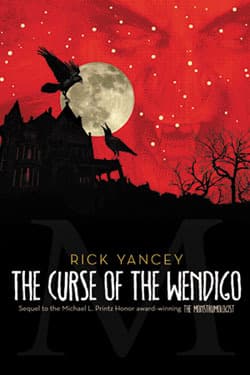
Rick Yancey (2010)
Genre
Fantasy / Historical Fiction / Mystery / Young Adult
Reading Time
560 min
Key Themes
See below
Sign in to track this book
In the Canadian wilderness, a skeptical doctor faces the terrifying reality of the mythical Wendigo, a creature of endless hunger, making him question life, death, and what makes a monster.
The story begins with Will Henry, Dr. Warthrop's apprentice, thinking about the doctor's habits and their isolated life. A rare letter arrives for Dr. Warthrop, making him unusually agitated. It's from Eleanor, his former fiancé, now Mrs. Caleb Cromley, asking for his help. Her husband, Caleb Cromley, an explorer, disappeared during an expedition in the remote Canadian wilderness, near the 'Hunger Mountains.' Eleanor, desperate and believing something supernatural is involved, asks Warthrop, the famous monstrumologist, to find him, even though Warthrop doesn't believe in the Wendigo she fears.
Despite his scientific doubts, Dr. Warthrop agrees to Eleanor's request, motivated by past feelings and curiosity. He and Will Henry prepare for a long, hard trip into the desolate Canadian wilderness. Following Cromley's last known location, they find his camp, which is destroyed and messy. They find Caleb Cromley alive, but barely. He is very thin, confused, and has a terrifying, endless hunger, eating anything he can get, even things that aren't food. His eyes have a chilling, unnatural shine, and his skin is thin. The sight deeply worries both Warthrop and Will Henry, suggesting something more than just starvation.
Warthrop tries to treat Cromley, but normal medicine doesn't help his fast-worsening condition. Cromley's hunger becomes a wild, violent rage. One terrible night, Caleb's body and mind completely break down. His body changes in a grotesque way: his limbs stretch, his skin tightens over his bones, and his teeth sharpen into fangs. He screams an inhuman sound, confirming Warthrop's worst fears and Eleanor's legends. Caleb Cromley has become a Wendigo, a creature of endless hunger, a living picture of starvation and death, and a terrifying hunter of human flesh. The reality of the myth destroys Warthrop's scientific view.
The changed Caleb, now a Wendigo, breaks free from their restraints with terrifying strength. Driven by a huge, primal hunger, he runs into the thick wilderness, becoming an immediate and deadly threat to anyone in his path. Warthrop, despite his initial disbelief, now faces the clear truth of the Wendigo's existence. He realizes Caleb's escape is a great danger, not just to them, but to any trappers, indigenous people, or settlers in the vast Canadian area. The monstrumologist and his apprentice, Will Henry, must become hunters, starting a desperate chase to find and stop the creature before it can harm more people. This task is even harder because of the Wendigo's supernatural speed and cleverness.
As Warthrop and Will Henry chase the Wendigo, a new problem arises. Eleanor, unable to wait, arrives in the wilderness, determined to find her husband herself. She still hopes, unaware of Caleb's monstrous change. Her arrival creates a deep moral problem for Warthrop, torn between protecting her from the terrible truth and the immediate danger from the Wendigo, who is still her husband in some horrifying, twisted way. Her presence adds emotional intensity to the already dangerous hunt, forcing Warthrop to deal with his past feelings and the devastating results of the creature's curse.
The chase leads to several terrifying encounters with the Wendigo. The creature moves incredibly fast through the forest and has great strength, easily killing animals and leaving a trail of gruesome destruction. During one close call, the Wendigo attacks Warthrop and Will Henry, showing its predatory skill. However, in the chaos, Warthrop notices something important: the Wendigo seems to be repelled or hurt by intense heat or fire. This observation, though brief, offers a bit of hope and a possible weakness they could use, changing the hunt from just avoiding it to strategic fighting. The creature's hunger, though endless, has some limits.
Driven by scientific curiosity and the need to understand his enemy, Dr. Warthrop studies local legends and stories about the Wendigo. He talks to indigenous trackers and trappers who have lived in the area for generations. He learns about old curses, the spiritual meaning of the 'Hunger Mountains,' and the belief that the Wendigo comes from endless greed and starvation. At the same time, he tries to match these myths with his scientific understanding, looking at ideas about extreme malnutrition, mental breakdown, and possible biological agents that could cause such a terrible change. His research shows that the curse is not just supernatural but is deeply connected to the human mind and the harsh realities of surviving in the wilderness.
Combining his scientific knowledge with what he learned from local legends, Warthrop plans a daring and dangerous way to trap the Wendigo. He builds a complex snare, using the creature's endless hunger against itself. He baits it with fresh meat and sets up a boundary to use its dislike of fire. The plan is very dangerous, requiring exact timing and courage from both Warthrop and Will Henry. The trap works, leading to a terrible fight with the Wendigo. The creature, driven by its endless hunger, falls into the snare, but its fierceness and supernatural strength make holding it a huge challenge, testing their determination and cleverness.
With the Wendigo temporarily caught, Warthrop faces a terrible ethical choice. The creature before him is a monster, a danger to people, but it is also, in some horrifying way, still Caleb Cromley, the man Eleanor loved. Warthrop struggles with the scientific need to study the creature versus the moral duty to end its suffering and stop more harm. Eleanor's presence, seeing her husband's monstrous form, adds deep sadness and despair to the situation. Finally, Warthrop makes a difficult, painful decision, knowing there is no cure for the Wendigo's curse and that true mercy means ending its life, even if it means destroying the last parts of the man Caleb once was.
The Wendigo is finally defeated, though the act is brutal and leaves Warthrop deeply shaken. The immediate danger is gone, but the experience has changed everyone involved forever. Eleanor is left to deal with the terrible truth of her husband's fate, her grief made worse by his monstrous change. Warthrop, once a strong skeptic of such mythical creatures, has had his scientific view broken and remade, now forced to accept the terrifying reality of the supernatural. Will Henry, having seen such deep horror, carries the weight of the events, forever changed by the encounter with the Wendigo. The trip home is quiet, filled with the lingering sounds of the creature's cries and the unsettling questions about what evil truly is and humanity's fragile place in a world where myths can become real.
The Protagonist
Warthrop's arc sees him forced to confront the limits of his scientific rationalism, acknowledging the terrifying reality of the supernatural and grappling with the moral implications of his work.
The Narrator and Protagonist
Will Henry's arc involves a deepening understanding of fear, loss, and the nature of good and evil, solidifying his role as Warthrop's indispensable partner.
The Supporting
Eleanor's arc is one of profound loss and the shattering of her world, from hopeful wife to a woman scarred by unspeakable horror.
The Antagonist (as Wendigo)
Caleb's arc is one of tragic descent, from a man lost in the wilderness to a terrifying, inhuman predator, a complete loss of self.
The Antagonist
The Wendigo's arc is less about personal development and more about its manifestation as a force of nature and a symbol of primal horror, its existence challenging the boundaries of reality.
The Supporting
Their arc is static, serving as sources of information and practical aid, embodying the wisdom of the land.
This theme is central to Warthrop's character and the story. Dr. Warthrop, a scientist, first dismisses the Wendigo as superstition. The journey forces him to confront the limits of his scientific view, as he sees Caleb Cromley's grotesque change. He must combine his scientific methods with the undeniable, horrifying reality of a creature from folklore. This struggle shows when he tries to find a biological reason for the Wendigo's curse even as he accepts its supernatural parts, highlighting the conflict between rational thought and the unexplainable.
“"There are more things in heaven and earth, Horatio, than are dreamt of in your philosophy," Warthrop often quoted, only to find himself truly believing it when faced with the Wendigo.”
The Wendigo itself represents this theme, as its curse is an endless, painful hunger for human flesh that can never be satisfied. This appears physically in Caleb Cromley's extreme thinness even as he eats everything. Beyond literal hunger, the theme extends to human desires: Eleanor's endless hope for her husband's return, Warthrop's constant desire for knowledge, and the destructive nature of uncontrolled greed and consumption. The Wendigo acts as a symbol for the self-destructive results of desires that have no limits, consuming not just flesh but also sanity and humanity.
“It was a hunger that devoured itself, an emptiness that grew larger with every bite, a living paradox of starvation and consumption.”
The book explores the fine line between being human and becoming a monster. Caleb Cromley's change into the Wendigo makes the characters, and the reader, ask what truly defines humanity. Is it just physical form, or is it empathy, self-control, and the lack of primal, destructive urges? Warthrop struggles with the ethical choice of destroying what was once his friend, showing the tragic loss of humanity within the monstrous. The Wendigo, while terrifying, is also a tragic figure, showing how extreme conditions and curses can strip away who a person once was, leaving only a hungry predator.
“"Is it still Caleb, Doctor? Or is it just... a thing?" Will Henry whispered, his voice trembling.”
The story's emotional core comes from the relationships among Warthrop, Eleanor, and Caleb. Warthrop's past love for Eleanor is a main reason for his journey, and her deep grief over Caleb's disappearance and monstrous change shows the great pain of loss. The 'betrayal' isn't intentional but rather the horrifying betrayal of Caleb's humanity by the Wendigo curse. Warthrop's decision to destroy the Wendigo, knowing it was once Caleb, is a poignant act of love and mercy, though a brutal one, showing the sacrifices demanded by deep affection and the ultimate heartbreak of seeing a loved one completely destroyed.
“To love something so deeply, only to witness its complete and utter annihilation, was a torment Warthrop knew all too well.”
Will Henry's youthful perspective and the passage of time color the recounting of events.
The story is narrated by Will Henry, recounted years after the events took place. While generally factual, his youthful fears, emotional responses, and the filtering of memory add a layer of subjectivity. His descriptions of Warthrop's eccentricities, the creatures, and his own internal struggles are vivid but inherently filtered through his personal lens, raising questions about the absolute accuracy of every detail. This device enhances the horror and mystery, as the reader experiences the events through the eyes of a boy profoundly impacted by the monstrous world he inhabits, adding an emotional depth that a purely objective account might lack.
Indigenous legends and whispered tales hint at the Wendigo's nature and methods.
Throughout the narrative, Warthrop and Will Henry encounter various indigenous legends and local tales about the Wendigo. These stories, initially dismissed as superstition by Warthrop, provide crucial foreshadowing about the creature's appearance, its insatiable hunger, its supernatural abilities, and even its potential weaknesses. The detailed descriptions of the curse and its effects in folklore parallel Caleb Cromley's horrifying transformation, building suspense and preparing the reader for the inevitable. This device not only enriches the world-building but also highlights the wisdom of ancient knowledge in understanding phenomena beyond conventional science.
The harsh Canadian wilderness acts as both a setting and an active force in the narrative.
The desolate and unforgiving Canadian wilderness is more than just a backdrop; it is an active participant in the story. Its vastness and isolation contribute to the characters' vulnerability and the Wendigo's ability to hunt undetected. The extreme cold, limited resources, and treacherous terrain amplify the sense of danger and despair, pushing the characters to their physical and psychological limits. The wilderness mirrors the Wendigo's primal nature, embodying a raw, untamed power that threatens to consume all who enter it, making it an antagonist in its own right, a force that facilitates the transformation and proliferation of the monstrous.
Warthrop's moral struggle over whether to save or destroy Caleb Cromley.
A significant plot device is the recurring ethical dilemma faced by Dr. Warthrop. His initial mission is to rescue Caleb, but once Caleb transforms into the Wendigo, Warthrop is forced to consider destroying him. This creates a profound moral conflict: is the Wendigo still Caleb, deserving of mercy, or is it a monster that must be eliminated? This dilemma is amplified by Eleanor's presence and Warthrop's past relationship with her. It forces Warthrop to weigh scientific curiosity against compassion, and the preservation of life against the prevention of harm, ultimately leading to a difficult and heartbreaking decision that defines the climax of the story.
“There are things in this world, things that live in the shadows and the deep places, that defy all reason, all science.”
— Dr. Warthrop often reminds Will Henry of the supernatural.
“The wilderness does not forgive. It remembers every mistake, every trespass.”
— Reflecting on the dangers of the Canadian wilderness.
“Fear is a powerful thing, Will Henry. It can make men do terrible things, and it can make them see terrible things that aren't there.”
— Dr. Warthrop discussing the psychological impact of the Wendigo legend.
“The greatest monster, perhaps, is the one that resides within us all.”
— A philosophical observation on human capacity for evil.
“Some truths are too terrible to be known, and some lies are too comforting to be denied.”
— Contemplating the nature of belief and reality.
“Even in the darkest of places, there is always a flicker of hope, however small.”
— Will Henry's internal thoughts during a desperate situation.
“The line between man and beast is often thinner than we care to admit.”
— Considering the primal instincts unleashed in extreme conditions.
“History is not merely a collection of facts; it is a tapestry woven with the fears and desires of those who came before us.”
— Dr. Warthrop's view on the study of historical events.
“To understand a monster, one must first understand what made it so.”
— Dr. Warthrop's approach to studying cryptids.
“The forest has eyes, Will Henry, and teeth. Never forget that.”
— A warning about the pervasive danger of the wilderness.
“Sometimes the most logical explanation is the one we least want to believe.”
— Will Henry grappling with improbable possibilities.
“The things we cannot see are often the most potent.”
— Discussing the power of unseen forces and beliefs.
“Every man carries his own personal wilderness within him.”
— A metaphor for internal struggles and challenges.
“Madness, like genius, often walks hand in hand with obsession.”
— Observing the intensity of certain characters' pursuits.
Ready to see how well you understood this book? Take our interactive quiz with 10 questions.

Biography coming soon.







