“I could feel the cold lake water seeping into my sneakers, making my toes go numb. It was so gross.”
— Sarah's initial discomfort with the lake

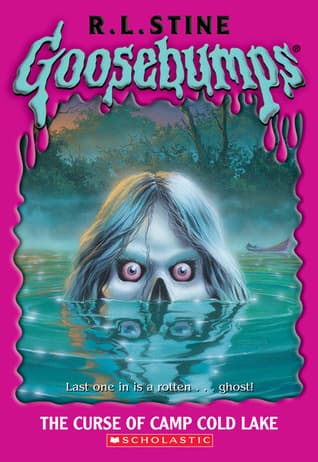
R.L. Stine (1994)
Genre
Fantasy / Children's / Mystery / Young Adult
Reading Time
120 min
Key Themes
See below
Sign in to track this book
When a prank gone wrong at a desolate summer camp reveals a watery ghost with pale blue eyes, a girl named Sarah must confront the chilling consequences of her own deception.
Thirteen-year-old Sarah Maas's parents drop her off at Camp Cold Lake. She already dreads the summer. Her first thoughts are bad: the lake is murky, and her bunkmates, Bree and Denise, seem popular and perfect but ignore her. They quickly form a group, leaving Sarah feeling alone and left out. Sarah tries to join their talks or activities, but they dismiss her, making her feel like an unwelcome outsider. This early rejection makes Sarah desperate for attention and acceptance.
As days pass at Camp Cold Lake, Sarah feels more alone. Bree and Denise keep ignoring her, making her feel invisible. Other campers also seem to like Bree and Denise, leaving Sarah by herself during meals and activities. Desperate for attention and a way to make her bunkmates feel bad for how they treat her, Sarah comes up with a dangerous plan. She decides to fake drowning in the camp's cold, murky lake, believing the panic and her 'return' will finally get her the sympathy and attention she wants.
Sarah starts her plan during a supervised swimming session. She swims out further than usual, pretends to be in trouble, and then goes underwater. She hopes a frantic lifeguard or camper will 'rescue' her. But as she holds her breath, the cold, dark water confuses her. She struggles to get back up, her lungs burning, and panic sets in. She realizes how badly she miscalculated. The fake drowning turns into a real fight for life, and for a terrifying moment, Sarah thinks she might actually drown, with no one seeming to notice.
Just as Sarah is about to give up, a strange, cold hand grabs her arm and pulls her to the surface. She gasps for air, confused, and scrambles out of the water. The lifeguard is distracted and doesn't see her. Looking back, she sees no one who could have saved her. Later that night, in her bunk, Sarah sees a pale, transparent girl with long, wet hair and blue eyes staring at her. The girl quickly disappears. Sarah thinks it was just her imagination from almost drowning, but an uneasy feeling stays with her, hinting at something supernatural at Camp Cold Lake.
The ghostly girl, who says her name is Della, starts appearing more often to Sarah. She always looks sad and gives a chilling message. Della says Sarah is no longer alive; she drowned in the lake when she faked her drowning. Sarah strongly denies this, believing Della is either playing a cruel trick or is just in her head, caused by guilt and fear. Della appears more insistently, showing Sarah glimpses of her own 'dead' state, like her reflection looking blurry or strange. This further unnerves Sarah and makes her question if she is going crazy.
Sarah keeps denying Della's claims, sure she is alive and Della is either her own worries or a cruel prank. She tries to talk to her bunkmates, but they seem to ignore her or talk as if she isn't there. Sarah thinks this is just because they still dislike her. However, strange things begin to happen: objects pass through her, she feels a constant chill, and her reflection in mirrors looks strange or is missing. These unexplainable events, along with Della's constant warnings, slowly break down Sarah's denial, replacing it with a growing, terrifying fear that Della might be telling the truth.
Della finally tells Sarah her full story. She explains that she also drowned in Camp Cold Lake years ago, a victim of a similar prank that went wrong. She has been trapped as a ghost ever since. She tells Sarah about the curse of Camp Cold Lake: spirits of those who drown there are bound to the lake until another victim takes their place. Della believes Sarah is her replacement, and now she is free. Della seems to feel a strange connection to Sarah and wants to help her, perhaps out of guilt or a shared tragedy. She explains that if Sarah doesn't want to be trapped, she must find another way.
Sarah accepts that she is a ghost and becomes desperate to escape her spectral life and avoid being trapped at Camp Cold Lake forever. Della, feeling some regret, offers vague advice, suggesting the curse can only be broken if someone else drowns in the lake, or if the original curse is somehow undone. Sarah, horrified by the thought of another person dying, starts looking for other solutions. She tries to remember details of her 'drowning' and searches for clues around the camp, hoping to find a loophole or an old legend that could free her from her watery grave.
While moving around the camp as a ghost, Sarah overhears counselors and the camp director talking. To her horror, she learns that Bree and Denise, her bunkmates who had seemed to ignore her, actually drowned in the lake shortly after Sarah's own 'drowning'. They had gone back to the lake to look for her after realizing she was missing, only to meet the same end. This news hits Sarah hard, filling her with immense guilt and sadness. She realizes her selfish prank had indirectly caused their deaths, making her an even more tragic figure.
The final, chilling truth hits Sarah: she isn't Della's replacement, she is Della. The ghost she has been seeing and talking to is her own past self, a sign of the curse's repeating nature. Sarah is the ghost who now haunts new campers, trying to warn them, and perhaps, to find a way to escape. The story ends with Sarah, now fully a part of Camp Cold Lake's ghost world, watching a new group of campers arrive, including a girl who reminds her of herself. This suggests the tragic cycle of drowning and haunting will repeat, trapping new victims in the cold, dark waters.
The Protagonist
Sarah transforms from a lonely, attention-seeking camper into a confused, then terrified, and finally resigned ghost, realizing she is trapped in a cyclical curse.
The Supporting/Antagonist (initially perceived)
Della's initial role as a mysterious informant gradually shifts as her true identity and connection to Sarah are revealed, culminating in the understanding that she is Sarah's future/past self.
The Supporting
Bree's role remains static as a perceived antagonist, but her ultimate fate reveals her as a tragic victim.
The Supporting
Denise's role remains static as a perceived antagonist, but her ultimate fate reveals her as a tragic victim.
The Mentioned
Their role is primarily functional, serving to provide exposition.
The Mentioned
Their role is primarily functional, serving to provide exposition.
Sarah's strong wish for attention and acceptance from her bunkmates, Bree and Denise, leads her to plan a dangerous and ultimately fatal fake drowning. This theme shows how insecurity and the need to be noticed can make people do extreme and harmful things. The tragic result of her prank, for herself and for Bree and Denise, warns about the unexpected and terrible outcomes of such actions. The story highlights that real connection is more important than just getting approval.
“Maybe if I pretended to drown, they'd finally notice me. They'd feel sorry for me. They'd like me.”
From the moment Sarah arrives at Camp Cold Lake, she feels alone. Her bunkmates' clear disinterest and exclusion make her feel even more like an outsider. This strong feeling of loneliness drives her desperate actions and leaves her open to the supernatural. The theme shows the emotional pain of being left out and how it can change how someone sees things and makes decisions. Even after becoming a ghost, Sarah's loneliness continues, as she is stuck in a world where she cannot truly connect with the living.
“I was invisible. Nobody saw me. Nobody cared.”
Sarah spends much of the story denying her own death, refusing to believe Della's warnings despite growing proof. This theme looks at how people often resist hard truths, especially when they are scary or unbelievable. Her struggle to match what she thinks is real with the ghostly experiences she has shows the psychological effect of trauma and how hard it is to accept an unbearable truth. Accepting her ghost state is a key moment, leading to the horrifying realization of the curse.
“No! You're lying! I'm not dead! I can't be dead!”
The most chilling part of the story is the curse of Camp Cold Lake. Those who drown there are trapped and become ghosts who warn (or perhaps lure) the next victims. Sarah's realization that she is not just a victim but also part of this cycle—that she is 'Della'—is very tragic. This theme explores how past tragedies can haunt and shape the present, creating an endless loop of suffering. Sarah's guilt over her actions and the later deaths of Bree and Denise adds another layer to this tragic cycle.
“You're Della. You're the one who drowned. You're the one who's trapped here forever.”
Sarah's perception of events is skewed by her denial and eventual ghostly state.
The entire story is told from Sarah's first-person perspective, making her an unreliable narrator. Initially, her perception is clouded by her insecurity and desire for attention, leading her to misinterpret her bunkmates' actions. As she transitions into a ghost, her denial of her own death further distorts her understanding of reality. This device keeps the reader immersed in Sarah's confusion and denial, building suspense until the final, shocking reveal that she is, in fact, dead and the ghost she sees is herself. It challenges the reader to question what is real alongside Sarah.
Della is presented as a separate ghost, diverting attention from Sarah's true state.
Della, the pale, wet ghost, acts as a significant red herring. She appears to Sarah, warns her of her death, and seems to be a distinct entity bound by the curse. This misdirection leads both Sarah and the reader to believe that Della is a separate ghost from a previous drowning, and that Sarah is merely her latest victim. The true twist, that Della is actually Sarah's own ghostly form from the future (or the endless loop of the curse), is concealed by this initial presentation, making the final revelation far more impactful and unsettling.
Sarah discovers she is not a new victim, but the ghost perpetuating the curse.
The story culminates in a classic R.L. Stine ironic twist ending. Sarah's journey from a living, attention-seeking camper to a terrified ghost seeking escape is dramatically overturned by the final revelation: she is not a new victim of the Camp Cold Lake curse, but rather the very ghost (Della) who has been haunting herself and will continue to haunt future campers. This twist completely recontextualizes all previous events, turning Sarah's struggle for survival into a realization of her own inescapable, cyclical damnation, making her both the victim and the instrument of the curse.
Subtle clues hint at Sarah's ghostly condition before the final reveal.
Throughout the narrative, subtle instances of foreshadowing hint at Sarah's true ghostly state, though they are often dismissed by Sarah (and the reader) as products of her imagination or the strange environment of the camp. Examples include her inability to get her bunkmates' attention (they can't see or hear her), objects passing through her, the constant cold she feels, and the distorted or absent reflections she sees. These seemingly minor details accumulate, building a sense of unease and preparing the reader for the eventual, shocking revelation of her death.
“I could feel the cold lake water seeping into my sneakers, making my toes go numb. It was so gross.”
— Sarah's initial discomfort with the lake
“Camp Cold Lake. The name itself sent a shiver down my spine. And it wasn't just because of the cold.”
— Sarah's apprehension about the camp
“The ghost girl was back. Floating above the water, her long, dark hair spread out around her like a fan.”
— Sarah's first clear sighting of the spectral figure
“No one believed me. Not my counselor, not my friends. They all thought I was making it up, or just trying to get attention.”
— Sarah's frustration at being disbelieved
“It wasn't a prank. It was real. And it was getting scarier.”
— Sarah realizing the danger is genuine
“The lake had secrets. Dark, watery secrets that no one wanted to talk about.”
— Sarah sensing the hidden history of the lake
“I just wanted to go home. To my own bed. Away from this creepy camp and its even creepier ghost.”
— Sarah's longing to escape the camp
“But the ghost wouldn't let me go. She wanted something. And I had a terrible feeling I was going to find out what.”
— Sarah's understanding of the ghost's intent
“The water was so cold, it burned. But I had to go in. There was no other choice.”
— Sarah facing a difficult decision involving the lake
“She wasn't trying to hurt me. Not really. She was trying to warn me.”
— Sarah's realization about the ghost's true intentions
“The real curse of Camp Cold Lake wasn't the ghost. It was the truth that had been buried for so long.”
— Sarah's final understanding of the camp's true horror
“Sometimes, the scariest things aren't the ones that go bump in the night. They're the ones that hide in plain sight.”
— A thematic reflection on the nature of fear
Ready to see how well you understood this book? Take our interactive quiz with 10 questions.

Biography coming soon.







