“It is a fearful thing, and a brave thing, to go into the wilderness.”
— Sarah's father prepares to leave her with a Native American family.

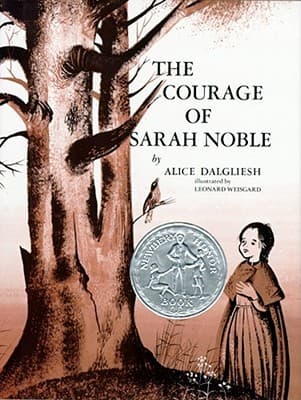
Alice Dalgliesh (1954)
Genre
Children's / Historical Fiction
Reading Time
30 min
Key Themes
See below
Sign in to track this book
Eight-year-old Sarah Noble discovers true courage is not the absence of fear, but embracing the unknown wilderness and befriending new neighbors while helping her father build a home in 1707 Connecticut.
In the autumn of 1707, eight-year-old Sarah Noble prepares to leave her home in Westfield, Massachusetts, with her father, John Noble. Her mother, Martha Noble, gives her a yellow cloak and reminds her to 'Keep up your courage, Sarah Noble.' The family is moving to New Milford, Connecticut, a place then considered a wilderness, where John plans to build a house for his wife and their other four children to join them later. Sarah is tasked with caring for her father and cooking during their journey. She is nervous but determined to be brave, remembering her mother's words as they set off into the unknown forests.
Sarah and her father travel for several days, seeing dense forests, wild animals like deer and bears, and many Native American trails. They sleep under the open sky, with Sarah often scared by the unfamiliar sounds of the wilderness at night. Her father reassures her and teaches her how to build a fire and cook simple meals. Sarah does her duties, remembering her mother's advice. One evening, a bear approaches their camp, frightening Sarah, but her father's quick thinking and their dog, Captain, scare it away. This shows Sarah's dependence on her father's strength and protection.
After a long journey, John and Sarah arrive in New Milford, a clearing in the wilderness. John immediately starts cutting trees to build their new house. Sarah helps by gathering firewood and keeping their small camp organized. Soon, Native American children from a nearby village cautiously approach their camp, curious about the new settlers. Sarah is initially shy and a little afraid, remembering stories she'd heard. However, her father encourages her to be friendly, and she offers them some of the dried apples her mother had packed. This starts an interaction with her new neighbors.
As winter approaches and the house is still under construction, John Noble realizes it will be too cold for Sarah to stay in their lean-to. He arranges for her to live with a friendly Native American family, the family of Tall John, for the winter months. Sarah is initially scared and lonely, missing her own family. However, she gradually adapts to their customs and learns some of their language. She becomes especially close to Tall John's daughter, who is about her age. They share games and stories, and Sarah teaches her some English words, finding comfort and friendship in an unexpected place.
Living with Tall John's family, Sarah learns many new things. She learns to grind corn, weave baskets, and understand the rhythms of the forest. She sees their respect for nature and their resourcefulness. Although she occasionally feels homesick, her courage grows as she lives in this new world. She learns to communicate through a mix of gestures and the few Native American words she learns. The initial fear she held towards the Native Americans turns into understanding and affection, especially for Tall John's Daughter, whom she now considers a friend.
As winter ends and spring comes, John Noble returns to Tall John's village to get Sarah. He has completed the basic structure of their new house and has traveled back to Westfield to bring the rest of the family. Sarah is happy to see her father and eager to reunite with her mother and siblings. She says goodbye to Tall John's family, especially her friend, promising to visit. Her time with them has changed her, making her more resilient and understanding of different ways of life. She is now ready to help her family settle into their new home.
Sarah and her father return to the new house, which is still rough but now has walls and a roof. Sarah helps her father clean and prepare the house, looking forward to her family's arrival. She feels a sense of ownership and pride in the home they have built together. She thinks about her journey, the fears she overcame, and the friends she made. The wilderness no longer seems as scary, and she realizes that her mother's words, 'Keep up your courage,' were not just about facing fear, but about embracing new experiences and finding strength within herself. She is no longer just a scared little girl but a brave and capable young woman.
Finally, Sarah's mother, Martha, and her four siblings arrive in New Milford. The reunion is joyful and emotional. Sarah proudly shows them the new house and tells them about her adventures and her Native American friends. She has grown in confidence and maturity, surprising her mother with her newfound independence. The book concludes with the Noble family settling into their new home, ready to face the challenges and joys of frontier life. Sarah, with her experiences and friendships, is a bridge between the settler and Native American communities, showing the true meaning of courage.
The Protagonist
Sarah transforms from a fearful child relying on her mother's words to a courageous and independent girl who embraces new cultures and challenges.
The Supporting
He successfully establishes a new home for his family in the wilderness, demonstrating leadership and resourcefulness.
The Supporting
Her influence on Sarah is foundational, and her eventual arrival completes the family's new beginning.
The Supporting
He provides a safe haven for Sarah, embodying cross-cultural understanding and hospitality.
The Supporting
She forms a genuine friendship with Sarah, demonstrating the power of cross-cultural connection.
The Mentioned
He serves as a loyal companion and protector throughout the journey.
The central theme is Sarah's journey of finding courage. Her mother's words, 'Keep up your courage, Sarah Noble,' are a recurring idea, guiding Sarah through her fears of the wilderness, wild animals, and the unfamiliar Native American people. Sarah's resilience is shown through her ability to adapt to new environments, perform duties beyond her years, and overcome loneliness and fear to embrace new experiences and friendships. The book shows that courage is not the absence of fear, but the ability to act despite it, growing stronger through challenges.
“Keep up your courage, Sarah Noble.”
The book shows the challenges of adapting to frontier life in early America. Sarah and her father must deal with the harsh wilderness, build a home from scratch, and live off the land. Sarah's stay with Tall John's family further shows adaptation, as she learns their customs, language, and survival skills. This theme highlights the resourcefulness and flexibility needed to thrive in a new, undeveloped territory, showing how individuals learn to make a home in unfamiliar surroundings.
“It was not easy to feel brave inside.”
A significant theme is the development of understanding and friendship between the English settlers and the Native American community. Sarah initially fears the 'Indians' based on common prejudices. However, through her direct interactions and especially her stay with Tall John's family, she learns to see them as kind, hospitable, and intelligent people. Her friendship with Tall John's Daughter bridges cultural divides, showing that empathy and shared humanity can overcome fear and prejudice, leading to peaceful coexistence.
“Now she was not afraid of Indians.”
Family and the creation of a new home is a main theme. The entire journey is undertaken to establish a new home for the Noble family. Sarah's longing for her mother and siblings shows the importance of family bonds. The building of the house symbolizes the creation of a safe and loving space. The story ends with the reunion of the family in their new dwelling, marking the successful establishment of their new life and the lasting strength of family connections, even across vast distances and challenging circumstances.
“She was so glad to see the house that was to be her home.”
A tangible symbol of comfort, home, and her mother's love.
The yellow cloak given to Sarah by her mother serves as a powerful symbolic object throughout her journey. It represents the warmth, comfort, and familiarity of her home and her mother's enduring love and presence. When Sarah feels scared or lonely, she often clutches the cloak, drawing strength from its association with her family. It's a physical reminder of her origins and the love that awaits her, reinforcing her courage and helping her endure the hardships of the wilderness.
A recurring mantra that guides and inspires the protagonist.
This phrase, spoken by Sarah's mother at the beginning of the journey, acts as a recurring motif and a psychological anchor for Sarah. It is repeated directly and alluded to several times, serving as an internal monologue that helps Sarah overcome her fears and continue her duties. This device highlights the power of encouragement and the internal strength children can draw from parental wisdom, demonstrating how a simple phrase can become a profound source of resilience and self-reliance.
The natural environment acts as both an antagonist and a teacher.
The wilderness of Connecticut in 1707 functions almost as a character itself, presenting challenges and opportunities for growth. It is initially portrayed as a frightening, unknown entity with wild animals and unfamiliar sounds, acting as an antagonist to Sarah's comfort and safety. However, as Sarah adapts, the wilderness also becomes a teacher, forcing her to learn new skills, appreciate nature, and develop resilience. It is the crucible in which Sarah's courage is forged, transforming her perception from fear to familiarity and respect.
The narrative primarily follows Sarah's emotional and physical journey.
While written in the third person, the story's perspective is closely tied to Sarah's experiences and emotional state. The reader sees the world through her eyes, feeling her fears, her loneliness, and eventually her growing courage and understanding. This focus allows for a deep connection with Sarah's internal journey, making her growth and the lessons she learns more impactful and relatable for young readers. The simplicity of the language also reflects a child's understanding of the world.
“It is a fearful thing, and a brave thing, to go into the wilderness.”
— Sarah's father prepares to leave her with a Native American family.
“Keep up your courage, Sarah Noble.”
— Sarah's mother tells her this repeatedly before and during their journey.
“Her father said, 'You are a brave girl, Sarah Noble.'”
— Her father praises her for her resilience.
“The woods were very quiet. Only the wind made a sound, a sighing sound.”
— Sarah experiences the quiet of the wilderness for the first time.
“She learned that to be a friend, you must be a friend.”
— Sarah reflects on her interactions and growing friendship with the Native American children.
“She looked at the little brown hands and thought of her own white hands.”
— Sarah observes the differences between herself and the Native American children.
“She had to make a new home in a new place, and that was a very big thing to do.”
— Sarah contemplates the challenge of settling in a new land.
“Even though she was afraid, she did not cry.”
— Sarah shows her resolve despite her fears.
“She was learning to understand the language of the forest.”
— Sarah gradually becomes more attuned to her natural surroundings.
“It was not easy to be brave all the time.”
— Sarah acknowledges the difficulty of maintaining courage.
“The smoke of the fire went up, up into the sky, carrying the smell of cooking meat.”
— A sensory detail describing daily life in the wilderness.
“She was a small girl, but she had a big job to do.”
— Refers to Sarah's role in helping her father and adapting to the new world.
“The stars were very bright, like tiny holes poked in a dark blanket.”
— Sarah observes the night sky in the wilderness.
“It was good to have a friend, even if the friend did not speak the same words.”
— Sarah finds comfort and connection with the Native American children despite language barriers.
Ready to see how well you understood this book? Take our interactive quiz with 10 questions.

Alice Dalgliesh was a beloved author and educator, celebrated for her children's historical fiction. Her most famous work, 'The Courage of Sarah Noble,' published in 1954, remains a classic, lauded for its engaging storytelling and historical accuracy. Dalgliesh's career spanned decades, impacting countless young readers and aspiring writers.

Dan Gemeinhart
4.5

Kate O'Hearn
4.4

Jeanne Birdsall
4.4

Jen Wang
4.4

Wendelin Van Draanen
4.3

John Marsden
4.3

Chris Van Allsburg
4.3
Jennifer A. Nielsen
4.2