“We are monarchs of all we survey, our right there is none to dispute.”
— Ralph's declaration upon first exploring the island with his friends.

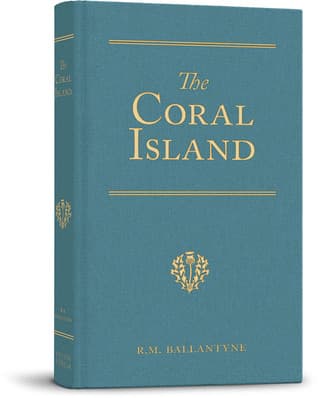
Genre
Children's / Historical Fiction / Young Adult
Reading Time
900 min
Key Themes
See below
Sign in to track this book
Three boys shipwrecked on a tropical island discover that paradise holds deadly secrets, from cannibal feasts to pirate raids, testing their ingenuity and courage against the South Pacific's wild beauty.
The story begins with fifteen-year-old Ralph, the narrator, and his companions Jack (eighteen) and Peterkin (thirteen), on the schooner 'Arrow'. A fierce storm strikes, wrecking the ship on a coral reef. The boys escape on a raft, carrying only a telescope and a broken pocketknife. After a dangerous journey, they land on a beautiful, uninhabited coral island. Initially, they are overjoyed by their survival and the island's abundance. They explore their immediate surroundings, finding fresh water, coconuts, and various fruits. They set up their first camp and admire the coral reefs around their new home. Their immediate concern is survival and making their new environment comfortable.
The three boys quickly adapt to their new environment. Jack, the eldest and most practical, takes charge of building a secure shelter and finding suitable food. Ralph, with his observational skills, helps identify edible plants and animals. Peterkin, the youngest and most mischievous, provides humor and often finds useful things. They build a comfortable hut, learn to hunt wild pigs and birds, fish in the lagoons, and gather fruits like breadfruit and bananas. They spend their days exploring the island's interior, discovering waterfalls, caves, and diverse wildlife. They believe they have found a tropical paradise free from the worries of civilization. Their resourcefulness and cooperation strengthen their bond.
Their peaceful existence ends when they see two large canoes approaching the island. Hiding, they watch in horror as a battle occurs between two groups of native islanders. One group, the 'black' islanders (implied to be from a different island), attacks the 'red' islanders (implied to be the island's inhabitants). The boys see brutal fighting with spears and clubs, ending in the defeat of the red islanders. The victors engage in cannibalistic practices, preparing and eating the bodies of their enemies. This terrifying sight deeply affects the boys, showing them the harsh realities of the world beyond their innocent view of paradise and making them fear encountering these groups.
Months later, a ship appears. Believing it is a rescue, the boys eagerly signal it. However, the ship is a pirate vessel. The pirates, led by the ruthless Bloody Bill, take the boys aboard. Instead of rescuing them, the pirates force the boys to serve them, making them witness their brutal acts of plunder, murder, and cruelty against other native islanders. Ralph, Jack, and Peterkin are horrified by the pirates' depravity and their complete disregard for human life. They are trapped, unable to escape and forced to comply with the pirates' demands while secretly wanting freedom and a return to their innocent island life.
During a violent storm, the boys see a chance to escape the pirate ship. They manage to lower a small boat and slip away undetected in the chaos. The storm carries them to a different, smaller island, which they believe is uninhabited. Exhausted but relieved to be free from the pirates, they again find themselves in a survival situation. This new island presents different challenges, but they are determined to make the best of it, grateful for their freedom. They quickly find food and shelter, using the skills they learned on their first island. Their experience with the pirates has made them much more mature.
On this new island, the boys find a lone hut and discover a kind, elderly Christian missionary named Mr. Henderson. He has been living there, trying to convert the native population to Christianity. While with Mr. Henderson, they encounter a tribe of fierce, cannibalistic natives hostile to the missionary's teachings. The boys, along with Mr. Henderson, must defend themselves against repeated attacks. They see the devastating effects of tribal warfare and the clash of cultures. Mr. Henderson tries to reason with the natives, but his efforts are largely met with aggression, showing the dangers of his mission.
During one of the fights with the hostile natives, Peterkin is captured. The boys and Mr. Henderson are very upset. Jack, driven by loyalty and courage, immediately plans a rescue mission. Ralph and Mr. Henderson hesitate because of the overwhelming odds, but Jack's determination is strong. He disguises himself and enters the native village, showing immense bravery and resourcefulness. His plan is dangerous, but he will not abandon Peterkin to a grim fate. This event tests the bonds of friendship and highlights Jack's leadership and protective nature.
Jack's daring rescue attempt is successful. He frees Peterkin from the native village, using clever tactics and quick thinking. The two boys then make a desperate escape, pursued by the angry cannibals. They narrowly avoid capture multiple times, using their knowledge of the jungle and their agility. Ralph and Mr. Henderson anxiously await their return. The reunion is joyful but brief, as the threat from the natives remains. This thrilling escape further strengthens the boys' bond and their shared resilience in danger.
To their dismay, the pirate ship, 'The Shark,' reappears at the island. The pirates, recognizing the boys, try to recapture them. However, the pirates also clash with the hostile native tribe already on the island. A chaotic battle happens between the pirates and the cannibals, allowing the boys and Mr. Henderson to remain hidden but witness the brutal conflict. The pirates, under Bloody Bill, are ruthless, but the natives are fierce defenders of their territory. This unexpected turn of events creates a desperate chance for the boys to escape both dangerous groups.
Just as the situation seems most dire, a British warship, 'The Dolphin,' arrives, drawn by the sounds of the battle. The British sailors quickly engage the pirates, leading to their defeat and the capture of Bloody Bill. The native tribe is subdued. Ralph, Jack, and Peterkin, along with Mr. Henderson, are finally rescued. They share their harrowing tales with the British captain. After a long and eventful journey, the boys are safely returned to England, forever changed by their experiences on the Coral Island and the subsequent adventures. They are reunited with their families, carrying with them the memories of their paradise lost and found, and the harsh realities of the world.
The Protagonist
Ralph begins as an innocent boy and matures into a thoughtful young man, deeply affected by the violence and moral ambiguities he experiences.
The Protagonist
Jack develops from a capable leader to a heroic figure, demonstrating unwavering loyalty and courage in the face of extreme danger.
The Protagonist
Peterkin retains his playful spirit but gains a deeper understanding of danger and the value of friendship through his ordeal.
The Supporting
Mr. Henderson steadfastly maintains his faith and mission, serving as a moral anchor for the boys amidst chaos.
The Antagonist
Bloody Bill remains a static, villainous character throughout, driven by greed and cruelty until his defeat.
The Mentioned
Tararo remains a loyal and helpful convert to Christianity, acting as a bridge between cultures.
The Antagonist
The Cannibal Chief remains a formidable antagonist, representing unyielding tribal traditions and violence.
The Supporting
The British Captain serves as a deus ex machina, arriving to restore order and facilitate the boys' return home.
The boys begin their adventure in youthful innocence, seeing the island as a pure paradise. However, witnessing cannibalism, experiencing the depravity of pirates, and confronting tribal warfare forces them to face the darker aspects of humanity and the world. Their experiences remove their naivety, making them mature quickly, develop survival skills, and make difficult moral choices. The idyllic vision of 'The Coral Island' becomes a place of moral lessons and harsh realities, marking their transition from boys to young men.
“We had indeed found a terrestrial paradise; but experience had taught us that even in paradise the trail of the serpent may sometimes be found.”
The novel constantly contrasts the 'civilized' values of the British boys and Mr. Henderson with the 'savage' practices of the native islanders and the lawlessness of the pirates. Ballantyne presents a clear hierarchy, with Christian European values shown as superior and bringing order, while native customs (especially cannibalism and tribal warfare) are portrayed as barbaric. The pirates represent a different form of savagery—that of corrupted 'civilized' men. This theme explores how fragile civilization is and the constant threat of barbarism, both from outside and within.
“Alas! it was but too true that human beings were savages, and that these savages ate each other.”
The bond between Ralph, Jack, and Peterkin is central to the story. Their survival depends entirely on their cooperation, mutual support, and deep loyalty to one another. Jack's daring rescue of Peterkin from the cannibals shows the strength of their friendship, demonstrating that they are willing to risk everything for each other. This theme highlights the importance of companionship, trust, and shared experience in overcoming adversity, forming the emotional core of the boys' journey.
“We were bound together by a tie that could not be broken, a tie of mutual danger and deliverance.”
The arrival of Mr. Henderson, the missionary, introduces a strong Christian moral framework into the story. His efforts to convert the natives, his unwavering faith, and his peaceful demeanor contrast sharply with the violence and barbarism around them. The boys, already having a Christian upbringing, find their values reinforced by Mr. Henderson. The novel suggests that Christianity is the path to true civilization and salvation, offering a moral guide in a world full of cruelty and sin, and providing hope for redemption.
“He told us that there was but one God, and that He was a God of love, and that He sent his Son into the world to die for all men.”
A classic setting for testing human nature and survival skills.
The deserted coral island serves as both a literal paradise and a crucible for the boys' characters. Initially, it symbolizes freedom, abundance, and innocence, allowing them to live out an idealized childhood fantasy. However, it quickly transforms into a testing ground for their survival skills, resilience, and moral fiber when outside threats emerge. The isolation of the island amplifies the sense of danger and emphasizes their self-reliance, forcing them to confront the harsh realities of nature and human evil without adult supervision.
Symbols of limited human ingenuity and the boys' resourcefulness.
These two items are the only tools the boys manage to salvage from the shipwreck. The telescope, though useful for observation, represents their limited ability to influence distant events or signal for help. The broken pocketknife, despite its damaged state, becomes a crucial tool, symbolizing their resourcefulness and ability to make do with very little. Together, they highlight the boys' reliance on their own ingenuity and the scarcity of technology in their primitive environment, emphasizing the contrast between their 'civilized' origins and their 'savage' surroundings.
A moral and spiritual guide, representing the influence of Christianity.
Mr. Henderson functions as a moral compass and a symbol of Christian evangelism in the narrative. His presence introduces a didactic element, emphasizing the book's themes of civilization, savagery, and the redemptive power of faith. He provides adult guidance and spiritual instruction to the boys, contrasting the brutal acts of the pirates and the cannibals with his message of love and peace. His character is a direct embodiment of the Victorian missionary zeal and the belief in the superiority of Western Christian values.
A symbol of human depravity and the corrupting influence of greed.
The pirate ship, 'The Shark,' represents the dark side of 'civilized' humanity—greed, cruelty, and lawlessness. Its appearance shatters the boys' remaining innocence and exposes them to a form of evil that is perhaps more disturbing than the 'savagery' of the cannibals, as it comes from men who should know better. The ship is a mobile symbol of danger and moral corruption, forcing the boys into terrifying situations and highlighting the pervasive nature of evil even in remote corners of the world.
“We are monarchs of all we survey, our right there is none to dispute.”
— Ralph's declaration upon first exploring the island with his friends.
“It is a capital thing to have a good conscience.”
— Ralph reflecting on their moral decisions while stranded.
“The sea was like a sheet of glass, so calm and bright.”
— Description of the peaceful ocean surrounding their island.
“We'll make a garden of Eden of this yet.”
— Jack's optimistic plan to cultivate the island's resources.
“Civilization is a good thing, but savagery has its charms.”
— Reflection on their simple, unencumbered island life.
“A man's a man for a' that.”
— Quoting Burns to emphasize human dignity in their plight.
“There is no place like home, after all.”
— Longing for England despite the island's beauty.
“We were like three Robinson Crusoes.”
— Comparing themselves to the famous castaway.
“The coral reef was a breakwater against the ocean's fury.”
— Describing the protective natural barrier of the island.
“It's wonderful what a little knowledge of natural history will do.”
— Using learned skills to identify edible plants and animals.
“We resolved to stand by each other to the last.”
— The boys pledging loyalty in the face of adversity.
“The stars shone like diamonds in the velvet sky.”
— Nighttime description emphasizing the island's beauty.
“Every day brought its own duties and its own pleasures.”
— Reflecting on the structured yet fulfilling island routine.
“We were boys no longer, but men in responsibility.”
— Acknowledging their maturation through hardship.
Ready to see how well you understood this book? Take our interactive quiz with 10 questions.

Biography coming soon.
Dan Gemeinhart
4.5
Kate O'Hearn
4.4

Jeanne Birdsall
4.4

Jen Wang
4.4

Wendelin Van Draanen
4.3

John Marsden
4.3

Chris Van Allsburg
4.3
Jennifer A. Nielsen
4.2