“The only thing you could be sure of was that life would go on, whether you were there or not.”
— Mehring's internal reflection on the farm's continuity.

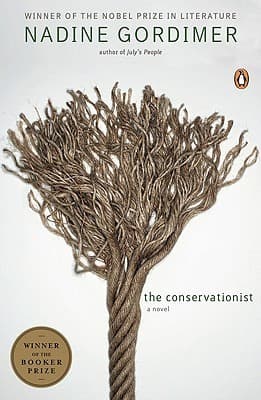
Nadine Gordimer (1974)
Genre
Literary Fiction
Reading Time
450 min
Key Themes
See below
Sign in to track this book
In Nadine Gordimer's "The Conservationist," a wealthy South African industrialist finds his privilege challenged as his relationships, his workers, and the land itself resist his control, leaving him isolated amid the ruins of his possessions and a changing world.
Mehring, a wealthy white industrialist and part-time farmer, finds the decomposing body of an unknown Black man on his Natal farm. The body is near a culvert, partly in mud. Mehring tells the local police, who, after a quick investigation, call it the death of an 'illegal' Black person and show little interest in identifying the deceased. Mehring, despite his initial detachment, becomes preoccupied with the body, which he allows to be buried on his land. This event, seemingly minor, begins to erode his sense of control and ownership over his property and life, introducing an unsettling presence that will last throughout the story.
Mehring's personal life is shown through fragmented memories and current observations. His wife, Antonia, has left him for America, taking their daughter, Susie. His son, Terry, a conscientious objector, lives a counter-cultural life and visits rarely, creating a large emotional distance. Mehring's current mistress, an Angolan woman named Rosa, offers brief companionship but no deep bond. He is surrounded by material wealth—his farm, his business, his possessions—yet feels deep emotional isolation. He tries to control his environment, from managing his farm to interacting with his Black workers, but increasingly senses a lack of true connection or understanding.
Mehring's relationship with his Black farm workers, especially his foreman, Jacobus, is full of unspoken tensions and power imbalances. He sees them as parts of his property, often referring to them as a group rather than individuals. However, the workers, sensing the changing political situation of apartheid South Africa, begin to assert their own will in subtle ways. Jacobus, while outwardly respectful, increasingly makes decisions independently, challenging Mehring's authority. The workers' families live on the farm, their lives connected to the land, but Mehring remains an outsider to their culture and community. He tries to implement new farming techniques and conservation efforts, but these are often met with quiet resistance or indifference from those who have a deeper, ancestral connection to the land.
Mehring's son, Terry, visits the farm, bringing a sharp contrast to his father's views. Terry is a young man critical of the apartheid regime and his father's role in it. He challenges Mehring's materialistic values and his treatment of the Black workers. Their conversations are often tense, showing a deep ideological gap. Terry represents a younger generation grappling with South Africa's moral complexities, while Mehring remains fixed in his beliefs and privileges. Terry's presence makes Mehring confront, however reluctantly, the ethical implications of his life and possessions, though he largely dismisses his son's perspective as naive idealism.
Rosa, Mehring's Angolan mistress, eventually leaves him. Her departure is quiet, reflecting the fading connections in Mehring's life. While their relationship lacked deep emotional intimacy, her presence offered companionship and distraction. Her absence further isolates Mehring, leaving him more alone on his vast farm. Her foreignness and her own experiences as an outsider in South Africa provided a different perspective, which Mehring, in his self-absorption, mostly failed to grasp. Her leaving highlights his inability to form lasting, meaningful bonds, reinforcing the novel's theme of emotional emptiness amid material abundance.
The grave of the unknown Black man, initially a minor issue, begins to subtly but persistently influence Mehring's mind. It remains unmarked, a silent sign of the man's anonymity and the casual disregard for Black lives in apartheid South Africa. Mehring occasionally passes it, and its presence seems to challenge his ownership of the land. He finds himself thinking about the man, imagining different identities and stories for him, almost as if the deceased is a silent observer of Mehring's life. The grave becomes a physical representation of unresolved guilt and historical injustices embedded in the land itself, a constant, unsettling reminder of a reality Mehring would prefer to ignore.
The farm's natural environment begins to reflect Mehring's inner decay and the wider social unrest. A severe drought hits the land, turning fertile fields into dry, cracked earth. His crops fail, and his livestock suffer. Mehring's attempts at conservation and modern farming prove useless against nature's power. The drought symbolizes a deeper problem, a disruption of order beyond his control. It highlights his basic separation from the land, which he sees mainly as a resource to exploit rather than an ecosystem to respect. The farm, once a symbol of his wealth and power, becomes a source of frustration and loss.
Just as the drought peaks, a heavy rain begins, causing catastrophic floods. The rains turn dry riverbeds into raging torrents, overflowing banks and flooding the farm. Fences are washed away, buildings are damaged, and more livestock are lost. The floods represent another natural force beyond Mehring's control, further eroding his sense of mastery over his environment. The land, having been neglected and exploited, seems to retaliate with destructive power. The body in the culvert is unearthed and re-submerged, its presence resurfacing with the floodwaters, reinforcing the idea that the past and its injustices cannot be simply buried or forgotten.
As his personal relationships crumble and his farm suffers natural disasters, Mehring's mental state declines. He becomes more withdrawn, his thoughts fragmented and obsessive. He hallucinates and engages in internal monologues, blurring the lines between reality and his anxieties. His sense of self, tied to his possessions and control, unravels as these elements are stripped away. The unnamed man's grave, his workers' indifference, and his family's abandonment all contribute to growing paranoia and a deep sense of dread. He struggles to maintain a clear story of his life, finding himself increasingly lost within his own mind.
Throughout Mehring's decline, the Black farm workers, especially Jacobus, continue their lives with quiet resilience. They observe Mehring's struggles with a detached perspective, understanding that his problems are separate from their own. They continue their traditional practices, maintain their community, and adapt to the farm's changing conditions. Their connection to the land is not one of ownership but of belonging, a deep-rooted relationship that outlasts Mehring's temporary presence. Their independence, though often subtle, contrasts sharply with Mehring's increasing powerlessness.
After the floods, the unnamed man's body is unearthed again. This time, the Black farm workers, led by Jacobus, rebury him. They do so according to their own customs, without Mehring's direct involvement or even his full awareness. This act is important; it shows their reclaiming of the land and their assertion of cultural practices over Mehring's nominal ownership. The man, who was 'illegal' and disposable to white authorities, is given dignity and a proper resting place by his own people. This event highlights the lasting power of community and tradition in the face of oppression.
By the novel's end, Mehring has lost everything. His family has left him, his mistress has gone, his farm is damaged by nature, and his workers have subtly asserted their own control. He remains on the farm, but his ownership is empty. The land, with its history and its people, ultimately rejects him. He is a 'conservationist' who has failed to conserve anything meaningful in his life or on his property. His wealth and privilege are not enough to give him true belonging or peace. He is left with the haunting presence of the unnamed man and the silent, enduring power of the land and its people, showing the final collapse of his colonial power structure.
The Protagonist
Mehring's arc is one of gradual dispossession and mental deterioration, as his material wealth fails to protect him from isolation and the land reclaims its own.
The Catalyst/Symbolic Figure
Though deceased, his 'arc' involves being discovered, briefly acknowledged by the white system, then ultimately reclaimed and given dignity by the Black community.
The Supporting Character
Jacobus maintains his dignity and connection to his community, demonstrating a quiet but powerful resilience against Mehring's fading authority.
The Supporting Character
Terry maintains his moral convictions, serving as a critical voice against his father's worldview and representing a different path for white South Africa.
The Mentioned Character
Her arc is completed off-page; she has already chosen a different life, leaving Mehring to confront his own failures.
The Supporting Character
She eventually leaves Mehring, choosing her own path away from his isolating influence.
The Supporting/Collective Character
As a collective, they demonstrate enduring resilience and subtle assertion of their cultural autonomy, outlasting Mehring's fading power.
The Mentioned Character
Her arc is completed off-page, as she lives a life separate from her father's.
The novel examines the idea of ownership, especially concerning land and people in apartheid South Africa. Mehring, as a white landowner, believes he 'owns' his farm and, by extension, controls his Black workers. However, the land itself, and the indigenous people who live on it, show a deeper sense of belonging that goes beyond legal title. The discovery of the unnamed man's body on Mehring's property immediately challenges his ownership, as the land becomes a burial ground for someone outside his control. The workers' eventual reburial of the man, according to their customs, further emphasizes this theme, showing that true belonging is not bought but earned through history, community, and respect for the land. Mehring's eventual loss of everything comes from his inability to understand this difference.
“He thought of the land as his, but it had its own memory, its own history that predated his claim.”
The Conservationist is set firmly in apartheid South Africa, exploring its moral and social decay. Mehring embodies the white privilege and psychological detachment the system created. His casual disregard for the unnamed Black man's life, the unspoken tensions with his workers, and his inability to form real relationships with Black individuals all reflect the dehumanizing effects of apartheid. The novel suggests that the land itself carries the scars of colonial conquest and racial injustice. The unnamed man's body, a symbol of the 'disposable' Black population, constantly reminds Mehring of the violence and exploitation that built his wealth and comfort. The workers' eventual reburial hints at a lasting indigenous culture that will reclaim its rightful place.
“The earth was no longer indifferent to what was put into it.”
Mehring is a deeply isolated figure, despite his material wealth and superficial connections. His wife and daughter have left him, his mistress departs, and his son is ideologically distant. He cannot connect authentically with his Black workers, seeing them as a group rather than individuals. This emotional emptiness is a direct result of his self-absorption and his adherence to a system that creates division. His internal monologues show a mind breaking under the weight of this isolation. The vastness of his farm, which should offer comfort, instead reflects his inner emptiness. This theme suggests that true wealth is not material but relational, and that the dehumanizing aspects of apartheid lead to a deep spiritual and emotional void for those who benefit from it.
“He lived in the house alone, and the sounds of the night were the sounds of the farm, not of human company.”
Nature in 'The Conservationist' is not just a background but an active, almost living force that reflects and reacts to the human condition, particularly Mehring's moral and psychological state. The land, initially a source of pride and control for Mehring, gradually turns against him. The severe drought and subsequent floods mirror his inner decay and the unraveling of his life. The repeated unearthing of the unnamed man's body by the elements suggests that the land refuses to bury or forget the injustices committed upon it. Mehring's attempts at 'conservation' are ironically undermined by his own destructive nature and his basic separation from the natural world. The land ultimately asserts its own power, showing that it cannot be simply owned or controlled, but requires respect and balance.
“The earth knew its own, and would not keep what did not belong.”
The novel explores how identity is fluid and hard to grasp, especially through the unnamed Black man and Mehring's own self-perception. The unnamed man, stripped of his name and history by the state, becomes a screen onto which Mehring projects his anxieties and guilt. His lack of identity highlights the systemic dehumanization of Black people under apartheid. Conversely, Mehring, who defines himself by his possessions and social status, finds his own identity unraveling as these external markers disappear. His fragmented thoughts and internal monologues reveal a man struggling to maintain a clear sense of self in a world that is slipping beyond his control. The novel suggests that true identity is not found in ownership or social roles but in one's connection to community, history, and the land.
“What was a name, after all, when the man himself was nothing?”
The decomposing body of an unidentified Black man found on Mehring's farm.
This is the central plot device. The unnamed body acts as a constant, haunting symbol of the unresolved injustices of apartheid and the historical violence embedded in the land. Its discovery immediately disrupts Mehring's sense of control and introduces an unsettling presence that he cannot fully dismiss. The body's repeated disinterment by natural forces (drought, flood) emphasizes that the past cannot be buried or forgotten. It serves as a moral mirror for Mehring, forcing him to confront, however subconsciously, the ethical implications of his life and possessions. It also highlights the dehumanization of Black lives under the regime, as the authorities show no interest in identifying the deceased.
Mehring's fragmented thoughts and internal reflections dominate the narrative.
Much of the novel is narrated through Mehring's internal monologue, often fragmented and non-linear. This device allows readers direct access to his anxieties, obsessions, and self-deceptions. It reveals his emotional barrenness, his attempts to rationalize his privilege, and his gradual mental deterioration. The stream of consciousness blurs the lines between his perceptions and objective reality, reflecting his increasing isolation and inability to connect with the external world. It also highlights the psychological impact of living within a morally compromised system, showing how his mind struggles to maintain a coherent narrative amidst the unraveling of his life.
The natural environment mirrors Mehring's internal state and the social decay of South Africa.
The weather and the state of the farm directly reflect Mehring's psychological decline and the broader social decay. The severe drought symbolizes his emotional barrenness, the lack of connection in his life, and the parched moral landscape of apartheid. The subsequent devastating floods represent the overwhelming forces beyond his control, mirroring the unraveling of his life and the eventual reclaiming of the land by nature and its original inhabitants. The land itself, through its resistance and destruction, acts as a sentient entity that refuses to be simply owned and exploited, reflecting the deep-seated injustices that Mehring embodies.
Mehring's farm as a microcosm of South Africa and his personal life.
The farm functions as a powerful symbol, a microcosm of South Africa under apartheid. For Mehring, it represents his wealth, control, and colonial ownership. However, it is also a site of deep historical and racial tension, where the indigenous Black workers have an ancestral claim that supersedes his legal title. The farm reflects Mehring's internal state: as his personal life unravels, so too does the farm, succumbing to natural disasters and the quiet resistance of its inhabitants. It becomes a battleground for competing claims of ownership and belonging, ultimately demonstrating the futility of Mehring's attempts to 'conserve' a system built on injustice.
“The only thing you could be sure of was that life would go on, whether you were there or not.”
— Mehring's internal reflection on the farm's continuity.
“He knew he had to keep himself busy, or the silence would eat him.”
— Mehring's struggle with solitude and the vastness of his farm.
“The land was not his, not really. He was merely its temporary custodian.”
— Mehring's growing realization about his ownership of the land.
“There was no answer, except the answer of the land itself, which was always silence.”
— Mehring seeking answers from the environment around him.
“You couldn't escape what you were, not in this country.”
— A reflection on identity and the inescapable nature of one's background in apartheid South Africa.
“The past was not dead; it was not even past. It was merely sleeping, waiting to be woken.”
— A general reflection on the lingering effects of history and injustice.
“He had bought the land, but he had not bought the people who lived on it.”
— Mehring contemplating his relationship with the black workers on his farm.
“The wilderness was not empty; it was full of presences.”
— Mehring's perception of the natural world and its unseen life.
“Everything changed, but nothing changed.”
— A paradoxical observation about the superficiality of change versus underlying realities.
“He was a man who lived in the present, but the present was always being invaded by the past.”
— Mehring's internal struggle with his personal history and the history of the land.
“The truth was not a single thing, but many things, shifting and elusive.”
— A philosophical reflection on the nature of truth in a complex society.
“He felt a great weariness, a weariness that had nothing to do with physical exertion.”
— Mehring's emotional and spiritual exhaustion from his life and the state of the country.
“The dead man was still there, under the ground, a constant reminder.”
— The lingering presence of the unidentified body found on Mehring's farm.
“The land was a mirror, reflecting back what he was, what he had done.”
— Mehring's growing sense of self-awareness through his connection to the farm.
Ready to see how well you understood this book? Take our interactive quiz with 10 questions.

Nadine Gordimer was a South African writer and political activist. She received the Nobel Prize in Literature in 1991, recognized as a writer "who through her magnificent epic writing has ... been of very great benefit to humanity".







