“I had been chosen by God for a great purpose.”
— Nat Turner reflecting on his early religious visions and his belief in divine election.


William Styron (1992)
Genre
Literary Fiction / Historical Fiction
Reading Time
12-15 hours
Key Themes
See below
Sign in to track this book
In 1831 Virginia, an educated enslaved preacher, Nat Turner, believes God chose him to lead a brutal, ultimately failed, rebellion against slavery.
The novel begins with Nat Turner, an educated enslaved man, in a jail cell in Jerusalem, Virginia. He awaits execution after leading a failed slave rebellion. Thomas R. Gray, a white lawyer, interviews Nat and records his 'confessions.' Nat is chained, cold, and haunted by the recent violence and the faces of those he killed and lost. He thinks about his early life, his unique position as a literate slave, and the strong religious visions that shaped his destiny. The story often shifts between his current imprisonment and clear flashbacks, showing his inner conflict and the weight of his actions.
Nat recalls his early childhood on the Turner plantation. His first mistress, Miss Sarah, recognized and encouraged his intelligence and literacy, which was unusual. He learns to read and write, mainly from the Bible, which deeply influences his perspective. Even as a young boy, Nat has intense religious visions and hears voices, believing God chose him for a special purpose. These early spiritual experiences set him apart from other enslaved people and lead him to see natural events as divine signs, hinting at his later role as a prophet and leader.
As Nat gets older, his literacy and religious passion make him a respected, though sometimes feared, figure among enslaved people. He becomes a traveling preacher, going to different plantations to give sermons. He interprets scripture through the lens of freedom and divine justice. This role gives him purpose but also deep inner conflict, as he struggles with his spiritual calling and his enslaved status. His preaching subtly plants ideas of resistance, even as he outwardly acts subservient to his white owners.
Nat experiences slavery's harsh realities through various owners and plantations, each showing different aspects of its cruelty. He is sold multiple times, separated from loved ones, and sees countless acts of violence, degradation, and sexual abuse against other enslaved people. One particularly painful experience involves his young wife, Cherry, being raped by a white overseer. This fuels his growing rage and strengthens his belief that divine action is needed to end their suffering. These personal and observed injustices solidify his decision to rebel.
Nat becomes more and more absorbed by his religious visions. He interprets natural events like solar eclipses and unusual weather as direct messages from God, signaling the time for the uprising. He retreats into intense prayer and fasting, seeking clarity on his divine mission. These signs, along with his deep study of biblical stories of freedom and revenge, convince him that he is God's chosen tool to lead his people out of bondage through violence. He begins to share his apocalyptic interpretations with a few trusted followers.
Over time, Nat carefully chooses and confides in a small group of enslaved men, including Hark, Nelson, and Sam. They become his most loyal followers. He shares his visions and interpretations of scripture, convincing them of the divine command for their rebellion. These men, each with their own complaints and desire for freedom, pledge their loyalty to Nat and his cause. They meet in secret, planning the details of the uprising, driven by shared desperation and Nat's firm belief in God's will.
On the night of August 21, 1831, Nat and his small group gather in the woods, preparing to start their rebellion. Nat feels intense spiritual and emotional turmoil, wrestling with the huge violence they are about to unleash. He has a final, clear vision, strengthening his belief that God demands the destruction of the oppressors. Despite moments of doubt and fear, his conviction in his divine mission wins out, leading him to give the final command to begin the revolt. The tension is clear as they arm themselves with crude weapons.
The rebellion starts at the home of Nat's owner, Joseph Travis, where Nat and his men kill Travis and his family. From there, they move from plantation to plantation, systematically killing white slaveholders and their families, sparing no one. Nat, though part of the violence, often cannot personally strike the final blow, leaving it to his followers. The initial phase is marked by raw, brutal efficiency, driven by years of stored rage and a desperate hope for freedom. The rebels grow in number as they move through Southampton County.
As the rebellion continues, the group grows to include dozens of enslaved men, armed with whatever they can find. The violence spreads across Southampton County, causing fear among the white population. However, the rebels lack advanced weapons and military training. As news spreads, white militias quickly gather. Nat's goal of reaching the armory in Jerusalem is stopped, and a stronger force eventually confronts the rebels. The tide turns against them, and their numbers decrease under attack.
Overwhelming white militias crush the rebellion. Many of Nat's followers are killed in battle, captured, or scatter. Nat himself escapes and hides in a cave for several weeks, enduring hunger and solitude. During this time, he continues to struggle with the meaning of his actions, his faith, and his divine mission's failure. The county is gripped by fear and brutal revenge against any suspected enslaved person, leading to widespread executions.
After weeks in hiding, a local farmer discovers and captures Nat. He is brought back to Jerusalem and imprisoned, where Thomas R. Gray interrogates him. During these interviews, Nat tells his entire life story, his reasons, and the rebellion's details. He maintains his belief in his cause's righteousness, even in defeat, seeing himself as a martyr. The confession is both a burden and a final statement for Nat, solidifying his story for history.
As his execution date nears, Nat thinks about the lives lost, both Black and white, and the deep impact of his actions. He struggles with the morality of his violence, especially the killing of children, but ultimately reaffirms his belief that he acted according to God's will. He receives communion from a sympathetic minister but refuses to take back his beliefs. On November 11, 1831, Nat Turner is hanged. His death ends his physical struggle but begins his legacy as a complex and controversial figure in American history.
The Protagonist
Nat transforms from a quiet, visionary preacher into a revolutionary leader, embracing violence as a divine imperative, ultimately becoming a martyr for his cause.
The Supporting
Gray remains largely static, serving as a conduit for Nat's story, though he grapples with the implications of Nat's narrative on his understanding of slavery and rebellion.
The Supporting
Hark fully commits to Nat's rebellion, becoming a key figure in the violence, and dies fighting for the cause.
The Supporting
Cherry's experience of sexual violence solidifies Nat's resolve for rebellion, making her a tragic symbol of slavery's dehumanizing effects.
The Supporting
Miss Sarah's initial act of teaching Nat to read inadvertently sets him on his revolutionary path, though she remains unaware of its ultimate consequences.
The Mentioned
Travis's death marks the violent inception of Nat's rebellion, symbolizing the end of any perceived 'benevolence' within slavery.
The Supporting
Samuel Turner maintains Nat's enslaved status, inadvertently fueling Nat's growing resentment and revolutionary fervor.
The Supporting
Nelson joins Nat's rebellion, actively participating in the violence, and is presumably killed or captured in the aftermath.
The novel shows how slavery corrupts both the enslaved and the enslavers, twisting morality and social structures. Nat's experiences under various masters, from the relatively kind Miss Sarah to the more openly brutal, illustrate the system's inherent violence and degradation. Pervasive sexual abuse, the constant threat of sale and separation, and the denial of basic human dignity are central to Nat's motivation. Even masters who see themselves as benevolent participate in a system that promotes cruelty and deprives individuals of their humanity, showing how the institution itself is evil, regardless of individual temperament. The white community's violent response after the rebellion further highlights the deep moral corruption.
“For the white man, whether he was a kind master or a cruel one, was still the white man, and his way of life was an abomination before the Lord.”
Nat Turner's strong religious faith drives his rebellion. He interprets biblical scripture, especially passages about divine punishment and freedom, as direct commands from God for him to lead his people out of bondage through violence. His visions, often about the end of the world, strengthen his belief that he is a prophet chosen for a holy war. This theme explores religion's dual nature: a source of comfort and spiritual strength for the enslaved, but also a powerful idea that can justify extreme violence in the pursuit of justice. The story shows how Nat's deep Christian belief, combined with extreme oppression, becomes a radical theology of freedom.
“And the Spirit of the Lord was upon me, and I heard a voice say, 'Arise, and prepare thyself, and slay thine enemies with fire and sword.'”
Nat's literacy and intelligence set him apart from most enslaved people and become both a gift and a burden. His ability to read the Bible allows him to create a complex religious framework for his rebellion. However, it also isolates him and deepens his understanding of his people's oppression, leading to deep inner conflict. His intellect makes him a leader and a prophet, but it also burdens him with knowledge of his situation and the responsibility to act. The theme explores how education, even in oppressive situations, can awaken revolutionary awareness and the complex psychological cost it takes on the individual who possesses it.
“I had been given a gift, a gift of the mind, and it was a terrible gift, for it showed me too much.”
The novel is presented as Nat's 'confessions' to Thomas R. Gray, which raises questions about memory's reliability, the nature of confession under pressure, and the subjective interpretation of historical events. Nat's story is filtered through his own psychological state, his religious beliefs, and the context of his impending execution. Gray, as the transcriber, also brings his own biases, creating a layered story that challenges the reader to distinguish truth from perspective. This theme shows how history is often built and understood, especially when dealing with marginalized voices and traumatic events, and how telling one's story can be both an act of defiance and a final statement.
“For I am a man, and I confess what I did, and I confess what I thought, and I confess what I feel now, in this cell.”
A central theme is the struggle for manhood and dignity when facing slavery's emasculating and dehumanizing institution. Nat's rebellion can be seen as an ultimate act of reclaiming power and asserting his manhood, which was systematically denied to enslaved men. The widespread sexual violence against enslaved women, including Nat's wife Cherry, directly challenges enslaved men's ability to protect their families and maintain their honor, fueling their rage. The rebellion, therefore, is not just about freedom, but about restoring a basic sense of self-worth and dignity that slavery actively tried to remove. Nat's inner struggles reflect this fight to maintain his identity and purpose.
“They had taken everything from us, everything but our souls, and even those they tried to buy and sell.”
Nat Turner recounts his life and rebellion from his jail cell.
The entire novel is narrated in the first person by Nat Turner as he awaits execution. This device provides intimate access to Nat's thoughts, religious visions, and complex motivations, allowing the reader to experience the world through his unique perspective. It creates a sense of immediacy and psychological depth, even as it's filtered through his memory and the act of confession. The retrospective nature also allows for foreshadowing and reflection, giving Nat a chance to interpret his own history and actions.
Biblical narratives and prophetic visions drive Nat's actions.
The novel is replete with religious symbolism and allusions, primarily drawn from the Old Testament. Nat interprets natural phenomena (eclipses, signs in the sky) as divine portents and frames his rebellion as a holy war, mirroring biblical narratives of liberation (e.g., Exodus) and divine retribution. This device deepens Nat's characterization as a prophet and provides a powerful ideological framework for his actions, highlighting how he uses scripture to justify and understand his violent mission.
Nat's memories of his past interweave with his present imprisonment.
The narrative constantly shifts between Nat's present confinement in Jerusalem jail and detailed flashbacks to various stages of his life: his childhood, his experiences with different masters, his spiritual awakening, and the moments leading up to the rebellion. This non-linear structure allows Styron to build Nat's character and motivations gradually, revealing the cumulative effect of slavery on his psyche and the development of his revolutionary ideology. It also creates dramatic tension as the reader moves between the aftermath and the events themselves.
Nat's story is presented as a recorded confession to Thomas R. Gray.
The entire narrative is framed as Nat's 'confession' to the white lawyer Thomas R. Gray. This device introduces an element of meta-narrative, raising questions about objectivity, the power dynamics between confessor and recorder, and the construction of historical truth. Gray's presence and occasional interjections remind the reader that Nat's story is being mediated and interpreted, adding a layer of complexity to the narrative's reliability and its historical context.
“I had been chosen by God for a great purpose.”
— Nat Turner reflecting on his early religious visions and his belief in divine election.
“The white man's law is not God's law.”
— Nat Turner contemplating the moral contradiction between earthly laws of slavery and his interpretation of divine justice.
“I saw white spirits and black spirits contending, and the sun darkened, and the thunder rolled in the heavens, and blood flowed in streams.”
— Description of one of Nat Turner's apocalyptic visions, foreshadowing the rebellion.
“Freedom is not a gift, but a right.”
— Nat Turner's internal justification for the rebellion, emphasizing the inherent human desire for liberty.
“The Lord spoke to me, telling me that I should arise and prepare myself and slay my enemies with their own weapons.”
— Nat Turner recounting a specific divine command that he felt sanctioned the insurrection.
“They had taught me to read, but they had not taught me what to read.”
— Nat Turner reflecting on the double-edged sword of his literacy, which allowed him to access religious texts but also deepened his awareness of injustice.
“I was a prophet, a leader, a avenger.”
— Nat Turner's self-perception and his understanding of his multifaceted role in the rebellion.
“I knew what I had to do. The time was at hand.”
— Nat Turner's resolute determination as the date for the rebellion approaches.
“Sleep, Nat, sleep. For soon you will be awake forever.”
— Nat Turner's thoughts during his last night, contemplating his impending execution and eternal rest.
“I had seen too much, felt too much, to turn back now.”
— Nat Turner's sense of inevitability and commitment to his cause despite the immense stakes.
“It was not for myself that I acted, but for my people.”
— Nat Turner articulating the altruistic motive behind his actions, seeing himself as a liberator for his fellow enslaved people.
“The blood of the innocent cried out to heaven for vengeance.”
— Nat Turner's belief that the suffering of enslaved people demanded divine retribution.
“I was a man, not an animal, and I would die like a man.”
— Nat Turner's assertion of his humanity and dignity in the face of dehumanizing slavery and his impending execution.
“The sun itself seemed to bleed.”
— A vivid description of the environment during the rebellion, reflecting the intensity and violence of the events.
Ready to see how well you understood this book? Take our interactive quiz with 10 questions.
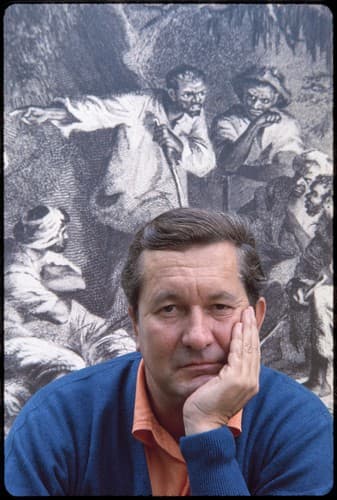
William Clark Styron Jr. was an American novelist and essayist who won major literary awards for his work.







