“When you have eliminated the impossible, whatever remains, however improbable, must be the truth.”
— Sherlock Holmes explains his deductive reasoning method to Dr. Watson.

Arthur Conan Doyle (1927)
Genre
Thriller / Historical Fiction / Mystery
Reading Time
2400 min
Key Themes
See below
Sign in to track this book
Don your deerstalker and prepare for Victorian London's most perplexing crimes, where Sherlock Holmes and Dr. Watson unravel mysteries from the scarlet-stained streets to the moors of Baskerville.
Dr. John Watson, recently returned from the Second Afghan War and seeking lodgings in London, meets the consulting detective, Sherlock Holmes. They agree to share rooms at 221B Baker Street. Soon after, Holmes is called to a murder scene at an empty house on Brixton Road. The victim, Enoch Drebber, is found dead with no apparent wounds, but with a word, 'RACHE' (German for 'revenge'), scrawled in blood on the wall above him. A woman's wedding ring is found nearby. Inspectors Lestrade and Gregson from Scotland Yard are baffled, but Holmes immediately observes details, such as the victim's pallor, the footprints outside, and the lack of struggle, which suggest a complex crime.
Through deductions, Holmes identifies the killer as Jefferson Hope, a cab driver. Hope confesses his motive, revealing a backstory rooted in the American West. Years prior, in the Mormon community of Utah, he was in love with Lucy Ferrier. Her father, John Ferrier, was forced by the Mormon elders to marry Lucy to either Enoch Drebber or Joseph Stangerson, against their will. Hope attempted to rescue them but was too late; John Ferrier was killed, and Lucy died of a broken heart shortly after being forced into marriage. Hope vowed revenge, tracking Drebber and Stangerson across continents for decades. He lured Drebber to the empty house, forced him to choose between two pills (one poisoned), and later tracked and killed Stangerson, fulfilling his promise of vengeance before dying himself of an aortic aneurysm.
Miss Mary Morstan visits Sherlock Holmes with a case. For six years, she has received a large, lustrous pearl annually, sent anonymously. Now, she has received a letter inviting her to a meeting, promising justice. Her father, Captain Morstan, disappeared ten years prior after returning from India, and she suspects a connection. Holmes, accompanied by Watson, meets Mary and Thaddeus Sholto, son of Major Sholto, her father's old friend. Thaddeus reveals that his twin brother, Bartholomew, has discovered a treasure, and that their father, Major Sholto, died years ago after confessing to a past crime involving Captain Morstan and the 'Agra Treasure'. Before they can discuss further, Bartholomew is found dead in his locked room, an apparent murder.
Holmes quickly deduces that Bartholomew Sholto was killed by a poisoned dart and that the treasure has been stolen. He identifies the culprits as Jonathan Small, an escaped convict with a wooden leg, and his accomplice, an Andaman Islander named Tonga. Small and Tonga are tracked by their distinctive footprints and Tonga's poisonous darts. A boat chase ensues on the River Thames, ending in Tonga's death and Small's capture. Small reveals the full story: he, with three Sikh confederates, acquired the Agra Treasure in India during the Sepoy Mutiny. Major Sholto and Captain Morstan betrayed him, stealing the treasure. Small escaped prison and, upon hearing of the treasure's rediscovery, sought to reclaim it with Tonga's help. The treasure, however, is lost when Small throws it into the Thames during the chase.
Dr. James Mortimer visits Sherlock Holmes, recounting the legend of a monstrous, spectral hound that has haunted the Baskerville family of Dartmoor for centuries. The latest victim is Sir Charles Baskerville, found dead on the moor with a look of terror on his face and giant hound footprints nearby. Sir Henry Baskerville, the last heir, arrives from Canada to claim his inheritance, and Mortimer fears for his life. Holmes, busy with another case, sends Dr. Watson to Baskerville Hall to protect Sir Henry and report back. Watson finds the moor a desolate and dangerous place, encountering suspicious characters like the reclusive Stapletons and the naturalist, Mr. Frankland, all while hearing the mournful howl of a hound at night.
Watson, while observing the moor, discovers a stranger living in a stone hut and learns about an escaped convict, Selden, hiding on the moor. He also grows suspicious of Jack Stapleton, a seemingly friendly naturalist, and his sister, Beryl. Holmes eventually arrives, having secretly been on the moor, and reveals that the stranger in the hut was himself. He deduces that Stapleton is actually Rodger Baskerville, Sir Charles's nephew, who faked his own death in South America. Stapleton, driven by greed, bred a phosphorescent hound to terrorize and kill his relatives, thereby inheriting the estate. He had been using Selden's clothes to lure the hound, and tragically, Selden was killed by the hound by mistake. Holmes and Watson ambush Stapleton, who flees into the mire of Grimpen Mire and is presumably swallowed by it, his reign of terror ended.
Sherlock Holmes informs Dr. Watson that he has cornered Professor James Moriarty, a criminal whose intellect matches his own, and who controls a criminal network. Holmes has spent months dismantling Moriarty's organization, but Moriarty is determined to eliminate him. After several attempts on Holmes's life, they flee to mainland Europe. Moriarty tracks them to the Reichenbach Falls in Switzerland. In a confrontation, Holmes and Moriarty struggle. Watson, having been lured away by a fake message, returns to find only a note from Holmes, stating that he intends to tackle Moriarty over the falls to ensure the criminal's demise, even if it means his own. Both are presumed dead, leaving Watson in grief.
Three years after his presumed death at Reichenbach, Dr. Watson encounters an old bookseller who later reveals himself to be Sherlock Holmes. Holmes explains that he survived the fall by using a Japanese martial art, baritsu, to throw Moriarty over the edge, while he himself clung to a ledge. He then feigned his death to evade Moriarty's remaining henchmen, particularly Colonel Sebastian Moran, Moriarty's chief of staff. Holmes reveals that Moran attempted to kill him with an air rifle shortly after the fall. Holmes and Watson then set a trap for Moran, who attempts to shoot Holmes again through a window at 221B Baker Street, but is captured. Holmes's return marks a new era of crime-solving.
The King of Bohemia visits Holmes, in disguise, to retrieve a photograph from Irene Adler, an American opera singer with whom he once had an affair. The photograph, showing them together, could jeopardize his upcoming marriage to a Scandinavian princess. Holmes uses disguises and schemes, including faking a street brawl and setting off a smoke rocket to find where Adler keeps her possession. He finds the hiding place but is outsmarted by Adler, who, having deduced his identity and purpose, leaves a letter for Holmes explaining she has fled with the photograph and married another man, promising never to use it against the King. Holmes is impressed by her wit, considering her 'the woman'.
Helen Stoner visits Holmes, terrified for her life after her sister, Julia, died two years prior under mysterious circumstances, uttering 'the speckled band' before her death. Helen is now engaged, and her stepfather, Dr. Grimesby Roylott, a violent man with exotic pets, insists she move into Julia's old room. Holmes and Watson visit Stoke Moran, Roylott's decaying estate. Holmes examines the room, finding a dummy bell-rope, a ventilator connecting to Roylott's room, and a small saucer of milk. He deduces that Roylott has trained a venomous swamp adder, the 'speckled band,' to crawl through the ventilator, down the dummy rope, and bite his stepdaughters in their sleep, thereby securing their inheritance. Holmes and Watson lie in wait, and when Roylott unleashes the snake, Holmes strikes it, driving it back through the ventilator, where it fatally bites Roylott instead.
Jabez Wilson, a pawnbroker with red hair, consults Holmes about a bizarre situation. He was hired by the 'Red-Headed League' for a lucrative but meaningless job of copying the encyclopedia, solely because of his hair color. The League suddenly dissolved, and Wilson suspects foul play. Holmes, intrigued, investigates Wilson's assistant, Vincent Spaulding (who is actually John Clay, a criminal), and the area around the pawnbroker's shop. He discovers that Wilson's shop is next to a bank. Holmes deduces that the 'Red-Headed League' was a ruse to keep Wilson out of his shop for several hours a day, allowing Clay and his accomplice to dig a tunnel from the pawnbroker's cellar into the bank vault. Holmes, Lestrade, and Watson intercept the criminals as they attempt to break into the bank, catching them.
Holmes receives a coded message from a Moriarty agent, warning of a crime. He is called to Birlstone Manor where John Douglas has been murdered, his face disfigured by a shotgun blast. The only clue is a missing wedding ring and a card left by an American secret society, 'the Scowrers.' Holmes deduces that the murder is staged, and that the 'victim' is actually a different man, killed by Douglas, who then faked his own death to escape his past. The truth is revealed: Douglas, formerly Birdy Edwards, an American detective, infiltrated the 'Scowrers' in the Vermissa Valley, bringing them to justice. One of the Scowrers, Ted Baldwin, tracked Douglas to England, leading to the confrontation that resulted in Baldwin's death and Douglas's escape plan. However, Douglas later truly disappears, likely a victim of Moriarty's revenge.
It is 1914, on the eve of World War I. An aged Sherlock Holmes has been in retirement for several years, living as a bee-keeper on the Sussex Downs. He is called upon by the British government for one final mission. He has spent the last two years undercover, posing as a pro-German Irish-American agent named Altamont, infiltrating a German spy ring led by Von Bork. Von Bork, believing Altamont to be a valuable asset, plans to leave England with British naval codes. Holmes, still in his Altamont disguise, meets Von Bork, ostensibly to hand over the plans. However, it is a trap. Holmes, with the help of Watson who arrives on cue, subdues Von Bork and his associate, securing the secret plans and ensuring their delivery to the British authorities. This act of patriotism marks Holmes's final documented case, a quiet but significant contribution to the war effort.
The Protagonist
From a brilliant but often reclusive detective, he evolves to a more active participant in the world, even feigning his death to pursue justice and ultimately returning for a final act of patriotism.
The Supporting
Initially a somewhat aimless veteran, he finds purpose and excitement in assisting Holmes, becoming a crucial part of the detective's life and legacy.
The Antagonist
Remains consistently a formidable, shadowy criminal mastermind, escalating his conflict with Holmes to a deadly, mutually destructive climax.
The Supporting
Serves as a static, yet profoundly impactful, character who demonstrates that Holmes is not infallible, leaving an indelible mark on his psyche.
The Supporting
Remains a dedicated but limited police officer, consistently serving as a foil to Holmes's genius, though his respect for Holmes gradually grows.
The Supporting
A static character who consistently demonstrates superior intellect but a lack of practical application, serving as a benchmark for Holmes's own abilities.
The Supporting
Transforms from a client in distress to a beloved wife, bringing a sense of domesticity and stability to Watson's life.
The Antagonist
Driven by a lifelong quest for his stolen treasure and revenge, he remains a determined and dangerous figure until his ultimate capture.
The Antagonist
His true identity and villainous plot are gradually revealed, culminating in his desperate flight and death in the mire.
This theme is central to Holmes's character and his approach to detection. Holmes champions logic and scientific method, often viewing emotions as impediments to clear thinking. In 'A Study in Scarlet,' he reconstructs the crime through observation, dismissing the emotional pleas of the police. His detached analysis of cases, even when gruesome, shows his belief in the supremacy of reason. Dr. Watson, in contrast, often provides the emotional counterpoint, reacting with horror or sympathy, grounding Holmes's intellectualism in human experience. The cases themselves often arise from human emotions like love, greed, and revenge. Irene Adler, in 'A Scandal in Bohemia,' is unique in that she outwits Holmes not through greater logic, but by anticipating his methods through her understanding of human nature and a clever emotional gambit, which leaves Holmes impressed.
“Data! Data! Data! I can't make bricks without clay.”
The series explores various facets of justice, from legal enforcement to personal vengeance. Holmes often operates outside the conventional legal system, sometimes letting a perpetrator go if he believes their actions were morally justified, as seen in 'The Adventure of the Blue Carbuncle.' Conversely, he relentlessly pursues those who commit crimes out of malice or greed, such as Professor Moriarty or Jack Stapleton. The backstory of Jefferson Hope in 'A Study in Scarlet' raises questions about justice when legal avenues fail, portraying him as a sympathetic avenger. The books often highlight the limitations of the law and the complexities of moral judgments, with Holmes often acting as a higher arbiter of what is right, even if it goes against formal legal procedures. His goal is often restoration of order and protection of the innocent.
“Crime is common. Logic is rare. Therefore it is upon the logic rather than upon the crime that you should dwell.”
Many Holmes cases are driven by secrets from the past that resurface with consequences. 'A Study in Scarlet' is based on a decades-old vendetta from the American West. 'The Sign of Four' unravels a colonial betrayal and stolen treasure from India. 'The Hound of the Baskervilles' is rooted in a family history of greed and a hidden identity. These narratives show how unresolved issues, forgotten crimes, and concealed identities can fester and erupt into the present. Holmes's role is often to unearth these truths, revealing the connections between past actions and present mysteries. The theme shows that secrets, no matter how deeply buried, eventually come to light.
“The past is a foreign country; they do things differently there.”
This is the foundational theme of the entire Sherlock Holmes canon. Holmes's ability to observe details and draw logical inferences from them is consistently shown as his primary tool. He demonstrates that clues, such as the type of cigar ash, footprints, or the wear on a man's trousers, can reveal entire narratives. In 'A Scandal in Bohemia,' his observation of Irene Adler's house and his staged incident allows him to deduce the location of the photograph. His method involves a systematic collection of 'data' followed by logical analysis, often to the astonishment of Watson and the police. This theme elevates detection from police work to a scientific art form, emphasizing the potential of the human mind when trained and applied with discipline.
“You see, but you do not observe. The distinction is clear.”
The stories frequently include elements and characters from outside Victorian England, often portraying them with a sense of exoticism or otherness that adds to the mystery or danger. In 'The Sign of Four,' the Andaman Islander Tonga and the Agra Treasure from India introduce elements of the unfamiliar and the perilous. 'A Study in Scarlet' explores the Mormon community in Utah. 'The Speckled Band' features Dr. Roylott's exotic animals, particularly the poisonous swamp adder, as instruments of murder, highlighting the perceived dangers of the unknown and foreign. These elements not only add intrigue but also reflect the Victorian era's fascination and anxieties about the wider, less understood world, often associating foreignness with mystery or threat.
“What is the meaning of it all, Watson? What object is served by this circle of misery and violence and fear? It must tend to some end, or else our universe is ruled by chance, which is unthinkable.”
Provides a human perspective and structures the cases
Dr. Watson serves as the primary narrator for almost all of the Sherlock Holmes stories. His role is crucial as he provides the reader with an accessible entry point into Holmes's complex world. Watson's perspective is that of an intelligent but relatively ordinary man, allowing Holmes's brilliance to shine by contrast. He often recounts his own astonishment and admiration for Holmes's deductions, thereby mirroring the reader's likely reaction. Furthermore, Watson's detailed, yet sometimes slightly embellished, accounts shape the dramatic structure of each case, building suspense and culminating in Holmes's grand revelations. His presence also humanizes Holmes, providing the detective with a loyal friend and confidant, and giving him someone to explain his methods to.
A seemingly impossible crime committed in an enclosed space
The locked-room mystery is a recurring plot device in the Holmes canon, particularly effective in showcasing Holmes's exceptional deductive abilities. This device presents a crime (usually murder) committed in circumstances that appear impossible, such as a room sealed from the inside, with no apparent entry or exit for the perpetrator. Examples include Bartholomew Sholto's murder in 'The Sign of Four' and Enoch Drebber's death in 'A Study in Scarlet'. Holmes's genius lies in meticulously examining every detail, no matter how small, to uncover the hidden mechanism, secret passage, or ingenious method that allowed the crime to be committed, thereby demystifying the 'impossible' and revealing the human element behind it.
Holmes's tool for gathering information and setting traps
Disguise is a frequent and effective plot device employed by Sherlock Holmes to gather information covertly or to set traps for criminals. Holmes is a master of impersonation, capable of adopting various personas, from a working-class loafer to an old bookseller, complete with convincing mannerisms and accents. In 'A Scandal in Bohemia,' he uses multiple disguises, including a drunken groom and a benevolent clergyman, to observe Irene Adler. In 'The Empty House,' he returns disguised as an old bookseller, and later uses a bust of himself to lure Colonel Moran into a trap. This device highlights Holmes's theatricality, his meticulous attention to detail, and his willingness to go to unconventional lengths to solve a case, often adding an element of surprise and cleverness to the narrative.
Characters' accounts are often incomplete or misleading
Many Holmes stories feature witnesses or clients whose initial accounts are either intentionally misleading, unintentionally incomplete, or simply misinterpretations of events. Holmes often has to sift through layers of biased or flawed testimony to get to the truth. Characters might withhold information due to shame, fear, or a desire to protect someone, as seen in 'The Adventure of the Speckled Band' where Helen Stoner is initially hesitant to fully implicate her stepfather. This device creates narrative complexity and allows Holmes to demonstrate his ability to read between the lines, spot inconsistencies, and extract the true facts from conflicting accounts, emphasizing that appearances can be deceiving and human perception is often flawed.
Misleading clues designed to distract the reader and characters
Red herrings are frequently used in the Sherlock Holmes stories to mislead both the characters and the reader, making the solution less obvious and the mystery more engaging. These are clues or plot elements that seem significant but ultimately lead nowhere or point to the wrong conclusion. For instance, the legend of the spectral hound in 'The Hound of the Baskervilles' serves as a massive red herring, distracting from the very human, scientific plot to use a real dog. The 'Red-Headed League' itself is a elaborate red herring to keep Jabez Wilson occupied. These diversions highlight Holmes's ability to see through the superficial and focus on the true, often more mundane, facts, thereby enhancing the surprise of the actual solution.
“When you have eliminated the impossible, whatever remains, however improbable, must be the truth.”
— Sherlock Holmes explains his deductive reasoning method to Dr. Watson.
“The world is full of obvious things which nobody by any chance ever observes.”
— Holmes remarks on human inattentiveness during an investigation.
“My name is Sherlock Holmes. It is my business to know what other people don't know.”
— Holmes introduces himself with characteristic confidence.
“You see, but you do not observe. The distinction is clear.”
— Holmes criticizes Watson's lack of detailed observation.
“I never guess. It is a shocking habit—destructive to the logical faculty.”
— Holmes dismisses guessing as antithetical to his method.
“The game is afoot!”
— Holmes enthusiastically announces the start of a new case.
“There is nothing more deceptive than an obvious fact.”
— Holmes warns against taking surface appearances for granted.
“Mediocrity knows nothing higher than itself, but talent instantly recognizes genius.”
— Holmes reflects on the nature of recognition and ability.
“I am a brain, Watson. The rest of me is a mere appendix.”
— Holmes describes his intellectual focus over physical concerns.
“It is a capital mistake to theorize before one has data.”
— Holmes advises against premature conclusions in detective work.
“The lowest and vilest alleys in London do not present a more dreadful record of sin than does the smiling and beautiful countryside.”
— Holmes comments on hidden evil in seemingly peaceful settings.
“Education never ends, Watson. It is a series of lessons, with the greatest for the last.”
— Holmes speaks on lifelong learning and experience.
“I have a curious constitution. I never remember feeling tired by work, though idleness exhausts me completely.”
— Holmes describes his need for mental stimulation.
“What one man can invent another can discover.”
— Holmes expresses confidence in solving cleverly devised crimes.
Ready to see how well you understood this book? Take our interactive quiz with 10 questions.
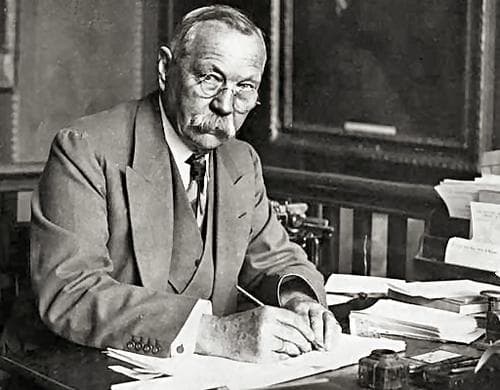
Sir Arthur Ignatius Conan Doyle was a British writer and physician. He created the character Sherlock Holmes in 1887 for A Study in Scarlet, the first of four novels and fifty-six short stories about Holmes and Dr. Watson. The Sherlock Holmes stories are milestones in the field of crime fiction.







