“Little Red-Cap went into the forest to gather wild strawberries, and when she had picked a great many, she saw a beautiful bouquet of flowers.”
— From 'Little Red-Cap' (Little Red Riding Hood), just before she encounters the wolf.

Jacob Grimm (2016)
Genre
Fantasy / Children's
Reading Time
1200+ min (for all 880 pages)
Key Themes
See below
Sign in to track this book
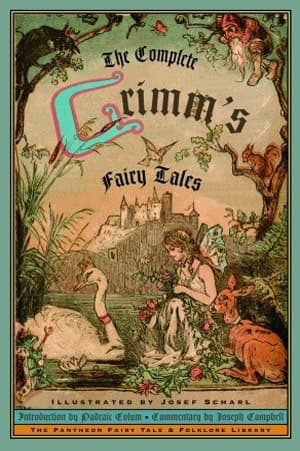
Enter a timeless world of wonder and warning, where enchanted forests, wicked witches, and noble heroes appear in 211 preserved German folk tales, illustrated by Arthur Rackham.
A proud young princess drops her golden ball into a well. A talking frog offers to get it back if she promises to let him eat from her plate, drink from her cup, and sleep in her bed. The princess agrees, but immediately tries to leave the frog once her ball is back. The frog, however, follows her to the castle, and her father, the King, insists she keep her promise. Annoyed, the princess throws the frog against a wall, breaking his magic. He turns into a handsome prince, and they fall in love and marry. Their loyal servant, Iron Henry, had three iron bands around his heart to keep it from breaking from sadness over his master's enchantment; these bands burst with joy on the way to the prince's kingdom.
A pregnant woman wants rapunzel lettuce from a sorceress's garden. Her husband steals it, but the witch, Dame Gothel, catches him. She demands their first child for the lettuce. When the child, Rapunzel, is born, Dame Gothel takes her and locks her in a tower with no doors or stairs, reachable only by Rapunzel's long, golden hair, which Dame Gothel uses to climb. Years later, a prince hears Rapunzel singing and sees how Dame Gothel gets in. He copies her, climbs the hair, and falls in love with Rapunzel. When Dame Gothel finds out, she sends Rapunzel to a lonely wilderness and blinds the prince. After wandering blindly for years, the prince finds Rapunzel and their twin children. Her tears give him back his sight, and they return to his kingdom to live happily.
Hansel and Gretel, two children of a poor woodcutter, are led into the forest and left there by their stepmother and father because of hunger. Hansel leaves a trail of pebbles, letting them find their way home. But the second time, birds eat his breadcrumb trail. Lost, they find a house made of gingerbread and sweets. An old woman invites them in, offering food and beds. She is a wicked witch who plans to fatten Hansel to eat him and make Gretel a servant. The witch, who has bad eyesight, often checks Hansel's finger to see if he's fat enough, but Hansel cleverly offers a bone instead. When the witch decides to eat Hansel anyway, Gretel outsmarts her, pushing her into the hot oven and ending her. The children escape with the witch's treasures and go home, where their stepmother has died, and their father welcomes them back, now no longer poor.
A poor fisherman catches a magical talking flounder, who says he is an enchanted prince. The fisherman, feeling sorry, lets him go without a wish. His wife, Ilsebill, is angry and demands he go back to the sea to wish for a nicer cottage. The fisherman unwillingly obeys, and the flounder grants the wish. Ilsebill's desires grow fast, demanding a stone castle, then to be king, emperor, and finally, the Pope. Each time, the sea gets stormier, showing the growing imbalance. When Ilsebill demands to be like God, controlling the sun and moon, the flounder, seeing her endless greed, returns everything to how it was, sending the couple back to their humble, dirty shack, teaching them a hard lesson about being happy with what they have and the dangers of too much ambition.
Cinderella is badly treated by her stepmother and two stepsisters after her father remarries. Her only comfort comes from a hazel tree she planted on her mother's grave, where white birds grant her wishes. When the King announces a three-day ball for his son to choose a bride, Cinderella is not allowed to go. With the help of the birds, who give her beautiful gowns, she attends all three nights, dancing with the prince who falls deeply in love with her. On the third night, she runs away, leaving a golden slipper. The prince uses the slipper to find his true love. The stepsisters try to fit into the slipper by cutting off parts of their feet, but the birds show their lie. Cinderella is revealed as the true bride, marries the prince, and her wicked stepsisters are punished by having their eyes pecked out by doves.
A young girl, known as Little Red-Cap because of her red cloak, is sent by her mother to deliver wine and cake to her sick grandmother. Her mother warns her to stay on the path. On her way, she meets a wolf, who tricks her into leaving the path to pick flowers. While she gathers flowers, the wolf goes to her grandmother's house, eats the grandmother, and then dresses in her nightcap and gets into her bed. When Little Red-Cap arrives, she notices how strange her 'grandmother' looks and sounds, ending with the famous 'What big teeth you have!' exchange. The wolf then eats Little Red-Cap. A passing huntsman, hearing the wolf's snoring, enters the house, kills the wolf, and cuts open its belly to save both Little Red-Cap and her grandmother, filling the wolf's belly with stones before throwing it into a well.
Queen Snow White's stepmother, a proud and wicked sorceress, has a magic mirror that says she is the fairest in the land. When Snow White gets older, her beauty is greater than the Queen's, and the mirror says Snow White is the fairest. Angry, the Queen orders a huntsman to kill Snow White and bring back her lungs and liver as proof. The huntsman, unable to hurt the innocent girl, lets her go and brings back a boar's organs instead. Snow White runs into the forest and finds safety with seven dwarfs, who let her stay if she keeps house for them. The Queen, learning Snow White is still alive from her mirror, tries to kill her three times: with a poisoned stay-lace, a poisoned comb, and then, a poisoned apple. The dwarfs save her from the first two attempts, but the apple puts her into a death-like sleep. A prince finds her, falls in love, and as his servants carry her coffin, a bump dislodges the apple piece from her throat. She wakes up, marries the prince, and the wicked Queen is forced to dance in red-hot iron shoes until she dies.
A boastful miller lies to the King, saying his daughter can spin straw into gold. The King, interested, locks the daughter in a room full of straw, threatening death if she fails. A tiny, strange man appears and offers to spin the straw for her in exchange for her necklace. This happens twice, with the imp taking her ring and then promising her first child. She agrees, as she sees no other choice. After marrying the King and having her first child, the imp returns to claim his prize. The Queen begs, and the imp gives her three days to guess his name. She sends out messengers, and one hears the imp singing his name, 'Rumpelstiltskin,' in the forest. When the Queen says his name, the imp is so angry he stamps his foot into the ground, pulling himself in half, and disappears forever.
A donkey, a dog, a cat, and a rooster, all old and about to be gotten rid of or killed by their masters, decide to run away and become musicians in Bremen. On their trip, they find a light in the forest and discover a house with robbers. The animals form a pyramid, with the donkey at the bottom and the rooster on top, and burst through the window, making a loud noise. The robbers, thinking they've met a ghost or monster, run away in fear. The animals settle into the house, enjoying the robbers' feast. When one robber returns to check, he is scared again by the animals in the dark and reports back to his gang that the house has a witch, a man with a knife, a giant, and a judge. The robbers leave the house, and the Bremen Town Musicians live there happily ever after.
A kind woman wishes for a child as red as blood and as white as snow. She has a son, but dies soon after. Her husband remarries a wicked woman who has a daughter. The stepmother dislikes her stepson, especially his inheritance. One day, she tricks him into reaching for an apple in a chest, then kills him by slamming the lid shut. To hide her crime, she cuts up his body, cooks him in a stew, and serves him to his unaware father. The stepdaughter, Marlene, gathers her brother's bones and buries them under the juniper tree, where his mother is buried. A beautiful bird comes from the tree, sings a sad song telling of the murder, and collects a golden chain, red shoes, and a millstone. The bird gives the chain to Marlene, the shoes to the father, and drops the millstone on the stepmother, killing her. The boy is then brought back to life, and the family is reunited.
A poor shoemaker has only enough leather for one pair of shoes. He cuts out the leather for the next day, planning to finish them in the morning. To his surprise, he wakes to find a perfectly made pair of shoes on his workbench. A customer immediately buys them, giving him enough money for two more pairs of leather. The next morning, two more finished pairs await him. This continues, and the shoemaker and his wife become rich. Curious about their helpers, they hide one night and discover two tiny, naked elves carefully working on the shoes. To show their thanks, the wife sews tiny clothes for the elves, and the shoemaker makes tiny shoes. The elves are happy, put on their new clothes, and dance away, never to return. The shoemaker and his wife continue to do well, blessed by their good luck.
A kind and hard-working girl, living with her stepmother and lazy stepsister, accidentally drops her spindle into a well. Her stepmother forces her to get it. The girl jumps into the well and finds herself in a magical meadow. She helps a talking oven with bread, an apple tree with ripe apples, and eventually reaches the house of Frau Holle, an old woman who makes it snow on Earth by shaking her feather bed. The girl works hard for Frau Holle, shaking the bed until the feathers fly. When it's time to leave, Frau Holle rewards her with a shower of gold, which sticks to her as she returns through the well. Impressed by the gold, the stepmother sends her own lazy daughter down the well. The lazy girl refuses to help the oven or the apple tree and does poor work for Frau Holle. As punishment, she is showered with pitch, which sticks to her for the rest of her life.
The Protagonist
Transforms from a vain and promise-breaking girl into a responsible and loving princess.
The Antagonist
Remains a static villain, her cruelty only escalating when challenged.
The Protagonist
Remains brave and cunning, successfully navigating extreme peril.
The Protagonist
Develops from a more reliant younger sister into a decisive and heroic figure.
The Antagonist
Remains static in her greed, leading to her downfall and a return to her original state.
The Protagonist
Rises from a life of servitude and abuse to become a beloved princess.
The Antagonist
Remains a static, predatory figure who is ultimately defeated.
The Protagonist
Endures persecution and a death-like sleep, only to be resurrected and find true love and her rightful place.
The Antagonist
Remains a static, powerful, and prideful figure whose own hubris leads to his demise.
The Supporting/Supernatural
A static figure who embodies judgment and consequence.
Many Grimm's fairy tales show a clear moral order where good is rewarded and evil is punished, often with harsh and symbolic revenge. This theme appears in many ways, from the wicked stepmother in 'Snow White' being forced to dance in red-hot iron shoes, to the stepsisters in 'Cinderella' having their eyes pecked out by doves. The imp Rumpelstiltskin tears himself in half, and the witch in 'Hansel and Gretel' is burned in her own oven. This often brutal justice reinforces moral lessons and the idea that wrongdoings will always meet with fitting consequences, often in a karmic and dramatic way.
“But the wicked stepmother had to put on red-hot iron shoes and dance until she dropped dead.”
A repeated theme is that kindness, humility, and hard work are eventually rewarded. Characters like Cinderella, the hard-working girl in 'Frau Holle', and the shoemaker in 'The Elves and the Shoemaker' all receive blessings and good luck because of their good nature and persistence. Despite facing trouble, these characters keep their good hearts, which often brings helpful magic or leads to their eventual wealth. This theme suggests that inner goodness is a strong force that can overcome outside difficulties and bring a positive future.
“And because she had been so good and diligent, the gold clung to her, and she was covered with it from head to foot.”
On the other hand, the tales often warn against the destructive nature of greed, vanity, and uncontrolled ambition. Ilsebill in 'The Fisherman and His Wife' loses everything because of her endless desires. The Evil Queen in 'Snow White' is consumed by her pride, leading to her downfall. The miller's daughter in 'Rumpelstiltskin' is first caught in a problem because of her father's boastful greed. These stories show how these vices ruin people, lead to their isolation, and ultimately cause their downfall. They serve as warnings against too much self-interest and superficiality.
“When she wished to be like God, the flounder made everything return to its original state.”
Change, both real and symbolic, is a central part. This includes physical changes, such as the frog turning into a prince, or the murdered boy in 'The Juniper Tree' becoming a bird. Spells and curses drive many plots, often needing to be broken through specific actions, promises, or acts of love. These changes symbolize inner shifts, the breaking of spells, or the journey from one state of being to another, often leading to a solution or a new start for the characters. They highlight the magical and often unpredictable nature of the world in these tales.
“As soon as he touched the wall, he changed into a handsome prince.”
Keeping or breaking promises often serves as a key plot point and a moral lesson. In 'The Frog Prince', the princess is made by her father to keep her word, leading to the prince's change. The miller's daughter in 'Rumpelstiltskin' makes a desperate promise to an imp, which later has serious results. These stories stress the moral weight of commitments, suggesting that one's word is binding and that breaking a promise can have bad outcomes, while honoring it can lead to unexpected rewards or solutions. It emphasizes honesty and the moral agreement between people.
“What you have promised, you must keep.”
Enchanted items or benevolent beings that assist protagonists.
Many tales feature magical objects or creatures that intervene on behalf of the protagonists. Examples include Cinderella's birds and the hazel tree, the talking flounder in 'The Fisherman and His Wife', Frau Holle's magical realm, and the elves in 'The Elves and the Shoemaker'. These elements often appear when the protagonist is at their most desperate, providing the means for them to overcome insurmountable obstacles or achieve their desires, emphasizing the presence of supernatural forces that influence human destiny and reward virtue.
The use of repeated actions or events, often three times, to build tension or reinforce themes.
The 'Rule of Three' is prevalent throughout the Grimm's tales. For instance, the prince visits Rapunzel three times, Snow White's stepmother attempts to kill her three times, and the miller's daughter makes three bargains with Rumpelstiltskin. This literary device creates a sense of rhythm and predictability, building anticipation for the final, often decisive, event. It also reinforces moral lessons and emphasizes the significance of certain actions or choices within the narrative structure.
The forest as a symbolic setting for trials, peril, and self-discovery.
The forest is a recurring and highly symbolic setting. It often represents a liminal space, a wild and untamed realm outside the safety of civilization where characters face their greatest challenges. Hansel and Gretel are abandoned in the forest, Snow White finds refuge (and danger) within it, and the prince wanders blindly through it in 'Rapunzel'. It is a place of both grave danger (witches, wolves) and potential transformation, where characters are tested, encounter magical beings, and often emerge changed or enlightened.
Antagonistic parental figures, often stepmothers, who pose a threat to the protagonist.
A prominent device is the wicked stepmother, who actively persecutes the innocent protagonist, as seen in 'Cinderella', 'Snow White', 'Hansel and Gretel', and 'The Juniper Tree'. These figures are typically driven by jealousy, vanity, or resentment, creating a clear antagonist within the domestic sphere. This device highlights themes of familial conflict, the vulnerability of children, and the struggle against malevolent forces often cloaked in authority. Sometimes, even biological parents, like the woodcutter in 'Hansel and Gretel', are complicit due to weakness or desperation.
“Little Red-Cap went into the forest to gather wild strawberries, and when she had picked a great many, she saw a beautiful bouquet of flowers.”
— From 'Little Red-Cap' (Little Red Riding Hood), just before she encounters the wolf.
“Mirror, mirror, on the wall, who is fairest of us all?”
— The vain Queen in 'Snow White' repeatedly asks her magic mirror.
“She pricked her finger on the spindle and fell down on the bed into a deep sleep.”
— From 'Little Briar-Rose' (Sleeping Beauty), describing the curse's fulfillment.
“And they lived happily ever after.”
— A common concluding phrase in many tales, signifying resolution and joy.
“He who is afraid of a little mouse will never catch a lion.”
— A moralistic saying from 'The Bremen Town Musicians', regarding courage.
“The wolf devoured her in one gulp.”
— From 'Little Red-Cap', when the wolf tricks and eats the grandmother.
“She took off her golden slipper, and threw it to him.”
— From 'Cinderella', when she drops her slipper for the prince.
“Then they all three sat down to their meal, and were well content.”
— From 'The Straw, The Coal, and The Bean', after their perilous journey.
“Crunch, crunch, who is nibbling at my house?”
— The witch in 'Hansel and Gretel' upon hearing them eat her gingerbread house.
“The king said, 'If you do not spin this straw into gold by tomorrow morning, you must die.'”
— From 'Rumpelstiltskin', the impossible task set for the miller's daughter.
“She was so beautiful that the sun itself, which has seen so much, was astonished whenever it shone on her face.”
— Describing Snow White's exceptional beauty at the beginning of her tale.
“But the children were hungry, and had nothing to eat, and so they said, 'We will go out into the wide world.'”
— From 'Hansel and Gretel', illustrating their dire poverty before being abandoned.
“For every hundred years, a prince will come and awaken her.”
— From 'Little Briar-Rose', the good fairy's softening of the curse.
“And when the morning dawned, the cock crowed, and the moon shone brightly.”
— From 'The Bremen Town Musicians', an atmospheric detail after the animals scare away the robbers.
Ready to see how well you understood this book? Take our interactive quiz with 10 questions.

Biography coming soon.







