“I think it pisses God off if you walk by the color purple in a field somewhere and don't notice it.”
— Shug Avery explains her spiritual philosophy to Celie.


Alice Walker (1985)
Genre
Historical Fiction
Reading Time
8-10 hours
Key Themes
See below
Sign in to track this book
Set in the early 20th century American South, this novel tells the story of Celie, a young black woman who finds her voice and strength through sisterhood and self-discovery amid a life of abuse and hardship.
The story begins in rural Georgia in the early 1900s, told through letters written by a fourteen-year-old Celie to God. Celie's stepfather, Alfonso, repeatedly rapes her, and she believes he is her biological father. She has two children, Olivia and Adam, who Alfonso immediately takes away, claiming he killed them. Celie is uneducated, isolated, and believes herself to be ugly and unloved. Her younger sister, Nettie, is bright, beautiful, and the only source of comfort and protection for Celie. Alfonso also tries to molest Nettie, leading Celie to intervene and protect her sister, strengthening their deep bond.
When a local farmer, Mister (Albert Johnson), asks Alfonso to marry Nettie, Alfonso offers Celie instead. He claims she is ugly, infertile, and a poor housekeeper. Celie, desperate to protect Nettie from Alfonso's abuse, agrees to marry Albert, seeing it as a way for Nettie to escape. Albert is a cruel and neglectful husband. He brings his children, Harpo, Henrietta, and Buster, into the household, and Celie is expected to care for them all. Nettie soon comes to live with them, but Albert tries to force himself on her. Nettie resists and leaves, promising to write. Albert, out of jealousy and spite, hides all of Nettie's letters from Celie. This makes Celie believe her sister has forgotten her or died.
Albert brings his long-time lover, Shug Avery, to live in their home when she falls ill. Shug is a glamorous, independent, blues singer, disliked by the community for her lifestyle but admired by Celie. Initially, Shug treats Celie with disdain. But as Celie nurses her back to health, they form a deep bond. Shug's confidence, sensuality, and defiance inspire Celie. This makes Celie question her own submissiveness and the nature of God. Shug encourages Celie to find her voice and helps her see her own worth. This is a turning point in Celie's self-perception.
While cleaning Albert's room, Shug discovers a hidden stash of letters addressed to Celie, concealed for years. These are the letters from Nettie. After leaving Albert's house, Nettie was taken in by missionaries, Samuel and Corrine, the same couple who adopted Celie's children, Olivia and Adam. Nettie has been living with them in Africa, working as a missionary and teacher, and has written to Celie all this time. The letters reveal that Samuel and Corrine are her children's adoptive parents and that Nettie has been helping raise them. This gives Celie hope that her children are alive and well.
The discovery of Nettie's letters starts a transformation in Celie. She confronts Albert, publicly cursing him and declaring her independence. With Shug's encouragement and financial support, Celie decides to leave Albert, taking Shug and her new lover, Grady, with her. This act of defiance is huge, as Celie has never before challenged authority or made a decision for herself. She moves to Memphis with Shug, where she develops her talent for sewing. She designs and makes pants, which she eventually turns into a successful business.
In Memphis, Celie thrives. She starts 'Celie's Pants,' a business creating unique and comfortable trousers for both men and women. Her business is successful, giving her financial independence and purpose. She continues to write letters, now to Nettie, sharing her experiences and newfound freedom. Her relationship with Shug changes, and while Shug eventually leaves to pursue other relationships, their bond remains strong. Celie's confidence grows, and she finds joy in her work and her friendships, building a community of supportive women around her.
Meanwhile, Albert's life falls apart after Celie leaves. He becomes depressed and neglected, thinking about his past cruelty. Over time, he begins to change, showing remorse for his actions and trying to make amends. He starts to garden, play music, and even develops a friendship with Celie, recognizing her strength and resilience. Celie, having found peace and success, is able to forgive Albert, seeing his genuine change. Their relationship moves from abuse to a quiet, respectful friendship, showing Celie's capacity for compassion and healing.
After many years, Nettie's letters describe her return journey from Africa. Samuel, Corrine, Olivia, and Adam are making their way back to America. Celie, now a successful businesswoman and a confident woman, waits for them with great anticipation. The reunion is emotional and joyful, as Celie finally meets her grown children and is reunited with her beloved sister. Olivia and Adam are well-educated and raised, and they embrace Celie as their mother. This reunion is the end of Celie's long journey of suffering and hope, bringing her full circle to the family she thought she had lost forever.
The Protagonist
From a voiceless victim of abuse, Celie transforms into a self-assured, independent woman who reclaims her family and finds her voice.
The Supporting
Nettie maintains her spirit and intellect despite separation, eventually returning to reunite her family.
The Supporting
Shug's journey involves self-love and finding a deeper connection with God beyond traditional church, while also empowering Celie.
The Antagonist/Supporting
From a brutal and oppressive husband, Albert transforms into a remorseful, gentle man seeking redemption.
The Supporting
Harpo learns to respect women's strength and independence, moving beyond his father's patriarchal influence.
The Supporting
Sofia endures severe trauma but maintains her inner strength and defiant spirit.
The Supporting
Samuel provides a loving home and education for Celie's children and later marries Nettie.
The Supporting
Corrine overcomes her initial suspicions to embrace Nettie, providing a loving home for Celie's children before her passing.
The Supporting
Raised in Africa, Olivia returns to America to reunite with her biological mother, Celie.
The Supporting
Raised in Africa, Adam returns to America with his wife, reuniting with his biological mother, Celie.
The novel explores Celie's journey of self-discovery from a voiceless, abused girl to an independent woman. Initially, Celie's identity is shaped by the abuse she endures and the roles forced upon her. Through her letters, her relationship with Shug Avery, and the discovery of Nettie's letters, she slowly learns to define herself outside of her circumstances. Her creation of 'Celie's Pants' symbolizes her embracing her own creativity and forging an identity based on her talents and desires, rather than external expectations. This theme is central to her transformation and freedom.
“I think us here to enjoy ourselves. God want to see us git up and shout. God don't need no more part time love. God got all the love it can use. What God need is a good time.”
The lasting bond between Celie and Nettie is the emotional core of the novel, giving Celie her only source of hope and love during her darkest times. Beyond this, the relationships Celie forms with other women—Shug Avery, Sofia, and Mary Agnes (Squeak)—are important for her survival and growth. Shug teaches Celie about love, spirituality, and self-worth, while Sofia's fierce independence inspires her. These female alliances offer mutual support, shared understanding, and a collective strength against patriarchal oppression. They show the power of women empowering each other.
“But I don't know how to fight. All I know how to do is stay alive.”
Celie begins by writing letters to a traditional, patriarchal God, reflecting her suffering and a sense of abandonment. Shug Avery challenges Celie's conventional understanding of God, suggesting that God is not an old white man but an omnipresent force of nature, beauty, and joy. This new definition of spirituality allows Celie to find God in everyday experiences, in nature, in love, and in herself, rather than through fear or dogma. This shift is important for her freedom, letting her connect with a more personal and empowering sense of faith.
“God is inside you and inside everybody else. You come into the world with God. But only them that search for it ever find it.”
The novel is set in the early 20th century American South, and the widespread racism of the era is a constant background to the characters' lives. Celie and her community face systemic discrimination and violence from white society. Sofia's brutal beating and imprisonment for defying a white mayor and his wife is a clear example of the racial injustice and brutality faced by African Americans. Nettie's letters from Africa also show the complexities of race and colonialism, showing how African people deal with their own heritage and the impact of European influence. Race shapes opportunities, interactions, and experiences throughout the story.
“They got a lot of colored people in Africa, but they not like us. They more like white people, in a way.”
The widespread theme of abuse—sexual, physical, and emotional—is central to Celie's early life, at the hands of her stepfather and then her husband. The story shows the devastating impact of this violence on individuals and communities. However, equally prominent is the theme of resilience. Celie's ability to survive, to find small joys, and ultimately to transform her life despite deep trauma shows the strength of the human spirit. Sofia's endurance of violence and imprisonment also shows a fierce, though different, form of resilience.
“I'm pore, I'm black, I may be ugly, but I'm here.”
The story is told entirely through letters, primarily from Celie to God and later to Nettie.
The novel's structure as a series of letters is a crucial plot device. It allows the reader intimate access to Celie's inner thoughts, feelings, and experiences, particularly when she is voiceless in her external life. The shift from letters to God to letters to Nettie marks Celie's growth and her developing understanding of connection and communication. Nettie's letters, introduced later, provide an external perspective, expanding the world of the novel and revealing crucial plot details that Albert had hidden, driving Celie's transformation and the eventual family reunion.
Celie's creation and business of making pants symbolizes her independence and self-expression.
Initially, Celie is forced into traditional female roles, wearing dresses and being confined. Her talent for sewing and her eventual business, 'Celie's Pants,' become a powerful symbol of her liberation. Pants, traditionally associated with men, represent freedom, agency, and the ability to move freely in the world. By making pants for both men and women, Celie literally and figuratively 'clothes' herself and others in newfound independence and self-determination. It's her creative outlet, her economic freedom, and a tangible manifestation of her transformed identity.
A recurring motif representing beauty, joy, and the overlooked wonders of God's creation.
The color purple, as discussed by Shug Avery, symbolizes the small, everyday beauties and pleasures in life that people often overlook or take for granted. Shug explains that God wants people to notice and appreciate these things, like 'the color purple,' rather than just focusing on strict religious dogma. It represents joy, sensuality, and the richness of existence. For Celie, discovering the 'color purple' signifies her awakening to the beauty in the world and within herself, moving beyond a life of suffering to one of appreciation and delight.
Harpo's establishment serves as a community hub and a site of both joy and conflict.
Harpo's juke joint is a significant setting where many pivotal events unfold. It's a place of music, dancing, and communal gathering, symbolizing a space for black joy and cultural expression outside the confines of white society. It's where Shug Avery performs, solidifying her status as a local legend. It also becomes a site of conflict and reconciliation, as characters like Sofia, Harpo, and Squeak navigate their relationships there. The juke joint represents a microcosm of the community's social dynamics, evolving as the characters themselves evolve.
“I think it pisses God off if you walk by the color purple in a field somewhere and don't notice it.”
— Shug Avery explains her spiritual philosophy to Celie.
“All my life I had to fight. I had to fight my daddy. I had to fight my brothers. I had to fight my cousins and my uncles. A girl child ain't safe in a family of men.”
— Sofia declares her resilience against patriarchal oppression.
“I'm pore, I'm black, I may be ugly and can't cook, a voice say to everything listening. But I'm here.”
— Celie asserts her existence and worth despite societal devaluation.
“You have to git man off your eyeball, before you can see anything a'tall.”
— Shug advises Celie to overcome internalized male dominance.
“I don't know how to fight. All I know how to do is stay alive.”
— Celie reflects on her passive survival under abuse.
“The more I wonder, the more I love.”
— Celie expresses her growing curiosity and affection for Shug.
“I'm a woman, I'm a woman. I'm a woman.”
— Celie affirms her identity after years of suppression.
“I curse you, I say. What that mean? He say. It mean you going to die.”
— Celie confronts her abusive husband, Albert, with newfound power.
“Everything want to be loved. Us sing and dance, make faces and give flower bouquets, trying to be loved.”
— Shug discusses the universal desire for love and connection.
“I'm black, I may be ugly and can't cook, but I'm here.”
— A variation of Celie's earlier assertion, emphasizing presence.
“You better not never tell nobody but God. It'd kill your mammy.”
— Celie's stepfather warns her to keep his abuse secret.
“I have never felt so loved, so cherished, so beautiful.”
— Celie describes her relationship with Shug.
“The Olinka people do not believe girls should be educated.”
— Nettie writes about the patriarchal customs in Africa.
“I thank you, Miss Celie, for everything you have done for me.”
— Harpo expresses gratitude to Celie for her support.
Ready to see how well you understood this book? Take our interactive quiz with 10 questions.
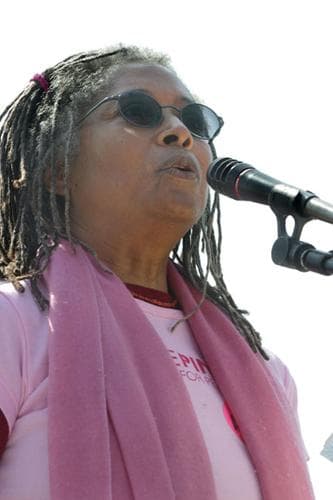
Alice Malsenior Tallulah-Kate Walker is an American novelist, short story writer, poet, and social activist. In 1982, she became the first African-American woman to win the Pulitzer Prize for Fiction, which she was awarded for her novel The Color Purple. Over the span of her career, Walker has published seventeen novels and short story collections, twelve non-fiction works, and collections of essays and poetry.







