“The world was of course only a small part of the great dance of the cosmos, but to the people who lived on it, it was home.”
— Describing the Discworld and its inhabitants' perspective.

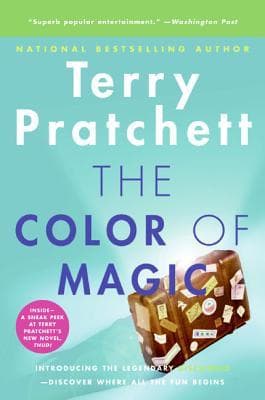
Terry Pratchett (1983)
Genre
Fantasy / Science Fiction
Reading Time
270 min
Key Themes
See below
Sign in to track this book
On a flat world on the back of a giant turtle, a jaded wizard is reluctantly saddled with the Discworld's first tourist and his sentient luggage, going on a chaotic journey to the edge of their belief-powered world.
The story begins in Ankh-Morpork, a sprawling city on the Discworld. Twoflower, a naive tourist from the Agatean Empire, arrives. He carries a sentient, multi-legged Luggage and is fascinated by everything. His presence, especially his seemingly endless gold 'rhinu,' causes a stir. The Patrician, Lord Vetinari, assigns the incompetent wizard Rincewind to be Twoflower's guide, hoping to stop the tourist from accidentally destroying the city's economy or himself. Rincewind, a failed student from Unseen University with only one spell in his head, reluctantly takes the job, mostly for the promise of more rhinu.
Rincewind tries to show Twoflower the seedier side of Ankh-Morpork, leading him to 'The Broken Drum' tavern. Twoflower, not understanding local customs, tries to pay for drinks with a large gold coin. This display of wealth, plus his innocent questions about local 'heroes,' quickly attracts various unsavory characters. A brawl starts, growing fast. In the chaos, Twoflower's Luggage proves strong, defending its owner. However, the fight soon causes a fire that, fueled by the city's wooden buildings, quickly burns much of Ankh-Morpork, forcing Rincewind and Twoflower to flee.
Fleeing the burning city, Rincewind and Twoflower find themselves in the wilderness. They meet Hrun the Barbarian, a strong warrior thinking about his career. Hrun, at first planning to rob them, is curious about Twoflower's Luggage and his 'picture box' (a camera). Before they can properly introduce themselves, the three are captured by dragon riders and taken to Wyrmberg, a mountain stronghold for dragon-riders and their mounts. Here, they discover a unique dragon: creatures that exist only as long as people believe in them, brought to life by the riders' minds.
At Wyrmberg, the Dragonlord, Liessa Dragonlady, reveals her plan to secure her rule. Twoflower, misunderstanding customs, suggests Hrun become a hero by rescuing a 'damsel in distress' from the dragon. This challenge angers Liessa, who demands a duel to the death. Hrun, reluctantly pulled into this by Twoflower's well-meaning suggestions, agrees to fight for his life and to become a Dragonlord. Rincewind, always a coward, tries to stay out of the conflict, but is drawn into the drama and the strange logic of the Wyrmberg inhabitants.
During the chaos of Hrun's duel, Rincewind and Twoflower escape Wyrmberg. They fall through a shimmering portal, landing in a strange, inverted forest. Here, trees grow downwards, and the sky is a vast, reflective surface, making a disorienting and dangerous place. They meet a dryad, who explains they are in a magical anomaly. Their journey through this strange land is full of danger and odd encounters, further testing Rincewind's nerves and Twoflower's optimism. The Luggage, as always, follows them.
Continuing their journey, Rincewind and Twoflower find an old temple for Bel-Shamharoth, a powerful, evil entity from the Dungeon Dimensions. The temple is a place of evil and illusion. Inside, they meet a terrifying eight-legged beast and face Bel-Shamharoth's reality-bending power. Rincewind, in a rare moment of accidental bravery, activates a magical device in the temple that destroys it, letting them escape the old evil, though Rincewind is shaken.
After the temple's destruction, Rincewind and Twoflower are rescued by a sentient tree named Ymper Trymon, who takes them through a series of strange places. Their journey eventually brings them to the very Edge of the Discworld, where the world ends in a waterfall of oceans. Here, they meet philosophers and astronomers studying the Great A'Tuin, the giant turtle that carries the Discworld through space. Twoflower is captivated by the sight, while Rincewind is terrified, sensing danger.
At the Edge, Rincewind finally understands the single spell trapped in his mind for years. It is one of the eight Great Spells of the Octavo, the most powerful magic book in the Discworld. The spell has protected him, refusing to be cast until it joins its brethren. The philosophers at the Edge say the Discworld is on a collision course with a red star, an event that will determine the sex of the Great A'Tuin. Twoflower, still eager for adventure, insists on seeing the 'final show,' to Rincewind's dismay.
As the red star nears and the Discworld shakes, the ground beneath Rincewind and Twoflower breaks. They are thrown over the waterfall at the Edge of the world, falling into the cosmic void. The Luggage, loyal, follows them. This dramatic cliffhanger leaves their fate unknown, setting up their next adventures. Rincewind's last thoughts are of his coming doom, while Twoflower, perhaps, wonders if he can get a good 'picture' of the experience.
The Protagonist
Rincewind begins as a completely self-serving coward and ends much the same, though his unwilling journey exposes him to profound truths about the Discworld and his own magical potential.
The Supporting
Twoflower remains largely unchanged in his optimism and naivety, serving as a catalyst for Rincewind's adventures rather than undergoing significant personal growth.
The Supporting
The Luggage's character is static, serving as a powerful, loyal, and often violent guardian, providing consistent comic relief and plot utility.
The Supporting
Hrun remains a simple-minded barbarian, focused on the immediate rewards of heroism, without significant personal development.
The Supporting
Liessa's arc is focused on her struggle for power within Wyrmberg, which is ultimately resolved in this volume.
The Supporting
Death's character is largely static, serving as an immutable force of the universe and a source of philosophical humor.
The Mentioned
Vetinari's role is foundational, establishing his character as the unseen hand of power in Ankh-Morpork.
This theme is central, comparing Twoflower's romantic view of adventure with the Discworld's often harsh, dangerous, and absurd reality. Twoflower expects valiant heroes and noble quests, as seen when he tries to hire Hrun, or his interest in dragons. Rincewind, however, shows the cynical reality, constantly trying to avoid danger and seeing the terrifying truth behind Twoflower's fantasies. The burning of Ankh-Morpork after Twoflower's arrival shows how his innocent actions have devastating consequences, highlighting the difference between expectation and experience.
“He'd always wanted to see a hero. Now he'd seen one, and it was a bit like seeing a picture of a unicorn and then seeing a real horse. There were definite similarities, of course, but the horse was much bigger, and smelled, and had a nasty habit of biting.”
The novel often explores how belief shapes reality on the Discworld. The main example is the dragons of Wyrmberg, which exist only because people believe in them. Liessa Dragonlady's power is tied to her ability to create and maintain these creatures of thought. Similarly, 'heroism' is often a construct of belief, as Hrun's actions are often guided by what he thinks a hero should do, influenced by Twoflower's expectations. This theme suggests that perception and shared imagination are strong forces, able to change existence itself.
“It was impossible to ride a dragon that didn't exist. Unless you were a dragon-rider, of course. Then it was merely difficult.”
Pratchett often makes fun of traditional fantasy tropes. Rincewind is the opposite of a hero – a coward who succeeds only by accident or others' mistakes. Twoflower's quest for 'adventure' meets real danger and often ends in disaster, not glory. Hrun, though a capable warrior, is often driven by simple desires and easily manipulated. The whole journey is a series of misadventures and near-fatal errors, making fun of epic quests in other fantasy by showing the messy, unglamorous, and often silly reality of such efforts on the Discworld.
“Rincewind had always been happy to think of himself as a wizard, but it was a bit like being a plumber. You did a job, got paid, and went home. But there were always bigger jobs, and sometimes you got to be a hero, and sometimes you just got wet.”
Magic on the Discworld is shown as a chaotic, often unpredictable force, not a systematic, controlled power. Rincewind's single, powerful spell is trapped in his mind, symbolizing magic's untamed nature. Unseen University is less about disciplined study and more about political maneuvering and old, often dangerous, texts. The Octavo, the source of Discworld magic, is a sentient entity with its own will. This theme suggests that magic is not just a tool but a fundamental, often dangerous, part of the universe that works beyond human understanding, showing its inherent wildness.
“The trouble with magic was that there was too much of it. It was like trying to drink the sea with a teaspoon. You got a lot of water, but it didn't really quench your thirst.”
A sentient, loyal, and formidable multi-legged trunk.
The Luggage serves as a mobile plot device, providing comic relief, unexpected protection for Twoflower, and a means of transportation for their belongings. Its magical nature allows it to follow its owner anywhere, defying physical obstacles and even magical barriers. It often solves problems through brute force or by consuming threats, acting as a deus ex machina for minor perils. Its mysterious origins and unwavering loyalty also add a layer of whimsy and wonder to the narrative, embodying the Discworld's unique brand of magical absurdity.
Twoflower's magical camera that captures images of reality.
Twoflower's 'picture box' (camera) acts as a device to highlight the theme of naive tourism. It allows him to capture the 'real' Discworld, which often clashes with his romanticized expectations. The pictures themselves are magical, reflecting the unique properties of light on the Discworld. It also serves as a catalyst for interactions, as characters are often fascinated or confused by its operation, leading to new plot developments or comedic misunderstandings, such as Hrun's initial awe or the general populace's bewilderment.
A powerful, trapped spell that protects Rincewind and drives his journey.
The single, powerful spell trapped in Rincewind's head is a crucial plot device. It explains his magical ineptitude while simultaneously providing him with a unique form of protection, preventing him from dying and allowing him to survive otherwise fatal encounters. This spell also serves as a long-term mystery, its true nature and purpose only revealed at the climax of the book, linking Rincewind directly to the most powerful magical artifact on the Discworld and giving his otherwise aimless wandering a grander, albeit unwilling, purpose.
The literal end of the world, a geographical and philosophical climax.
The Edge of the Discworld functions as both a geographical destination and a symbolic climax. It represents the ultimate boundary of their known world, a place of profound philosophical contemplation and existential dread. Its dramatic waterfall into space provides a visually stunning backdrop for the story's concluding events and the revelation of the Discworld's cosmic purpose. The threat of falling over the Edge provides constant tension and serves as the ultimate danger that Rincewind and Twoflower face, literally pushing them off the known map.
“The world was of course only a small part of the great dance of the cosmos, but to the people who lived on it, it was home.”
— Describing the Discworld and its inhabitants' perspective.
“Most human beings, for example, wouldn't even think of carrying a dagger to a duel. They'd take a gun. Or a very large rock.”
— Rincewind's cynical observation about human nature and combat.
“Rincewind had a mental block about magic. He was, in fact, the only wizard in the whole history of the university who had been thrown out of every class for consistently failing to understand the basic principles of thaumaturgy.”
— Introducing Rincewind's magical ineptitude.
“He just wanted to be somewhere else, and preferably somewhere where there weren't any dragons, or heroes, or dark lords, or people who wanted to give him things.”
— Rincewind's desire for a quiet, uneventful life.
“A man who has been soaked once has nothing to fear from being soaked again.”
— Rincewind's philosophy on repeated misfortune.
“The Luggage was not just a trunk. It was a traveling companion, a protector, and a loyal friend. Albeit a very large, very hungry, very homicidal one.”
— Describing the unique nature of The Luggage.
“The problem with being a hero is that it's just so much easier to be a villain.”
— A cynical thought about the ease of villainy versus heroism.
“Ignorance is not bliss. Ignorance is a blank sheet of paper and a very large pencil.”
— A reinterpretation of the common saying about ignorance.
“The tourist, Twoflower, was a walking disaster area. He attracted trouble like a magnet, and then photographed it.”
— Characterizing Twoflower's propensity for attracting danger.
“It was a dark and stormy night, and the rain fell in sheets, and the wind howled like a banshee, and the hero was already regretting his choice of career.”
— A parody of classic fantasy opening lines, with Rincewind's typical perspective.
“There was a time when the world was flat, and the stars were just holes in the sky, and magic was real. And in some places, it still is.”
— Reflecting on the nature of belief and reality on the Discworld.
“The only thing that kept him going was the knowledge that, sooner or later, he would run out of things to be afraid of.”
— Rincewind's grim determination in the face of constant fear.
“The universe was a much more interesting place if you didn't know everything about it.”
— A thought on the beauty of mystery and the unknown.
“He didn't want to be a hero. He just wanted to go home, have a nice cup of tea, and not get eaten by anything.”
— Rincewind's simple desires contrasted with his adventurous predicament.
Ready to see how well you understood this book? Take our interactive quiz with 10 questions.
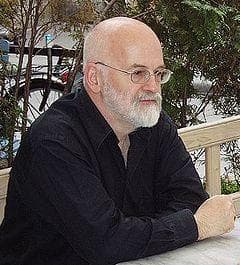
Sir Terence David John Pratchett was an English humorist, satirist, and author of fantasy novels, especially comical works. He is best known for his Discworld series of 41 novels.







