“The past is a ghost, the future a dream, and all we ever have is now.”
— Lincoln Rhyme pondering the nature of time and his existence.

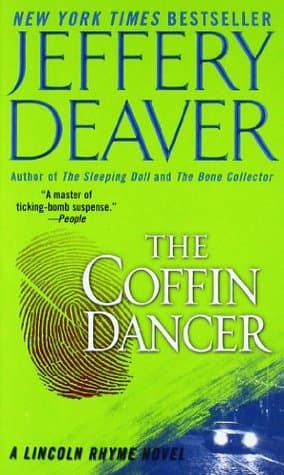
Jeffery Deaver (1988)
Genre
Thriller / Mystery
Reading Time
1064 min
Key Themes
See below
Sign in to track this book
Paralyzed criminalist Lincoln Rhyme and his partner Amelia Sachs race to unmask the 'Coffin Dancer,' a master of disguise leaving a trail of bodies and a chilling Grim Reaper tattoo across New York City.
The novel opens with the murder of Richard Logan, a commercial pilot, at a remote airfield. The killer, the 'Coffin Dancer,' stages the scene to look like an accident, but authorities quickly realize it is murder. NYPD detective Lincoln Rhyme, a quadriplegic forensic criminalist, takes on the case. His former partner, Amelia Sachs, assists him, meticulously collecting evidence. The only significant lead is a distinctive tattoo on the killer's arm, briefly seen by a witness: the Grim Reaper dancing with a woman in front of a coffin. This tattoo becomes the main identifier for the elusive killer, who disappears after each attack, leaving minimal forensic traces.
Rhyme and Sachs determine that Logan was not the primary target. Through forensic analysis and witness interviews, they link Logan to two other targets: an elderly woman named Helen Bach and a former mob enforcer, Joey 'The Hammer' Cortland. It becomes clear the Coffin Dancer is eliminating people connected to an event from several years prior. Rhyme realizes the killer is working from a list, and time is short to identify the remaining targets before the Coffin Dancer strikes again. Pressure builds as a cryptic message hints at a 48-hour deadline.
Despite Rhyme's efforts, the Coffin Dancer strikes again, murdering Helen Bach in her home. The killer's methods are precise, leaving little forensic evidence. Amelia Sachs, following a lead, corners a suspect matching the Coffin Dancer's description in a deserted building. A tense chase leads to a violent confrontation where Sachs is almost killed. The Coffin Dancer, showing agility and ruthlessness, escapes, leaving Sachs shaken but determined. This close call highlights the killer's cunning and the extreme danger they pose to Sachs.
Recognizing Joey 'The Hammer' Cortland as the next likely target, Rhyme plans a complex operation to protect him. Police apprehend Cortland, surprising and angering him. Under interrogation from Rhyme and Sachs, Cortland reluctantly reveals details about a past incident. He admits involvement in a witness protection program, and that the victims are all connected to a federal case where they testified against mob boss Marcus Andrews years ago. This breakthrough narrows the investigation and gives Rhyme a clearer understanding of the killer's motive.
With Cortland's information, Rhyme and Sachs investigate the past witness protection program. They discover that the victims were all part of a group who testified against Marcus Andrews, a mob figure. The Coffin Dancer, they realize, is systematically eliminating everyone involved in that case. The ultimate target, they deduce, is a key witness who helped put Andrews away. The challenge is to identify this individual, who lives under a new identity, and protect them from the Coffin Dancer before the killer completes the list. The race intensifies as the killer's pattern becomes clear.
Rhyme and Sachs realize the Coffin Dancer is a master of disguise. The killer frequently changes appearance, using wigs, makeup, and even surgical alterations to avoid detection, making witness identification almost impossible. They encounter several false leads and red herrings, carefully planted by the Coffin Dancer to mislead them. Rhyme's forensic expertise is tested as he analyzes subtle clues, trying to find the killer's true identity beneath many manufactured personas. This constant deception adds complexity to the investigation, showing the killer's intelligence and planning.
Through forensic analysis, psychological profiling, and deduction, Rhyme begins to piece together the Coffin Dancer's true identity. He realizes the killer is not just a hired assassin but someone with a personal vendetta and a deep understanding of the witness protection program. A critical piece of evidence — a unique chemical residue on a discarded item — leads Rhyme to a shocking conclusion: the Coffin Dancer is actually Marcus Andrews's former lawyer, William 'Billy' Hand, who was believed to be dead. Hand, driven by loyalty and revenge, underwent extensive plastic surgery to become a master of disguise.
With the Coffin Dancer's identity revealed as Billy Hand, Rhyme and Sachs intensify efforts to protect the final target. They identify the last surviving witness from the Andrews trial as Theresa Lin, a young woman who built a new life under witness protection. Hand's goal is to eliminate Lin, erasing the past and avenging Andrews. The team races to locate Lin and warn her before Hand strikes. The urgency is clear; Hand's relentless pursuit leaves no room for error, and Lin's life is in danger.
Knowing Hand's meticulous nature, Rhyme and Sachs devise a plan to trap him. They use Theresa Lin as bait, creating a scenario Hand cannot resist. Amelia Sachs, as the primary operative, sets up a carefully orchestrated ambush. The confrontation is intense and dangerous, with Hand proving a formidable opponent. He is cunning, resourceful, and ruthless, making the pursuit a high-stakes game. Sachs's courage and quick thinking are tested as she faces off against the Coffin Dancer in a climax, with Lin's life at stake.
In a harrowing climax, Amelia Sachs confronts Billy Hand, the Coffin Dancer. The fight is brutal, showing Hand's physical prowess and desperate determination. Sachs, using her tactical skills and Rhyme's remote guidance, outwits and overpowers Hand. The Coffin Dancer is finally caught, ending his deadly spree. Theresa Lin is saved, and justice is served. The investigation, which pushed Rhyme and Sachs to their limits, concludes with the capture of a dangerous killer, solidifying their reputation as an investigative duo.
The Protagonist
Rhyme's arc centers on his continued adaptation to his physical limitations while embracing his role as a brilliant, albeit immobile, detective, deepening his reliance and trust in Amelia Sachs.
The Protagonist/Supporting
Amelia's arc involves growing confidence in her abilities, confronting personal fears, and solidifying her unique partnership with Lincoln Rhyme, both professionally and emotionally.
The Antagonist
Hand's arc is one of escalating precision and ruthlessness in his mission of revenge, culminating in his downfall as Rhyme and Sachs unravel his elaborate deceptions.
The Supporting
Thom's arc remains largely consistent, showcasing his unwavering dedication and quiet resilience in supporting Rhyme.
The Supporting
Sellitto's arc reinforces his role as a bridge between traditional police work and Rhyme's advanced forensics, demonstrating his growing respect for Rhyme's methods.
The Supporting
Banks's arc is one of gaining experience and practical knowledge under the tutelage of more seasoned detectives.
The Supporting
Cortland's arc involves moving from belligerent fear to reluctant cooperation, ultimately aiding in the case's resolution.
The Supporting
Lin's arc is one of being unknowingly hunted, then rescued, embodying the vulnerability of protected witnesses.
The novel explores the line between justice and revenge. The Coffin Dancer's mission is an act of vengeance against those who wronged his former client, Marcus Andrews. While Rhyme and Sachs seek legal justice, Hand believes he is delivering his own form of justice. This theme questions whether true justice is possible when personal vendettas drive actions, and shows the destructive cycle revenge creates, affecting both targets and the perpetrator. The plot often demonstrates how past injustices, real or perceived, fuel present violence.
““Justice isn't about what's fair. It's about what's law.””
Identity is a fluid and deceptive concept in the story. The Coffin Dancer, Billy Hand, is a master of disguise, constantly changing his appearance and creating false personas to avoid capture. Witnesses in the protection program also live under new, fabricated identities, blurring who they truly are. This theme emphasizes how easily identity can be manipulated and how difficult it is to tell truth from illusion. Rhyme's forensic work often involves battling these layers of deception, trying to uncover the killer's true identity beneath his many masks.
““The killer doesn't just change his face, Sachs. He changes his entire life.””
Lincoln Rhyme's character shows the triumph of intellect over severe physical limitation. Confined to a wheelchair and mostly immobile, Rhyme's investigative ability relies solely on his brilliant mind, deductive reasoning, and forensic expertise. This theme highlights that true power is not in physical strength or mobility, but in intellectual capacity and strategic thinking. Rhyme's ability to direct complex investigations from his bed, using Amelia Sachs as his 'eyes and ears,' demonstrates the potential of the human mind when faced with extreme adversity. His disability forces him to think differently and innovate, making him a more effective detective.
““My brain works, Sachs. That's all I need.””
The dynamic between Lincoln Rhyme and Amelia Sachs is central to the novel, showing partnership and interdependence. Rhyme, physically incapacitated, relies entirely on Sachs to be his 'legs' in the field, meticulously collecting and interpreting evidence. Sachs, in turn, depends on Rhyme's intellect to solve the forensic puzzle and guide her. Their relationship is symbiotic, with each compensating for the other's limitations, creating an almost unbeatable investigative team. This interdependence goes beyond professional, hinting at a deep personal bond and mutual trust essential for their success.
““You're my hands, Sachs. My eyes. Without you, I'm blind.””
A ticking clock that amplifies tension.
The Coffin Dancer explicitly sets a forty-eight-hour deadline for his final strike, creating immense narrative tension and a relentless sense of urgency. This device forces Rhyme and Sachs to work at an accelerated pace, making every decision critical and every moment count. It prevents the investigation from becoming stagnant, constantly pushing the plot forward and heightening the stakes for the characters and the potential victims. The deadline is a constant reminder of the killer's control and the limited time available to prevent further tragedy.
A killer who constantly changes his appearance.
The Coffin Dancer's ability to flawlessly adopt multiple identities and appearances serves as a significant plot device. This makes him incredibly difficult to track and identify, creating numerous false leads and forcing the investigators to rely on subtle forensic clues rather than eyewitness accounts. It also highlights the theme of identity and deception, challenging the characters and the reader to look beyond surface appearances. This device keeps the audience guessing about the killer's true form and adds layers of complexity to the investigative process, as Rhyme must deduce the man behind the masks.
The primary method for solving the mystery.
Lincoln Rhyme's reliance on meticulous forensic deduction is the central plot device driving the investigation. Instead of traditional detective work, Rhyme pieces together the killer's profile and movements through minute details: trace evidence, chemical residues, fiber analysis, and crime scene patterns. This device showcases the power of scientific investigation and Rhyme's extraordinary intellect. It allows the reader to follow the logical progression of the investigation, understanding how seemingly insignificant clues contribute to the larger picture and ultimately lead to the killer's identity and motives.
The catalyst and central conflict of the plot.
The witness protection program serves as the narrative's foundational conflict. The Coffin Dancer's targets are all former witnesses who testified against a mob boss, and the program's inherent secrecy and the new identities it provides both protect the witnesses and make them incredibly difficult for the police to locate and protect. This device creates a high-stakes scenario where the very system designed to ensure safety becomes a vulnerability, forcing Rhyme and Sachs to navigate a complex web of past lives and new identities to save the remaining targets.
“The past is a ghost, the future a dream, and all we ever have is now.”
— Lincoln Rhyme pondering the nature of time and his existence.
“Forensics isn't about finding answers. It's about finding questions.”
— Rhyme explaining his investigative philosophy to Amelia Sachs.
“Every contact leaves a trace.”
— A fundamental principle of forensic science often referenced by Rhyme.
“It wasn't about the kill. It was about the chase.”
— Describing the Coffin Dancer's motivation and psychological profile.
“You can't solve a puzzle if you don't know all the pieces.”
— Rhyme emphasizing the importance of thorough evidence collection.
“The truth is rarely simple, and never easy.”
— A reflection on the complexities of uncovering facts in a case.
“Sometimes the best way to hide something is in plain sight.”
— Rhyme considering how the killer might be concealing information.
“Fear is a powerful motivator. It can make people do things they never thought they would.”
— Observing the impact of the killer's terror on witnesses and victims.
“The world is full of people who want to tell you what you can't do. Don't listen to them.”
— Rhyme's internal monologue about overcoming his physical limitations.
“Details. Always the details. They're the only things that matter.”
— Rhyme instructing Sachs on the meticulous nature of forensic work.
“A good lie always has a kernel of truth.”
— Analyzing a suspect's alibi or testimony.
“He didn't just kill them. He erased them.”
— Describing the Coffin Dancer's method of eliminating his victims' identities.
“You have to think like the killer. Get inside his head. See what he sees.”
— Rhyme advising Sachs on developing an understanding of the perpetrator.
“The greatest weapon against fear is knowledge.”
— Rhyme's belief that understanding the threat helps to combat it.
Ready to see how well you understood this book? Take our interactive quiz with 10 questions.

Biography coming soon.







