“Money, it seemed, was the only true religion, and its prophets were the traders.”
— Miguel's early observations on the Dutch exchange.

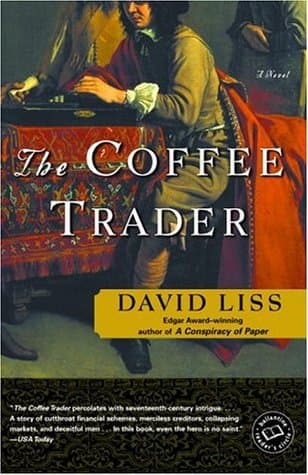
David Liss (2003)
Genre
Thriller / Historical Fiction / Mystery
Reading Time
10-12 hours
Key Themes
See below
Sign in to track this book
In 1659 Amsterdam, a disgraced Portuguese Jewish trader risks everything on a daring plot to corner the nascent coffee market, navigating ruthless competitors, hidden agendas, and the seductive allure of a Dutch businesswoman to reclaim his lost fortune and reputation.
Miguel Lienzo, a Portuguese-Jewish merchant in 1659 Amsterdam, is ruined. A sudden downturn in the sugar market has decimated his fortune, leaving him bankrupt and reliant on his younger brother, Daniel. His respected position in the Jewish community is shattered, replaced by shame. Desperate to regain his wealth and honor, Miguel needs a new venture, but traditional options seem closed. His reputation as a reckless trader precedes him, making it difficult to secure new investments, and he feels the pressure of his community's judgment.
At the exchange, Miguel is approached by Geertruid Damhuis, a shrewd and independent Dutchwoman. She presents an unusual business proposition: to corner the market on an exotic new commodity called 'coffee.' Geertruid explains the potential of this stimulating new drink, still largely unknown in Amsterdam, and her plan to introduce it to the wealthy. Skeptical yet intrigued, Miguel sees this as his last chance for redemption. He agrees to partner with her, despite the risks and the secretive nature of her operation, which involves smuggling and avoiding established trade guilds.
Miguel begins his secret education in the coffee trade. Geertruid introduces him to coffee beans, their origins in the Ottoman Empire, and the complex, often illicit, supply chains needed to bring them to Amsterdam. He learns about roasting, brewing, and taste. This new venture is dangerous, as established spice and tea merchants see coffee as a threat, and the city's powerful guilds could easily crush any independent operation. Miguel must navigate this shadowy underworld, learning to trust Geertruid and her network while constantly watching for rivals and authorities.
The initial phase of the coffee venture is successful. Miguel and Geertruid secure a significant quantity of coffee beans and introduce the beverage to influential social circles, creating demand. However, as Miguel delves deeper into their partnership, he uncovers inconsistencies and suspicious details about Geertruid's past and her true motives. He learns she has a history of questionable dealings and a network of associates that seem more criminal than mercantile. Miguel's initial trust erodes, replaced by a suspicion that he might be a pawn in a larger, more dangerous game.
As the coffee market takes shape, Miguel and Geertruid attract the attention of powerful established merchants, especially Christoffel van Baerle. Van Baerle, a ruthless and influential figure in Amsterdam's trade circles, sees coffee's potential and aims to control its distribution, viewing Miguel and Geertruid as unwelcome competitors. He uses tactics from market manipulation to intimidation to undermine their efforts. Miguel finds himself in a cutthroat competition, realizing that success will require not just commercial acumen but also the ability to outmaneuver dangerous, unscrupulous rivals who operate outside conventional morality.
Beyond market rivals, Miguel faces another threat: Amsterdam's powerful and entrenched trade guilds. These guilds, protective of their monopolies, view the independent coffee trade as a direct challenge to their authority and economic interests. Rumors of Miguel and Geertruid's activities reach guild masters, who begin investigations and employ spies to gather evidence. Miguel realizes that if the guilds prove they are operating outside regulations, their venture could be shut down, goods confiscated, and they could face severe legal repercussions, including imprisonment.
As pressure mounts, Miguel experiences a sense of betrayal. He discovers that his own brother, Daniel, who initially provided him with grudging support, has been secretly undermining his efforts, possibly for his own gain or under pressure from other merchants. This revelation deeply wounds Miguel, highlighting the pervasive deceit in Amsterdam trade. He questions everyone's motives, realizing that loyalty is rare. This betrayal forces Miguel to become more cautious and cynical, recognizing that he must rely solely on his own wits to survive the web of deception.
The pressure and compromises of the coffee trade begin to affect Miguel's personal life. His relationship with his brother Daniel is strained, and his standing within the Jewish community remains precarious, further complicated by his association with the gentile Geertruid. He feels isolated, his ambition consuming him and alienating him from those who once mattered. The constant threat of ruin and the need for secrecy force him to make difficult choices that blur the lines between right and wrong, leaving him questioning his character and the ultimate cost of his pursuit of wealth and redemption.
The climax of Miguel's struggle arrives as he and Geertruid execute their most audacious plan to corner the coffee market. This involves complex transactions, timed to exploit market vulnerabilities and outmaneuver rivals, particularly Van Baerle. Miguel uses his knowledge of the exchange, his understanding of human greed, and his newfound ruthlessness to manipulate prices and supply. It is a high-stakes gamble, where a misstep could lead to complete financial ruin, and potentially physical danger. The tension is palpable as fortunes hang in the balance, and Miguel must confront his fears and adversaries.
Through deduction, intercepted information, and unexpected allies, Miguel uncovers the full conspiracy against him. He realizes that the market crash that ruined him was not accidental, and that powerful forces manipulated events from the shadows. The true identities of his most dangerous enemies are revealed, along with their complex motivations, which extend beyond commercial rivalry. This revelation forces Miguel to re-evaluate everything he thought he knew about the market and the people in his circle, leading to a confrontation with the mastermind behind his misfortunes.
After the market manipulation and the unmasking of the conspirators, Miguel achieves significant success in the coffee trade, regaining much of his lost wealth and re-establishing his reputation, though in a different light. However, this victory comes at a substantial personal cost. His relationships are irrevocably altered, and he carries the scars of betrayals and compromises. While he has proven his commercial acumen and resilience, he is a changed man, more cynical but also wiser about power, greed, and the human heart in Amsterdam commerce. He looks towards an uncertain but self-determined future.
The Protagonist
Miguel transforms from a financially ruined and humiliated merchant into a shrewd, resilient, and morally ambiguous coffee trader, learning to navigate deception and betrayal to reclaim his fortune.
The Supporting
Geertruid maintains her independent and enigmatic nature, revealing layers of her cunning and ambition, ultimately proving to be a formidable and unpredictable partner.
The Supporting/Antagonist
Daniel's character arc highlights the corrosive power of envy and social pressure, as he moves from cautious support to outright betrayal of his brother, driven by his own insecurities.
The Antagonist
Van Baerle serves as the primary external antagonist, consistently challenging Miguel and Geertruid, representing the entrenched power that new ventures must overcome.
The Supporting
Hannah's arc is less about personal development and more about reflecting Miguel's changing priorities and the increasing distance between him and his traditional past.
The Supporting
Jacob remains a consistent, if minor, source of support for Miguel, highlighting the protagonist's ability to maintain some connections despite his downfall.
The Mentioned
The Rabbi serves as a static moral and communal authority figure, representing the established order that Miguel often challenges or disappoints.
The novel portrays Amsterdam in 1659 as the birthplace of modern capitalism, with the world's first commodities exchange. It explores the moral questions in this new economic system, where fortunes are made and lost through speculation, manipulation, and ruthless competition. Miguel's journey from traditional merchant to coffee speculator highlights the shift from tangible goods to abstract market forces, and the ethical compromises needed to succeed. The tension between religious rules and commercial ambition, seen in Miguel's struggle within his Jewish community, emphasizes the novel's examination of capitalism's impact on personal ethics. The ruthless actions of characters like Van Baerle show the 'survival of the fittest' mentality that emerges.
“Money was not merely a means of exchange, but a force, a living thing that could be made to grow or wither, depending on the skill and daring of the hand that held it.”
Miguel Lienzo's main motivation throughout the novel is not just to regain wealth, but to restore his shattered reputation and honor within his community. His bankruptcy has stripped him of his social standing, making him an outcast. The coffee venture is his last desperate chance at redemption. The theme explores how reputation, especially in a close-knit community like the Portuguese Jews, is linked to one's financial success and adherence to societal expectations. Miguel's struggle forces him to decide how far he will compromise his principles to achieve this redemption, questioning whether true honor can be bought back through morally questionable means. His eventual success is a form of redemption, but it is complex and often tarnished.
“To be ruined was one thing; to be shamed was another entirely, a wound that festered in the soul long after the coffers were emptied.”
Deception is present throughout 'The Coffee Trader,' in market speculation and personal relationships. Miguel constantly navigates a world where trust is a luxury. Geertruid's enigmatic nature and hidden motives, Daniel's quiet undermining, and Van Baerle's overt schemes all contribute to a world where betrayal is everywhere. The novel shows how deception is not just a tool of villains but an intrinsic part of the cutthroat commercial environment, where information is power and misdirection is strategy. Miguel himself must learn to deceive and manipulate to survive, blurring the lines between protagonist and antagonist and forcing the reader to question who is truly trustworthy.
“In this city, a man's word was often less valuable than the ink it was written with, and even then, the ink could be watered down.”
The novel explores the tension between the traditional values and religious rules of Amsterdam's Portuguese-Jewish community and the emerging, more secular demands of modern commerce. Miguel, a Jew, operates in a Christian city, and his business dealings often push against the boundaries of what is acceptable within his own community, particularly his partnership with the gentile Geertruid. The theme examines the challenges of maintaining cultural and religious identity in a rapidly globalizing and secularizing world, where economic opportunities often require breaking with tradition. Miguel's internal conflict reflects the broader societal shifts occurring in 17th-century Europe, where old orders are challenged by new economic realities.
“He was a Jew in a Christian city, a man of faith in a world increasingly driven by profit, and sometimes, the two simply would not reconcile.”
The 'unknown' appears in several ways throughout the novel, most prominently in the exotic new commodity of coffee itself. It represents opportunity, but also immense risk, as its market is unestablished and its properties unfamiliar. Geertruid, as an independent and unconventional woman, also embodies the allure and danger of the unknown for Miguel. The theme explores humanity's fascination with novelty and the willingness to take gambles on untested ventures. It highlights the inherent risk in pioneering new markets and the courage (or recklessness) required to challenge established norms and embrace the uncertain future, often with consequences.
“Coffee was a mystery, a whisper from distant lands, and in that mystery lay its power, both to enchant and to destroy.”
The exotic new commodity that drives the plot.
While coffee is a real commodity, in the context of the narrative, it functions as a MacGuffin in its initial stages. It is the object of desire and the catalyst for the entire plot, propelling Miguel and Geertruid into their daring venture. Its novelty and unknown potential make it an ideal subject for market speculation and manipulation, serving as the central focus around which all the characters' ambitions, rivalries, and deceptions revolve. Its exotic nature also allows for the exploration of new trade routes and cultural exchanges.
Miguel's perspective shapes the reader's understanding, often colored by his biases and limited information.
The story is told primarily from Miguel Lienzo's perspective, making him an inherently unreliable narrator, especially when it comes to judging the motives of others or his own moral compromises. His desperation for redemption, his pride, and his evolving cynicism color his interpretations of events and characters, particularly Geertruid. This device creates suspense and forces the reader to constantly question what is truly happening and who can be trusted, mirroring Miguel's own journey of doubt and discovery in a world full of hidden agendas.
The use of financial schemes and speculation as the primary form of conflict.
Instead of physical battles or overt espionage, the core conflict of the novel is driven by elaborate schemes of market manipulation, speculation, and financial warfare. Characters use insider information, rumors, strategic buying and selling, and even the threat of guild interference to gain control over the coffee market. This device allows Liss to create tension and suspense through intellectual combat and economic strategy, showcasing the sophisticated yet cutthroat nature of 17th-century Amsterdam's financial world, where fortunes are won and lost through cunning rather than brute force.
A seductive and mysterious woman who leads the protagonist into danger and moral ambiguity.
Geertruid Damhuis embodies many characteristics of a femme fatale. She is alluring, intelligent, and independent, drawing Miguel into a dangerous and morally ambiguous venture. Her motives are often unclear, and her past is shrouded in mystery, making Miguel (and the reader) constantly question her true intentions and loyalty. While not purely malicious, her willingness to engage in illicit activities and her enigmatic nature serve to lead Miguel down a path he might not otherwise have taken, challenging his ethics and pushing him into increasingly perilous situations.
“Money, it seemed, was the only true religion, and its prophets were the traders.”
— Miguel's early observations on the Dutch exchange.
“The market was a beast, and like all beasts, it could be tamed, but never fully trusted.”
— Miguel reflecting on the volatile nature of the coffee market.
“Every secret has its price, and every man, his breaking point.”
— Miguel contemplating the pressures of his double life and the threats against him.
“To be a Jew in Amsterdam was to exist in a liminal space, neither fully accepted nor entirely rejected, always observed.”
— Miguel's internal thoughts on his identity and community in a foreign land.
“Truth was a commodity, easily manipulated, often undervalued, and rarely pure.”
— Miguel's cynical view of information and its use in the trading world.
“Fear was a useful tool, but only if one knew how to wield it without being consumed by it.”
— Miguel's strategy for dealing with his enemies and the dangers he faced.
“The past was a relentless hunter, and its prey was always the present.”
— Miguel's struggle to escape his past in Portugal and the Inquisition.
“A man’s reputation was his most valuable asset, and the easiest to lose.”
— Miguel's concern over his standing in the Jewish community and the exchange.
“Sometimes, the only way to find light was to first embrace the darkness.”
— Miguel's willingness to engage in morally ambiguous actions to achieve his goals.
“The scent of coffee was the scent of possibility, of wealth, and of dangerous ambition.”
— Miguel's initial fascination with coffee and its potential as a commodity.
“Trust was a luxury few could afford, and even fewer should grant.”
— Miguel's cautious approach to alliances and partnerships in a treacherous world.
“In the dance of commerce, one must always lead, or be trampled underfoot.”
— Miguel's aggressive stance in the competitive world of Amsterdam's exchange.
“Revenge, like a fine wine, was best served cold, and with careful planning.”
— Miguel's long-term strategizing against those who wronged him.
“The city of Amsterdam was a labyrinth of canals and contracts, where fortunes were made and lost in the blink of an eye.”
— A description of the bustling and complex economic landscape of Amsterdam.
Ready to see how well you understood this book? Take our interactive quiz with 10 questions.

David Liss is a critically acclaimed historical fiction author, known for his intricate plots and vivid portrayals of bygone eras. His debut novel, "A Conspiracy of Papers," was a finalist for the Edgar Award, and "The Coffee Trader" earned him the Barry Award for Best Historical Fiction. Liss masterfully blends suspense, history, and compelling characters into unforgettable narratives.







