“The cobra event is when a virus or other biological agent is released into the human population, either intentionally or accidentally, and causes a widespread epidemic.”
— Defining the central concept of the novel.

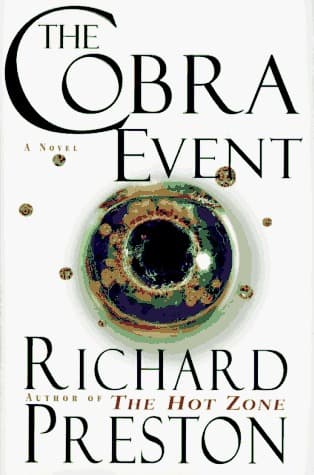
Richard Preston (1997)
Genre
Thriller / Mystery / Science Fiction
Reading Time
7-8 hours
Key Themes
See below
Sign in to track this book
A lone terrorist unleashes a biological weapon, turning a New York City teenager's head cold into a gruesome act of self-cannibalization, sparking a silent race against a global pandemic with real-world implications.
Seventeen-year-old Kate Moran, a high school student in New York City, suddenly experiences a severe and bizarre illness. What starts as a common cold quickly becomes violent seizures, hallucinations, and a horrific act of self-cannibalization in her art class. She is rushed to the hospital but dies shortly after, leaving doctors baffled by the unprecedented symptoms. The rapid progression and grotesque nature of her death immediately raise alarms, hinting at something far more sinister than a typical pathogen. Her death is the first public sign of the Cobra virus.
Days after Kate Moran's death, a homeless man in New York City is found dead under similar horrific circumstances, showing the same self-destructive behaviors and rapid decline. The peculiar nature of these deaths, especially the self-cannibalization, triggers an official response. The Centers for Disease Control (CDC) in Atlanta sends Dr. Alice Austen, a skilled pathologist, to New York City to investigate these disturbing incidents. Her arrival marks the beginning of the federal government's covert response to what is quickly suspected to be a deliberate act rather than a natural outbreak.
Dr. Alice Austen begins her investigation, examining the bodies of Kate Moran and the homeless man. Her meticulous work in the autopsy room reveals microscopic evidence of a new, aggressive virus that targets the brain, causing extreme neurological damage and an overwhelming urge for self-mutilation. She works closely with local law enforcement and medical examiners, gradually piecing together the horrifying puzzle. The speed and severity of the disease point to a genetically engineered pathogen, leading her to suspect biological terrorism rather than a natural occurrence. Her findings are chilling.
As Dr. Austen's findings confirm the theory of a deliberate biological attack, a secret FBI forensic team, led by Agent Mike Crichton, is activated. This team operates under extreme secrecy, recognizing the catastrophic potential of public panic. They call the unfolding crisis the 'Cobra Event.' Their mission is to identify and apprehend the perpetrator, a man who calls himself Archimedes, and to contain the spread of the deadly Cobra virus before it can devastate New York City. The FBI's involvement raises the investigation to a national security crisis.
The investigation reveals that Archimedes is a brilliant but disturbed former government scientist with a radical, misanthropic ideology. He believes humanity is a plague and seeks to 'cleanse' the world using his engineered virus. He spreads the virus using seemingly harmless objects like toys and everyday items coated with the virus, leaving them in public places across New York City. His meticulous planning and advanced scientific knowledge make him an exceptionally dangerous adversary, leaving a trail of terror and fear.
Dr. Austen, working closely with the FBI team, analyzes the patterns of the virus's spread and the locations where victims were infected. They deduce that Archimedes is systematically distributing the virus in public spaces, aiming for maximum impact. The team races against time, using forensic analysis, surveillance, and psychological profiling to narrow down Archimedes's potential hiding places and predict his next moves. The pressure mounts as more potential exposures are reported, threatening to overwhelm the city's emergency services.
The story details the terrifying specifics of the Cobra virus. It is a chimerical pathogen, a product of genetic engineering, designed to be highly contagious, lethal, and to inflict maximum psychological and physical suffering. The virus rapidly destroys brain tissue, causing victims to experience intense hallucinations, paranoia, and an irresistible urge to self-mutilate, often by biting off their own flesh. The disease's horrifying symptoms are designed not just to kill, but to spread fear and revulsion, making the threat even more potent.
As the FBI closes in, Archimedes escalates his attacks, leaving more infected objects in increasingly crowded locations. The city is on the verge of widespread panic, though the government keeps the true nature of the crisis secret. Dr. Austen and the team realize that Archimedes's ultimate goal is not just a few isolated deaths, but a large-scale epidemic designed to create chaos and societal collapse. The urgency of their mission becomes paramount as the window to contain the outbreak narrows.
Through relentless investigation, the FBI finally tracks Archimedes to his hidden laboratory, a makeshift bio-weapon facility. A tense confrontation ensues as agents raid the compound. Archimedes, heavily armed and prepared for a last stand, attempts to unleash a massive, aerosolized dose of the Cobra virus. The agents engage him in a dangerous battle, managing to subdue and capture him before he can execute his final, catastrophic act of bioterrorism. The capture prevents a far wider catastrophe.
With Archimedes captured and his lab neutralized, the immediate threat of widespread Cobra virus infection is averted. Dr. Austen and her team work quickly to contain and decontaminate the affected areas, and to develop a potential treatment or vaccine. However, the novel ends with a sobering reflection: while this specific crisis was contained, the technology and knowledge to create such a pathogen still exist. The 'Cobra Event' is a chilling reminder of the danger of biological weapons and society's vulnerability to such attacks, leaving a lingering sense of unease about future threats.
The Protagonist
Alice evolves from a dedicated pathologist into a frontline defender against biological terrorism, showing immense courage and resourcefulness under extreme pressure.
The Antagonist
Archimedes remains steadfast in his nihilistic mission, serving as a static, unyielding force of destruction throughout the narrative.
The Supporting
Crichton's character demonstrates resilience and adaptability as he confronts an unprecedented form of terrorism, solidifying his role as a protector.
The Mentioned
Her brief appearance serves to initiate the plot, not to develop her character.
The Supporting
Johnson maintains his role as a steady, authoritative figure, providing crucial institutional support and strategic oversight.
The Mentioned
His death serves as a plot device to confirm the pattern of infection and escalate the investigation.
The novel shows how easily a sophisticated biological weapon can cripple a modern, interconnected society. The Cobra virus, designed to be highly contagious and devastating, uses the very fabric of urban life—public spaces, casual contact—to spread. The government's struggle to contain the threat secretly highlights the immense challenge of preventing mass panic while combating an invisible enemy. The book emphasizes that a single, determined individual with advanced scientific knowledge can pose an existential threat to millions, demonstrating the fragility of public health systems and social order.
“The problem with bio-weapons, Dr. Austen realized, was that they were designed to be invisible, silent, and to spread fear as much as disease.”
The Cobra Event explores the ethical dilemmas surrounding biological research, particularly the 'dual-use' nature of scientific advancements. Archimedes, a former government scientist, uses his knowledge of virology and genetic engineering, originally developed for defensive or medical purposes, to create a weapon of mass destruction. The novel raises questions about the responsibility of scientists, the potential for technology to be perverted for malevolent ends, and the reality that the same research that could cure diseases could also unleash them. It shows the fine line between scientific progress and catastrophic potential.
“The tools to create hell were often the same ones used to build heaven.”
A central theme is the psychological impact of an unseen, terrifying threat. The government's covert response is largely driven by the fear of mass panic, which they believe could be as destructive as the virus itself. The grotesque symptoms of the Cobra virus—self-cannibalization—are specifically designed to maximize horror and revulsion, amplifying the psychological warfare aspect of Archimedes's attack. The story explores how uncertainty and the inability to identify the enemy can erode trust and social cohesion, demonstrating that fear itself can be a potent weapon, capable of paralyzing a population.
“The greatest weapon wasn't the virus itself, but the fear it generated.”
The novel presents a contrast between humanity's capacity for destruction, embodied by Archimedes and his engineered virus, and its resilience and will to survive, represented by Dr. Austen and the FBI team. Archimedes's nihilistic view of humanity as a 'plague' is challenged by the dedicated efforts of those fighting to protect life. The story shows both the darkest aspects of human nature—the desire to annihilate—and the brightest—the courage, intelligence, and self-sacrifice displayed in the face of an existential threat. It highlights the enduring human spirit in crisis.
“Even in the face of such horror, there was an unbreakable human will to live, to fight, to protect.”
The central biological weapon and catalyst for the plot.
The Cobra virus is a fictional, genetically engineered pathogen designed by Archimedes. It is the primary plot device, driving the entire narrative. Its horrifying symptoms—rapid neurological degradation leading to hallucinations, seizures, and self-cannibalization—are crucial for establishing the high stakes and grotesque nature of the threat. The virus's novel design and extreme lethality necessitate the covert, urgent response from the CDC and FBI, making it the ultimate antagonist that the characters must understand, track, and ultimately neutralize.
The FBI and CDC operate in secrecy to prevent mass panic.
The government's decision to handle the Cobra Event with extreme secrecy is a key plot device. This secrecy creates immense pressure on Dr. Austen and the FBI team, forcing them to operate outside conventional protocols and making their task even more challenging. It highlights the fear of mass panic in a modern society and adds an additional layer of tension and urgency to their investigation. This covert operation allows the narrative to explore the complexities of crisis management without widespread public knowledge.
Archimedes uses everyday items to spread the virus discreetly.
Archimedes's method of distributing the Cobra virus by coating seemingly innocuous everyday objects (toys, books, etc.) and leaving them in public places is a crucial plot device. This strategy makes the virus's spread insidious and difficult to trace, as there is no obvious point of contamination. It magnifies the sense of vulnerability and paranoia, as any object could be a carrier. This device underscores the cunning and malevolent nature of the antagonist and forces the investigators to think outside conventional epidemiological models.
The invisible nature of the pathogen creates pervasive fear.
The fact that the Cobra virus is an invisible, microscopic enemy is a powerful plot device. Unlike a conventional terrorist attack, there is no visible perpetrator or immediate explosion; the threat is insidious and unseen. This invisibility amplifies the sense of dread and vulnerability, making it difficult for characters and, by extension, the reader, to feel safe. It forces the protagonists to rely heavily on scientific analysis and forensic detective work to combat a foe that cannot be directly perceived, highlighting the unique challenges of biological warfare.
“The cobra event is when a virus or other biological agent is released into the human population, either intentionally or accidentally, and causes a widespread epidemic.”
— Defining the central concept of the novel.
“It's not about being ready for the last war, it's about being ready for the next one.”
— Discussing preparedness for biological threats.
“The human race is a single organism, and if you prick it anywhere, the whole thing bleeds.”
— Reflecting on the interconnectedness of humanity in the face of a global threat.
“Fear is a powerful mutagen. It changes everything.”
— Observing the psychological impact of a potential bioweapon attack.
“The problem with absolute power is that it corrupts absolutely, and the problem with absolute knowledge is that it drives you absolutely mad.”
— A character's reflection on the dangers of unchecked power and information.
“Sometimes the greatest evil is committed with the best intentions.”
— Exploring the complex motivations behind dangerous scientific endeavors.
“The most dangerous thing in the world is a human being with a broken heart and a brilliant mind.”
— Describing the profile of a potential bioterrorist.
“We are living in a biological century, and we had better get used to it.”
— A scientist's assessment of the evolving threat landscape.
“The only way to contain a bioweapon is to understand it, and the only way to understand it is to get your hands dirty.”
— Highlighting the necessity of direct engagement with dangerous pathogens.
“The world is full of invisible enemies. Some of them are just waiting for their chance.”
— A chilling reminder of the constant, unseen threats.
“There's a fine line between genius and madness, and sometimes that line is made of DNA.”
— Pondering the ethical boundaries of genetic engineering and scientific ambition.
“When you're dealing with something that multiplies exponentially, a single mistake can be catastrophic.”
— Emphasizing the extreme danger of highly contagious biological agents.
“The truth is rarely pure and never simple.”
— A character grappling with the complex and often murky reality of the situation.
“It's not about stopping death; it's about delaying it.”
— A pragmatic view on the limitations of medical intervention in a pandemic.
“The greatest weapon against chaos is knowledge, but even knowledge can be weaponized.”
— Reflecting on the double-edged nature of scientific understanding.
Ready to see how well you understood this book? Take our interactive quiz with 10 questions.







