“Nancy Drew felt a thrill of anticipation as she steered her roadster along the winding country road.”
— Opening of the book as Nancy drives to meet Mrs. Joslin.

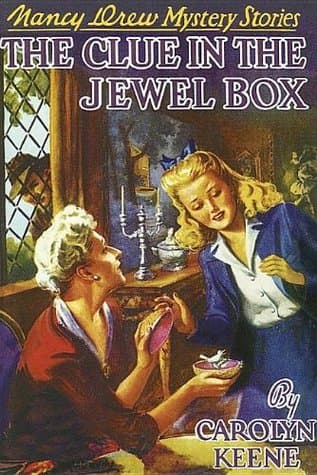
Carolyn Keene (1943)
Genre
Children's / Mystery / Young Adult
Reading Time
150-180 min
Key Themes
See below
Sign in to track this book
Nancy Drew must decipher a faded photograph and a queen's secret heirloom to unmask an imposter and reunite a royal family, all while navigating perilous encounters in River Heights.
Nancy Drew meets an antique dealer, Mr. Tedesco, who reveals his client, Madame Alexandra, is a former European queen living secretly in River Heights. Madame Alexandra tells Nancy her kingdom was overthrown, forcing her to flee and leave her young grandson, Prince Michael, behind. She wants Nancy's help to find him. Her only clue is an old photograph of Prince Michael as a four-year-old, showing him with a distinct jewel box. Nancy, interested in the royal mystery, accepts the case, promising to use her skills to reunite the family.
Nancy begins her investigation by researching Madame Alexandra's deposed kingdom and the royal family, focusing on the jewel box. She learns the box is a valuable heirloom, believed to contain a secret compartment with important documents or a hidden message. Madame Alexandra reveals the box was given to a loyal servant before her escape, and she thinks it holds the key to her grandson's identity or location. Nancy realizes understanding the jewel box's secrets is vital to finding Prince Michael. She consults historical archives and antique experts, trying to track the box's journey and any clues it might offer.
As Nancy investigates, she notices a suspicious man, later identified as Nikolas, a former member of the royal court with a bad reputation. He often lurks around Madame Alexandra's home and the antique shops Nancy visits, seeming to follow her. One evening, while Nancy examines old royal documents, a brick breaks her window, barely missing her. The incident unnerves Nancy but confirms her suspicion that someone is trying to stop her investigation and perhaps harm her. She realizes the search for Prince Michael is dangerous.
A young man named Anton appears in River Heights, claiming to be the lost Prince Michael. He presents himself to Madame Alexandra, who, despite wanting her grandson back, feels uneasy about him. Nancy is immediately suspicious of Anton. His story seems too convenient, and he lacks certain family traits or memories Madame Alexandra would expect. Nancy decides to discreetly investigate Anton, watching his behavior and looking for inconsistencies in his claims. She suspects he might be a clever imposter, possibly connected to Nikolas.
Nancy, with Bess and George, carefully traces the jewel box's journey since it left the royal palace. Her investigation leads her to various antique dealers, collectors, and a pawn shop in different cities. She uncovers a complex series of transactions, some legitimate, others seemingly meant to hide the box's true owner. Along the way, she gathers bits of information about the box's previous temporary owners. This work slowly shows a clearer picture of who might have had the box and how it ended up with Mr. Tedesco, near Madame Alexandra.
While following a lead about the jewel box's last owner, Nancy is ambushed by Nikolas and his accomplice. They force her into a car, intending to take her to a remote location to stop her from exposing Anton as an imposter. Fortunately, Nancy's friends, Burt and Dave, who had been discreetly following her out of concern, see the abduction. They immediately give chase, leading to a thrilling car pursuit. With quick thinking, Burt and Dave manage to corner the kidnappers, rescue Nancy, and ensure the villains are caught by the police, preventing further harm.
After the rescue, Nancy works harder to unlock the jewel box's secret. She carefully examines the antique box's intricate carvings and mechanisms, eventually finding a hidden spring. When pressed in a specific order, it opens a secret compartment. Inside, she finds not only valuable jewels but also old letters and a birth certificate. These documents confirm the true Prince Michael was taken from the kingdom and raised under a different name. They provide details about his foster family and current location. This discovery is a major breakthrough.
With the documents from the jewel box, Nancy confronts Anton and Nikolas. She presents the evidence that Anton is not Prince Michael, detailing his fabricated story and the inconsistencies she found. The birth certificate clearly identifies the true prince, and the letters from the royal family's loyal servant provide proof of Anton's deception. Faced with facts, Anton and Nikolas confess their scheme: Nikolas found Anton, a young man who vaguely resembled the prince, and trained him to impersonate the royal heir, hoping to get access to the royal fortune.
Following clues from the birth certificate and letters, Nancy, with Carson Drew, travels to a quiet town where the true Prince Michael, now named Michael Smith, has been living a normal life, unaware of his royal heritage. Nancy carefully approaches him and his foster family, explaining his past. Initially, Michael is skeptical, but Nancy presents the evidence and a personal message from Madame Alexandra. He is overwhelmed but slowly accepts his royal lineage, agreeing to meet his grandmother, Madame Alexandra.
The story ends with a heartfelt reunion between Madame Alexandra and her long-lost grandson, Prince Michael. Their embrace shows the power of family and Nancy's dedication. Madame Alexandra is overjoyed to have her grandson back, and Michael begins to learn about his royal heritage. The jewel box, now a symbol of their reunited family, holds its secrets no more. Nancy Drew has solved another complex mystery, bringing justice and happiness to a displaced royal family.
The Protagonist
Nancy's arc reinforces her established reputation as a top-tier detective, showcasing her growth in handling high-stakes, international mysteries.
The Supporting
From a heartbroken, exiled queen, she is transformed into a joyous grandmother reunited with her heir.
The Supporting
Discovers his true identity and royal heritage, embracing his grandmother and past.
The Antagonist
His deception is exposed, leading to his downfall and the failure of his scheme.
The Antagonist
His criminal plot is uncovered and thwarted by Nancy, leading to his arrest.
The Supporting
Consistently supports Nancy, overcoming her fears to aid in the investigation.
The Supporting
Proves her bravery and resourcefulness in assisting Nancy, especially during dangerous situations.
The Supporting
Provides consistent support and crucial aid to Nancy, particularly during her kidnapping.
The Supporting
Consistently provides support and guidance to Nancy, facilitating her investigation and ultimately the reunion.
The main theme is Madame Alexandra's search for her long-lost grandson, Prince Michael, and the strong bond of family that lasts through time and distance. The jewel box itself is a family heirloom, representing their heritage even after losing their kingdom. Nancy's dedication to reuniting the royal family highlights the importance of lineage and belonging. The emotional reunion at the end shows that true wealth is in family ties, not crowns or kingdoms.
“"The jewel box is more than just jewels; it is a symbol of our family, of what we lost, and what I pray we can regain."”
This theme is shown through Anton, the imposter prince, and Nancy's efforts to expose his fraud. The story contrasts the genuine desire for truth (Madame Alexandra's search, Nancy's investigation) with deception (Anton's impersonation, Nikolas's manipulation). Nancy's detective work aims to uncover lies to reveal the facts, ending with the dramatic reveal of the true Prince Michael and the unmasking of the imposters. This highlights the dangers of false appearances and the triumph of evidence.
“"An imposter can mimic words, but they can never truly replicate the heart or the memories that define a person's past."”
Nancy Drew's main goal is to ensure justice for Madame Alexandra and her family. The overthrow of the kingdom and the separation of the prince are major injustices. Nancy's pursuit of the true heir and her efforts to expose the imposter are acts of justice, restoring what was lost and punishing those who sought to exploit the situation. The capture of Nikolas and Anton shows that malicious actions will face consequences, and the innocent will find peace.
“"Sometimes, solving a mystery isn't just about finding a person or an object, but about restoring a sense of justice that has been lost."”
Despite years of exile and difficult odds, Madame Alexandra never loses hope of finding her grandson. Her hope starts the entire investigation, driving Nancy. Even when faced with the convincing imposter, Madame Alexandra's intuition and hope for the true Prince Michael guide her. Nancy also maintains hope during dangerous encounters, believing the truth will eventually come out. The story ends with this hope fulfilled, showing its strength against adversity.
“"Hope, Nancy, is the last thing a queen loses, even when her kingdom is gone."”
A priceless royal heirloom containing a crucial hidden secret.
The jewel box serves as the primary MacGuffin in the story. While it is a tangible object, its true importance lies not in its intrinsic value as jewelry but in the secret compartment it holds. This compartment is believed to contain documents or clues vital to identifying the true Prince Michael and confirming his heritage. The search for the box, the understanding of its history, and ultimately the discovery of its secret drive much of the plot, propelling Nancy's investigation and creating a focal point for both the protagonists and antagonists.
A false lead designed to mislead both characters and the reader.
Anton, the young man who initially claims to be Prince Michael, functions as a significant red herring. His appearance creates a false sense of resolution and a plausible, yet ultimately incorrect, answer to Madame Alexandra's quest. His presence diverts attention and resources, forcing Nancy to meticulously investigate his claims and expose his inconsistencies. This device heightens the suspense and complicates the mystery, making the eventual revelation of the true prince more impactful and satisfying for the reader.
An old, indistinct image serving as the initial, ambiguous clue.
The faded photograph of Prince Michael as a four-year-old is the initial, and perhaps most challenging, clue given to Nancy. Its indistinct nature and the passage of time make it incredibly difficult to use for identification, symbolizing the elusive nature of the lost prince. It forces Nancy to rely on other, more concrete evidence, such as the jewel box's secrets, rather than a simple visual match. The photograph serves to establish the difficulty of the case and the long odds Nancy faces, making her eventual success even more impressive.
The act of following and observing characters to gather information or intimidate.
Shadowing and surveillance are repeatedly used by both the antagonists and protagonists. Nikolas and his accomplice shadow Nancy to obstruct her investigation, leading to the kidnapping attempt. Conversely, Burt and Dave discreetly follow Nancy, which ultimately allows them to intervene and rescue her. This device creates tension and highlights the constant danger Nancy faces, while also demonstrating the protective nature of her friends. It underscores the high stakes of the mystery and the covert operations involved in both solving and hindering it.
“Nancy Drew felt a thrill of anticipation as she steered her roadster along the winding country road.”
— Opening of the book as Nancy drives to meet Mrs. Joslin.
“The jewel box itself was an antique, made of polished mahogany, with intricate carvings on its lid.”
— Description of the titular jewel box.
“Nancy knew that often the smallest clue could unlock the biggest mystery.”
— Nancy's general detective philosophy.
“The old woman's eyes, though dimmed by age, still held a spark of determination.”
— Description of Mrs. Joslin.
“A good detective never jumps to conclusions without solid evidence.”
— Nancy's advice or internal thought process.
“There was more to this case than just a missing jewel; it involved a person's entire past.”
— Nancy realizing the depth of the mystery.
“The feeling of danger was palpable, a chilling reminder that she was getting closer to the truth.”
— Nancy facing a dangerous situation.
“Courage isn't the absence of fear, but the triumph over it.”
— Nancy reflecting on a brave act.
“Every secret has a way of revealing itself, given enough time and a keen observer.”
— Nancy's belief in the eventual uncovering of truth.
“The old mansion, with its creaking floors and shadowed corners, seemed to breathe secrets.”
— Description of the setting, adding to the atmosphere.
“It wasn't just about finding the jewels, but about righting a wrong.”
— Nancy's motivation beyond just solving the puzzle.
“Sometimes the most obvious solution is hidden in plain sight.”
— Nancy considering a difficult clue.
“The satisfaction of solving a complex puzzle was a reward in itself.”
— Nancy's feelings after making a breakthrough.
“Nancy felt a surge of triumph as the final piece of the puzzle clicked into place.”
— Conclusion of the mystery.
Ready to see how well you understood this book? Take our interactive quiz with 10 questions.
Carolyn Keene is the pseudonym for the authors of the Nancy Drew Mystery Stories series. Under this pen name, numerous authors have penned over 170 books since 1930, captivating young readers with thrilling mysteries and adventures. The series, including notable titles like "The Secret of Red Gate Farm" and "Mystery of Crocodile Island," has become a cultural phenomenon, selling millions of copies worldwide and inspiring adaptations across various media.

Dan Gemeinhart
4.5

Kate O'Hearn
4.4

Jeanne Birdsall
4.4

Jen Wang
4.4

Wendelin Van Draanen
4.3

John Marsden
4.3

Chris Van Allsburg
4.3

Jennifer A. Nielsen
4.2