“And so Giovanni became a juggler, the best in all of Italy.”
— Giovanni's early success as a performer.

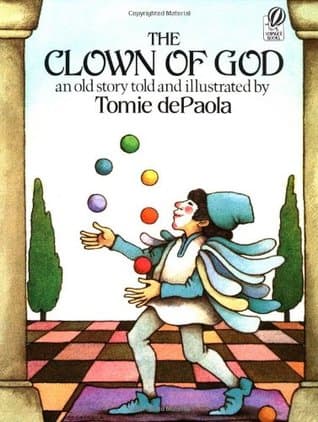
Tomie dePaola (1978)
Genre
Children's / Historical Fiction / Spirituality
Reading Time
15 min
Key Themes
See below
Sign in to track this book
In a medieval Italian town, a humble juggler, with nothing but his tattered skills, offers a silent performance as his Christmas gift to the Virgin and Child, proving that devotion comes from the heart, not the purse.
The story introduces young Barnaby, an orphan boy in Italy, who has a talent for juggling. From a very young age, he delights the villagers with his simple yet captivating performances, using three golden balls. His only belongings are his tattered clothes and his juggling balls, yet he finds joy in his art. The villagers, though poor, appreciate his performances, often sharing their meager food with him in return for the entertainment he provides. Barnaby's juggling is his way of expressing himself and connecting with the world around him, bringing moments of lightness to their hard lives.
As Barnaby grows older, he continues his life as a wandering juggler, traveling from village to village. He is known as Brother Barnaby, a title of affection and respect given by the people he entertains. His performances are simple, yet they bring smiles to many, from children to the elderly. He performs in market squares, at village festivals, and even for small gatherings, always with his three golden balls. His life is one of constant movement and humble existence, but he remains content, finding purpose in spreading joy through his unique talent. He experiences the beauty of the Italian countryside and the kindness of strangers.
Years pass, and Brother Barnaby, now an old man, finds his once nimble body and sharp reflexes failing him. His juggling becomes less precise, his movements slower, and the golden balls occasionally slip from his grasp. The joy he once found so easily in his performances is now tinged with sadness and frustration. He notices the change in the audience's reactions; the laughter is less frequent, replaced by pity or indifference. His health deteriorates, and he struggles to maintain his livelihood, often going hungry. The once celebrated juggler feels his purpose slipping away.
Exhausted and ill, Brother Barnaby eventually finds his way to a monastery, where the kind monks take him in. He is welcomed with compassion and given food, warmth, and a place to rest. The monastery offers him a refuge from the harsh realities of his declining life on the road. Though he is grateful for their kindness, Barnaby feels a deep sense of inadequacy. He observes the monks, each contributing to the community with their unique skills—painting, writing, gardening, cooking—and feels he has nothing left to offer, his juggling now a source of shame rather than pride.
As Christmas Eve approaches, the monastery is busy. The monks prepare a celebration for the Christ Child, each contributing their finest work. Brother Thomas paints a fresco, Brother Francis composes a hymn, Brother Andrew carves a wooden statue, and others prepare food and decorate the chapel. Barnaby watches them, feeling increasingly isolated and useless. He sees their sincere offerings, born of devotion and skill, and contrasts them with his own perceived lack of ability. The pressure to offer a gift weighs heavily on his heart.
On Christmas Eve, as the other monks gather in the chapel to present their gifts before the statue of the Madonna and Child, Barnaby feels despair. He has no material gift to offer, and his once-great talent is now a source of embarrassment. He retreats to his small room, deeply saddened. However, a memory stirs within him—a vision of himself as a young boy, juggling with pure joy and innocence. A realization dawns: his juggling, though imperfect now, is the only true gift he possesses, a part of his very soul.
Later that night, when the chapel is quiet and empty, Barnaby steals in, his heart pounding. He approaches the statue of the Christ Child, takes out his three golden balls, and begins to juggle. His movements are slow and clumsy at first, a pale imitation of his youthful prowess, and a tear rolls down his cheek. Yet, as he continues, a sense of his old joy returns. He juggles with all his heart, not for an audience, but as a pure, humble offering of his spirit to the Christ Child. He falls to his knees, utterly spent but at peace.
Unbeknownst to Barnaby, some of the younger monks, curious about his whereabouts, had followed him and secretly watched his performance from the shadows. Initially, they are shocked, believing his act to be disrespectful. However, as Barnaby collapses from exhaustion, a miraculous event occurs: the statue of the Christ Child, which had been still, slowly raises its hand and blesses Barnaby. The golden balls, which had fallen, gather around the Christ Child's feet, glowing softly. The watching monks are stunned into silent awe, realizing the sanctity of Barnaby's humble offering.
The commotion from the younger monks alerts the Abbot and the older monks, who quickly come to the chapel. They find Barnaby lying exhausted before the statue, and the Christ Child's hand still raised in blessing. At first, some are perplexed, but the Abbot, a wise and understanding man, immediately comprehends the depth of Barnaby's devotion. He explains to the others that Barnaby's gift, though unconventional, was given with a pure heart and was the most precious offering of all. The monks, seeing the miracle and hearing the Abbot's words, bow their heads in reverence, understanding the true meaning of selfless giving.
In the presence of the blessed Christ Child and the understanding monks, Brother Barnaby finds ultimate peace. He is no longer ashamed of his gift, but rather filled with a sense of acceptance and redemption. His life, which had seemed to dwindle into insignificance, is now seen as a sign of the power of simple, heartfelt devotion. The miracle in the chapel affirms his lifelong purpose and brings closure to his journey. He rests, his spirit light, having offered his truest self, and in doing so, found his place in the heart of the divine.
The Protagonist
Barnaby transforms from a joyful, celebrated juggler to an old, disheartened man, only to find spiritual redemption and peace by offering his authentic self as a gift.
The Supporting
The Abbot's character remains constant as a beacon of wisdom, guiding others to a deeper understanding of faith and acceptance.
The Supporting
They transition from skepticism and judgment to awe and understanding after witnessing the divine response to Barnaby's offering.
The Supporting
Their understanding of 'worthy' offerings broadens through the Abbot's explanation of Barnaby's miracle.
The Mentioned/Symbolic
Remains static as a symbol, but its miraculous action transforms the perceptions of others.
The Mentioned
No specific arc, as they are a collective and appear only in Barnaby's past.
This theme explores the idea that the sincerity of a gift far outweighs its material worth or conventional form. Barnaby, an old and ailing juggler, feels he has nothing 'worthy' to offer compared to the monks' artistic and scholarly contributions. Yet, his simple act of juggling, performed with his whole heart before the Christ Child, is divinely acknowledged as the most precious gift. The miracle of the Christ Child blessing Barnaby emphasizes that true devotion comes from within, not from outward displays or expectations. It encourages readers to value their unique talents and offer them sincerely.
“And the Christ Child smiled, and slowly, slowly, raised his tiny hand and blessed Brother Barnaby.”
Barnaby's journey is tied to his sense of identity and his struggle with self-worth as his abilities decline. His juggling is an extension of his being. As he ages and his performances falter, he feels useless and ashamed, believing he has lost his purpose and his ability to contribute. His decision to juggle for the Christ Child, despite his imperfections and fear of judgment, is an act of reclaiming his true self. The divine blessing validates his unique identity and shows that his worth is inherent, not dependent on perfection or external approval.
“He had no gift to offer. He was old and clumsy. He was nothing but a poor, old juggler.”
The story challenges conventional notions of religious worship and devotion. While the monks offer traditional gifts like paintings, hymns, and carvings, Barnaby's offering is a street performance, an act of physical skill and joy. This initially appears sacrilegious to the younger monks. However, the miraculous response from the Christ Child validates Barnaby's unconventional form of worship, suggesting that genuine faith can manifest in diverse and unexpected ways. It promotes an understanding that spiritual connection is personal and can transcend rigid religious norms, embracing joy and individual expression as forms of prayer.
“He saw the little old man, with his golden balls, juggling with all his heart before the statue of the Christ Child. And then he saw the Christ Child smile...”
The book sensitively portrays the challenges of aging, particularly the loss of physical prowess and the associated emotional toll. Barnaby, once a celebrated juggler, experiences the decline of his skills and the diminishing appreciation from his audience. This leads to feelings of sadness, inadequacy, and loneliness. His eventual acceptance into the monastery and the ultimate validation of his offering provide a message of hope and dignity in old age. It suggests that even when physical abilities fade, the essence of one's spirit and the capacity for heartfelt giving remain valuable and can still bring profound meaning and purpose.
“His hands were not so quick, his feet not so light, and sometimes a ball would fall to the ground.”
A recurring symbol representing Barnaby's talent, identity, and life's journey.
The three golden balls are a central symbolic object throughout the story. Initially, they represent Barnaby's youthful talent, his joy, and his means of livelihood. As he ages and his skills decline, the balls symbolize his fading abilities and his struggle with self-worth. Finally, when he offers his performance to the Christ Child, the balls become a symbol of his pure, heartfelt offering and his authentic self. Their golden color can also subtly suggest preciousness and divine connection. Their placement at the feet of the Christ Child after the miracle reinforces their sacred significance.
A symbolic figure that acts as the divine judge and bestower of grace.
The statue is a critical plot device as it serves as the direct recipient of Barnaby's offering and the source of the story's central miracle. It is initially a passive object, representing the sacred figure towards whom all the monks' efforts are directed. However, its miraculous action of raising its hand to bless Barnaby transforms it into an active agent of divine validation. This act is the climax of the story, confirming the purity of Barnaby's heart and shifting the perception of his offering from sacrilegious to sacred, thereby resolving his internal conflict and providing spiritual affirmation.
A narrative technique highlighting the story's central message about true devotion.
This device is used to emphasize the story's core theme. The narrative explicitly contrasts the monks' traditional, skilled, and 'respectable' offerings (paintings, carvings, hymns) with Barnaby's humble, unconventional, and physically demanding act of juggling. This contrast initially frames Barnaby's act as potentially inappropriate or unworthy. However, the subsequent divine validation of Barnaby's gift powerfully subverts this initial perception, reinforcing the message that the sincerity and heart behind an offering are more important than its form or perceived grandeur. It challenges the reader to look beyond surface appearances in matters of faith and value.
A setting that provides refuge and a stage for spiritual transformation.
The monastery serves as more than just a setting; it is a sanctuary for Barnaby in his old age and a crucible for his spiritual transformation. It offers him physical shelter and community when he is at his lowest. More importantly, it provides the context for the Christmas Eve celebration, which acts as the catalyst for Barnaby's internal conflict and his ultimate act of devotion. The enclosed, sacred space of the chapel within the monastery is where the private, heartfelt offering takes place, allowing for the intimacy of Barnaby's act and the miraculous divine response without external worldly distractions.
“And so Giovanni became a juggler, the best in all of Italy.”
— Giovanni's early success as a performer.
“But as the years passed, Giovanni grew old and tired, and no one wanted to see an old man juggle.”
— Giovanni's decline with age and loss of audience.
“He had nothing left but his juggling balls and the ragged clothes on his back.”
— Giovanni's poverty in his old age.
“On Christmas Eve, he crept into the dark church to get out of the cold.”
— Giovanni seeking shelter in a church.
“He saw the statue of the Holy Child, and it seemed to him that the Child was sad.”
— Giovanni's observation of a statue in the church.
“I have nothing to give you, but I can do what I do best.”
— Giovanni deciding to juggle for the statue.
“And he began to juggle, as he had not juggled in years.”
— Giovanni performing his juggling act in the church.
“Faster and faster he juggled, the balls flying like a rainbow.”
— Description of Giovanni's juggling during his offering.
“Then, with a final flourish, he threw the golden ball high into the air.”
— The climax of Giovanni's juggling performance.
“And as the ball came down, he caught it, and fell to the floor, lifeless.”
— Giovanni's death after his performance.
“But the people who found him saw a smile on his face, and the golden ball in the hand of the Holy Child.”
— The miraculous discovery after Giovanni's death.
“He had given the only gift he had, and it was accepted.”
— The moral conclusion of the story.
“For even the smallest gift, given with love, is great in the eyes of God.”
— The spiritual lesson of the story.
“And so the legend of the juggler of God was born.”
— The origin of the story's legend.
Ready to see how well you understood this book? Take our interactive quiz with 10 questions.
Biography coming soon.

Dan Gemeinhart
4.5
Kate O'Hearn
4.4
Jeanne Birdsall
4.4

Jen Wang
4.4
Wendelin Van Draanen
4.3

John Marsden
4.3

Chris Van Allsburg
4.3
Jennifer A. Nielsen
4.2